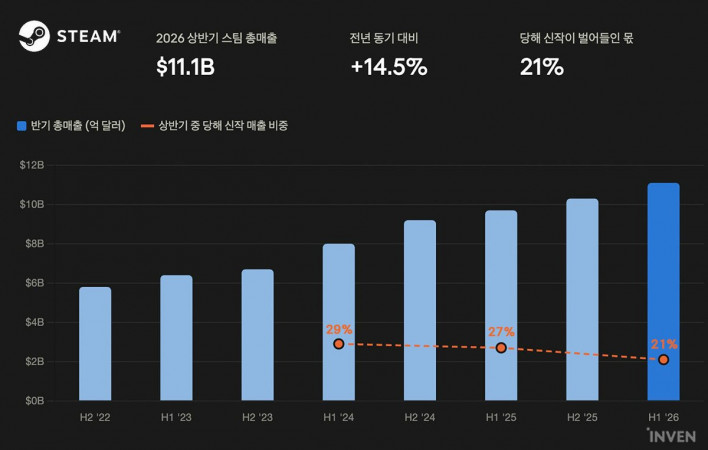
Steam has grown every year. According to game market analyst Alinea Analytics, Steam's total estimated revenue for the first half of 2026 is $11.1 billion (approximately ₩16.3 trillion). This is a 14.5% increase compared to the same period last year and 8% higher than the second half of 2025, which benefited from the year-end peak season. In just six months, it has nearly matched the total revenue of 2021, a year when the pandemic drove a massive surge in gaming.
This trend is mirrored across the entire gaming industry, so record-breaking revenue figures themselves are not surprising. However, the 21% figure attached to that $11.1 billion is different: it represents the portion of revenue generated by games released in 2026.
In a growing market, new products typically drive that growth. Whether it's clothing, cars, smartphones, or movies, new releases usually push up annual sales. Yet, while Steam's total revenue has reached an all-time high, it wasn't new games that fueled this growth. The market has expanded, but the space for new releases has narrowed. Why is the share for newly created games shrinking in a market that is selling more than ever?
New games entering the market face pressure from both price and volume. One source of pressure is the 'catalog'—the entire list of products currently available for sale to users in the market.
As the market rapidly shifts to digital and games can be purchased with a few clicks on platforms like Steam or the PlayStation Store, the 'back catalog' (older titles) competes for purchases just as aggressively as the 'front catalog' (new releases). These are proven games, often with thousands of positive reviews and frequently available at a discount.
The other source of pressure is the sheer volume of other new releases. According to SteamDB, approximately 21k games were released on Steam in 2025. This number has been steadily increasing, from 14k in 2023 to 18k in 2024. Mathematically, that is about one new game every 26 minutes. The number of games that actually survive this competition is limited.
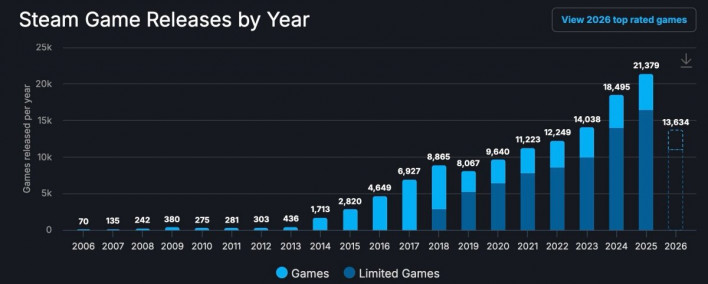
or sales thresholds required for proper algorithmic exposure ©SteamDB, Highcharts
Game data analytics firm Gamalytic reported that as of October 2025, 40% of new releases failed to even recoup the $100 Steam Direct registration fee. 47.4% sold fewer than 100 copies, and 8388 games—65.9% of the total—earned less than $1k. Furthermore, 9327 games failed to reach 10 reviews. Steam specifically activates relevant metrics only for games that reach a certain threshold of sales and player engagement, which then qualifies them for various exposure channels. Games with fewer than 10 reviews are not just commercial failures; they never even get the chance to be commercially evaluated.
New releases are squeezed from above by established masterpieces and from the side by the 20k other new titles released in the same year. This 'squeezing' is one of the primary reasons why new releases account for only 21% of revenue.
So why do back-catalog titles continue to sell long after their release? The answer lies in a fundamental change in how games are sold.
For a long time, games pursued visible, external changes. Better graphics in new releases made older games look not just 'old,' but 'obsolete,' driving sales. With every hardware generation, yesterday's latest title would suddenly look noticeably 'worse,' and players could immediately see on their screens why they needed to buy the new one. A significant part of a new game's competitiveness relied on this obsolescence of older titles.
However, the gap between 'better graphics' and 'superior technology' has begun to fade. The generational leap from PS4 to PS5 was less impressive than previous transitions. While there are still visible differences, games from the previous generation have reached a level where they still look perfectly fine today.
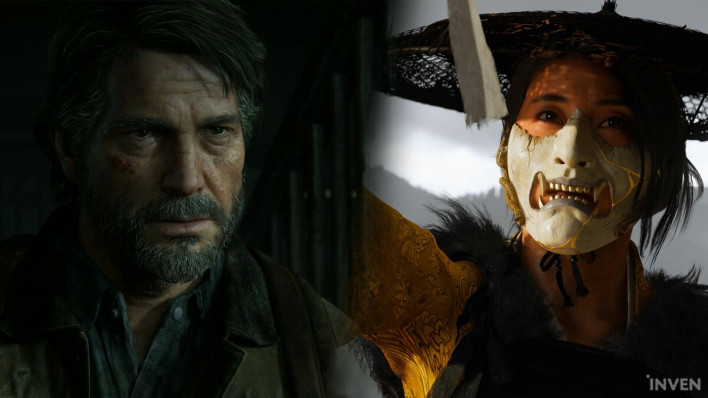
but the image of The Last of Us Part II, released during the twilight of the PS4, still looks great ©Naughty Dog, Sucker Punch Productions
Rising development costs have also played a role. While it is possible to pursue graphics significantly better than the previous generation, the cost of achieving those improvements has skyrocketed, while the visual difference relative to the cost has diminished. The development budget for AAA games released in 2024 and 2025 reached approximately $200 million. Even with such investment, the finished product is nearing a point where it is not significantly distinguishable from games released five years ago.
Another factor is the shift toward live-service gaming. Popular titles are updated consistently after launch, preventing them from becoming obsolete. Some even improve their graphical quality over long service periods, effectively resisting visible aging. Since the Steam algorithm does not heavily bias toward a game's release year, long-running older titles receive exposure equal to new releases. They don't age, and they are constantly presented as 'fresh.
Steam, in particular, does not rely on manual, human-led curation. Instead, it uses algorithmic exposure distribution as its core mechanism. This is combined with a self-service model where developers or publishers set their own discounts and request slots. In other words, a system that does not intentionally push new releases also does not intentionally push out older ones, creating a system that favors the back catalog.
The difficulty of acquiring high-spec PCs and rising costs also drive users toward older titles, which are relatively less demanding on hardware.
If half of the 79% revenue share of the back catalog is driven by supply, the other half comes from the players—the consumers.
According to the 'Generations in Play 2026' study conducted by IGN Entertainment with Kantar and UC Berkeley, 62% of the most active consumers in the U.S., U.K., and Australia (those with limited time to play and who choose to spend it on gaming) said they no longer buy games at full price.
Even the most dedicated players are no longer buying games at full price the moment they launch. Libraries are already saturated with games to play and content to watch on Netflix, Prime Video, and elsewhere. New games are also frequently released in an unfinished state or require waiting for improvement patches. This means the reason to rush has vanished. Libraries are already full, games get cheaper if you wait, and they become more complete if you wait.
Generational differences also highlight the shift in full-price purchasing trends. While 38% of Millennials and 42% of Gen Z said they still buy games at full price, only 20% of Gen X did so. Contrary to the common belief that younger generations accustomed to free-to-play games don't buy packages, the strongest resistance to full-price games came from those who watched the standard price rise from $60 to $70.
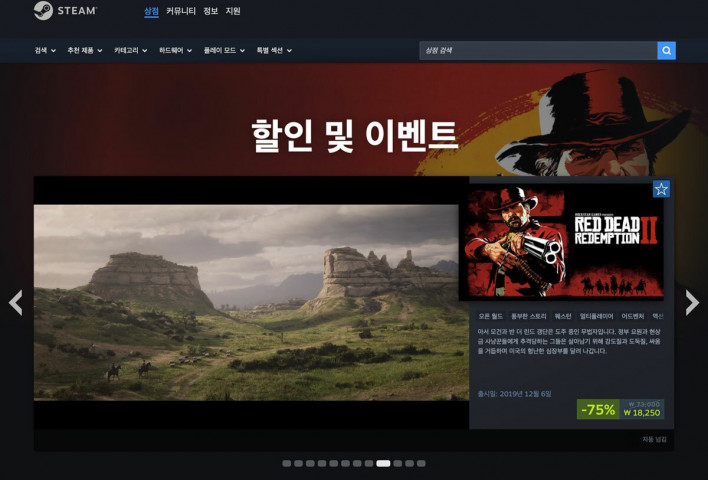
There are those who prefer to wait for a game to be completed and discounted rather than buying it at launch ©Valve
Gen X grew up with physical packages and complete single-player experiences, and they remain focused on finishing and mastering games. In fact, their preference for single-player games is 62%, higher than Millennials (45%) and Gen Z (35%). Conversely, Gen Z views games as a place for community. 61% of Gen Z prefers multiplayer.
For a generation where social games and social interaction make up a large part of the fun, buying a game on launch day is worth the price, because joining after friends have already gathered is not the same experience. Conversely, for single-player-focused consumers whose experience is the same regardless of when they start, waiting means a lower price and higher quality. Resistance to full-price games is not a matter of generational stinginess, but of the nature of the games themselves.
The market is moving in the opposite direction. $70 has already become the psychological threshold, and the next step is $80. Microsoft tried to sell 'Outer Worlds 2' for $80 but faced backlash and reverted to $70, while Rockstar priced GTA6 at $80. Now, games priced at $80 are naturally compared to GTA6.
Let's look back at that 79% figure. This number was not created unilaterally by supply. While core users who reject full prices wait for discounts, what they actually purchase are older titles already on sale. It is a number created by demand as well.
Supply and demand are pointing in the same direction. Consequently, companies are building their strategies accordingly.
Capcom is the most representative example. In its earnings announcement for the fiscal year ending March 2026, Capcom presented a mid-to-long-term growth strategy led by a 'flywheel.' In gaming, this is a cycle where remakes and new releases revive interest in past series, that interest leads to catalog sales, and that revenue then funds the next remake. The same dynamic is observed at Sony.
What is notable about Capcom's announcement is that this is not an external post-mortem analysis, but an official mid-to-long-term strategy presented to investors. The surge in remakes and remasters over the past few years is proof that this strategy actually works. You can re-commercialize already-completed assets for the cost of a single new game, and the risk of failure is much lower.
Another method is using new releases as advertisements for the catalog. Viewed differently, the flywheel diagram looks like this: the catalog becomes the business itself, and the new release becomes the marketing to sell that catalog. Originally, a new release was the product to be sold, and past works were the history supporting its credibility. Now, what is being sold is 20 years of catalog, and the new release serves to make that catalog a topic of conversation again.
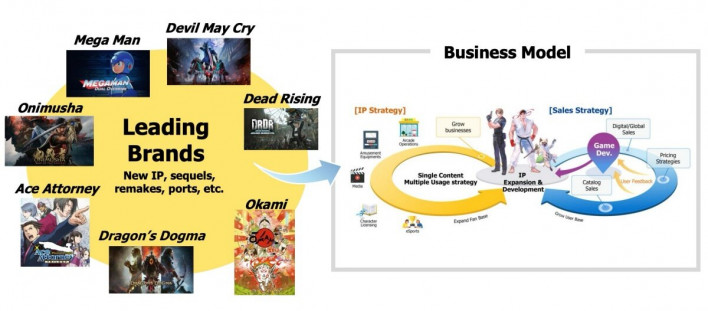
a circular structure that heightens interest through remakes ©Capcom
This logic manifests as the dominance of franchises in the new release market. Looking at the top-selling games in the U.S. for the first half of 2026, as tracked by market research firm Circana, titles like Resident Evil Requiem, 007 First Light, MLB The Show 26, Forza Horizon 6, Pokémon Pokopia, and WWE 2K26 appear in succession. They are all games with existing series or IP. This is why the 2026 market is explained by the dominance of established annual franchises. There is no formula for success, but there is an insurance policy that lowers the probability of failure. That insurance is the franchise, and the franchise is the catalog. Truly new IP in the top ranks is limited to titles like Crimson Desert or ARC Raiders.
There are also strategies moving in entirely different directions—specifically, moving outside of games. Once an IP becomes an asset, there is no reason to use it only for games. In recent years, adapting games into video content has become the most stable path for expansion. The Minecraft movie earned $950 million worldwide, becoming one of the biggest hits of 2025, and The Last of Us and Fallout broke viewership records for their new seasons. Nintendo is also expanding its IP in various ways, including museums, Mario and The Legend of Zelda movies, and theme parks.
It is also worth noting that this expansion is not one-way. The Fallout series led to a surge in sales for the original game franchise. Adaptation does not end with selling IP to other media; it returns to sell the game catalog once again. Capcom's flywheel also promotes growth in business segments through video adaptations, character businesses, esports, and arcade machines and facilities. A single IP is repeatedly expanded into games, remakes, subscriptions, video, and merchandise, with each expansion cross-selling the others.
For large publishers, games are now just one of many revenue streams, and the asset that runs through all of them is the IP. New releases have also taken on the role of a means to refresh that asset. In this structure, the party at the greatest disadvantage is clear: those who have no assets to refresh in the first place.
If a franchise is insurance, what should a new IP without a catalog lean on? The answer is 'what the consumer already knows.' Instead of going head-to-head with the catalog, they land on a point where the consumer doesn't need to learn anything new.
The first is price. If a decade's worth of masterpieces is on sale for $20, a $70 new release is a direct confrontation, but at $6 it's a different calculation. There is little to lose if it fails, and no burden in adding one more to the library. The #1 selling game on Steam in the first half of 2026 was the $6 Metcha Chameleon. ARC Raiders was also a new IP, but it led shooter sales at the end of the year through a low price of $39.99 and social virality.
The second is gameplay. R.E.P.O. and PEAK climbed to the top of sales charts with the familiar fun of cooperation and virality. The generational differences explained earlier apply here. For consumers who view games as a place for community, a co-op game is a product whose meaning is halved if bought late. Social-centric games bypass full-price resistance while simultaneously creating their own exposure without marketing costs, as friends buy it when their friends do.
The third is genre grammar. Crimson Desert is a $70 full-price, single-player-focused open-world new IP. It is neither low-priced nor a social game. It doesn't belong to either of the previous two paths, yet it ranked at the top of new release revenue in the first half of the year. There are other examples of Korean games. Lies of P, with the hardcore 'Soulslike' genre, surpassed 4 million cumulative copies in the PC/console market, which was once considered an impossible territory for domestic games. Stellar Blade sold 6.1 million copies as a character-action-focused hack-and-slash title.
The commonality among these three is that while the IP is new, the genre is not. People who like Soulslikes immediately know what Lies of P offers. Open-world action fans already know what to expect from the first screen of Crimson Desert. Even without an IP catalog, they have boarded a different form of catalog: genre-based trust. And the fact that all three games came from Korean developers is no coincidence. This is one of the few entry strategies available to latecomers without a catalog.

The three successful domestic titles also leveraged familiar genre characteristics ©INVEN
High accessibility in price, familiar gameplay, or familiar genre. Conversely, games that cannot expect new IP, new genres, full pricing, or social elements like cooperation or virality stand in the most dangerous position. This is exactly the layer where half of the 20k games in 2025 failed to even reach 10 reviews.
Low prices and indie games seem like a wide door. But that door is also narrow. According to VG Insights, the revenue share of indie games on Steam rose from 24% in 2018 to 32% in 2022, and reached 48% from January to September 2024. By sales volume, it is a majority at 58%. However, during the same period, indie games accounted for 98.9% of Steam releases. 99% of releases shared 48% of the revenue.
Looking at the composition of that 48% makes it even clearer. 'Black Myth: Wukong,' classified as indie under VG Insights' publisher grading, earned $1 billion—more than all other indie new releases that year combined. Palworld followed with $500 million. Furthermore, $1.7 billion, or 43% of indie revenue, came from games released before 2024. Even within the indie sector, the back catalog took nearly half.
Indies didn't win. Some indies won. Polarization is happening simultaneously within AAA full-price games and the indie market, at every level.
Making and selling games has become the easiest it has ever been in history. Digital transformation has eliminated the need to fight for shelf space or print inventory. A $6 two-person project and a $200 million AAA game hang side-by-side on the same screen. In 2025, 20k games passed through that door on Steam alone.
The problem is that the room beyond the door has not widened. Steam revenue has grown more than fourfold in 10 years. However, 79% of that growth was taken by games already in the room. The 20k games released that year shared 21%. The new releases—the entire front catalog—competed for that space against the accumulation of the last 10 years.
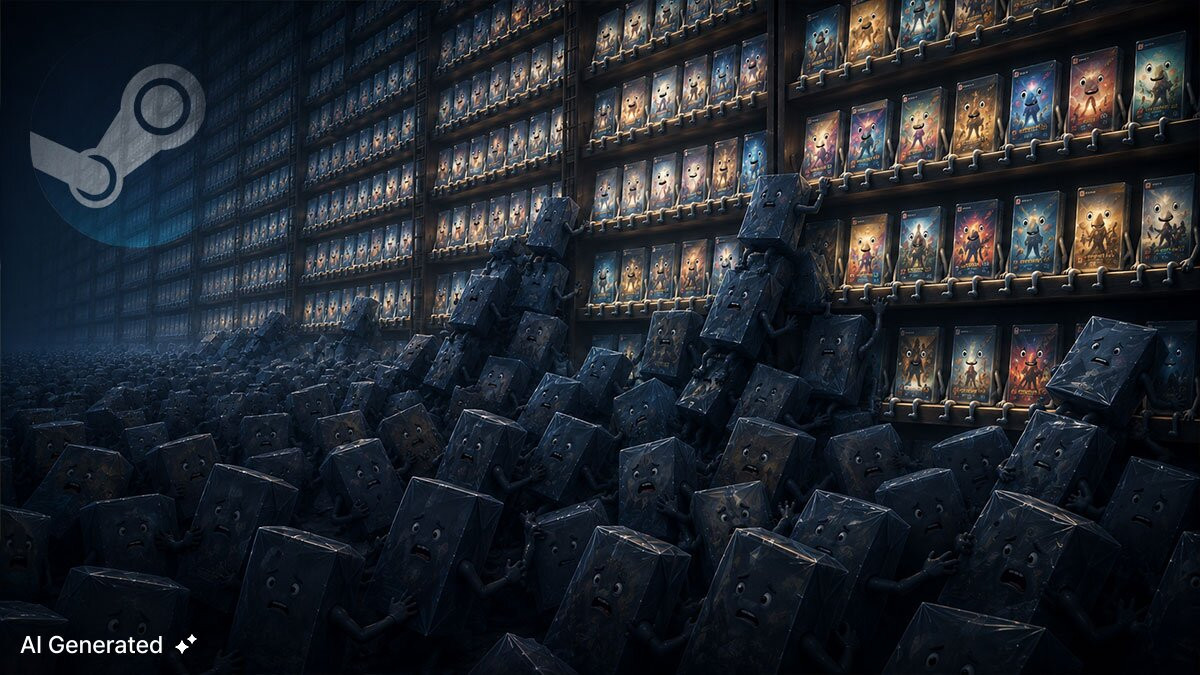
Even within that 21%, the space was not divided evenly. The top was filled by franchises. The bottom was carved out by $6 games and co-op games through virality. Ultimately, what survived were games that had a catalog or had a reason not to compete with the catalog. The most precarious position is in between: full-price new releases with no powerful IP, no reason to enjoy together, and no room to lower the price. The statistic that 40% of 2025 releases didn't even recover their $100 registration fee is a story from the bottom, but the same pressure operates above it. This is why mid-to-low-budget games that receive critical acclaim but fail to translate into sales appear every year.
What widened was the right to release, not the opportunity to sell. What is happening now is not a contraction of the industry, but a relocation. The money keeps increasing, but the points where that money touches are narrowing. The top and bottom are holding on, while the middle is thinning.
Ultimately, the question has changed. It is no longer whether you can make a good game, but whether you can be discovered after making it. And discovery is no longer determined solely by the game's quality. You must hold onto something the consumer already knows—whether it's price, genre, or friends to play with. For a game that holds onto nothing, the door is still open. It's just that no one can guarantee where that door leads.

Sort by:
Comments :0