After landing in Fortnite late last year, 'The Simpsons' will be applied to UEFN later this year, allowing for diverse use within the Fortnite world. While several factors made this decision possible, the full realization of Springfield and the show's main characters within Fortnite played a significant role.
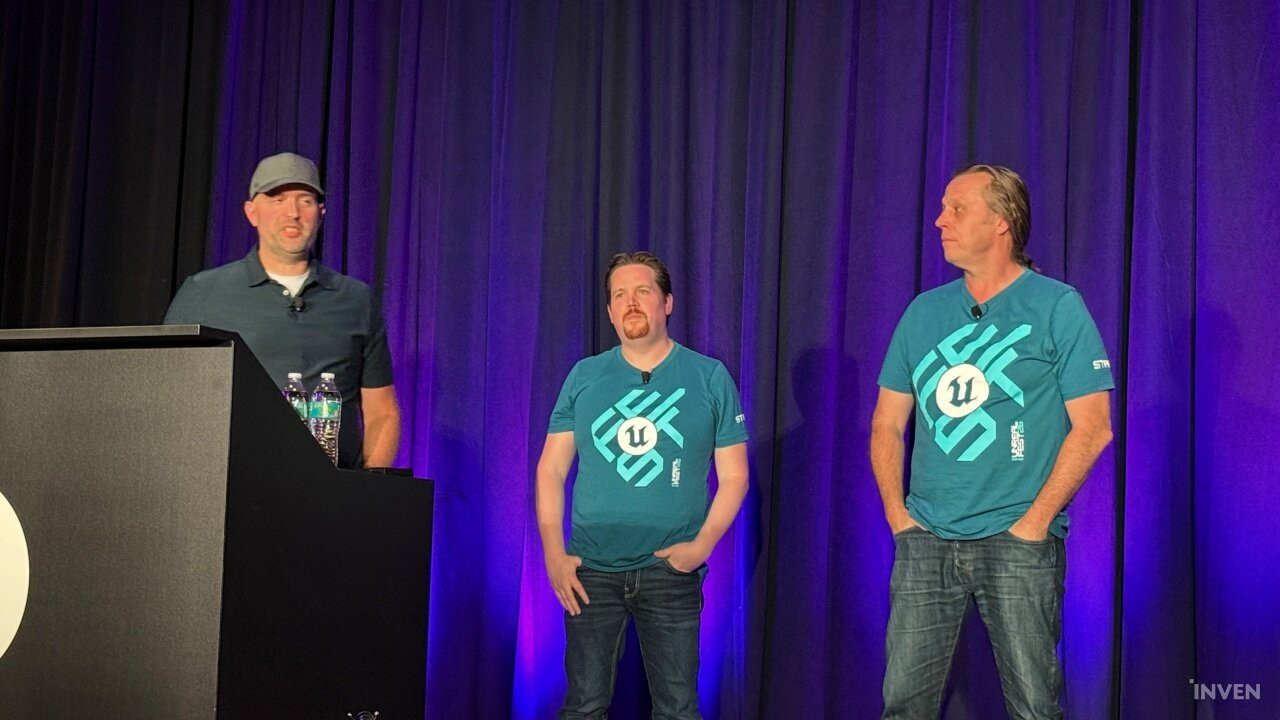
Just a few years ago, it would have been hard to imagine Unreal Engine handling such high-quality cartoon-style art. Because Unreal Engine is built on physically based rendering (PBR) and has long aimed for realistic graphics, an animation style that directly defies these principles was bound to clash. However, Epic Games—the engine's developer—and many other game studios are now successfully incorporating diverse graphic styles using Unreal Engine. At the UNREAL FEST 2026 Chicago session, three Epic Games TA and art experts broke down the process of how they precisely implemented the unique 2D feel of The Simpsons in 3D.
"The Clash Between 40 Years of Animation and a Shooter Game: An Artistic Challenge"
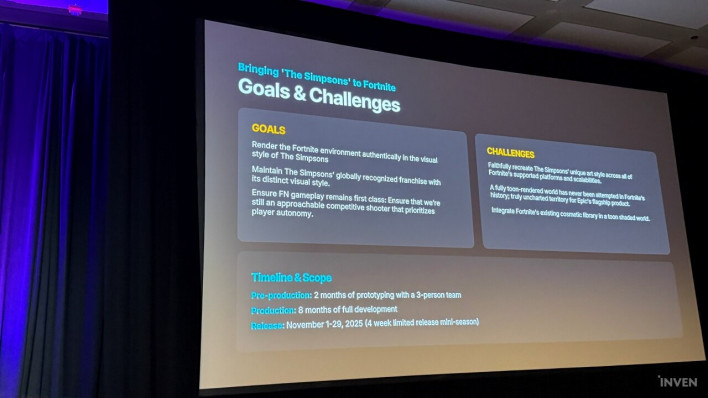
Before beginning the session, Bill Cladis, TA Director, emphasized that the core of this project was to 'provide players with a Springfield that is truly faithful to the original work, without interfering with the competitive gameplay inherent to Fortnite.'
The Simpsons is an IP with high recognition across all generations worldwide, and its signature bright colors and unique art style are widely known. On the other hand, Fortnite, now in its 10th year, is a competitive shooter that has its own distinct style and, above all, requires players to win. Therefore, the art could not come at the expense of gameplay or performance. Furthermore, the team faced the complex challenge of implementing the unique style of The Simpsons with high quality across all devices, from high-end consoles like the PS5 to older mobile phones.
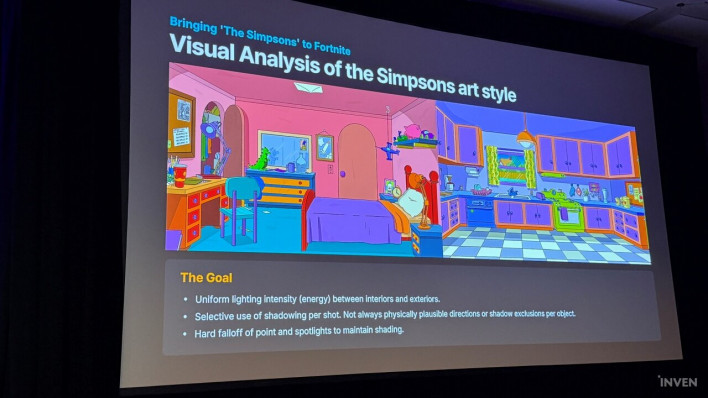
Bill Cladis defined the essence of The Simpsons' style as 'cel-shading and outlines that defy the principles of physically based rendering (PBR).' The Simpsons universe is a bright, clean environment with almost no shading or gradients, where soft, fixed-width outlines form the boundaries between colors.
The biggest challenge was that the lighting and shadows do not follow the laws of physics. In the original animation, the light outside the window and the brightness inside match perfectly, eliminating the need for automatic exposure compensation. Strong falloff effects, like those on the ceiling of Bart's room, are applied selectively at the artist's discretion. Shadows under chairs are projected vertically rather than at an angle, and headboards cast no shadows at all. Combining these artistic liberties with a physically accurate renderer was the season's greatest challenge.
"Post-Processing and Visual Tricks: Technical Art that Sculpted The Simpsons' Identity"
Artist Paul Meader, who took the stage next, presented specific technical solutions for material shading, outline generation, and the handling of water and foliage.
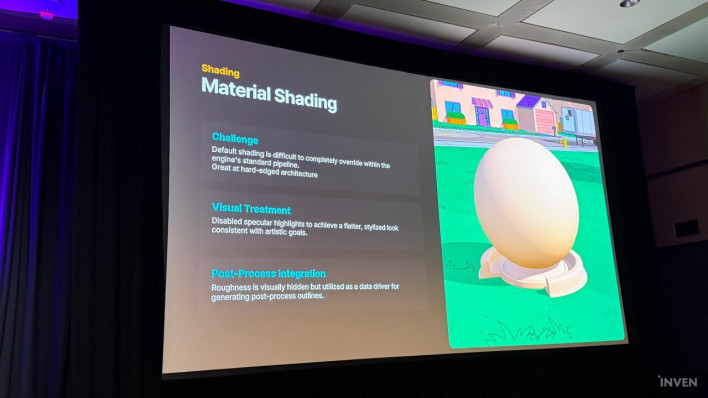
When working on The Simpsons event last year, Unreal Engine did not have a built-in toon shading model. Using the standard PBR model resulted in unwanted, harsh gradients on complex geometries like spheres. Methods involving full emissive materials or normal modifications had the drawback of causing broken lighting responses or malfunctions. The solution the development team found was to use a large number of 'sun direction vector-based contrast lanes' to trick the eye into perceiving the surfaces as much flatter. They combined this with material instance parameters to adjust the optimal effect for each object.
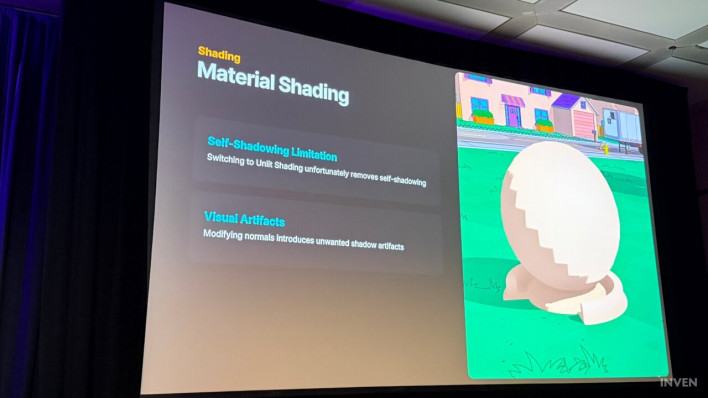
For outline generation, they utilized post-process materials to combine depth, normal, and roughness buffers. While the depth buffer can implement simple outlines, it only works where there is a large depth difference between pixels, failing to capture edges like those on cubes. Conversely, while normals fill in depth gaps, they cannot detect surfaces with the same normal as the ground. To compensate, they set specular to zero, utilized the roughness map arbitrarily, and rendered the static mesh's grayscale color directly onto the vertex cluster, generating outlines whenever the values changed.
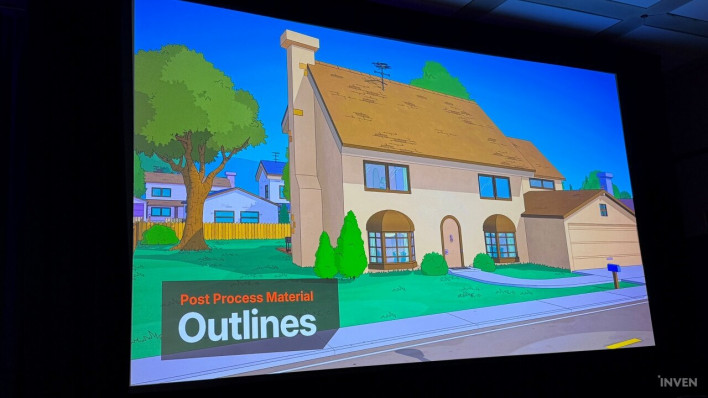
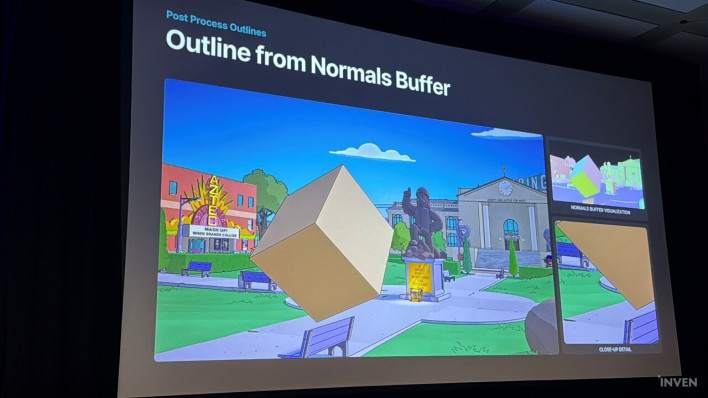
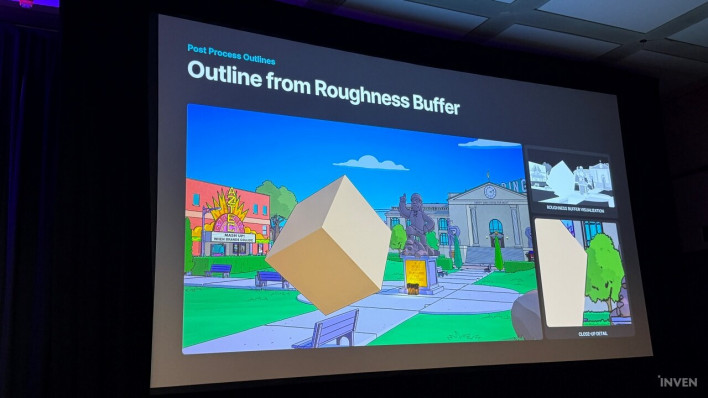
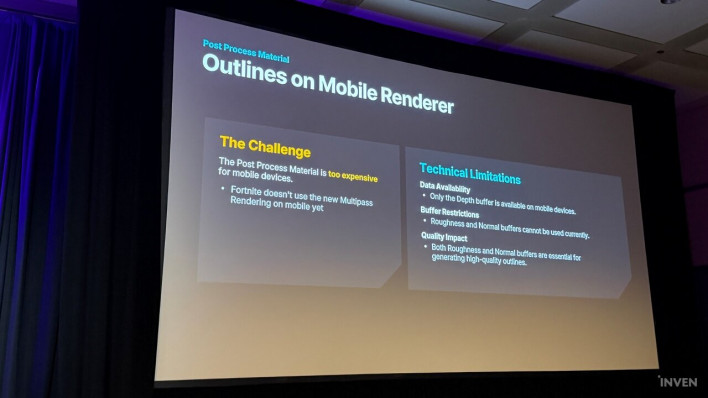
When applied this way, the outlines would often blur at a distance or disappear against the sky. To prevent this, they sampled the minimum value of the depth buffer four times to maintain a consistent fade-out intensity. For mobile environments, where only the depth buffer was available and quality suffered, they utilized The Simpsons' characteristic flat color composition to 'generate outlines whenever the scene color changed,' resulting in an output optimized for mobile devices.
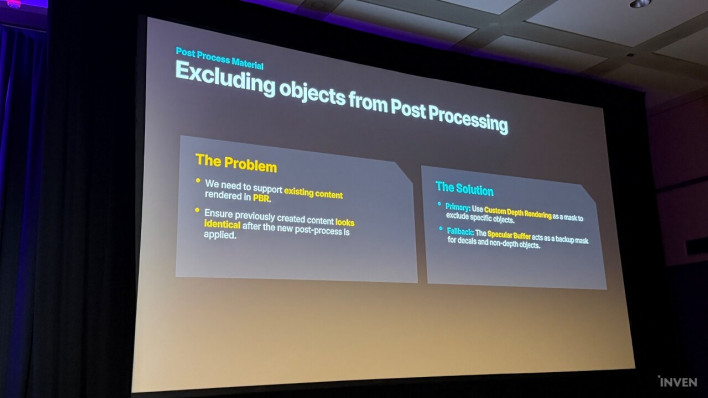
Additionally, to prevent existing PBR assets in Fortnite—such as characters and vehicles—from developing noisy outlines due to post-processing, they built a two-track masking solution: 'custom depth rendering' and 'excluding objects with a specular value greater than 0.' They also wrote code to automatically exclude assets from post-processing if their file path was not in the stylized folder upon loading.
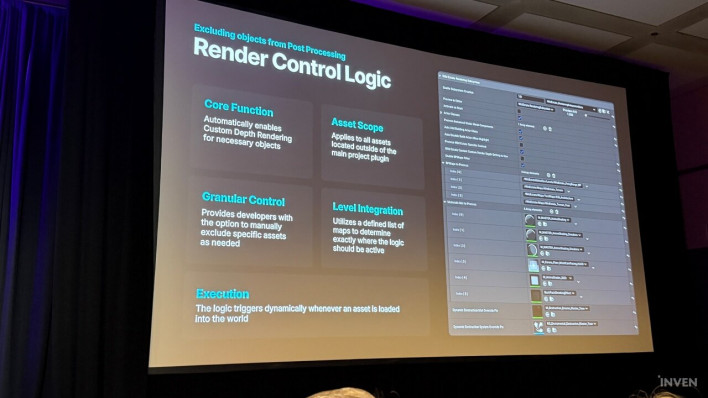
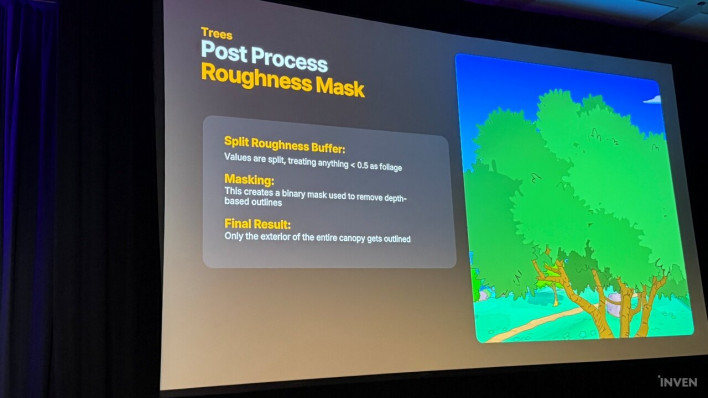
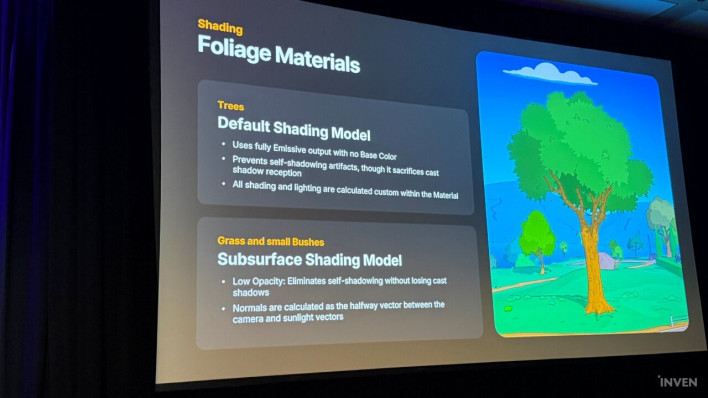
They also technically solved the issue of overlapping boundaries between leaves. Placing detailed leaf models on simple primitives caused outline noise to explode. To fix this, they split the roughness buffer in half, classifying values under 0.5 as foliage to create a mask that erased lines inside the canopy and left only the perimeter. For messy lines between overlapping fence assets, they used Blueprints to recursively detect adjacent boundaries and force the same roughness value, leaving only the outline surrounding the entire cluster.
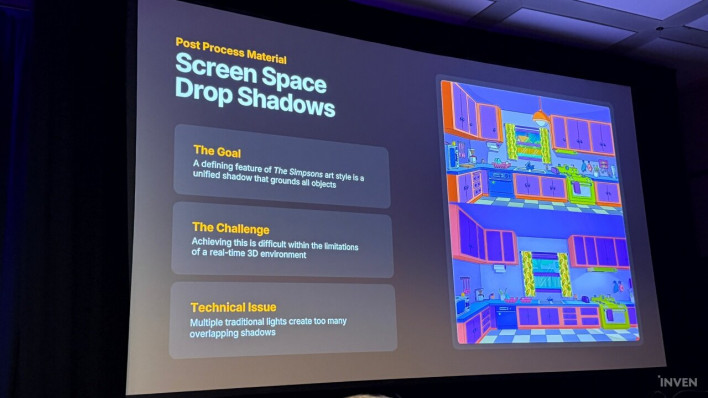
The Simpsons' signature 'drop shadow,' which lacks physical light sources, was implemented in screen space using 3D vector offsets within the post-process material. They used 16 dense sampling steps to ensure objects were perfectly connected to the ground without appearing to float.
"Simplifying Lighting and Atmospheric Environments: The Final Puzzle for Perfect Immersion"
Finally, Lighting Art Director Paul Oakley explained how they built the overall lighting balance and atmospheric environment of Springfield.
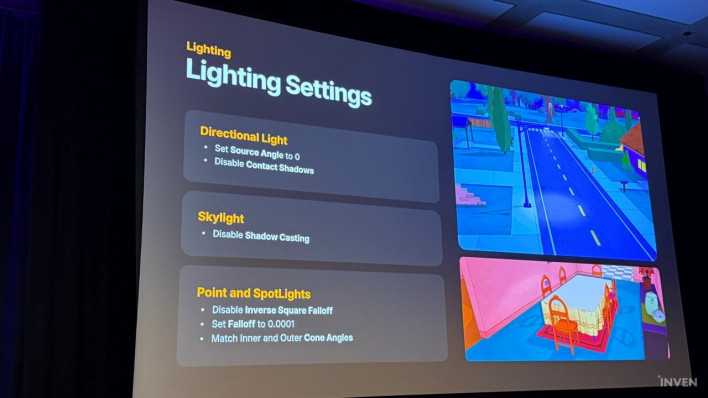
Initial PBR-based lighting left gradients everywhere and shadows were too dense, failing to capture the feel of The Simpsons. The team boldly disabled Lumen and Global Illumination (GI) to eliminate the root cause of the gradients. To keep indoor and outdoor color and brightness balanced, they removed Adaptive Exposure, turned off skylight shadows, and significantly reduced Ambient Occlusion (AO). Instead, they limited Screen Space Reflections to PBR assets like characters and vehicles to maintain minimal depth.
In particular, to ensure environmental assets didn't look too out of place, they injected a small amount of base color into emissive environmental assets. This allowed them to find a lighting balance where the environment's brightness was less affected by lighting components while still blending naturally with PBR characters.
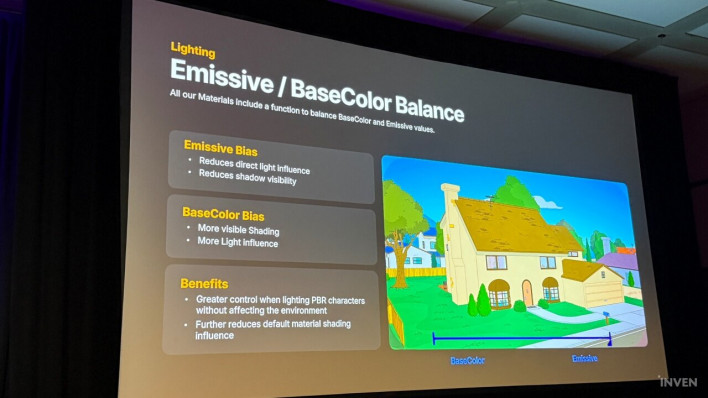
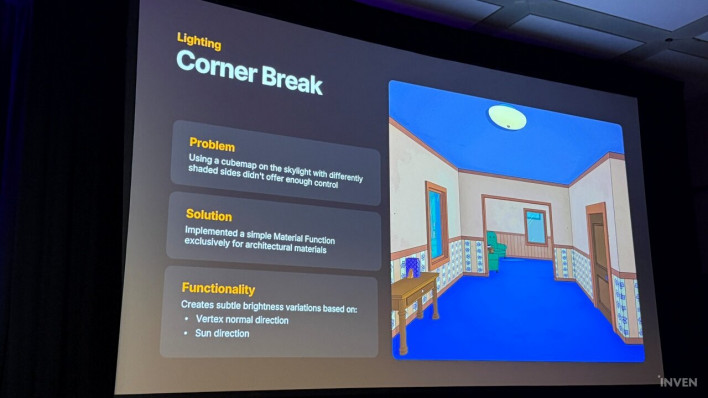
To resolve the extreme flatness of interior lighting, they calculated the dot product between the vertex normal direction and the directional light vector and added it to the emissive material function. This gave the surface subtle dimensionality while maintaining the simplicity characteristic of The Simpsons.
They also lowered the sun's source angle to create consistently sharp shadows and adjusted the falloff values of indoor point/spot lights to near the engine's limit of 0 (actually set to an imperceptible tiny number to prevent it from clamping to 1), eliminating messy geometric shadow interference caused by overlapping lights.
Finally, they completely rebuilt the visuals for the 'Storm,' a core element of Fortnite, to match The Simpsons' style. They split simple cloud strip textures with R (shading), G (outline), and B (opacity mask) channels into two layers rotating at different speeds, and applied drop shadows with subtle UV offsets between layers to create a deep 2D cloud cascade within a simple dome geometry. For fog, they applied a day sequence volume so that high-altitude fog at Battle Bus height and ground fog blended organically based on player position, recreating the clean, sharp, and unique intro visuals of The Simpsons across all scalability levels.
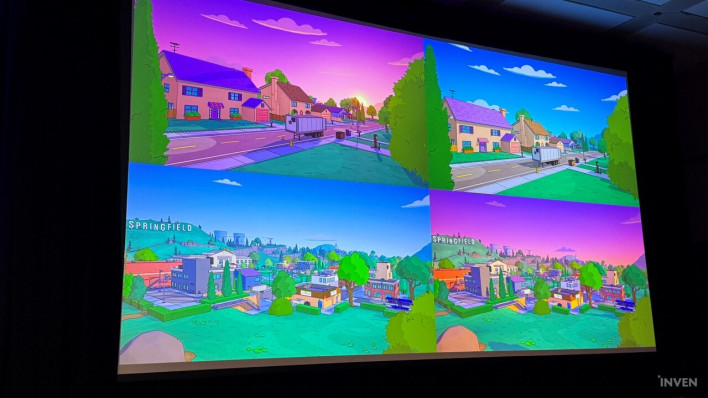
After introducing these processes, TA Director Bill Clardy returned to the podium to express his gratitude to all the developers and outsourced staff who helped realize the world of The Simpsons in Fortnite, even those who could not stand on stage. The Simpsons collaboration was tasked with perfectly capturing the family's worldview in line with Fortnite's unique 24-hour cycle. Clardy concluded the lecture by noting that while there were many difficulties, given that the project involved thousands of assets and impacted gameplay, he hoped that sharing the experience gained through this process would be helpful to other developers.

Sort by:
Comments :0