If asked to name a fun roguelike, 'Hades' is the first that comes to mind. By layering exceptional action and storytelling onto a structure of repeated death and incremental progress, it became a benchmark for the genre. Meanwhile, 'Vampire Survivors' used simple controls to define the 'Vampire Survivors-like' subgenre. Countless games followed in its wake, though many failed to find their own identity, settling for being mere 'Hades-likes' or 'Vampire Survivors-likes.
Facing this question, Flyway Games (CEO Kim Su-young), a creative studio under KRAFTON (CEO Kim Chang-han), sought its own unique color and found the answer in 'time.' The result is 'Ascend to ZERO,' launching globally on July 13.
Of course, games using time as a theme are nothing new. The concept of 'saving the world in 30 seconds' was pioneered by the PSP title 'Half-Minute Hero,' and 'SUPERHOT: MIND CONTROL DELETE' was the first to combine time manipulation with roguelike mechanics.
What sets 'Ascend to ZERO' apart is how it utilizes time. In this game, time is a resource to be spent, recovered, and invested; a weapon to be paused and wielded; and a subject of growth to be strengthened through repeated runs. Time is not just a single mechanic—it is the language that permeates the entire game.
'Ascend to ZERO' is an action roguelike centered on time manipulation. Set in the year 2,225, a future destroyed by the invasion of intelligent machine lifeforms, the player takes on the role of a survivor with the ability to manipulate time, traveling back to the past to rescue comrades and restore the world.
The game will be available on Steam, Xbox Series X|S, PC, and Xbox Cloud Gaming, with support for the ROG Ally X. Notably, it is confirmed for a day-one release on Xbox Game Pass. Developed using Unreal Engine 5, the project was led by PD Heo Tae-wook and AD Lee Young-kwon.
Ultimately, It's About Time
If you had to summarize the combat of 'Ascend to ZERO' in one sentence, it would be: 'Ultimately, it's about time.' The thrill of defeating a boss with only one second remaining is the core of the experience.
While other roguelikes are built on the two pillars of player control and character growth, 'Ascend to ZERO' adds a third: a 'time limit.' Even with perfect controls and a fully leveled character, you cannot survive if you fail to manage your time.

Eliminating enemies strengthens your character while simultaneously extending your remaining time based on certain conditions; if time runs out, your progress collapses. The timer at the top of the screen is a resource as desperate—perhaps even more so—than your health bar.
Added to this is a 'time stop' ability that can be triggered at any moment. With the press of a button, the world freezes, allowing the player to calmly navigate through bullet hells, find the optimal position, combine skill chips, and unleash explosive firepower the moment time resumes.
The fact that the cooldown is short and can be used frequently is crucial. Time stop is not an ultimate skill to be hoarded, but a basic move used like breathing. Predict, stop, counter, and annihilate. Once this rhythm becomes second nature, 'Ascend to ZERO' transforms from a simple shooter into a strategic action game where every moment is a calculated move.
Even death is converted into time. If your character falls, you can spend a portion of your remaining time to revive on the spot. Time is life, and life is time. The experience of burning your remaining time to revive during the final moments of a boss fight and taking them down with one second left is the game's peak moment.
PD Heo Tae-wook’s comment in an overseas interview perfectly captures the game's essence: "If 'Vampire Survivors' asks 'how long can you survive,' 'Ascend to ZERO' asks 'how far can you go within the given time?'" This game proves through play that even with the same auto-attack foundation, a different question leads to a different game.
Time Management Through a Roguelike Lens

When you first start the game, you are greeted with the slogan, 'Save the world in 30 seconds.' Without prior knowledge, one might worry, 'Can you really save the world in 30 seconds.'
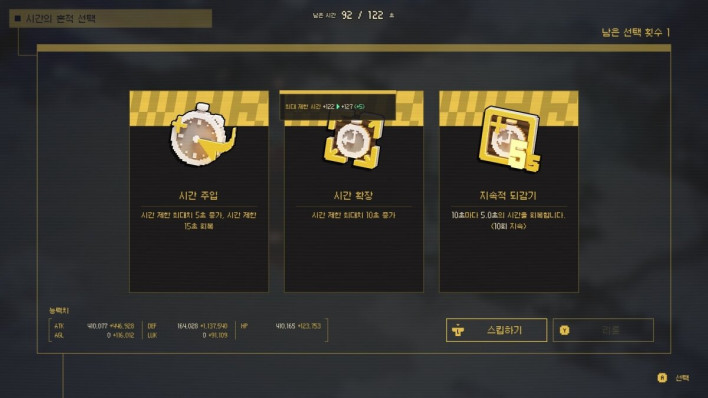
However, a little playtime reveals the truth. 30 seconds is merely the initial 'condition,' and the real game lies in how you manage and expand that time. While other roguelikes focus on growing character stats, 'Ascend to ZERO' adds a layer of 'roguelike-style time enhancement.' Whether to recover 10 seconds immediately or choose an option to gain 5 seconds per boss kill—time itself becomes the subject of your build.
Choosing between immediate gain and long-term investment is a classic roguelike pleasure, but the fact that the subject is 'time' adds a unique tension. It even adds a somewhat realistic lesson: time is, ultimately, about management.
As you follow the game's design, you will encounter points where the developer intentionally forces the player to hit a wall. Just as you start wondering, 'How can I possibly break through this?' with your current stats, a new NPC naturally joins, unlocking new abilities and upgrade methods. Equip these new powers, challenge the wall again, and you will find it surprisingly easy to break through.
This rhythm of frustration and unlocking is meticulously designed. The story flow—where the protagonist travels back to rescue comrades one by one, and those comrades unlock new features in the bunker—aligns perfectly with the system unlocks. Because the moment you hit a wall is also the moment the story progresses, the narrative and gameplay never feel disconnected.
The most unique, and initially questionable, element is the growth curve. 'Ascend to ZERO' features inflation in its leveling. It doesn't climb steadily; it skyrockets exponentially. Even if you worry at level 1 about how you'll ever reach level 20k to unlock a NPC, you'll find yourself there in just a few hours.
Crucially, this inflation is not an accident caused by poor character growth or economic design, as seen in some online games. It is clearly an intentional device designed to multiply the thrill of growth by letting players see the numbers explode.
The developers have stated they were inspired by Japan's 'Inflation RPG.' The system of retrieving powerful equipment from previous runs for the next is designed with the same intent: to alleviate the emptiness of starting from scratch every time. While personal tastes may vary, it is not a negative factor that detracts from the game's quality. It is rare to see a game push the fun of growing numbers this explicitly, yet in such a controlled manner.
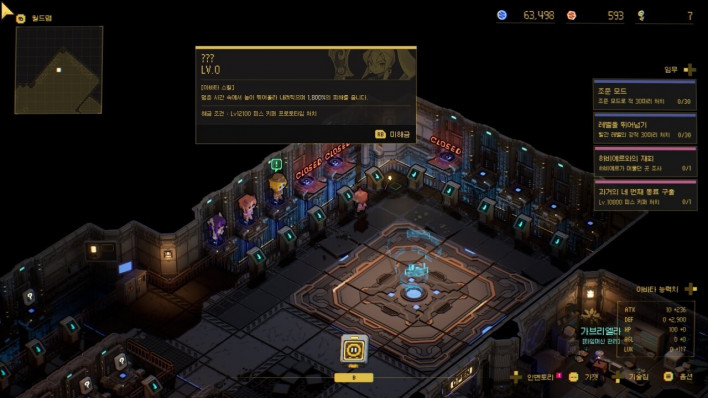
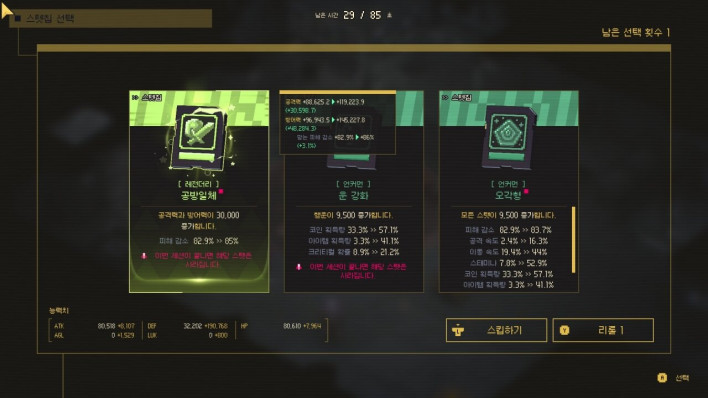
The deck-building variety is also generous. Each avatar has unique weapons, skills, and combat styles, as if to say, 'Surely one of these will suit your taste.' From melee sword-wielders to gun-based ranged damage dealers, you can follow the avatar's characteristics or build your own skill deck.
Depending on the combination of equipment, skill chips, and devices, you can even create extreme builds that abandon time stop entirely for other advantages. The developer's promise of 'infinite growth and infinite combinations' has been faithfully implemented.
The bunker that connects runs is another pillar of this cycle. When time runs out, the player returns to the destroyed underground bunker, where they convert items retrieved from the previous run into permanent assets and prepare for the next run using new features unlocked by rescued comrades.
Converting temporary items into permanent ones involves success rates and costs, maintaining the tension of choice even within the bunker. There is plenty of incentive to rotate through different avatars, and with new avatar packs and an infinite mode (Tower of Infinity) DLC planned after the official launch, there is ample room for expansion.
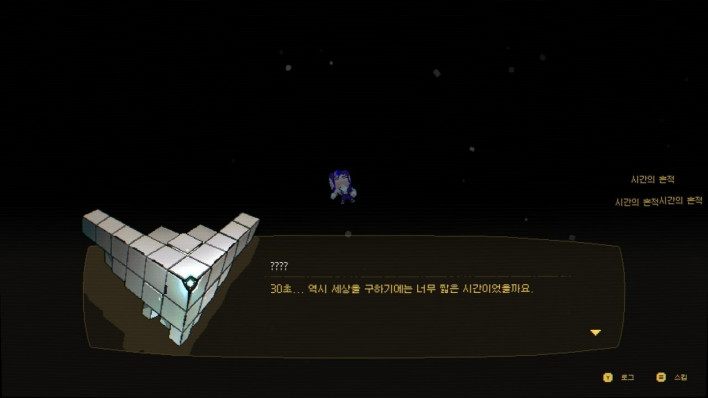
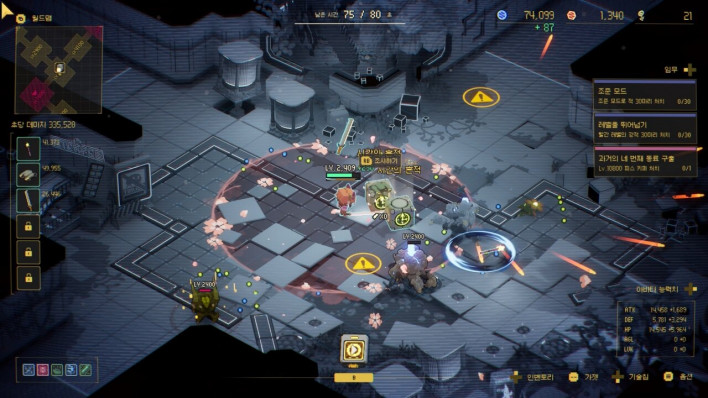
The graphics feature high-quality 3D voxels with the familiarity of a Minecraft style. The visual of a cyberpunk city built of square blocks collapsing and scattering captures the unique materiality of voxels, and the visual contrast when walking between frozen bullets and debris during time stop is impressive. Based on Unreal Engine 5, the combination of modern lighting and effects on simple voxel forms strikes a good balance between pixel-art sentiment and 3D presentation.
Character art is another highlight. During development, the original SD (two-head-tall) style was completely overhauled to cartoon-style full-body illustrations, making each avatar's personality much clearer on screen. However, there are moments when the screen becomes cluttered when enemies, effects, and projectiles flood in at once, sometimes exacerbated by the information-heavy combat UI.
Personally, I was interested in the optimization for portable gaming. The clear top-down view and short run-based play loop are a great fit for handheld devices. Considering the ROG Ally X support and Xbox Cloud Gaming compatibility, it seems the game was planned from the start with 'pick up and play' in mind. The time-based run structure starting from 30 seconds fits the grammar of portable session play so well that it feels like a deliberate design choice rather than a coincidence.
KRAFTON's New Grammar, Challenged by the 'Youngest of the Household'
Another notable aspect of 'Ascend to ZERO' is its journey to release. From the first demo in April 2025 to Steam Next Fest (June), public playtests (December), and three limited demos in 2026, the game has been polished through over a year of user testing and feedback. It ranked 65th in 'most played demos' at Next Fest, and Steam user reviews remain 'Very Positive' (92% positive).
Traces of feedback-based updates—such as reduced excessive grinding, added difficulty systems, revamped onboarding, renewed stat information, and a redesigned codex—are palpable in actual gameplay. The aforementioned time management options and the rhythm of frustration and unlocking are better understood as the product of repeated verification rather than something that appeared overnight.
In this regard, 'Ascend to ZERO' holds significance beyond just being a game. Flyway Games is a studio specializing in soft-launching, established by KRAFTON in 2023 alongside its new project proposal system, 'The Creative.' The goal was to quickly bring ideas to market regardless of platform or genre, verify them through user reactions, and officially launch successful projects.
'Ascend to ZERO' is a representative case where that methodology has completed a full cycle from demo release to global launch. For KRAFTON, which relies on the PUBG IP for most of its revenue, it is worth noting what it means for these small-scale new IP experiments to be completed one by one.
Clear Shortcomings, Yet a Distinct Identity

Of course, it is not without flaws. Some systems, such as upgrades or grade systems, still have unfriendly in-game explanations, leaving sections where you have to learn by trial and error. Despite several onboarding revamps, the layers of the growth system—stacked with equipment, skill chips, devices, and stat chips—can act as a barrier to entry for newcomers.
It should also be noted that the early movement tempo can feel slow. Before the strategic fun of time stop fully opens up, the first hour or two may feel somewhat flat. Due to the random nature of the battlefield, some runs feel smooth while others feel particularly frustrating. Even if it is the fate of the roguelike genre, there are moments that feel like a gamble.
The repetition that sets in toward the later stages due to the genre's nature is also a factor. As powerful as the 'time stop' hook is, how diversely the gameplay is maintained after getting used to it depends on post-launch updates. The promised infinite mode and new avatar packs must provide that answer.
Nevertheless, 'Ascend to ZERO' is a game with a clear identity among the many roguelikes available. The shift in the question from 'how long can you survive' to 'how far can you go within the given time,' the build design that treats even time as a subject of growth, the rhythm where frustration and unlocking align with the narrative, and the thrill of defeating a boss with 0.1 seconds left all stand out.
Considering the 20+ hours of playtime in the official version and the accessibility of Game Pass day-one, it is well worth a roguelike fan's time to play. After all, within this game, that time can be reversed as much as you like.

- Unique combat using time as a weapon
- Design where frustration and unlocking align with the narrative
- The taste of inflation-style growth where levels explode
- Wide range of avatars, deck-building, and handheld optimization
- Somewhat flat early tempo
- Random battlefield variance and late-game repetition
Review Platform: PC (Review Build)

Sort by:
Comments :0