On the 16th, data analytics firm FirstLook released its Spring/Summer 2026 report, 'Signals of Success,' which argues that the pre-launch metrics global game developers have long relied on have serious limitations in predicting a game's commercial performance.
The report highlights a painful industry reality: despite an abundance of seemingly impressive numbers—such as hundreds of thousands of wishlists and millions of trailer views—predictions often fall flat when the game finally launches. The survey, which polled 253 senior product and marketing executives at AA and AAA studios in the U.S., U.K., and EU, reveals just how unreliable the industry's long-held success formulas have become.
93% of AAA and AA Studios Fail to Predict Game Success

The modern gaming industry tracks more pre-launch data in real-time than ever before, from trailer views and social media reach to demo downloads and influencer interest. Theoretically, with such transparent visibility, predicting a game's success should be easier than ever.
In reality, the results are the opposite. A staggering 93% of the surveyed experts admitted to having failed to predict a game's performance due to misinterpreting pre-launch data. This suggests that the industry is fixated on superficial metrics rather than truly meaningful user behavior.
These failures generally manifest in two extreme forms. The first is the 'false positive' trap. 76% of the developers surveyed reported experiencing the illusion of a guaranteed hit based on explosive pre-launch metrics, only to see the game's actual commercial performance remain dismal.
The second is the opposite: the 'sleeper hit.' 83% of developers had braced for commercial failure due to lackluster marketing metrics, only to be caught off guard when the game launched and generated massive, unexpected revenue.
This data shows that most game companies are trapped in a cycle of either pouring massive budgets into hollow metrics or undervaluing titles that possess immense potential.
YouTube Views and Wishlist Numbers Are Deceiving Developers

The most fatal trap for game companies is their blind faith in awareness metrics like YouTube views or Steam wishlists. Post-mortem analyses of highly anticipated games that failed miserably show that the critical warning signs—which were ignored or went untracked before launch—were always present at the top of their marketing dashboards.
The most commonly overlooked warning sign in failed games was poor 'YouTube trailer views' (40%), followed by 'demo downloads' (34%), 'Steam wishlists' (32%), and 'Discord community size' (31%).
The core issue is that even when these awareness figures are high, they represent purely 'passive reactions.' The fact that someone clicked on a trailer does not translate into a firm intent to open their wallet and purchase the game on launch day.
The reality of Steam wishlists is even more stark. Almost every game company spends its budget inflating wishlist numbers to make their marketing dashboards look impressive. Yet, only 11% of developers truly trust these as independent indicators of success.
Because adding a game to a wishlist takes only a single mouse click and requires no cost or effort from the user, it is far too weak a metric to represent genuine purchase intent. Eden Chen, CEO of FirstLook, harshly criticized the industry for being "addicted to comfortable lies," pointing out that companies should measure actual user commitment rather than simply celebrating clicks.
Actual Playtime Matters More Than Clicks
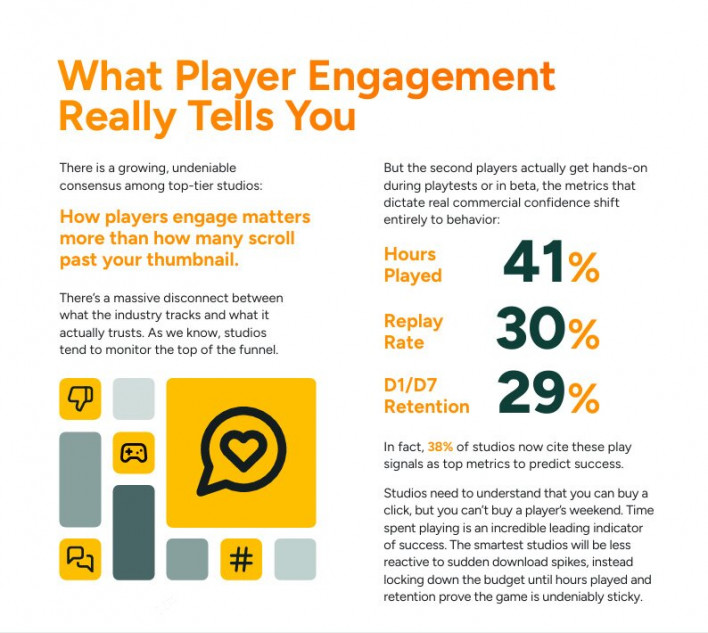
Among the smartest developers leading the market, there is a firm consensus that how players actually engage with a game is far more important than simple thumbnail exposure. The moment a user picks up a mouse and starts interacting with the game during a playtest or beta, the developer gains access to truly reliable data.
Developers ranked 'playtime' (41%) as the most reliable behavioral indicator for predicting commercial success, followed by 'replay rate' (30%) and 'Day 1 and Day 7 retention' (29%). In fact, 38% of all developers now cite these tangible play signals as their top priority for predicting success. While companies can pay for marketing to artificially inflate click counts, they can never buy a user's precious weekend time.
Active social engagement also serves as a powerful signal in the same vein. When users willingly take the time to leave reviews, share information, or engage in heated discussions, it involves physical effort. Because this expresses genuine purchase intent, 51% of the surveyed developers track this closely, using it as their primary metric to build real confidence within their launch teams.
Successful Games Have Vibrant Communities

While generating short-term buzz is easy with a textbook marketing blitz, accurately capturing long-term demand before launch is the industry's most difficult challenge. To filter out casual onlookers and identify the core users who will stick with the game, one must look at the 'depth' of the community. Internationally, Discord serves as the ultimate litmus test for identifying the next big hit.
Only 5% of developers consider the raw size of a Discord community to be the most reliable indicator. However, the story changes completely when analyzing the hidden signals of 'sleeper hits' that defy expectations. 48% of developers point to the growth of Discord as the number one invisible success factor for these breakout titles. This figure dwarfs other prominent marketing metrics like YouTube views (43%), active social engagement (42%), and media coverage (38%).
Joining a Discord server and consistently participating in conversations is impossible without persistence and deep affection from the user. Even if superficial buzz metrics look average, if highly active users within Discord are growing exponentially every day, it is the most certain precursor to the birth of a next-generation mega-hit.
There Is Other Data That Needs Careful Attention
Statistics show that YouTube (78%) is the platform most used by developers for pre-launch marketing, followed by TikTok (53%), Twitch (48%), and Discord (41%). Additionally, 86% of developers value pre-launch interest from influencers and creators. However, high utilization of a channel does not guarantee the reliability of its metrics.
Smart developers who dominate the market are focusing their efforts on driving meaningful interaction rather than superficial user exposure. They value how deep and solid the community's foundation is, rather than how large it appears. Instead of reacting impulsively to spikes in visible download numbers, they show the discipline to hold back budget spending until playtime and retention prove the game's strong binding power.
Data analytics firm FirstLook emphasized, "Visible metrics do not pay the bills. Ultimately, it is the actual behavior of users that determines a company's survival. When making critical decisions about investing massive marketing budgets ahead of an official launch, companies must shift the decision-making power to concrete behavioral data like engagement, retention, and playtime."


Sort by:
Comments :0