


A National Assembly forum aimed at strengthening the role and policy status of the game industry was held on the 28th, hosted by Representative Kim Jae-won of the Rebuilding Korea Party. Song Jin, Director of the Policy Research Division at the Korea Creative Content Agency (KOCCA), delivered the keynote presentation. The subsequent discussion, moderated by Hwang Sung-ki, Chairman of the Game Self-governance Organization of Korea (GSOK), featured Chae Jong-sung, head of the tax response team at Yulchon LLC; Park Jung-eun, a reporter at Electronic Times; Choi Seung-hoon, Policy Director at the Korea Association of Game Industry (K-GAMES); and Choi Won-seok, Director of the Game Content Industry Division at the Ministry of Culture, Sports and Tourism (MCST).
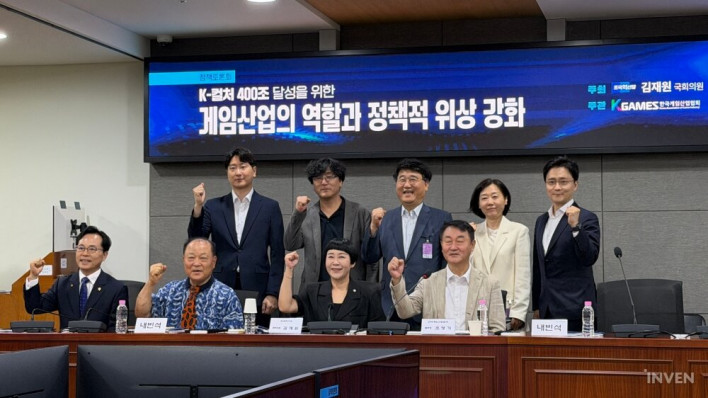
In his opening remarks, Representative Kim Jae-won stated, "It is time for a policy shift that aligns with the actual status of the Korean game industry," adding, "We must build a foundation for the continuous production of globally competitive, innovative content by fully expanding tax credits and fiscal support for game production costs."
He further emphasized, "We must create a virtuous cycle for investment and creation by thoroughly protecting domestic and international game IP, and provide systematic support for global marketing and promotion. Amid the rapid influx of AI technology, we need to establish sophisticated institutional norms to ensure that AI utilization and IP protection work in harmony."
Director Song Jin delivered a presentation titled 'The ₩400 Trillion K-Culture Era: Strategic Importance and Policy Direction for the Game Industry.' He identified several crises facing the industry: #1 profitability decline due to stagnant growth and lower usage rates; #2 sluggish new IP development caused by rising costs, such as development and production expenses; #3 over-reliance on mobile platforms, specific genres, and export regions; #4 increased global competition and regulations in major markets like China; and #5 negative public perception of games.
Conversely, he highlighted opportunities: #6 Leading innovation in technology and platforms such as AI; #7 Transmedia expansion through IP-based content convergence; #8 A strong fandom economy; #9 Tapping into emerging digital markets (Middle East, India, Southeast Asia, etc.); and #10 The role of games as a medium for leisure and socio-cultural engagement.
Director Song stated, "We need a structure where the industry ecosystem can distribute and absorb heightened risks," adding that the industrial foundation must be strengthened through overcoming polarization, providing support at each growth stage, fostering indie games, offering financial aid, and improving regulations. He added, "We need strategic cultivation to achieve global results, a shift in business models, and diversification of exports and revenue streams. We also need a foundation to lead the future content industry, such as implementing an innovation ecosystem that responds to the AI transformation (AX) of the content sector."
He stressed, "Rather than focusing on technology development, we need support for the entire process of 'content completion, release, employment, and IP accumulation' as a mechanism to share production risks." He explained, "By refunding a certain percentage of costs for large-scale upfront investments, we can reduce the risk of investment loss and turn that into capacity for reinvestment." He added, "A culture that acknowledges failure and a cost-based tax deduction system have the effect of encouraging innovation by enabling diverse experiments."
The Korea Creative Content Agency (KOCCA) projected that the economic ripple effects of game production tax credits would generate ₩1.4554 trillion in value-added, ₩2.255 trillion in production, and 15513 new jobs by 2029.
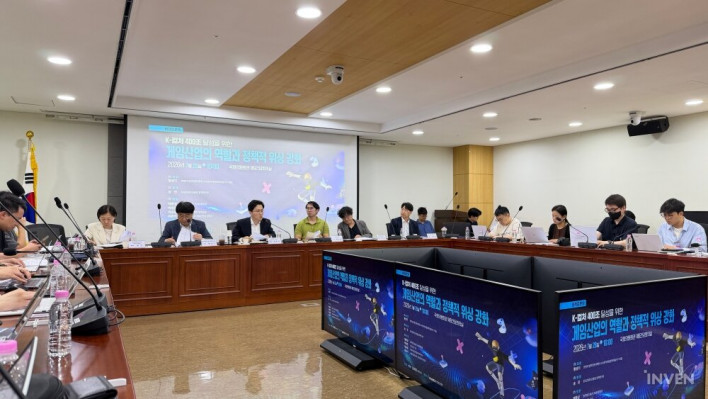
The subsequent discussion directly challenged the logic of fiscal authorities, who have excluded games from production tax credits. While Articles 25-6 and 25-8 of the current Restriction of Special Taxation Act provide tax credits of up to 15–30% for films, dramas, OTT content, comics, and webtoons, games and music are excluded. Fiscal authorities have argued that game companies already receive significant R&D tax credits under Article 10 of the same Act.
Team Leader Chae Jong-seong refuted this logic, calling it "institutionally inconsistent." He said, "Korea does not operate a refundable tax credit system and maintains a minimum tax system, so creating a deduction system does not automatically result in tax support. Establishing the system provides an 'opportunity' for deductions, not a guarantee of tax relief."
He pointed out, "The fact that a company actually received a tax credit only means it conducted eligible R&D activities and had sufficient taxable income to utilize the deduction; it does not indicate whether the R&D was successful or if the game using that technology was a commercial hit."
He added, "The industry is not asking the government for the results of success, but for the opportunity to compete, and we are not asking for the game industry to be treated as a special case."
Team Leader Chae explained that the nature of costs differs between the two systems. R&D tax credits target costs for accumulating general-purpose technical assets that can be reused in sequels, such as rendering engines or network synchronization algorithms. In contrast, production cost tax credits target one-time costs tied to a specific work, such as scenarios, character design, voice recording, and level design. He dismissed concerns about double-dipping, stating, "Just as we don't call the costs of a movie's scenario, casting, and filming "R&D," character creation and level design in games are cultural creative activities, not technology development."
He also pointed out errors in the Korea Institute of Public Finance's report on 'Tax Credits for Video Content Production Costs.' Regarding the report's claim that the average production cost per game project is ₩490 million—significantly lower than ₩2 billion for films and ₩1.44 billion for broadcasting—he argued, "This is a statistical distortion based on a simple arithmetic mean that fails to account for the industry's characteristics, which span from micro-indie games to AAA blockbusters."
As for institutional improvements, he proposed an integrated tax system that introduces genre-agnostic production tax credits and adds a statutory base deduction rate for 'transmedia projects' that jointly produce content across two or more genres, such as games, webtoons, music, and video.
Reporter Park Jung-eun suggested that tax credits should be addressed alongside revisions to the Game Industry Act, prize regulations, and the investment ecosystem. She said, "Key tasks such as game production tax credits, specialized investment accounts, Game Industry Act revisions, and improvements to prize regulations have been stuck in discussion for years. The speed of policy is also a factor that determines industrial competitiveness."
Regarding the comprehensive amendment to the Game Industry Act pending in the National Assembly, she suggested prioritizing consensus-based items such as distinguishing between digital games and location-based games, expanding private-sector autonomous content rating systems, and refining post-management systems, while ensuring that the issue of establishing a new Game Promotion Agency does not delay the entire bill. On prize regulations, she proposed a shift to risk-based regulation, suggesting that while high-value prizes and cash-convertible rewards should be strictly managed, small-scale goods and souvenirs should be gradually permitted, noting, "The core is not to eliminate regulation, but to make it predictable."
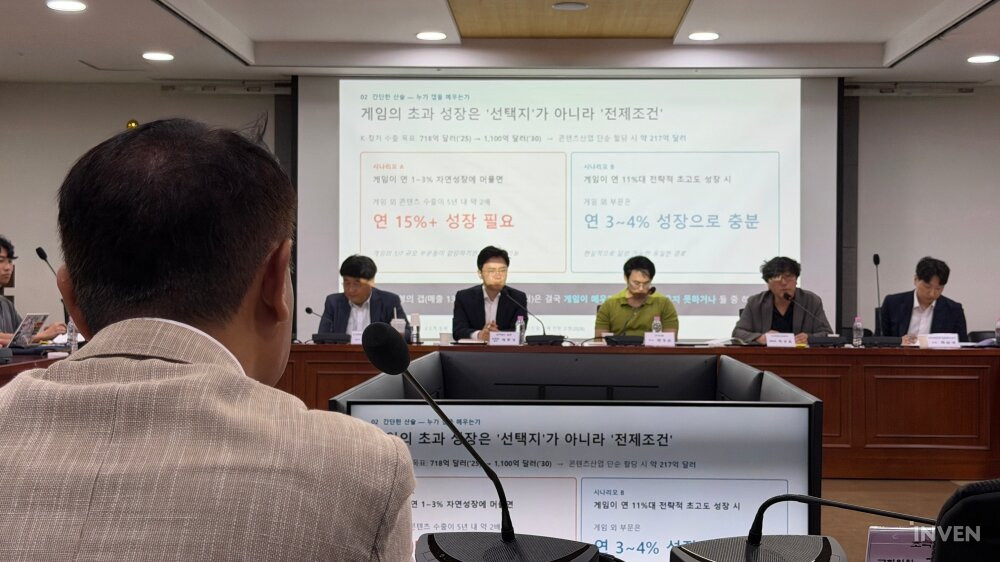
Policy Director Choi Seung-hoon raised the issue of the mismatch between export contributions and budget allocation. He said, "Out of the total content industry budget of ₩1.6177 trillion, the game budget is only ₩112.3 billion, or about 6.9%. A structure where an industry responsible for 60% of exports receives 7% of the budget is the current state of its 'policy status.'" He further argued, "If game exports remain at the current natural growth rate of 1–3% per year, other content sectors would need to grow by over 15% annually within five years to reach the goal, which is virtually impossible for sectors one-seventh the size of the game industry. Thus, the outsized growth of the game industry is a prerequisite for achieving the ₩400 trillion K-Culture goal."
He noted that the game industry has the highest generative AI adoption rate (70%) among all content genres, citing AI transformation as a breakthrough. However, he warned of the risk of AI being used for layoffs in an industry where 66.7% of production costs are labor and outsourcing expenses. "Market signals determine which path a company chooses, and government policy creates those signals," he said, emphasizing the need for a policy shift (PX). The association requested a package including expanded production tax credits, expanded integrated employment tax credits, permanent establishment of a game-specialized account in the Fund of Funds, new special listing rules for game companies, flexible working hours, and improved gacha item regulations.
Choi Won-seok, Head of the Game Content Industry Division at the Ministry of Culture, Sports and Tourism, explained the government's response. He stated, "There has been a lack of novel games due to a focus on gacha item-based MMORPGs," and announced plans to expand support for indie games and create a separate track next year to support larger production costs for mid-sized companies. He also mentioned expanding export vouchers, establishing two new Korean joint pavilions in the Global South, and launching a pre-evaluation program for local users by region. Regarding financial support, in addition to the ₩120 billion Game IP Fund formed last June, he announced plans to create a new loan program for the game industry next year, noting, "There was previously no separate loan program for the game sector." On production tax credits, he said, "We are consulting with relevant ministries, including the Ministry of Economy and Finance, to implement them."
Regarding the distribution order, he stated that the government is pushing to introduce emergency blocking measures against illegal private servers, establish punitive damages of up to five times the actual loss in the Game Industry Act, and raise penalties from the current five years/₩50 million to seven years/₩100 million. He added that since the introduction of gacha item information disclosure, about 3200 corrective actions have been taken, and 80 out of 81 companies required to designate a domestic agent have completed the process.
Regarding the practical opposition encountered during consultations on tax benefits with other ministries, Division Head Choi Won-seok explained, "They recognize the importance and high revenue of the game industry, but the biggest hurdle is that the estimated scale of tax revenue reduction is larger than in other industries. It is estimated at about ₩330 billion per year, or ₩1.5 trillion over five years, making it difficult to persuade fiscal authorities." He added, "However, we plan to continue persuading them that there are economic ripple effects and induced benefits that more than offset this tax shortfall."
In response, Director Choi Seung-hoon emphasized, "This is no longer a matter of logic, but a matter of policy decision-making." He stated, "The fiscal authorities, the Ministry of Culture, Sports and Tourism, and the industry are all already fully aware of the necessity and logic. Now is the time for a clear decision at the government level."
![]()
- Doohyun "Biit" Lee
- Email : biit@inven.co.kr





Sort by:
Comments :0