


How truthfully can the human eye perceive reality? We are limited by the fixed position of our eyes, the slow speed dictated by our physical constraints, and a field of vision restricted to how far we can turn our heads. Can we truly call the human eye perfect?
The 'Kino-Eye' (camera-eye) concept, declared by Soviet filmmaker Dziga Vertov, is rooted in the belief that a mechanical eye can capture the world more perfectly than the human eye. Jung-won, the protagonist of the new two-person original musical Don't Touch, which opened on the 19th at the Jeongdong Theater Cecil, was also a student who, like Vertov, believed in capturing reality exactly as it is through a mechanical lens. Even after many years, Jung-won remains a person behind a camera, capturing the landscape of a sleeping city in a quiet, early-morning cafe through his mechanical eye. It is there that his lens catches someone: Ji-an, who sits in the corner of the cafe, having just taken off a raccoon mask and looking as if she is on the run.
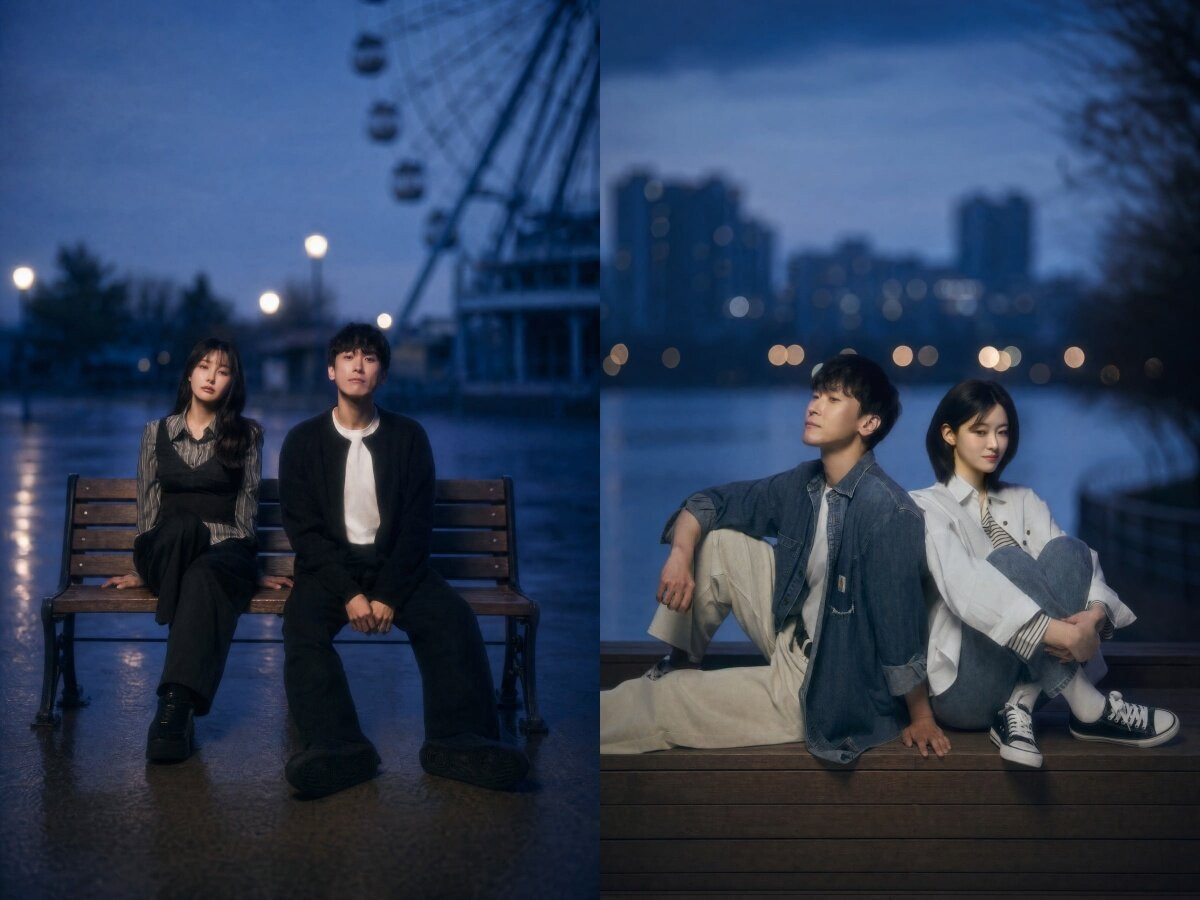
Ji-an, a former child star who was once successful, declares at the start of the play that her life is ruined. After Jung-won—who had abruptly cast her as the lead in his film, shouting 'Be an actor!' the moment they met—left suddenly for Russia, Ji-an made a name for herself in a school-based drama. However, after quitting acting due to conflicts with other actors, the world’s gaze turned cold and judgmental. Her part-time job wearing a mascot costume at an amusement park was a refuge where no one could see her true self.
Jung-won returns to Korea after a long time, and Ji-an, having caused a scene at her part-time job that ended up in the news, crosses paths with him at the cafe. She avoids him. She has lived with her guard up, pushing people away and clinging to her pride, perhaps because she didn't want to show the world how much she had changed. She resents Jung-won for leading her down the path of acting and cries out, Don't touch.
Jung-won tries to stop Ji-an, urging her to finish the film they started in their school days. But he, too, fears her touch and shouts, Don't touch! Having developed Complex Regional Pain Syndrome (CRPS) in Russia, a rare disease, Jung-won feels as if he is burning or being stabbed by knives whenever someone touches him. The pain makes him unstable, as if his body has been hollowed out.
After many twists and turns, they begin filming again, and Ji-an tells Jung-won that there is another way to see the world. Neon signs reflected in a lake sometimes look more beautiful than the real thing; the refracted, distorted image is more beautiful precisely because of that distortion. Ji-an had said the same thing in high school. She was suggesting that his insistence that only a mechanical eye could capture a perfect world might actually be a way of viewing truth through his own prejudices.
Jung-won offers no clear rebuttal. Between his family environment and the way people around him viewed him as 'strange,' he may have worshipped the mechanical eye to avoid being touched or hurt. It is as if that internal state manifested as his rare disease, making it impossible for anyone to touch him. Beyond a simple artistic philosophy, this serves as a solid pillar of the play, showing how he relies on the mechanical eye to connect with the world. This extends beyond metaphor into the very direction of the production.
What completes Vertov’s Kino-Eye is not just filming through a mechanical lens; equally important is the assembly of time and space. It is about connecting fragments of different perspectives and places that the human eye cannot link. It is a truth constructed only through editing. This is evident in the flashback scene that occurs when Jung-won and Ji-an reunite at the cafe early in the play.
In high school, Jung-won sees Ji-an’s career plan, where she wrote 'Cold-hearted city girl' as her future goal, and tells her, 'Be an actor!' At first, this scene seems random, highlighting Jung-won’s eccentric nature. However, this flashback structure does not hide the play's conclusion. The reason Jung-won shouts for her to be an actor, and the reason Jung-won, who should be behind the camera, is captured within the film, are all revealed without concealment.
It is not a matter of convenient omission for the sake of narrative, but a juxtaposition of distant fragments of time that shows their connection. It is that gap left unsealed—what Vertov intentionally pursued instead of narrative. Audiences may pass over these moments without filling in the meaning at first, but by the end, they realize the pieces are connected. The editing and form of the Kino-Eye, and Jung-won’s worldview, are thus embodied in the very form of the work.
Here, the irony of Jung-won is revealed. Behind the 'cold-hearted city girl' career goal was Ji-an’s true dream. Jung-won was the only one who believed in her, making her feel special as an actor and helping her believe in herself. What he saw in Ji-an was not through a lens, but through his own human eyes.
This recovery through the human eye is completed in the final act. Ji-an and Jung-won dance in an empty amusement park at dawn. Jung-won reaches out a hand that should not be touched, and Ji-an places her hand over his. There is a slight gap between their hands—a space they navigate with careful steps. A moment later, their hands slowly meet. Jung-won, as if forgetting his pain, holds her hand tightly and dances, as if Ji-an’s sharp thorns are perfectly filling the empty void in Jung-won’s body.
The lyrics of the song about dreams and imagination hint that this moment is merely a fantasy. However, the audience’s gaze—the human eye—perceives this as a moment of emotional resolution. Ultimately, both Jung-won and the audience look at the world through Ji-an’s worldview: the human eye. Jung-won hands his camera—his mechanical eye and his own eye—to Ji-an, bidding farewell to their one-night reunion. Having received that eye, Ji-an can now look at the dream no one once believed in with her own eyes. While the form and motifs are borrowed from Vertov, the play captures all the foreshadowing and seals it with the very 'complete meaning' he rejected.
This is why 'Don't Touch' becomes complete only upon a second viewing. It is due to the aforementioned flashback structure. Pieces that were left meaningless during the first viewing reveal that they were pointing in one direction all along once you know the ending. The conversations, actions, and words exchanged in the past take on a different weight the second time around.
Even after Ji-an meets Jung-won and passes through that night, the world’s gaze surrounding her does not change. Her career, which she believed was ruined, and the incident involving the mascot costume do not disappear just because a new day begins. The play does not solve everything at once.
However, one thing has changed: the sensation of that hand she held despite knowing it would hurt, and the eye offered by the one person who believed in her until the end. Ji-an can now look at herself not through the world’s distorted gaze, but through that eye. The dawn that greeted the two people who once shouted 'Don't touch' at each other—that 'Dawn Touch,' like the first ray of sunlight, was a small warmth that allowed them to take a step toward the self they had been avoiding.
![]()
- Seungjin "Looa" Kang
- Email : looa@inven.co.kr


Sort by:
Comments :0