


Topic: The Secret Behind an App Opened by 50 Million People Daily: Making Learning So Fun It Feels Like a Game, and How a Green Owl Took Over the Internet Speaker: Ma Ju-yeon - Head of Duolingo Korea Field: Business & Marketing, Production & Operations Recommended for: Marketers, planners, designers, and students
Tags: #NDC26 #Duolingo #Marketing
[🚨 Lecture Topic] We share the background of how Duolingo, a language learning app, grew into a service with 50 million daily active users (DAU) and became a leader in social trends, from the perspectives of product design and marketing strategy.
How did a language learning app become a service that 50 million people around the world open every single day, and how did it come to lead social trends.
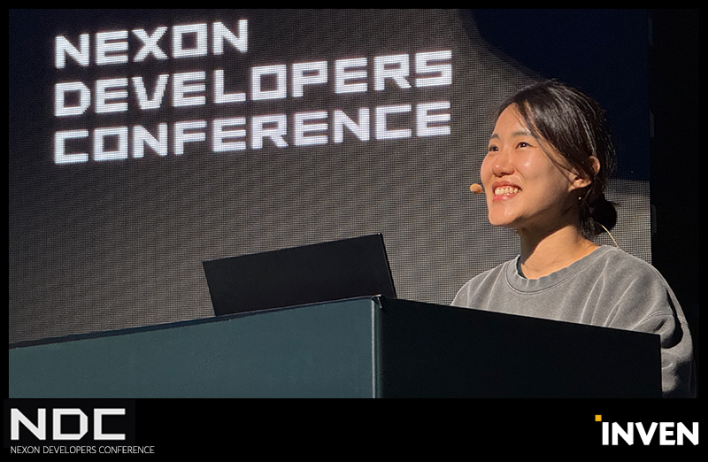
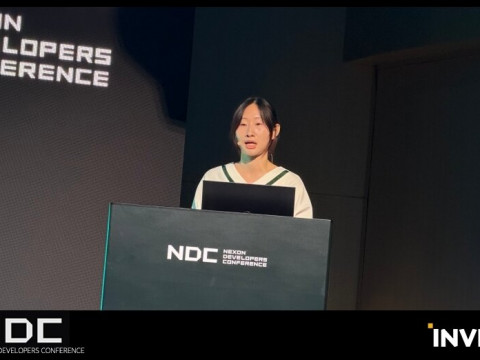
At NDC 2026, Ma Ju-yeon, Head of Duolingo Korea, explained the secret behind this success through the lenses of product design and marketing strategy. A veteran marketer with experience at Naver, Line, VCNC, Playlist, and Netflix Korea, she engaged the audience throughout the lecture with her signature lighthearted style, saying, "My goal today is for you to have a fun time and to go do one more Duolingo lesson."
"It's painfully boring"... The failure of the first app created by two geniuses

Duolingo began with a meeting between a professor and a graduate student. Founders Luis von Ahn and Severin Hacker were professor and student, but they shared a vision and were highly regarded talents who had received blank checks from major corporations. Both came from immigrant families and shared a belief in how much opportunity language provides and how educational equality can give hope to many and change the world. They wanted to create a language learning app that anyone, rich or poor, could use anywhere.
The two quickly built an app—an exchange learning tool where they taught each other Spanish and German. Like the geniuses they were, they referenced countless professional books by linguists and educators to create a systematic, professional, and truly 'incredible' app. But the results were abysmal. Ma recalled the founders' own description of that time: "It was painfully boring and terrible."
During a retrospective meeting, the two faced a dilemma. They had the motivation, they had considered all the 'educationally sound' features and the latest teaching methods, and they certainly didn't lack the will—so why couldn't they finish it? Ma asked the audience, "What is the best way to learn a new language?" and answered it herself: "Consistency—doing it every day."
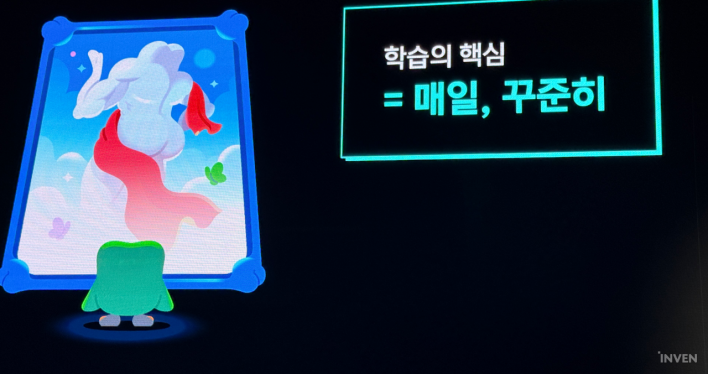
Just as a baby's language skills improve quickly when surrounded by talkative caregivers, language absorption accelerates with frequent repetition. Like all learning, language requires daily consistency to build neural pathways. Ultimately, the failure of their first app lay in the user experience—it lacked the 'motivation to keep going every day.' People had the will, but they didn't repeat the habit. That was the moment they identified both the problem and the direction forward.
Severin and Luis dove deep into one thing: games. Specifically, they began to study the 'grammar of games.' Their textbooks were two games that people around the world were glued to for hours every day. The presentation slides showed icons for Angry Birds and Clash of Clans. Luis and Severin sought to learn how these games kept people coming back daily and how they maintained user motivation through design.
That is how the Duolingo we know today was born.
"All decision-making converges on DAU"
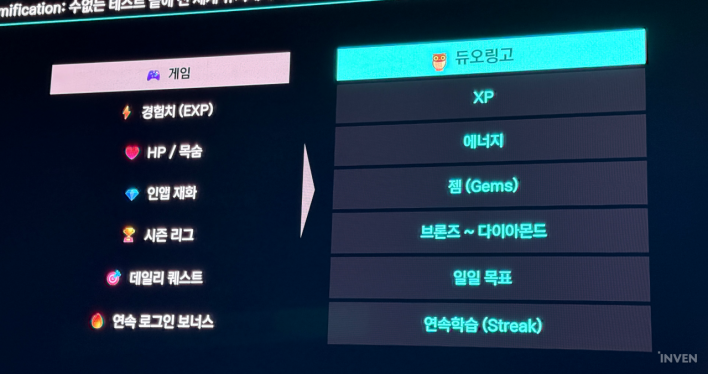
If the most important thing in language learning is 'consistency,' then translating that into product language means increasing 'Daily Active Users' (DAU). From that point on, every decision at Duolingo began to converge on DAU.
Duolingo tests constantly. They run at least 500 A/B tests per quarter. Ma mentioned that she personally receives two alpha versions of the app via TestFlight every day. About 40% of these tests fail. While it might look inefficient, Duolingo believes there is value in it. They have a culture where failure is acceptable, and they believe that through these experiments, they can find ways to boost DAU and maximize the learning experience.
While testing countless features, there was only one criterion: 'Does this feature motivate people all over the world to keep learning every day?' It wasn't about whether a feature was complex, effective, or cool, or if it only appealed to a specific user base. By making bold decisions based on this standard, Duolingo narrowed its core gamification elements down to six: accumulating EXP, rewards like in-app resources, seasonal leagues, reputation, and social connections, daily quests, and, most importantly, 'streaks.'
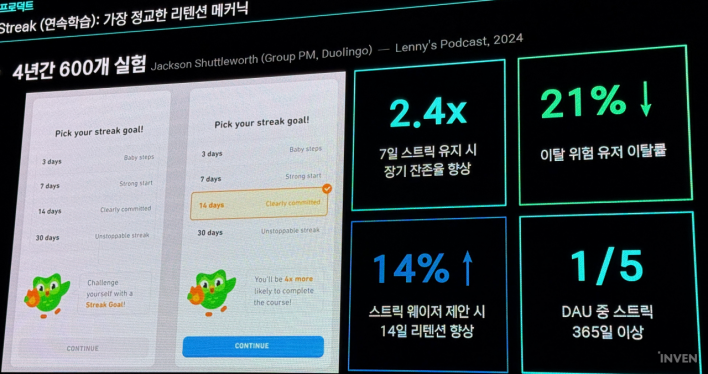
A streak is a concept that tracks how many consecutive days you've used Duolingo; it is essentially synonymous with DAU. It is also the feature Duolingo puts the most effort into. Ma revealed that there is a dedicated team solely for streaks, and they have conducted over 600 experiments on it over the past four years.
The reason Duolingo focuses so heavily on streaks is clear: if you can get a new user to maintain a streak for just 7 days—even for one minute a day—the probability of them becoming a long-term user jumps by 240%. It is overwhelming efficiency.
Her favorite experiment is the goal-setting flow right after sign-up. Initially, they simply asked, "How many days will you do this?" at the time of registration, especially when motivation was high, like on New Year's Day. Later, they refined the options to "1 day, 3 days, 7 days, 30 days." Since everyone sets grand goals at the start of the year, people would choose high targets, thinking, "I can definitely do 14 or 30 days."
Taking it a step further, they recently combined these gamification elements to boost motivation, such as offering in-app resources for setting long-term streak goals. They even refined the button text. By changing simple prompts like 'OK' to phrases like 'Yes, I'll do it' or 'I can do this,' they saw conversion rates jump by 7% to 10% each time.
Ma emphasized, "While a big, long-prepared "one-hit" product is important, the key is to consistently stack up experiments behind the scenes that people aren't even aware of, all aligned with the mission of DAU." These improvements compound like interest to create high retention and DAU.
"One red dot equals 1% DAU"... Improvements that compound like interest
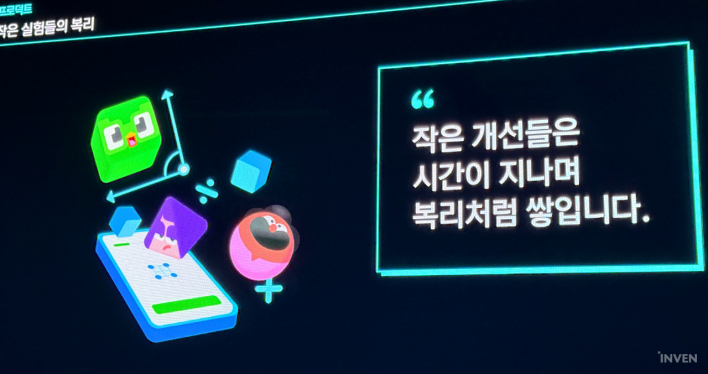
Personalization works on the same principle. Users around the world receive Duo's notification messages based on different patterns. If someone is most likely to open the app when notified in the morning, they get a morning notification; if someone needs multiple nudges throughout the day, they receive them accordingly. Duolingo uses machine learning to constantly personalize the motivational tools that remind each user of their initial intent.
The learning content itself is the same. Long before the AI boom, Duolingo operated an AI tool called 'Birdbrain,' which analyzes error patterns to provide customized problems. Although they often receive customer inquiries complaining, "I'm bored of seeing the same patterns," language proficiency doesn't rise in a straight line—it rises in steps. Duolingo provides repeated, personalized problems only when it is confident that mastering a specific pattern is the optimal curriculum to reach the next level.
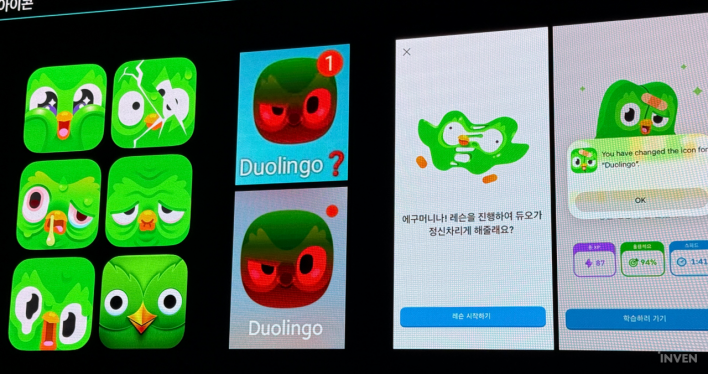
One of the most interesting examples is the app icon. Duolingo changes its icon to make users feel like 'Did I break Duo?' when they miss a streak, prompting them to return. CEO Ma Ju-yeon explained, 'Even a small red dot like this can increase DAU by 1%. With tens of millions of DAU, 1% is a massive scale.' It’s about believing in the 'magic of compounding' and building up even the smallest elements step by step.
An asset no one looked at—the 'unhinged owl'
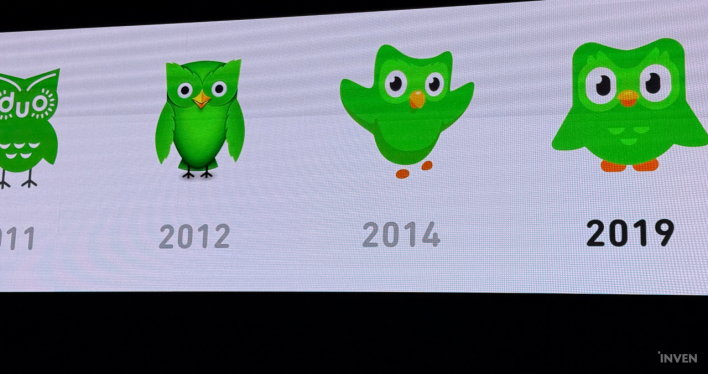
If the product 'Duolingo' was a device to maintain motivation with DAU as its North Star, bringing in those users was the job of marketing. Ma honestly admitted that for the first six years after founding, they did 'ordinary' marketing, being "a bit poorer because it's a free app." Then, the marketing team discovered an asset no one had paid attention to: the mascot owl, 'Duo.'
At the time, there was a strong perception that mascot marketing was a thing of the past—an outdated method for children, like Sesame Street. However, Ma believed that marketing has trends. Pop-ups were considered 'over' seven years ago but are popular now, and outdoor marketing, once thought dead, blooms again when given a new narrative.
Duolingo revived mascot marketing, but gave Duo a personality completely different from typical mascots. It was an 'unhinged' character. While it has the noble intention of providing free language education and is smart enough to teach over 40 languages, as well as math, music, and chess, it is also a bit mischievous and subtly unhinged. The calculation was that people would want to get closer to a character like that.
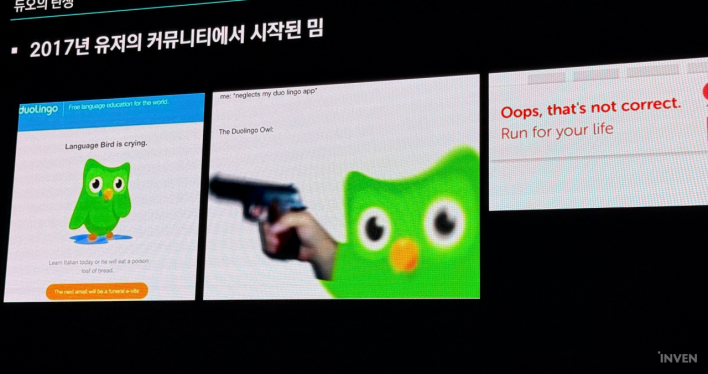
The interesting part is that this persona was essentially created by the fans. When Duo sent messages like, "I'm sad that you don't seem to read my notifications anymore," conversations started in fan communities like Reddit, asking, "Isn't this owl a bit passive-aggressive?" Someone jokingly replied, "It looks weak, but it's actually strong—if you don't do your lessons, it'll drag you away," and a meme spread that it was a character you shouldn't mess with. Seeing that people loved it, Duolingo decided to "make that persona even more fun" and launched full-scale mascot marketing, which was a huge success.
This is how today's meme/social marketing began. Duo loves Dua Lipa because their names are similar, Duo tries on a bikini because it looks pretty, Duo does fitness training to chase people better, and there's even the eccentric Duo who projects "Do Duolingo" onto apartment walls.
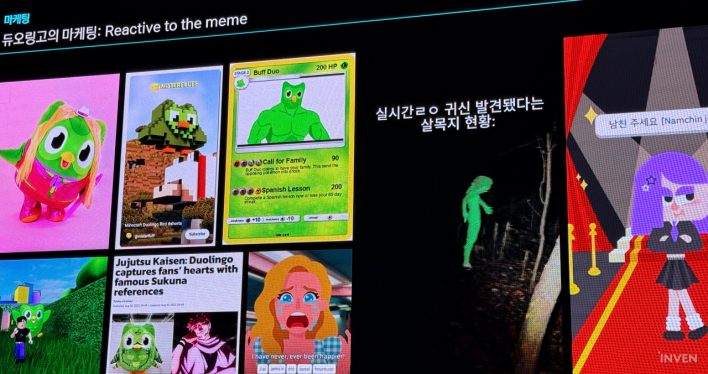
They also quickly caught up with the latest memes. When the movie Barbie was trending, 'Barbie Duo' was created; when a specific meme went viral in Korea, Duo jumped on it; and when K-pop was hot, content covering it was made. When a trend hits, they create images—sometimes even ones that might be painful for a designer to look at—to jump on the meme within hours.
The reason for doing this is the same as the product strategy. Ultimately, the North Star is to get more people learning on Duolingo, and that requires high DAU. But the place where people who don't use Duolingo yet are hanging out is social media. So, they decided to have Duo appear directly in their feeds. It was a strategy to flip the stale, painful image of learning with a fun owl persona, giving people the courage to think, "This is fun, maybe I should try it," and creating a sense of "the thing to do" through memes and trends.
"Duo is dead"... A single post that beat Super Bowl ads
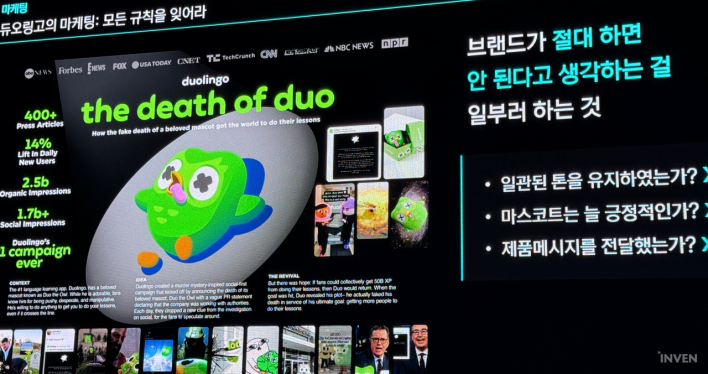
The pinnacle of this marketing was the 'Duo is dead' campaign. There had never been a case in history where a mascot character died, but Duolingo actually 'killed' Duo last year. The reason? "Because users were lazy with their learning." Duo declared, "To save me, users around the world must study hard and earn 5 billion EXP."
The result was explosive. Brand mentions skyrocketed 25k times on the day of the announcement, and 1.7 billion impressions were generated across social media in two weeks. Ma compared the significance to the Super Bowl. She noted that a single post generated twice as much social conversation as the top 10 ads of the Super Bowl, where marketers pay the highest prices in the world. The budget was zero. In the end, Duo was successfully revived as about 50.9 billion EXP were accumulated in 15 countries around the world.

Since then, Duolingo hasn't just stopped at following memes; they are trying to create cultural moments themselves. When Game of Thrones was a hot topic, they launched the languages from the show, and during Squid Game, they significantly increased Korean learners with a campaign saying, "You will be punished if you don't learn Korean." In Korea, they even participated in the New Year's countdown.
Recalling the New Year's countdown campaign, Ma said, "I didn't want to ruin the moment when people make New Year's wishes, as it's not a commercial moment." She wore a hanbok and made a wish, saying, "In the new year, don't be stressed about English, please enjoy Duolingo." It was covered by over 7 news outlets and received a great response on social media; she considers it the campaign she personally found most fun.
Three principles: DAU, listening, and "reasons to open it every day"
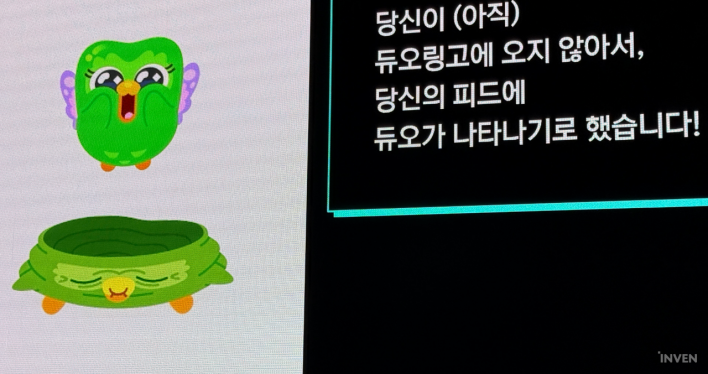
Concluding the lecture, Ma summarized that Duolingo runs on three principles. First, there must be a single aligned goal from the mission to the product, marketing, and company culture—and for Duolingo, that goal is DAU. This is because the more metrics you have, the more blurred the direction becomes. When there's a temptation to make money or increase sign-ups, they gather around a single metric to make decisions, and when judgment is unclear, "just run an experiment" has proven to be the best fit for Duolingo's mission.
Second is listening well to users. She said, "User feedback is the best brief," noting that Duo's unique persona and the product concept of streaks both came from user usage patterns and fan community reactions. They constantly think about how to provide motivation by reflecting the ever-changing perceptions of people.
Finally, she closed the lecture by quoting founder Luis: "As long as there is motivation, people eventually enjoy the process of learning on their own." Learning is ultimately a matter of motivation, and Duolingo is constantly thinking about how to keep the good intentions of users rolling and how to optimize them. Ma ended the presentation by saying, "Ultimately, we are working every day to design reasons for people to want to open the app every day."

![]()
- Kyuman "Frann" Kim
- Email : frann@inven.co.kr





Sort by:
Comments :0