SQUARE ENIX's HD-2D was one of the visual innovations of its time. By blending modern rendering techniques and 3D effects with pixel art, it evokes a classic sentiment that holds up to today's standards. While HD-2D is a trademark of SQUARE ENIX, similar technologies and imitations have since emerged. Nevertheless, the texture of HD-2D possesses a unique quality that satisfies both the emotional and visual cravings that simple pixel art games cannot fulfill.
Thanks to these characteristics, HD-2D has been used in original IPs like 'OCTOPATH TRAVELER' and 'TRIANGLE STRATEGY,' as well as in remakes of SQUARE ENIX classics such as 'LIVE A LIVE' and 'Dragon Quest.' These are all games that prioritize a classic sensibility, framed within the boundaries of the RPG genre.
Therefore, much of the interest in 'The Thousand-Year Journey of Adventurer Elliot' (hereinafter 'Thousand-Year Journey'), which marks the first expansion into action, was clearly focused on its HD-2D action. The rest of the anticipation likely stemmed from the homage to classic action RPGs like 'The Legend of Zelda' or the 'Mana' series, as showcased in the demo.
In reality, 'Thousand-Year Journey' is a game that perfectly meets those expectations. It offers the visual satisfaction crafted by HD-2D, while the sense of classic action RPGs is deeply embedded in the gameplay, much like how the series drew its classic sensibilities from old-school RPGs.
■ This article contains spoilers.

HD-2D: Beyond Visual Effects, a Variable in Level Design
The reason it was necessary to mention HD-2D is that its utility has changed significantly with the shift to action.
HD-2D is closer to a graphic style and directing technique used to implement a game. It is a technology designed primarily for visual satisfaction. This was particularly prominent in RPGs where the world is static and combat is turn-based. Background effects or depth perception had little impact on actual gameplay, aside from basic navigation.
However, when applied to an action game, HD-2D became intertwined with map and level design.
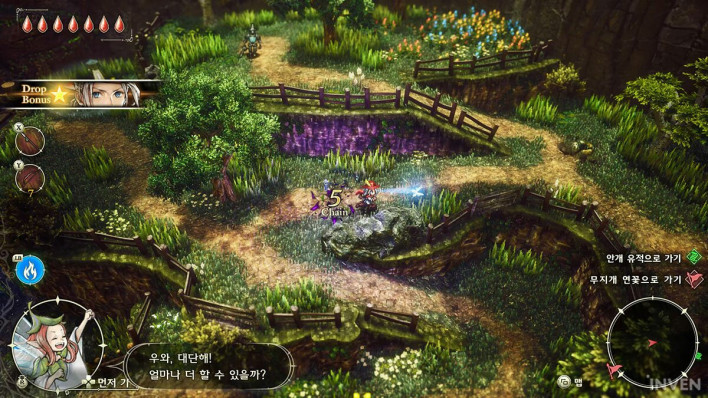
The adventure centered on the protagonist, Elliot, follows the flow of a relatively traditional action RPG. It features enemies roaming freely on the fields, a combat system where you must avoid attacks through movement since there is no dodge button, and a 8-directional attack system centered on Elliot. Fundamentally, it takes the form of a classic 2D action game.
However, the sense of depth that creates this space is expanded through HD-2D. While it usually captures the world in a quarter-view, it sometimes lowers the camera angle to get closer to the ground, capturing a wider view of the world. Conversely, it amplifies the sense of depth by implementing the verticality of the 3D background world. It goes beyond the 2D method of expressing height through tilted backgrounds, adding a more complex concept of elevation.
This verticality plays a role in shaking up game design in an action setting where you must move, dodge, and solve puzzles in real-time. Decisions such as when and how to step on platforms that change height in real-time, or how to attack enemies at different elevations, are woven into the gameplay. A single region is not just divided into high and low areas; it is split into multiple tiers, creating complex paths and serving as the foundation for intricate puzzles.

While it is similar to 'The Legend of Zelda: A Link to the Past'—often cited as a comparable game since its first reveal—and the 'Mana' series, which director Tomoya Asano mentioned as a conceptual foundation, this HD-2D is what makes it most distinct. It brings about a fundamental change in level design, not just visual satisfaction.
The Sense of Classic Action RPGs, Built Upon Depth
Although the deeper sense of space allows for various variations in level design, the core of the game does not stray far from classic action RPGs. The play style reminiscent of 'The Legend of Zelda: A Link to the Past' or the 'Mana' series from the Super Famicom era can be felt throughout.
The adventure area for Elliot, starting from the Kingdom of Huda, is not so vast that it is packed with content, even though it is designed to be traversed freely. Instead, the world is implemented as an open field that can be explored freely, rather than a separate hub world. It is designed so that players can fully experience the changes in vegetation and regional characteristics while moving between areas.
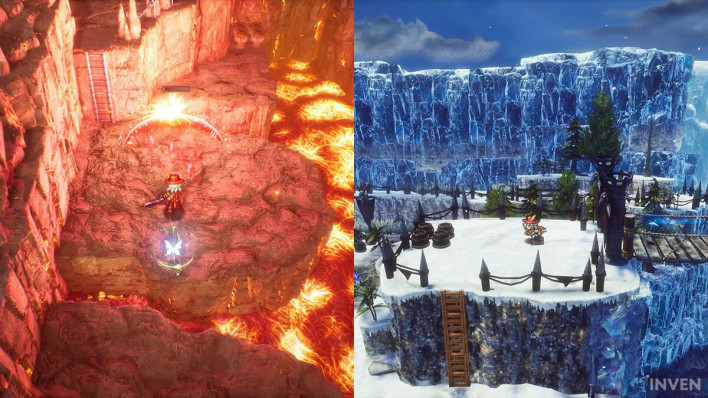
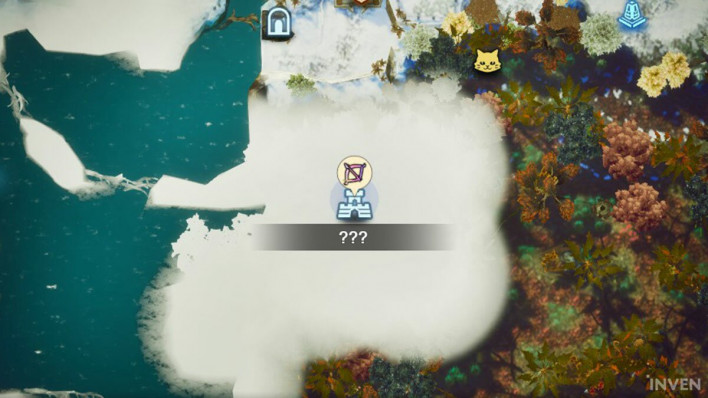
Past the lush green kingdom, there is a swamp with poisonous plants, and a desert stretches to the west of the beach. To the north lies a snowy field, and at the end of the world opposite the kingdom, there is a blazing lava zone. Each dungeon in these regions also features designs and gimmicks suited to those regional characteristics.
Combat in this space is quite straightforward. As mentioned, there is no dodge function, so blocking and attacking are the basics. Since the guard gauge decreases when blocking, you cannot just block indefinitely; you must move the character to avoid attacks, reflecting an old-school play style. The ability to use a ultimate skill after charging by holding a button adds a layer of action, but since you cannot perform other actions while charging, the pattern is mostly about quickly suppressing enemies before they attack.
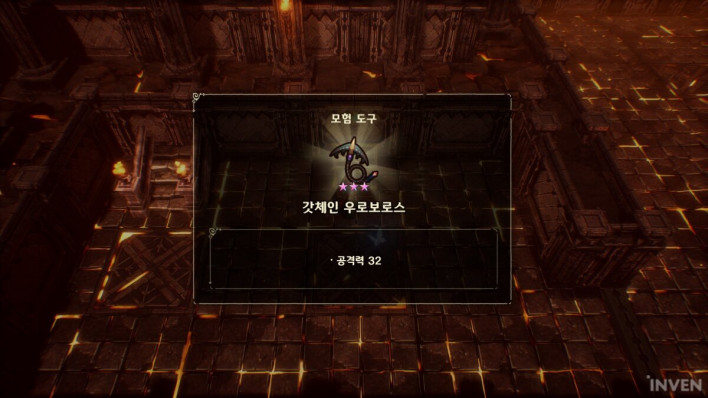
This simple combat gradually becomes more diverse as you progress and acquire various weapons. Starting with only a sword, the arsenal expands to include spears, hammers, chain sickles, bows, boomerangs, bombs, and more. Once you obtain a new shield, parrying becomes possible, further enhancing the action. Each weapon has different uses and combat styles, making it fun to utilize various weapons to approach combat differently.

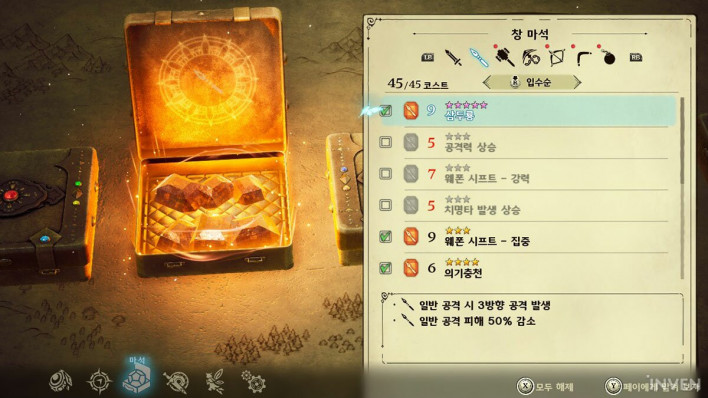
You can deal heavy damage at once with a hammer or deal damage safely from a distance with a bow. On top of this, the fun of constructing various builds through weapon variations using Magic Stones is added. Instead of a level system, you can become stronger by equipping Magic Stones to your weapons.
Magic Stones range from simply increasing damage or crit chance to changing how the weapon itself operates. For example, a bomb might not explode immediately but instead emit flames that damage surroundings, or a chain sickle might fire flame projectiles while charging a ultimate skill. Within the cost limit of each weapon, you can combine various Magic Stones to change your play style, alleviating the boredom of a simple game system.
Growth Through Exploration, and the Expiration Date of Its Charm
Magic Stones, a pillar of character growth, can be generated randomly during the game or obtained as high-grade versions through dungeon exploration. While Magic Stones are manageable, Elliot's other growth structures are all focused on growth through exploration.
Along with Magic Stones, Elliot's growth is handled by health upgrades and weapon acquisition. Without a separate level-up system, and with no way to upgrade weapons or buy higher-grade ones without Magic Stones, these must also be obtained in dungeons. Health increases by one for every four Life Fragments collected from dungeons or temples. It is a structure where growth—from Magic Stones to weapons and health—expands through exploration.
However, the segments where exploration is truly engaging pass by relatively quickly. While exploration areas expand through weapons or items—such as clearing paths with bombs or driving giant nails with hammers—these are limited to a few spaces when you first acquire a new weapon. Usually, it feels like dungeon gimmicks are recycled; they are emphasized briefly when you get a new weapon or item, but their utility decreases afterward. It is far from the Metroidvania-style level design seen in recent 3D games.

Of course, major temples that serve as the main story or certain mandatory dungeons are designed to utilize puzzles in various ways. There are several types that require thought, such as puzzles using light or puzzles involving draining and filling water to swim and dive. However, these are closer to clearing sections for story progression rather than elements of exploration. While exploration is an important part of growth, the moments where that exploration is actually fun are not long during gameplay.
Weapons are also often implemented such that higher-grade Magic Stones simply enhance existing stats. Eventually, the process of creating new builds or weapon combinations ends, and you end up using only the weapons you are used to. Since weapon usage is registered to two buttons (X and Y), even with a system that allows you to pause and switch weapons during combat, there is a strong tendency to stick to the weapons you are used to unless a specific situation demands otherwise.
This ultimately makes combat monotonous in the mid-to-late game, where it should have become more diverse through the use of various weapons.
Loose Time Travel, and the Classic Path That Works Within It
What keeps the interest alive in the game, which becomes relatively monotonous in the latter half, is the narrative.
The game is a story about the protagonist, Elliot, setting out on an adventure to protect the kingdom. The Elliot depicted in the beginning is not a hero or a brave warrior as portrayed in classic RPGs, but just an adventurer who likes to help people. However, his talent as an adventurer is recognized, and as he travels through the gates of time, the scale of his journey grows.
As the title 'Thousand-Year Journey' suggests, it covers a long span of time: from the Era of Protection, where humanity is protected by barbarians through Princess Huria's blessing magic; to the Era of Reconstruction, facing the crisis of human extinction; the Era of Magic, which enjoyed prosperity through advanced magic; and the Era of Germination, dealing with the story of the Mu tribe, who possessed nascent civilization and magic.
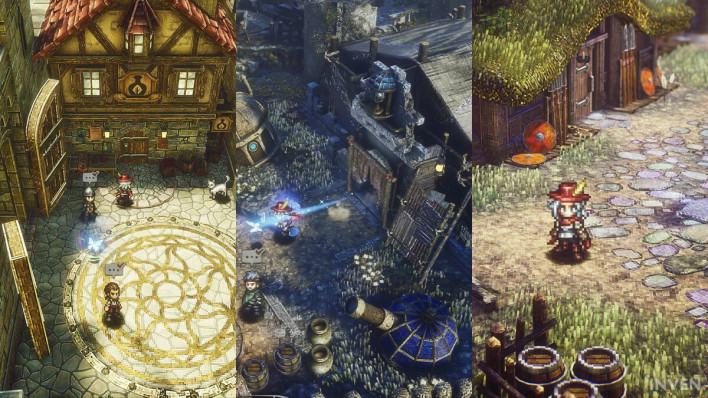
Elliot traverses vast time periods, forming various relationships with people in each era and intervening in their events. And this story unfolds quite loosely. Elliot's actions influence not only the present Era of Protection but also the future in various ways. However, the changes resulting from Elliot's actions do not create very significant shifts, making the term 'butterfly effect' feel somewhat misplaced.
If you save a merchant who is about to die while protecting his goods, the family motto of 'cherish your goods' changes to 'cherish people more' in the future. The tavern owner changes into a person who cherishes others in line with the new teaching, but other than that, their relationships or situations do not change much. This is the same even when Elliot, the center of the story, intervenes in events that have a core impact on his own life.
It is a result of applying changes in time travel conveniently rather than through complex scientific thinking or theory. Combined with the frustratingly slow pace of the story in the beginning, the narrative immersion is bound to lag.
However, the story itself is not bad. That is thanks to the classic, heroic story structure of the game. While the adventurer profession is generally depicted as belligerent, the protagonist Elliot is a person of a different disposition. Raised in an orphanage, he cares for children who grew up without parents like himself as if they were his own siblings. Also, because he survived after someone saved him when he was abandoned, he does not pass by those in danger.
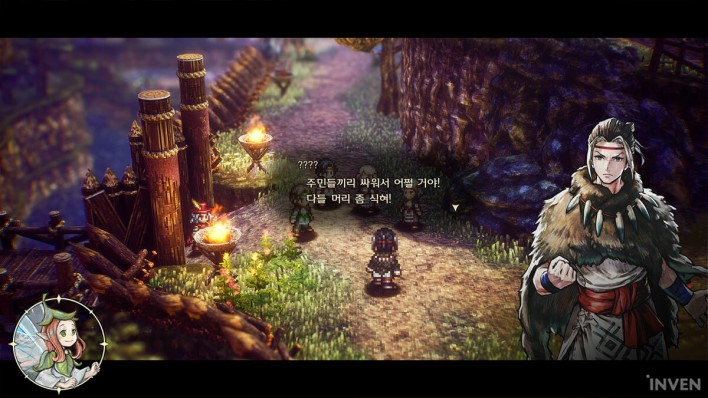
This personality makes the player feel it is not awkward for Elliot to suddenly save the kingdom from danger and go on to save the world. Except for the villain who appears at the very end, the antagonists also have their own stories, and conflicts usually stem from misunderstandings. The depiction of good-natured characters makes the story clean and pure.
Sensibility That Connects Mismatched Fun
This narrative structure is actually depicted relatively flatly in the beginning. The first ending, which effectively opens the latter half of the game, is close to a fake ending, and the full secrets of the world or the deep stories of Elliot and the surrounding characters are revealed from then on. Events within the kingdom or villages are quite frequent, and they are all captured with dubbed voice acting, but since the story's progression is slow, it is a structure that feels frustrating to some.
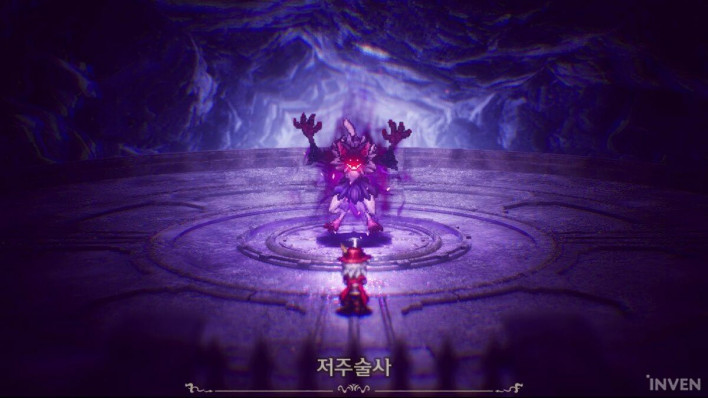
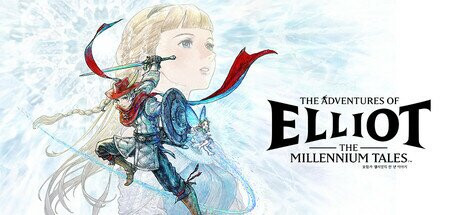
Here, the game's features—HD-2D and Naoki Ikushima's illustrations—set the mood. In particular, there are many segments in the narrative where character illustrations are captured together, and Ikushima's art style, which even includes mouth movements according to expressions or lines, emphasizes the atmosphere in a lyrical and soft way. Thanks to this, it evokes empathy for the characters' soft yet strong personalities and their actions.
After passing through the early sections, the various events that had been building up narratively pour out rapidly. Although you travel between four eras, the number of villages the player can interact with is limited, so the number of characters is small. However, as these characters intertwine and the influences they have on the next era are revealed one by one, the story unfolds with a sense of speed.
These developments are handled seriously until the second ending, and the process leading to the final true ending flows rapidly without a moment to breathe. It might even feel forced, but when you realize that the foreshadowing of this story has been continuing since the beginning of the game, you get a stronger feeling that it was finished well rather than feeling disappointed. This is also possible thanks to the simplicity of taking only the necessary parts according to the flow of the story, rather than complex developments like multiple worlds or time paradoxes, within the framework of time travel.

Also, the fact that the center of this story is Elliot and the fairy Fay who travels with him reminds one of classic RPGs. After the appearance of the fairy Fay, the game begins to feel different. She acquires dropped currency, tools, or Magic Stone materials within a wide radius and performs magic such as acceleration, teleport, and ignition. These are used when solving boss gimmicks or puzzles and play a role in filling the lack of action. In addition, if you pay currency, you can revive even if you are dead and continue playing. Although the cost increases each time you revive, the value of money, which does not have many places to be spent, changes.
Also, narratively, she breathes life into Elliot's journey, who travels alone the whole time. Fay, who appears at the bottom of the screen and chatters incessantly, livens up the atmosphere of the game, which would otherwise be desolate, and also acts as a guide to remind you of the path ahead. Like many characters in the game, through the appearance of Fay, who is innocent and cute and writes her own story, you become softly immersed in the game's world.
In this way, within a story that unfolds predictably with relatively honest character direction and mostly clear foreshadowing, each era transition deepens the immersion in the narrative part. However, unlike the story part, it does not give much satisfaction in terms of gameplay. This is because the terrain itself is almost shared, weakening the feeling of exploring a new area. It is closer to the feeling of exploring the same area again with a slightly different composition. Rather, it is a way of filling that lack of satisfaction in the narrative part.
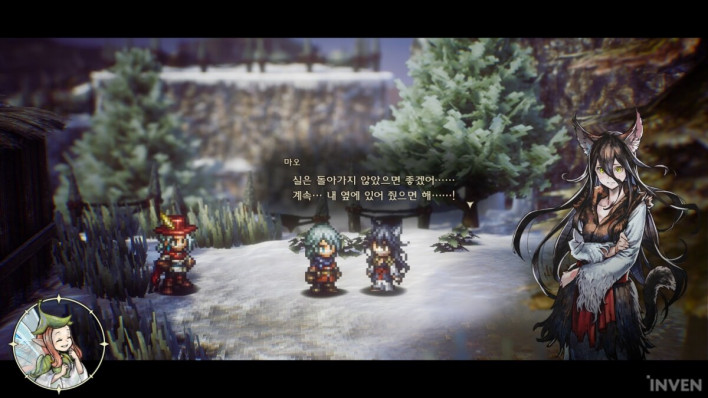
The Thousand-Year Journey of Adventurer Elliot' contains a variety of attractive elements one by one. Combat that reminds one of the 'Mana' series, exploration and growth structures that bring 'The Legend of Zelda' to mind, and a heroic story like a classic JRPG. The fact that the fun segments of these parts are quite mismatched remains a regret.
In the beginning, variety in combat and exploration creates fun in gameplay, and in the latter half, the speed of the previously weak narrative gains momentum, adding immersion. And the emotional direction provided by HD-2D and illustrations, along with the music that is lyrically drawn throughout the game, connects these mismatched fun segments. So, when you look back at the game after finishing all the stories, the satisfaction of a well-finished story and gameplay remains stronger than the regrets.
After the final ending, as it basically supports New Game+, you can look back at that world once more. While ruminating on the foreshadowing that was widely contained within the game.
- HD-2D, which became a level design variable for visuals
- Colorful early combat created by weapons and Magic Stones
- A time-travel story unfolded through a heroic narrative
- Emotional direction created by illustrations and music
- Story gaining momentum in the latter half and recovery of foreshadowing
- Exploration that loses its flavor due to similar world composition
- Combat system that becomes monotonous in the mid-to-late game
- Narrative that creates a barrier to entry due to slow early progression
- Recycled dungeon gimmicks except for story dungeons, etc
Review Platform: PC (Launch Build)

Sort by:
Comments :0