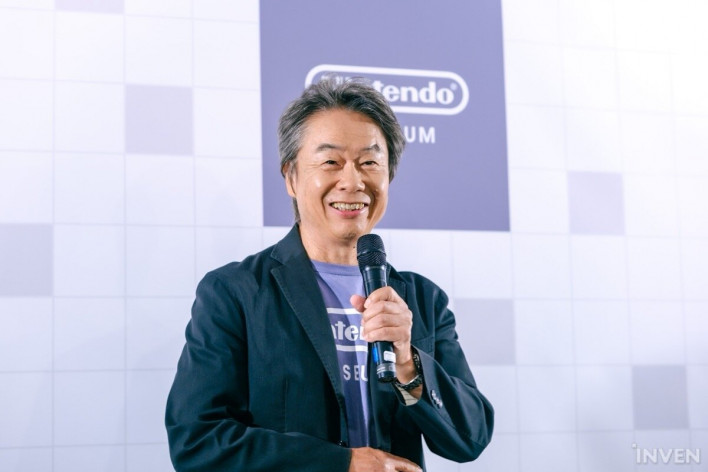
Shigeru Miyamoto recently commented on the surge in remakes during an interview with the Japanese gaming outlet Famitsu on July 22.
"While some might say there are too many remakes, many players move on from a game after five years. The current younger generation has no way to access games from a decade ago. Recreating them in a more accessible format is a great way to meet that demand. We are actively pursuing this because introducing the original works also paves the way for future development"
His argument rests on three points: after five years, players have moved on and demand for the original wanes; the current generation has no way to access decade-old games; and promoting original titles leads to future development. It is a cycle where remakes are explained by accessibility, and the results feed back into the development of new titles.
Market trends are supporting this explanation. Remakes have increased, and this shift is becoming apparent in critical reception even more than in sales figures.
Remakes Are Profitable
Game companies have begun choosing remakes over remasters because they are profitable.
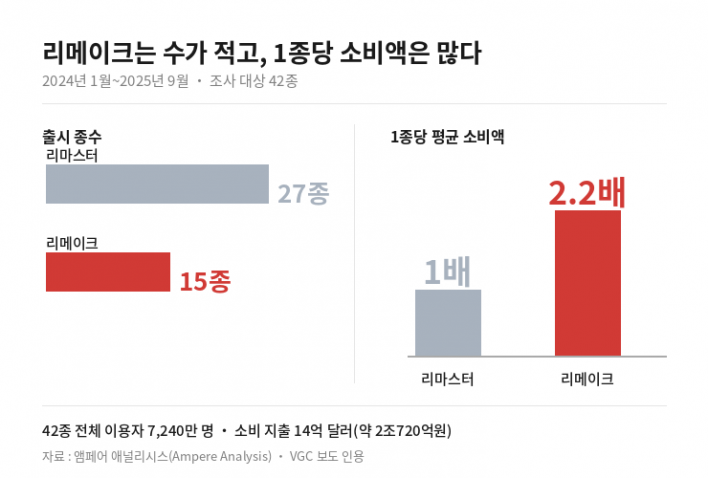
A remaster is a light touch-up that improves resolution and frame rates, while a remake involves rebuilding the original from the ground up, keeping only the core framework. According to data from the UK market research firm Ampere Analysis, which tracked Xbox, PlayStation, and Steam users from January 2024 to September 2025, the average consumer spend per remake was 2.2 times higher than that of a remaster.
The study covered 42 titles: 15 remakes and 27 remasters. While there are nearly twice as many remasters, remakes generate more than double the revenue per title. Although remakes require higher production costs and longer development times, they can be sold at full price and retain users for longer. Ampere noted that publishers must weigh these risks and rewards when deciding to revive older titles.
The 42 titles combined attracted 72.4 million users and generated over $1.4 billion in consumer spending, a figure that includes both base game sales and in-game purchases.
Critical acclaim has followed as well. Of the 50 highest-rated games in 2025, 16 were older titles, according to data compiled by TheGamer based on Metacritic scores. The share of remakes, remasters, and re-releases rose to 32%, up from 20% in 2024. Since this list is based on ratings rather than sales, it indicates that well-made older games, not just best-sellers, now account for one-third of the top tier.
This is why major 2026 projects are leaning toward full-scale remakes rather than remasters. Simply touching up graphics often triggers user backlash and commands a lower price point. Rebuilding from scratch, however, is treated as a new release and can be sold at full price.
Choosing Proven Remakes Over Risky New Titles
If a new title fails, the company's foundation is shaken.
As of 2026, AAA game development costs range from $80 million to $300 million, excluding marketing expenses. A game with a $150 million budget often requires an additional $100 million to $150 million for launch costs. Development takes three to six years and involves teams of 200 to over 1k people. To break even, the game must sell millions of copies.
Failure to meet these benchmarks leads to layoffs. According to the 2026 GDC State of the Game Industry report, 67% of AAA studio respondents experienced layoffs at their companies within the past year, compared to 33% for indie studios. The larger the scale, the higher the rate. In 2026 alone, Epic Games cut over 1k employees—about 23% of its workforce—and Ubisoft targeted around 380 roles for reduction in June.
Remakes mitigate most of these risks. They have a sales history, an existing fan base, and a completed blueprint. While a new game's success is a gamble, a remake relies on the proven appeal of the original.
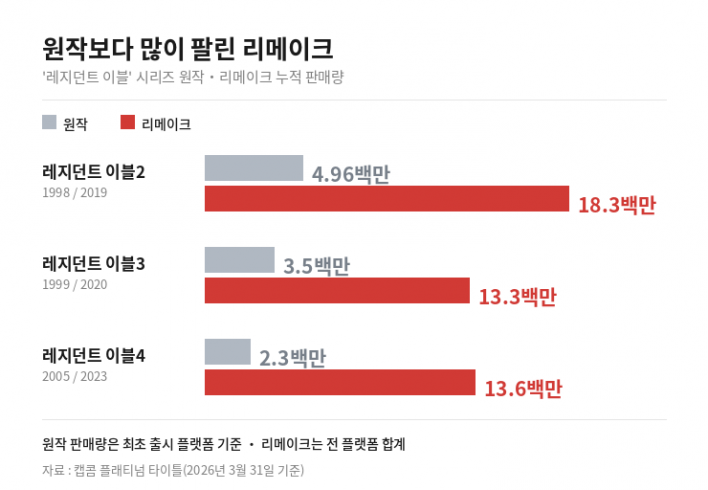
Capcom’s track record illustrates this. The original 'Resident Evil 4' sold 15 million units, and as of January 2026, its remake has surpassed 12 million. The 'Resident Evil 2' remake reached 16 million units, outpacing the original’s total sales. In this sense, the original’s performance serves as a benchmark for the remake’s projected sales.
Remakes Can Fail, Too
There is a specific type of original game suited for a remake. Most successful remakes are based on titles from the 1990s to the early 2000s. These games were released before 3D gaming conventions were fully established, leaving significant room for improvement. There is ample opportunity to modernize control schemes, camera angles, and level design.
Games from the 2010s onwards face different conditions. Even with improved graphics, the difference is often negligible. This is why remasters of games less than five years old are often criticized as rehashes. As modern consoles offer extensive backward compatibility, the incentive to re-purchase older games is also diminishing.
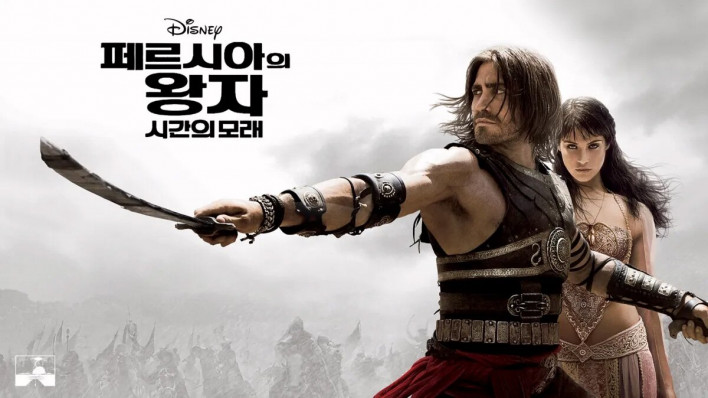
Sometimes, remake projects are scrapped entirely. During a 2026 organizational restructuring, Ubisoft canceled its 'Prince of Persia: The Sands of Time' remake. The 'Splinter Cell' remake has yet to secure a release window. Remakes require significant development costs, and if they fail to meet expectations, the outcome is no different from a failed new IP.
The Remaining Remakes of the Year and Beyond
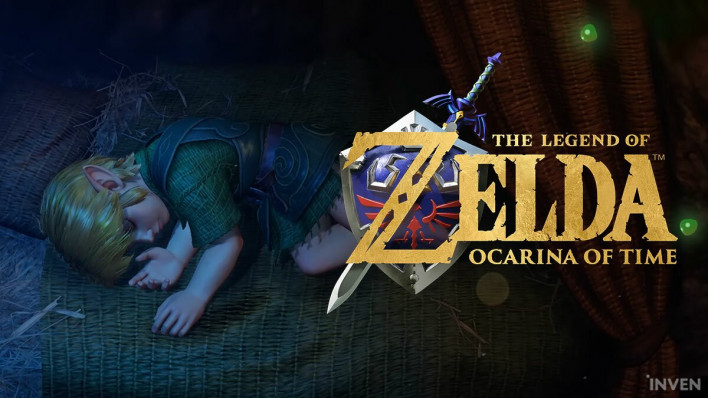
Projects based on older titles continue to dominate the lineup for the second half of 2026. Nintendo is releasing two this year: 'Star Fox,' a remake of 'Star Fox 64,' launched on the Nintendo Switch 2 on June 25, and a remake of 'The Legend of Zelda: Ocarina of Time' is slated for release on the Switch 2 later this year, though an exact date has not yet been announced. Microsoft’s 'Halo: Campaign Evolved'—a remake of the campaign from the 2001 original 'Halo: Combat Evolved'—began early access for Premium and Collector’s Edition buyers on July 23 (local time). The official release is set for July 28 on Xbox Series X|S, PS5, and PC.
The trend of reviving classic titles will extend into next year. 'Resident Evil Code: Veronica' and 'Virtua Fighter Crossroads,' both unveiled at the Summer Game Fest in June, are scheduled for 2027. The former is a remake of the 2000 title 'Resident Evil Code: Veronica'; Capcom stated it will retain the original’s core elements while restructuring the story and rebuilding graphics using the RE Engine. The latter is the first new entry in the series in over 20 years, developed by Sega and Ryu Ga Gotoku Studio, and will feature a single-player story mode for the first time in the franchise. With major new releases avoiding the window around the November 19 launch of 'GTA 6,' both titles have opted for a release next year rather than the end of this year.
Miyamoto noted that introducing original works to new audiences paves the way for future development. This holds true for Nintendo, which maintains the capacity to launch new IPs even while remaking titles like 'Star Fox' and 'Ocarina of Time.'
However, not every company uses older titles as a foundation for new growth. For a studio grappling with $300 million in development costs and a 67% workforce reduction, a remake is not a choice—it is the only safety net. Relying on that safety net repeatedly can atrophy the creative muscle needed to build new IPs. Ubisoft’s decision to cancel even its 'Prince of Persia' remake highlights just how thin that muscle has already become.
Will the time bought by remakes help nurture new IP? Or will it simply call for more remakes? As we receive this flood of remakes, we can only hope for a new masterpiece that will sustain the gaming industry for decades to come.


Sort by:
Comments :0