
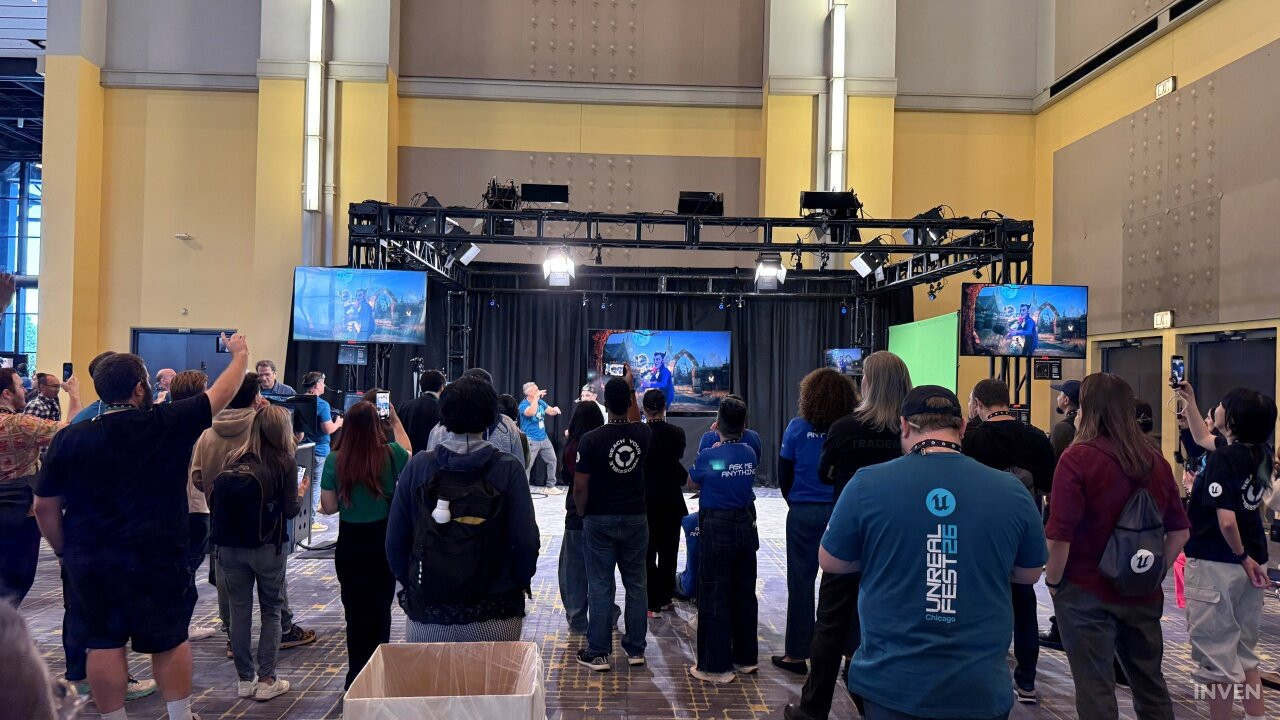
'UNREAL FEST 2026 Chicago,' held over two days from the 17th to the 18th (local time), served as a venue for attendees to explore various technical sessions on Unreal Engine and its ecosystem, as well as to experience the results firsthand. While various games built with Unreal Engine were on display, Epic Games also provided a space where developers could get hands-on experience with technologies that could prove useful for their own projects.
The first thing that caught the eye was 'MetaHuman,' a core technology long championed by Epic Games. It is a tool and technology that allows anyone to easily utilize virtual humans for games and content, and a dev kit was released for free during the keynote on the 17th.
Because the word 'free' carried such significant impact, it was difficult to get into the finer details of MetaHuman at first. To address this, Epic Games set up a special booth at UNREAL FEST 2026 Chicago, where they held sessions that allowed attendees to participate in demonstrations and learn more about the technology.
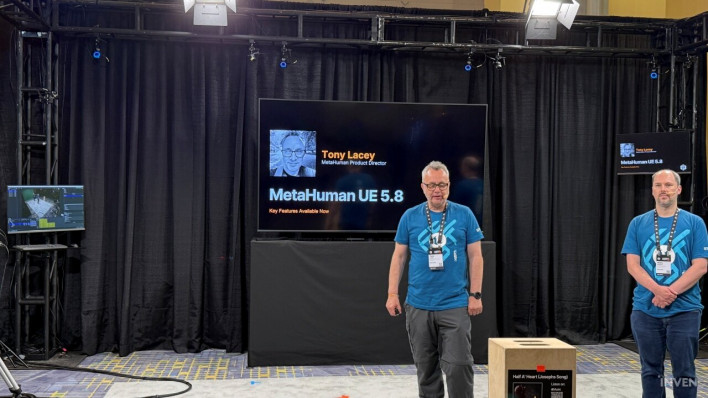
From a Single Sketch to a Full-Body Virtual Human: Mesh to MetaHuman
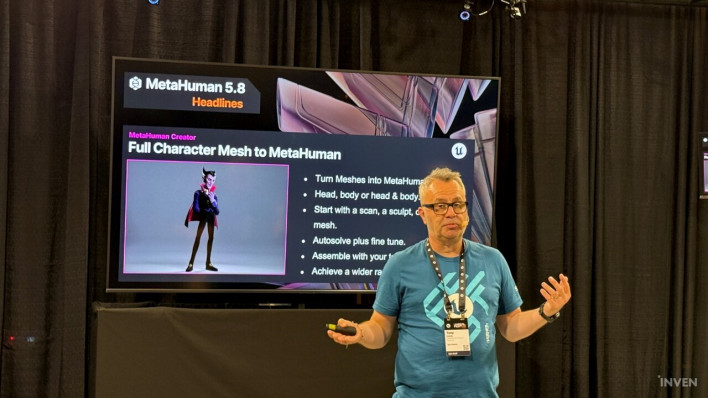
The first change introduced was the 'Mesh to MetaHuman' feature, which has expanded from its original focus on head scans to full-body support. Developers can now import bipedal character meshes generated from scan data or external tools (such as Meshy or Tripo) and automatically convert them into fully rigged, full-body MetaHuman characters with just a few clicks. If the character is in an A-pose, clothing, accessories, and textures are all automatically transferred at once.
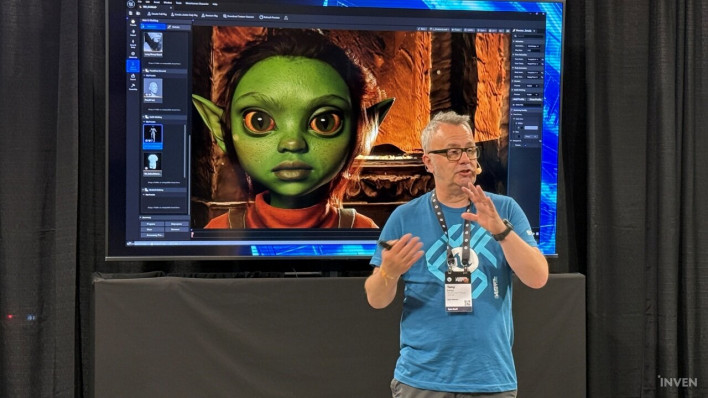
Improvements aimed at syncing graphic quality with the production environment were also notable. It is now possible to import lighting and render settings from an actual game scene directly into 'MetaHuman Creator,' completely bridging the visual gap between the production engine and the in-game view. Additionally, changes made to unbaked textures in external tools like Photoshop can be checked instantly within the Creator, making it much easier to create unique characters like goblins or monsters. 'Scalable Normal Textures,' which compress texture size by up to 10 times (from 140MB to 10MB) without sacrificing quality, were also introduced as a key technology for maintaining visual fidelity.
"No Equipment? No Problem"... 'Markerless Motion Capture' Using Just One Camera
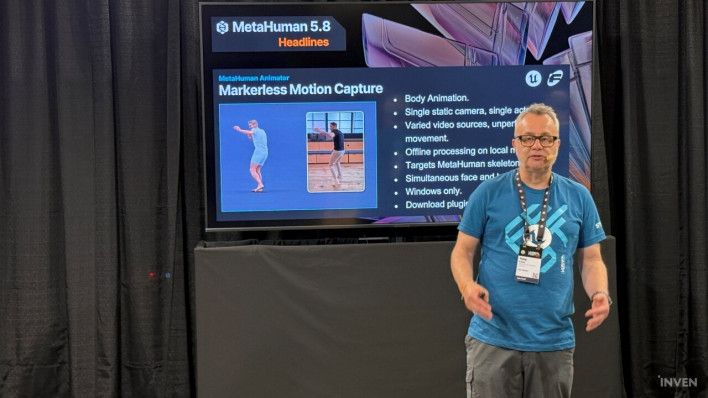
Convenience has also been added to the animation pipeline. The newly introduced 'Markerless Motion Capture' plugin allows for the simultaneous extraction of facial and upper-body animations for MetaHuman using only a single camera and one actor, without the need for special markers or expensive equipment. Notably, all video data is processed offline on a local machine (Windows only), ensuring safety and speed without relying on the cloud.
Audio-based animation has been enhanced with more natural 'procedural blinking' to increase character liveliness, and support for MetaHuman Animator has been expanded to include Linux and macOS. For large-scale projects, the batch processing system, which can be controlled via Python and Blueprints, has been completely rewritten, creating an environment where developers can automate data processing overnight, much like a rendering pipeline.
"Lag-free 1k-person Crowd Scenes": Optimization Technology 'ISKM' and the Open-Source Dev Kit Announcement
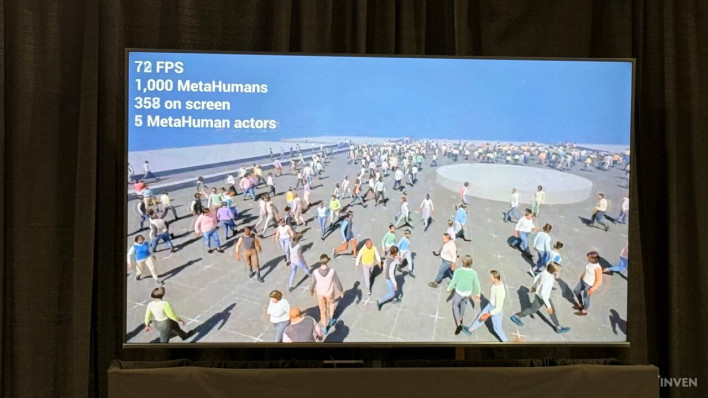
Next was a demonstration of 'MetaHuman Crowds,' an experimental feature added in Unreal Engine 5.8. 'MetaHuman Crowds' allows for the smooth rendering of crowds of up to 1k–1500 unique characters at 60 frames per second on current-gen consoles and PC environments by utilizing Nanite and the Mass Framework.
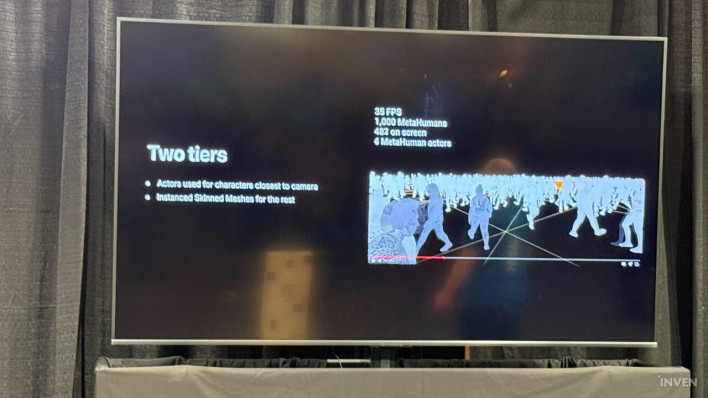
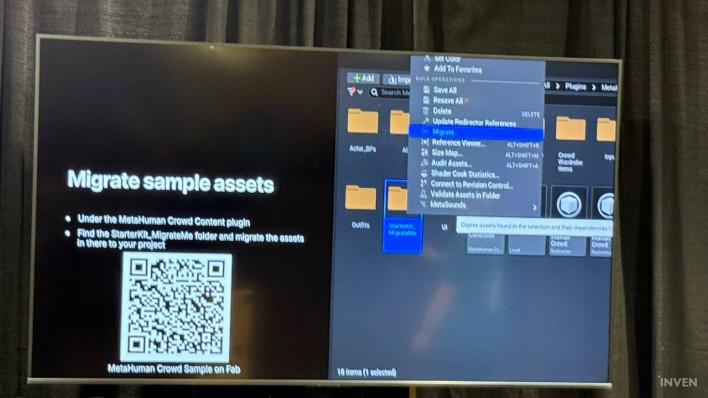
The secret to this optimization is the 'Instance Skinned Mesh Component (ISKM)' technology. Characters close to the camera are rendered as high-quality actors, while distant crowds transition seamlessly to GPU-based ISKM without visual stuttering. Complex hair (groom) calculations are also converted and baked into skeleton or texture forms, drastically reducing the computational load. Sample scenes and starter kits applying this technology are currently available for download via FAB. Furthermore, the MetaHuman dev kit was released under an MIT license on the 17th, allowing it to be used in other engines and platforms without legal or technical restrictions.
Hands-on with 'Markerless Motion Capture': So Good Even Without a Suit

After the session, attendees were given the opportunity to try out markerless motion capture. To use it, one had to install the plugin, approach the camera and PC, and map the skeleton to one's own image captured by the camera. Once a camera helmet was equipped, not only facial expressions but also precise movements of various body parts were captured by the booth's cameras and transmitted directly to the MetaHuman.
Of course, strictly speaking, it wasn't 100% real-time. There was a slight delay between the original person's movement and the character's response. However, considering that traditional motion capture requires wearing a helmet, suit, and gloves, it was quite surprising to see the character accurately mimic intricate movements and input animation just by wearing a single helmet.
Recalling that previous versions only implemented the upper body accurately, I recklessly attempted a Nike-style pose. The movements were clumsy, but it was amazing to see the character mimic every awkward gesture from head to toe. Even when I took the camera helmet off for a maintenance check, the surrounding cameras were still able to track the movements. While it couldn't perfectly capture finger gestures without the helmet, it was impressive that the overall flow of the capture process remained consistent.

This also implies that, beyond the person wearing the helmet, multiple people can participate in motion capture simultaneously. In fact, at the end, a developer and a guest singer performed on the motion capture stage; even though only one person wore the helmet, the motion capture was so effective that it was hard to find any flaws in the larger movements. While I didn't get to see the process of extracting animation data for development, it is a massive leap forward compared to the early access days of MetaHuman, when only the outer appearance of a person was rendered. With the user base expected to grow thanks to the open dev kit, all eyes are on how 'MetaHuman' will continue to evolve.

Sort by:
Comments :0