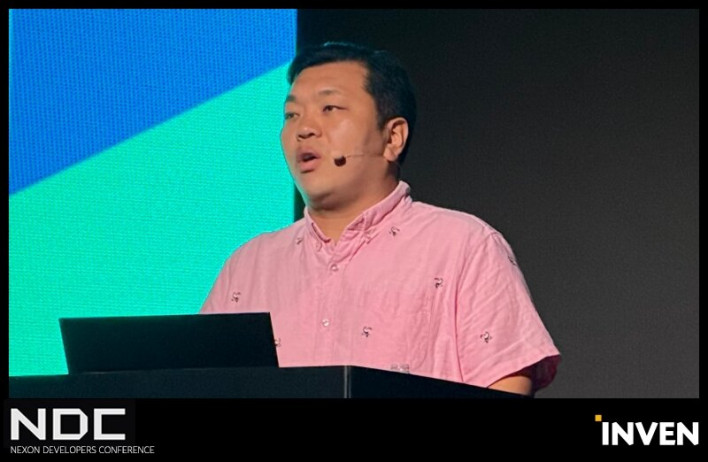
Topic: 'Blue Archive' Post-Mortem: From a Game Director's Perspective Speaker: Cha Min-seo - Nexon Games Category: Production / Operations / Planning Recommended for: Developers aspiring to be game directors or those interested in post-mortems of new game development
Tags: #NDC26 #Blue Archive #Production
[🚨 Lecture Topic] I intend to share the lessons learned from the development of 'Blue Archive' by explaining what went well and what did not.
Cha Min-seo, PD of the RX Studio at Nexon Games' IO Division and former game director of 'Blue Archive,' took the stage to provide an unfiltered review of the game's development. In this session titled 'Blue Archive Post - Mortem - From a Game Director's Perspective,' he candidly laid out both the successes and failures, sharing a development methodology summarized by speed, delegation, and constant self-verification. It was not a marketing-driven success story, but rather a presentation that put failures and trial-and-error at the forefront—a "Nexon-esque and NDC-esque, witty, and unfiltered" talk, as the moderator described it.
Since his time at NAT Games (now Nexon Games), PD Cha has spent about 10 years working on 'HIT' and 'OVERHIT' before creating 'Blue Archive.' He currently serves as Vice Head of Division while developing the new title 'Project RX' at the IO Division's RX Studio. Before starting, he appeared slightly nervous, noting that he was "not in a familiar setting," but explained his purpose: "I created this document with the hope that it would be helpful to those who want to create games like this to provide good experiences and inspiration to others."
He mentioned that he wrote this post-mortem around the time the final chapter of "Blue Archive" Part 1 was being finalized, but kept it internal for a while. He explained, "Because the game was already live and partly out of my hands, I was concerned that such stories might have unintended effects." He began the presentation by saying, "Now is a time when I can speak more comfortably." The presentation was structured around three successes and three failures, focusing on the period from the start of development to about one year after launch.
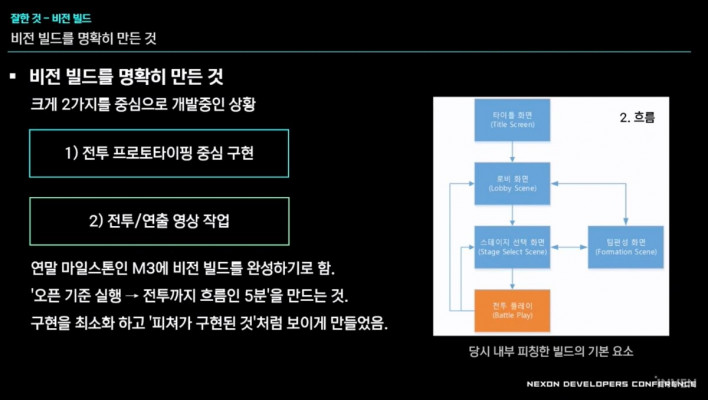
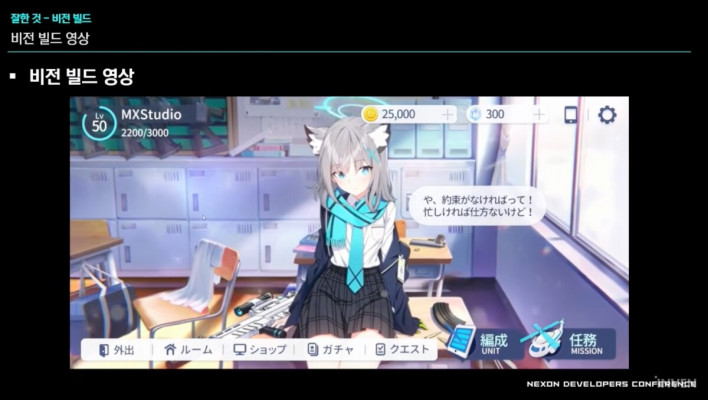
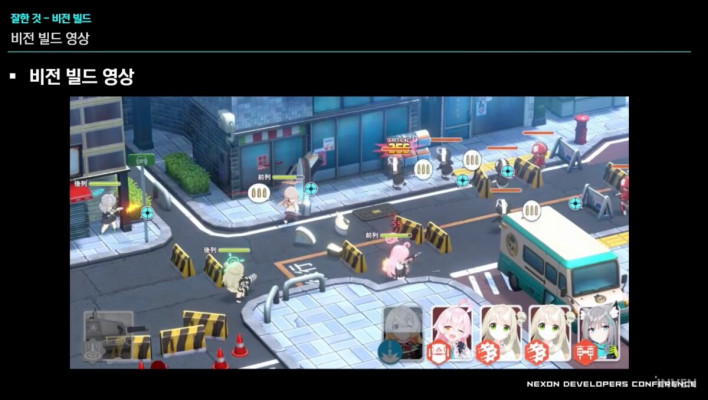
The first success PD Cha highlighted was creating a clear vision build. When he joined, the team was simultaneously working on combat prototyping and combat/cinematic videos. They decided to complete a vision build for the year-end milestone that captured the flow from execution to combat. At the time, they minimized implementation and used video processing for some elements to make it look like a finished game. Although it was a simple build consisting of only five screens—title, lobby, stage selection, formation, and combat—the goal was to allow anyone to experience the core of the game in its entirety.
He evaluated this build as achieving its goal of "creating a true vision that would never change even when the game was finished." The basic framework—such as character eye-tracking (like Shiroko's), stage selection, dialogue direction, and combat gimmicks like tank summoning and boarding—remains largely unchanged in the current "Blue Archive." He said that after everyone played the build, they were convinced that "the story and art are great, so we just need to launch it," and decided to quickly complete the requirements for a sellable game.
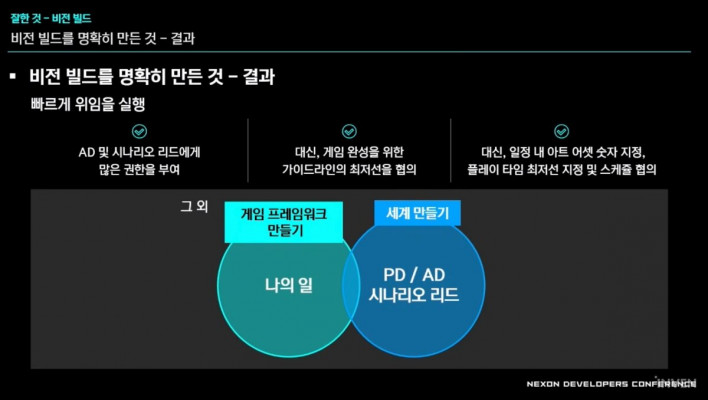
The method used was 'rapid delegation.' Once everyone was convinced of what to build, it was crucial to divide tasks effectively. He explained that instead of taking full control, he delegated significant authority to the Art Director and Scenario Lead, while negotiating a 'minimum baseline' for the game's completion. They set lower limits for criteria like playtime, account level, number of characters, and number of backgrounds, and continuously negotiated and compromised to ensure the game framework felt natural within those bounds. "A significant portion of 'Blue Archive' was created by Director Kim Yong-ha, the Art Director, and the Scenario Leads, while I focused on building the game framework that made it all look like a single, cohesive game," he said.
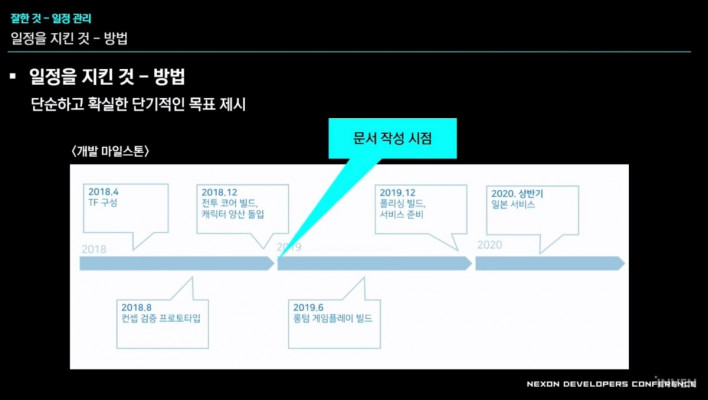
The second success was meeting the schedule. 'Blue Archive' launched in Japan on February 4, 2021, taking about 34 months from the start of development in April 2018. Although it was slightly delayed from the initial target of late November 2020, it meant they released a new title within three years. Subsequently, the global version was released on November 9, 2021, and the Chinese version followed in 2023.
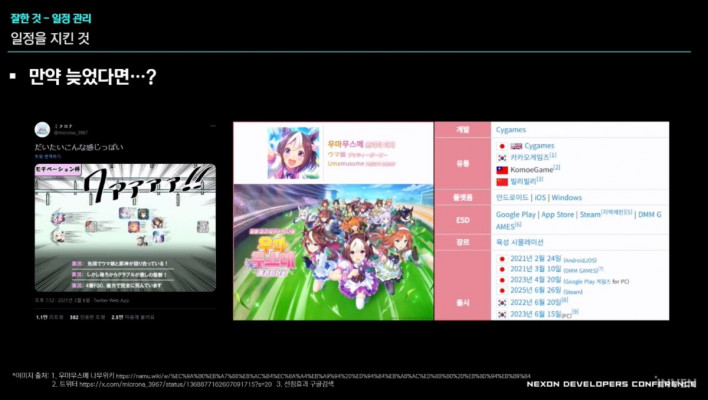
He found the key to meeting the schedule in the 'first-mover effect.' His logic was that "predicting when a game will be finished and reach the people who will love it is crucial, and the surest way to keep that prediction is to release the game on the expected schedule." He cited presenting simple and clear short-term goals as the secret to keeping the schedule.
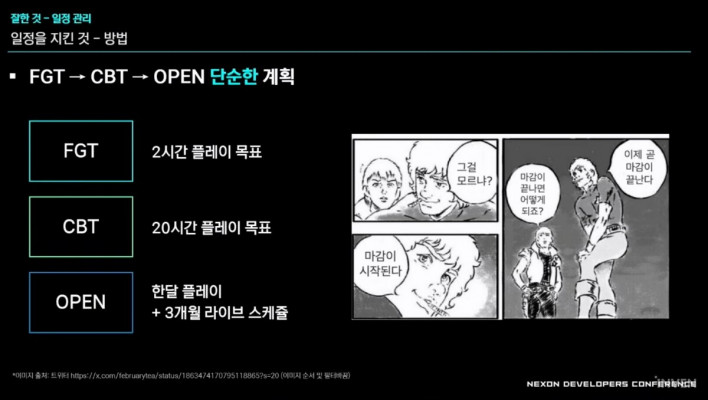
He recalled setting goals that anyone could understand, such as 2 hours of gameplay for FGT and 20 hours for CBT, and focusing on creating content that filled that time by estimating how many hours a single gamer could play in a day. He established a standard of preparing about one month's worth of play for launch and three months of live schedule, and recalled repeating deadlines infinitely, such as setting the CBT deadline immediately after the FGT deadline.
He emphasized 'testing, playing, and feedback' as a way to manage anxiety and fear during development. "Worrying about what if it fails or if someone won't like it creates infinite fear, so the answer is to test it yourself and get external feedback to verify it," he said.
He noted that things everyone wanted to fix were reflected in the next version, and they consistently fixed issues noted at every milestone. He compared this to 'dogfooding' in software engineering. He said that while it is most efficient for developers to play and test what they created themselves, it is also very painful, adding, "Nevertheless, I approached it with the attitude that 'only I can fix this.'"
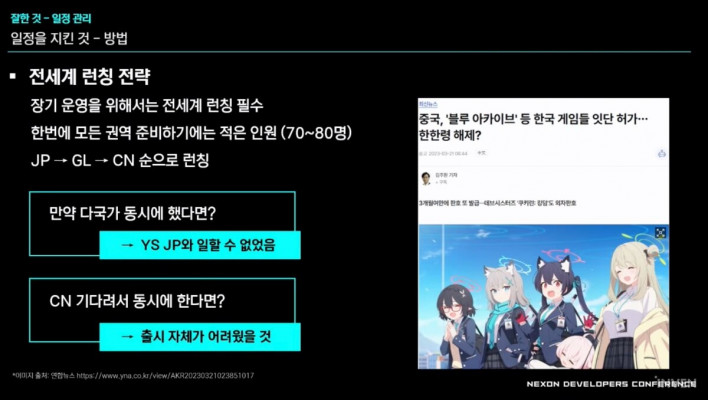
Releasing in the order of Japan, Global, and China instead of a simultaneous worldwide launch was in the same vein. He believed that "with a team of about 70 people at the time, a simultaneous worldwide launch was difficult," and that insisting on it might have made it difficult to collaborate with the Japanese publisher Yostar, or delayed the launch itself while waiting for the Chinese schedule, thereby losing the first-mover effect. "We started slowly with what we could do and in the most important regions first," he said.
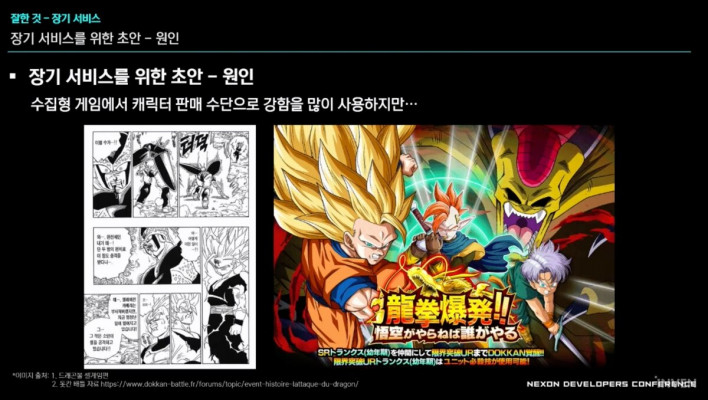
The third success was sketching the blueprint for long-term service. Based on his experience with the previous project 'OVERHIT,' he said he was wary of the trend where many character-collection games use 'strength' as the primary hook. Comparing the original 'Dragon Ball' with the mobile game 'Dokkan Battle,' he pointed out that while fans of the original know who is stronger, the hierarchy of strength becomes blurred in long-running games due to power inflation. He also cited the tendency of users to operate only one party as a challenge for collection games, comparing it to wanting to use only Liu Bei, Guan Yu, and Zhang Fei of Shu in 'Romance of the Three Kingdoms,' and pondered, "How can we make them use multiple parties."
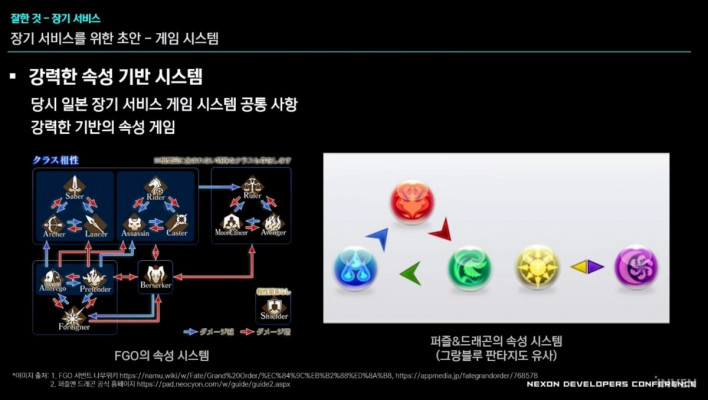
His answer was to focus on 'affinity.' If the rules are the same for everyone, users will accept them even if they are somewhat complex. However, the foundation had to be great story and art. He shared an anecdote where, when Director Kim Yong-ha proposed an elemental system like water, wind, earth, and fire, he asked back, "Does water come out of their hands?" emphasizing that for it to be plausible and convincing to everyone, it must be supported by context and narrative.
The result was the attack/defense attribute affinity system and the competitive end-content 'Total Assault.' He explained that they provided devices so that even someone turning on the game for the first time could intuitively infer armor types from their appearance and naturally learn affinity relationships through character colors.
He revealed that he got the idea for the strategy map that forces the use of multiple parties from 'Girls' Frontline,' and the competitive Total Assault from 'Princess Connect.' However, he noted that the results were different because "the point of inspiration and the point where it becomes fun while actually making it are bound to be different." He evaluated this design as having a great effect on long-term retention because it was "easy to learn, hard to master," and self-assessed that it "worked well as intended," based on community reactions on sites like Ruliweb and performance metrics.
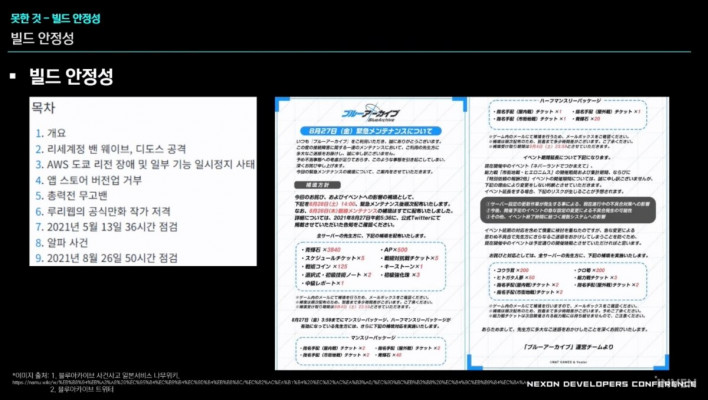
He then brought up the shortcomings, saying, "I am sorry to those who love 'Blue Archive.'" The first was build stability. He mentioned the 'Blue Archive' incident/accident document on Namuwiki and cited the initial Japanese version's maintenance and reward notices as a representative example. He attributed the cause to his first collaboration with an external publisher.
"Most games made by Nexon Games were launched after going through Nexon QA, so we were used to that environment, but since it was our first time working with an external publisher, our preparation was insufficient," he said, pointing out that "it was not the publisher's problem, but rather the result of not setting internal QA standards more firmly."
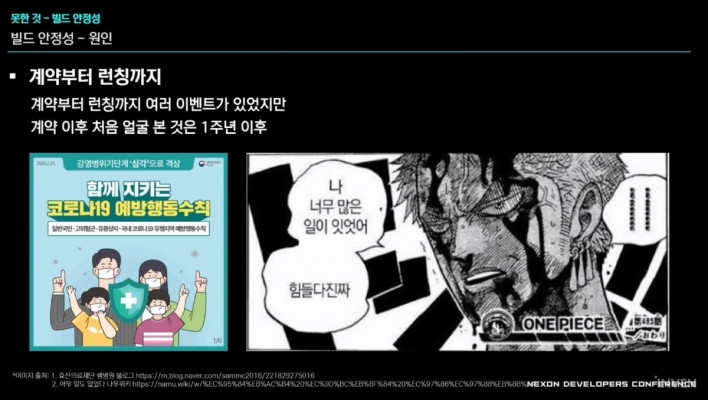
The success that far exceeded expectations also paradoxically became a burden. Achieving over 500% of the target DAU (Daily Active Users) is a dream, but "it's different when you actually face it." On top of this, an AWS Tokyo region outage occurred, affecting service stability in the early stages.
The biggest variable was COVID-19. He could not have face-to-face meetings with the publisher from contract to launch, and he lamented, "There are things you can only know through direct communication beyond writing or email, and it was very difficult to let time pass without that."
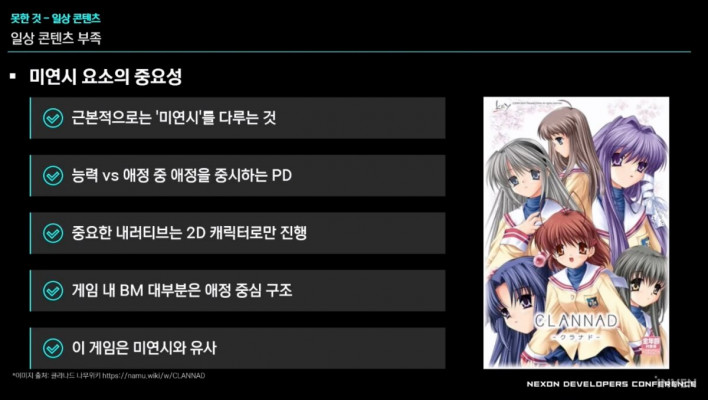
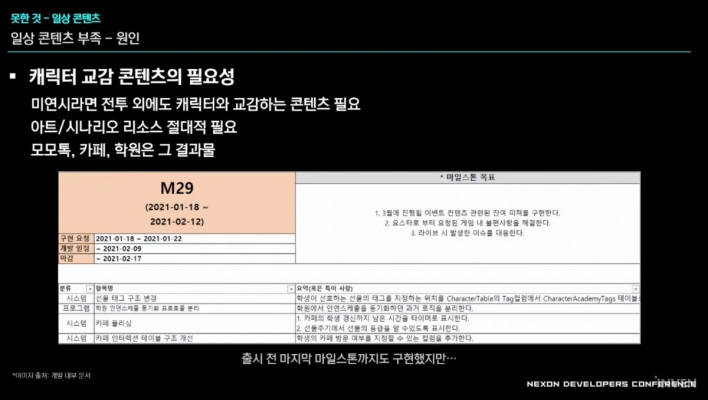
The second shortcoming was the lack of daily content. He said that in a Q&A with Director Kim Yong-ha about "what is more important, ability or affection," the answer was 'affection,' and when they organized similar content, it ended up being close to a dating sim (pretty girl dating simulation). Therefore, content to interact with characters outside of combat was needed, and features like MomoTalk and the Cafe were the results. However, such content required polishing and improvement until the very end.
He described this work as "the most expensive resource in development." It requires UI, art, direction, and scenarios, and there are few personnel with experience in creating daily content for pretty girl games, and the market that wants high-quality writing and art (Pixiv, Fanbox, Fantia, web novel platforms, etc.) is already large. He added that 'expensive' here does not just mean money.
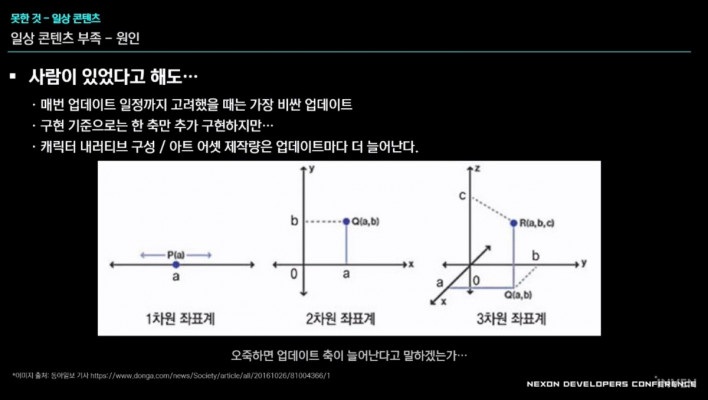
He also explained that every time a new student (character) is updated, interaction content for all existing students must also be created, so it is not just a matter of making one part look pretty, but a problem of increasing the 'stamina' of the entire game. "Every time the update axis increases, it brings great pain," he said.
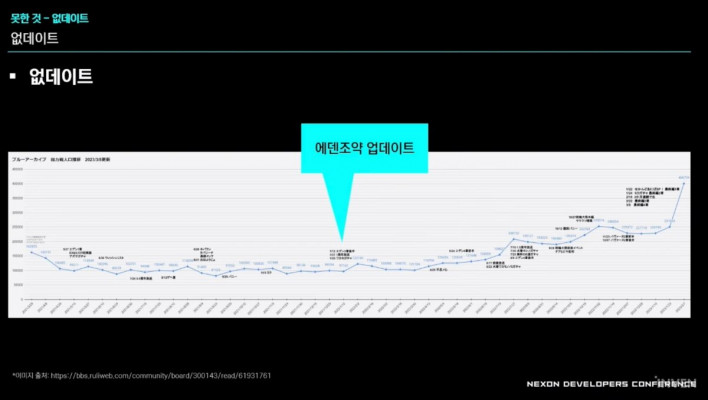
The third was updates. PD Cha intentionally used the term "No-date" (a twist on 'update') to self-deprecatingly describe the lack of prepared update volume. He cited the case where metrics rebounded after the 'Eden Treaty' update to explain the difficulties of the period just before it. It is very difficult to create updates in advance.
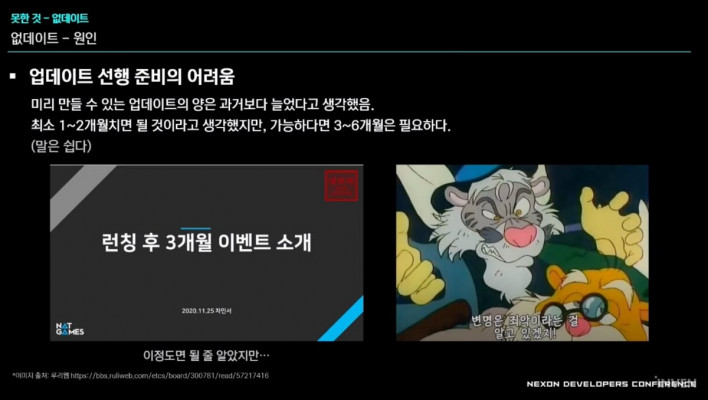
He recalled, "I thought it would be fine if I made at least 1-3 months' worth in advance, but it turned out I should have made more than 6 months' worth." Even though he had prepared event introduction documents for 3 months after launch before the actual launch, the volume was ultimately insufficient. He used the term "No-date" to point out that there was a content void for a while because pre-production could not keep up.
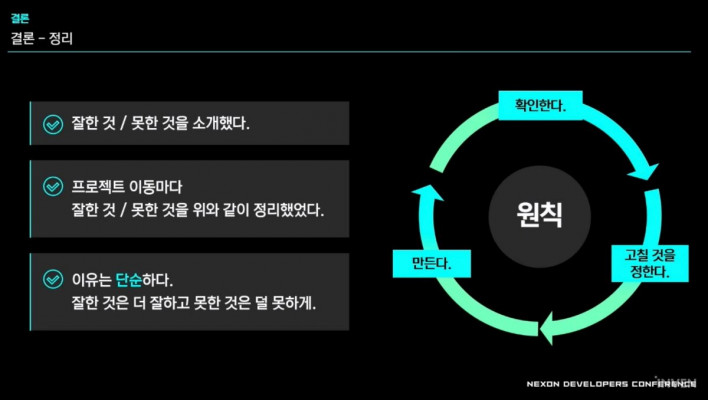
PD Cha said he organizes what went well and what didn't every time he moves to a new project. It is for the simple reason that "to become a better game and a better developer than before, you have no choice but to do what you are good at better and do what you are bad at less poorly." The principles he emphasized were also simple. It is to repeat the cycle of making first, checking together, deciding what to fix together, and making again and checking again. He defined himself as "a person who focuses on making many people work toward the same goals and values with simple standards and stories, rather than a type who presents fancy agendas."
He explained the new project 'Project RX' he is currently making as an extension of this principle. It is a process of applying what he felt and wanted to fix after making one game to the next. He told 'Blue Archive' users, "There are better developers than me at 'Blue Archive' now, so please support them," adding, "I am also cheering for them from behind." He continued, "This presentation was made because Director Kim Yong-ha said, 'It would be good to talk about RX at next year's NDC and help those who want to make games like RX.'" He urged, "The current situation is very difficult, but we are trying to make something different and good, so please look forward to RX."
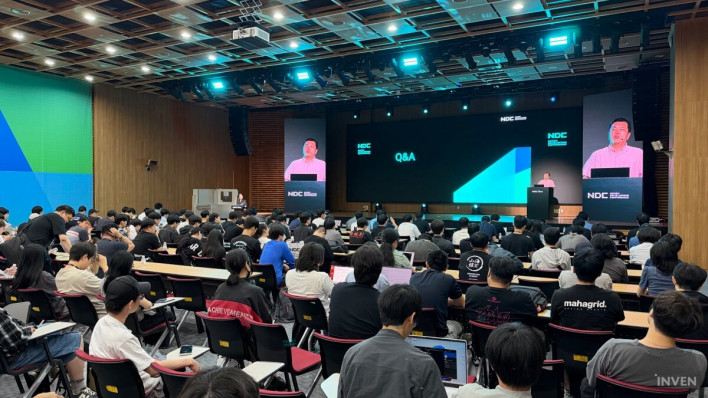
In the Q&A, a user asked where the fun of subculture games is headed, citing the fact that daily quests can feel like homework. PD Cha replied, "I agree that it can feel like homework," but asked back, "Isn't the act of touching the game client every day sacred and noble?" He said that the small experiences of pressing buttons, making eye contact with characters, and talking while doing daily quests are important, and answered, "It's not a matter of whether it exists or not, but I focus on making the experience within it decent."
To the question of 'how do you decide what to fix,' he presented a concrete methodology. A person who only talks about problems without solutions should not enter the discussion table. They identify whether what is needed to fix the problem is time, money, decisions, or policy, and set the priorities for the organization to execute.
He said, "Even the time spent worrying is a cost, so handle what you can do immediately without worrying first." He explained that if there are 500 things to fix in a game that is 70 out of 100, if you don't handle the 50-100 things you can fix immediately without worrying, even if the score efficiency is low, the score will remain the same. He emphasized, "Since modern game development is carried out by 100-150 people simultaneously, if each person does not fix what they can fix themselves as an excellent gamer and developer, many problems cannot be solved."
To the question of whether he has any thoughts of making a short story or console package game with an IP like "Blue Archive" like "Granblue Fantasy," he replied, "I like package games very much, but I have to think more about whether I have the talent to do it well," adding, "I have the mindset that I must be able to make any game to make games for a long time." It means he could make it if various circumstances align, but not now.
Citing evolutionary anthropologist Robin Dunbar's 'Dunbar's Number (about 150 people),' a question was asked about how to overcome the user's cognitive limit when students (characters) continue to increase beyond 100-150. He replied, "There are two ways: increasing the drawers of the mind or taking other things out of the drawers, but I don't think the drawers increase." Rather than increasing cognitive capacity with technology, he focuses on making them have a more intense experience momentarily. He said, "There seems to be no way other than to imprint it more strongly by giving experiences that could not be tried in other games," and "I am the type to just take good care of the existing drawers."
To the question asking about the future outlook of subculture games and RX's strategy, he replied, "As the world comes where anyone can easily access the content they want beyond the limits of technology, the ability to create good taste, cool things, and things you think are better becomes more important." He said, "Rather than the ups and downs of market trends, it is more important to give a different experience from others with what I like most and make best," and just as there was always talk of 'it's over' during the heyday of MMORPGs, all trends have rotations, and "only those who have their own noble values and work hard survive."
He added, "Games saved my life, so I make games because I want to save other people's lives, too," and "I have a somewhat naive thought that since I am making it with that level of temperature and hurdles, it will be okay in the future."
To the question of why the next project RX is being unveiled for the first time at the US Anime Expo, he laughed and said, "Various adult circumstances," and replied, "The time has come to show something in development, and one of the events with a schedule that fits it was just chosen, so please do not see it as an intention to target a specific region." He explained that he intends to attend most events if the schedule fits even after that. Project RX is scheduled to meet global users for the first time at Anime Expo 2026, which will be held in LA, USA, from July 2-5 (local time), immediately after NDC.
The answer to the question of how he minimized discord when strong-willed creators gathered was particularly impressive. He cut in and said, "Should we minimize discord? I don't think so." He said that the pain of creation essentially stems from anxiety and fear, and discord is another expression of that enthusiasm.
He said, "If it is discord that arises in the process of talking to others to solve the anxiety that the part I am responsible for might be bad, it is justified," but suggested "recording most things and following past decisions or changing standards based on those records" as a way to solve it. He concluded with a somewhat firm theory, saying, "Even if there is discord in that process, what is important is to complete the game within the time limit," and "I am on the side that a creator who cannot finish within the set time has no value."

Sort by:
Comments :0