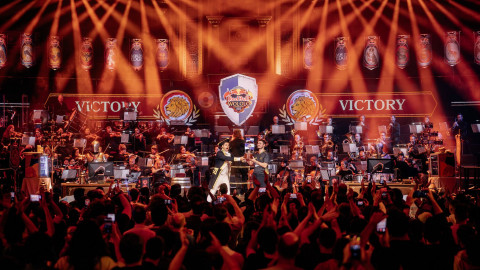
'Orbitals' by Shapefarm, which appeared like a comet at the last The Game Awards, is a title that captured the attention of many gamers the moment it was unveiled. Split-screen co-op games have become a relatively familiar genre to the public through titles like 'It Takes Two' and 'Split Fiction.' Of course, if that were all it had to offer, it might not have garnered so much interest. The biggest draw of 'Orbitals' is its visuals. With an aesthetic reminiscent of 80s and 90s anime, it possesses a charm that is impossible for any gamer with nostalgia for that era to ignore.
However, there were concerns. The developer, Shapefarm, was virtually unknown. While many gamers were excited by this sudden arrival, they also worried whether such an attractive game could actually be delivered. Fortunately, Shapefarm was not truly unknown; they were a studio that had built solid development capabilities by participating in outsourcing for numerous games.
Now, over a decade after its founding, Shapefarm is finally releasing its own game to the world. It is hard to imagine a developer that has created a more thoroughly anime-like experience; from the 12/24 FPS character movement to the 2D cutscenes completed in close collaboration with Studio Massket, the entire game is designed to feel like a single animated work. Ahead of its release this summer, we visited Shapefarm's Japanese headquarters to meet Creative Director Marcos, Game Director Jacob, Lead Animator Johannes, and Operations Manager Megumi to hear about the passion behind 'Orbitals' and the stories behind the scenes.
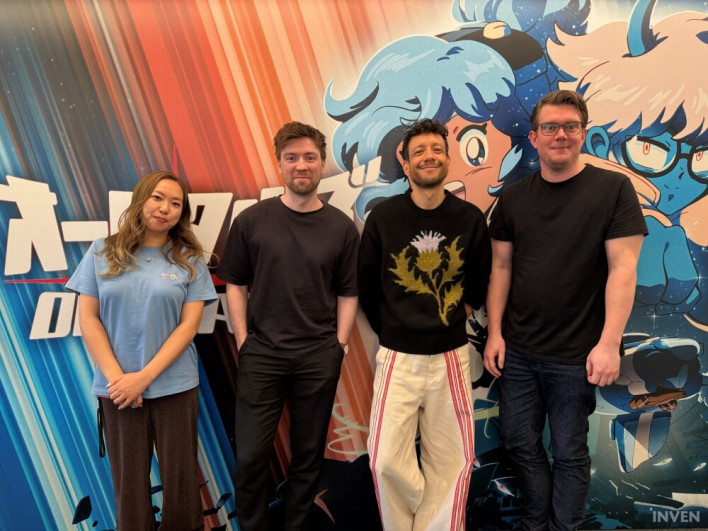
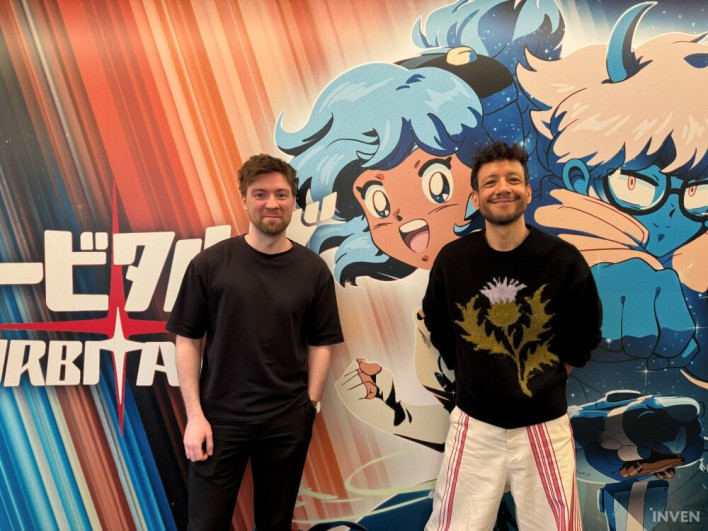
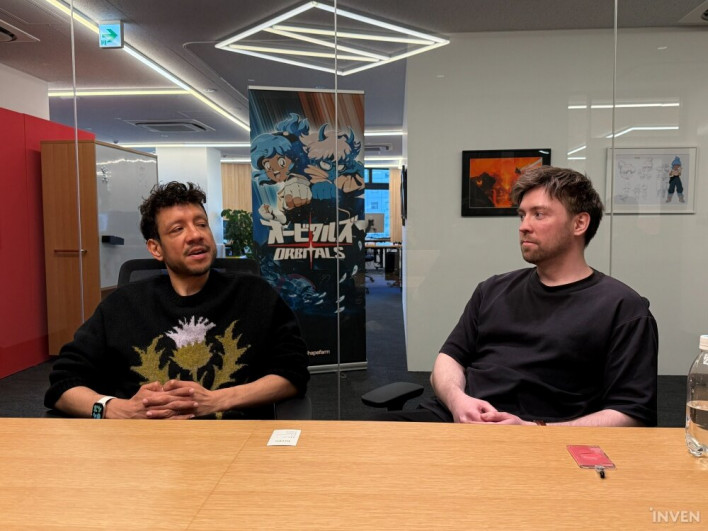
Marcos Ramos (Creative Director), Johannes Varmedal (Lead Animator/Art Director)
Nostalgia for 80s/90s Anime: Crafting a Playable Animation
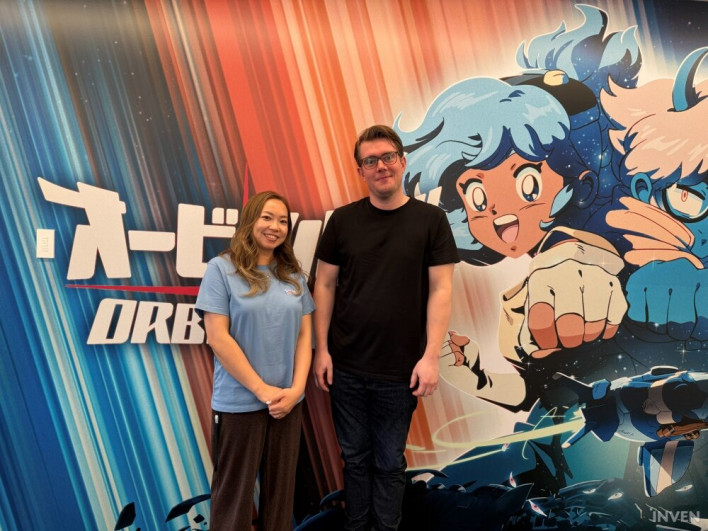
Q. Could you please start with a brief introduction.
Johannes = My name is Johannes. I am in charge of background graphics and technical art.
Megumi = I am Megumi Varmedal, the Operations Manager. Within the company, I handle production tasks for our Japanese clients related to the development of 'Orbitals.' To put it simply, you can think of me as managing things like the schedule for Studio Massket, which handled the 2D cutscene animation, and the voice acting recordings.
Q. The most prominent feature of 'Orbitals' is undoubtedly its 80s-90s Japanese anime art style. Is there a specific reason you chose that era's style rather than just a generic anime look?
Johannes = I think our Creative Director, Marcos, would be better suited to answer that, but I believe it is also a style that the entire development team loves. Basically, if you look at the projects Shapefarm has participated in, you will see many stylized art styles. Since we have handled a lot of subcontracting work for animation-based games, our team's know-how is specialized in implementing that style.
Because of that, from the early prototyping stage, everyone on the team—who all love anime—would say, "We definitely want to make an anime-style game someday." As a result, it happened quite naturally. Once we finalized the 80s-90s visual style, we studied the rendering methods of that era's animation and built our workflow accordingly, which allowed us to achieve the current look.
Q. As an aside, you mentioned watching a lot of 80s and 90s anime. Do you have any personal favorites?
Johannes = Personally, my favorite work from that era is the film 'Royal Space Force: The Wings of Honnêamise.' It is a truly magnificent work, and I think the art is incredibly beautiful. I also love the BGM. Of course, I don't only like 80s and 90s anime; I recently enjoyed watching 'Frieren: Beyond Journey's End.'
Megumi = I also love the work Johannes just mentioned, but if I had to pick my personal favorite, it would be 'Evangelion.' Beyond that, I watch everything from 'Sailor Moon' and 'One Piece' to relatively recent hits like 'Demon Slayer.'
Q. The 80s-90s anime style gives off a vibe similar to 'Nausicaä' or Ghibli films from that era. Was that intentional?
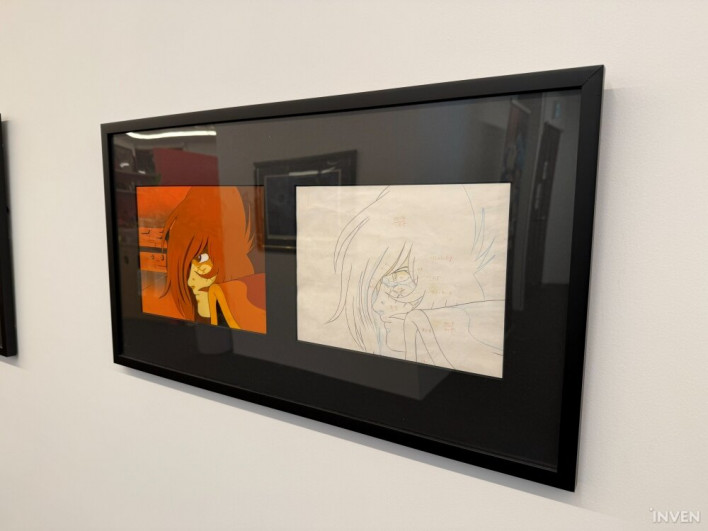
Johannes = We referenced a wide variety of works when setting the art direction. It is difficult to say we referenced just one specific work because we took elements we liked from various films and series for each part, such as background art, characters, and animation.
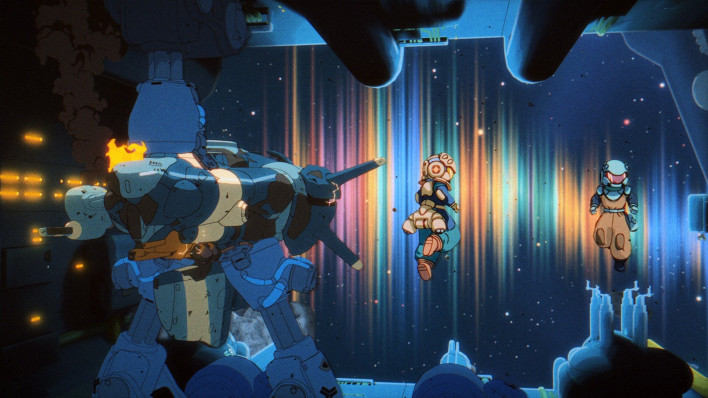
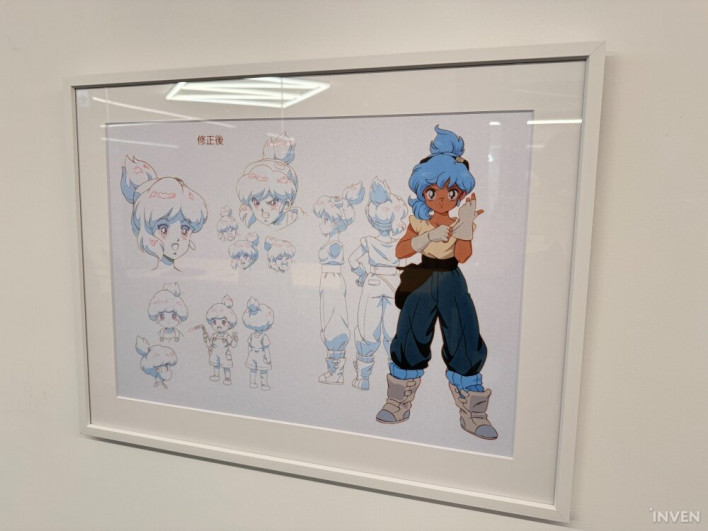
To explain in detail, for the atmosphere and quality of the backgrounds, we referenced SF-style space operas like 'Akira' and 'Ghost in the Shell.' On the other hand, for characters and animation, we looked at more charming and cute series from the 80s. Marcos, in particular, loves early 'Dragon Ball,' and the unique charm of those characters provided a lot of inspiration.
Q. Implementing such a unique visual style into a game couldn't have been easy. Did you face any difficulties?
Johannes = As you guessed, it wasn't easy. The 80s-90s anime focus was actually a bit of a hurdle. While the team members were all anime fans from the start, quite a few of them hadn't deeply experienced the Showa-era anime from that time, which was essential for capturing the 'feel' of 'Orbitals.'
Furthermore, the fact that the development team is scattered across the globe—from our headquarters in Japan to Europe and New Zealand—was also a challenge. It took a lot of time to align the direction of the art and push the final quality, especially regarding communication and feedback. In the beginning, this was our biggest challenge.
There were technical aspects as well. We are developing in Unreal Engine 5, and we went through a lot of trial and error adjusting rendering values one by one to find the optimal settings that evoke that 80s-90s anime feel. I believe those efforts are why we achieved the current quality.
Megumi = We invested a lot of time in research and study to establish the style.
Q. Let's talk about the playable characters, the protagonists. Who are Maki and Omura?
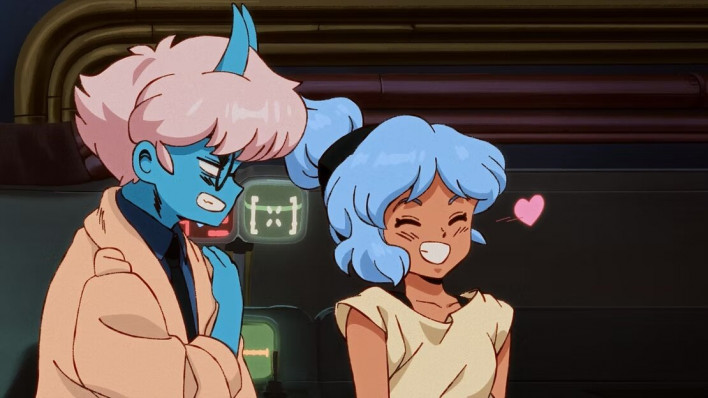
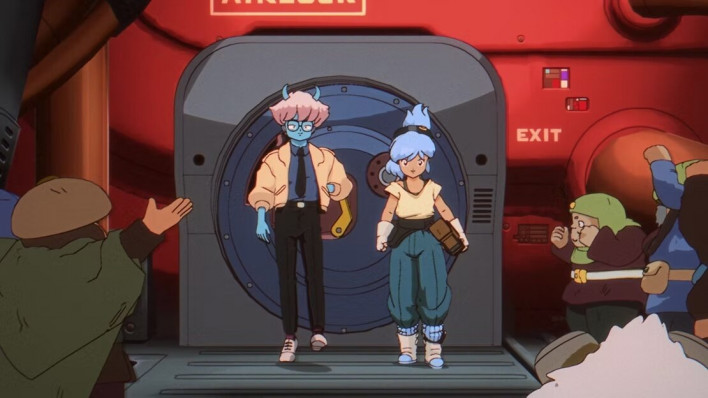
Megumi = By the time we started casting for voice acting, the story, game background, and cutscene work were already well underway. Naturally, the character traits were already established. Maki is very energetic and mischievous, while Omura is a character who is somewhat cynical and quiet but harbors a burning passion inside.
Perhaps because the character traits were already set, casting was very smooth. We were able to decide easily, saying things like, "This voice is perfect for Maki," or "We have to go with this actor for Omura."
The trailer released at last year's The Game Awards is a great way to get a quick glimpse of their personalities. At the end of the trailer, Maki is excited, saying, "It's coming out on Nintendo! Yay!" while Omura quietly says, "Yeah..." next to her. I think that perfectly captures their personalities.
Q. It feels like something that would be best played on a CRT monitor. I don't suppose anyone on the team is doing that, right?
Johannes = Recently, we have been testing on various monitors to ensure the visuals and atmosphere we intended come through regardless of the screen. In that process, we did try playing on an old CRT TV. As you suggested, the retro feel was definitely much stronger. We also tried it on an old LCD monitor, and that felt great too.
Q. It feels like watching an animation while playing a game. Is that an intentional design?

Megumi = That was a deliberate design choice. Once the project began to take shape, our team set a goal to create an 'animated experience you can play.' We poured all our efforts into blurring the lines between 2D cutscenes and actual gameplay to ensure the transitions were as seamless as possible.
To achieve this, when collaborating with Studio Massket, we built a pipeline where technical artists like Johannes and our concept artists could communicate directly with Massket's technical team. We wanted to ensure feedback could be exchanged quickly without a producer in the middle. That effort is why we have the current result.
Q. I played it myself, and it seems like it was intentionally set to 30 FPS. Is that correct? Is there no 60 FPS option?
Johannes = Yes, that's correct. Since we have to implement split-screen rendering for co-op play, we are developing with a target of maintaining 30 FPS, considering the processing load.
Q. It's quite interesting that you are a global development team based in Japan. Since the team is so global, it seems like you could have developed it in other countries. Why did you choose Japan? Was it a source of inspiration?
Johannes = It was partly a coincidence, but when Shapefarm was first founded, all the team members were already in Japan. We were doing art work subcontracted by game companies in Tokyo. Above all, many of us came to Japan because we loved Japanese anime and games so much. So, it was natural for us to establish the company here.
Megumi = Since it's a company founded by developers who came to Japan because they loved the culture, anime, and games, working in Japan itself feels like an inspiration. We have built know-how by co-developing animation-based games like 'Naruto,' and we always said, "We want to make our own IP someday." That dream has finally been realized with 'Orbitals.'
We have been growing the team for this project, and our animation team leader joined right after 'Orbitals' started. They loved Japanese anime so much that they really wanted to work in Japan, and they worked incredibly hard after graduating from university to get hired by a Japanese company. You could say that Japanese anime and culture itself became an inspiration.
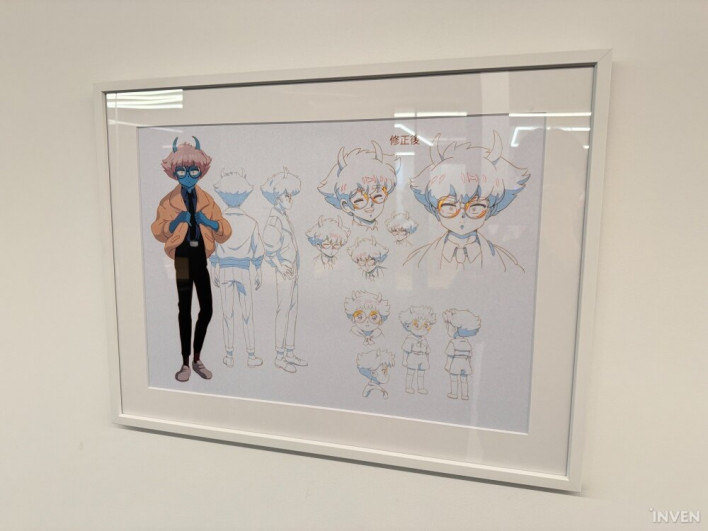
we could feel the development team's affection for 80s-90s anime
Q. Who is your favorite character in the game, including the protagonists?
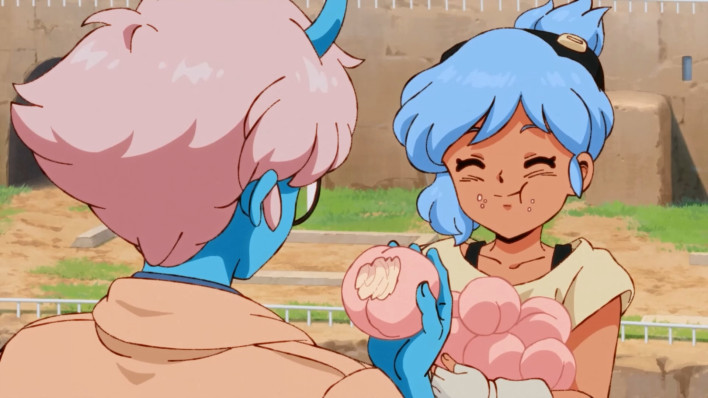
Megumi = Ah, that's difficult. Honestly, I love them all, but if I had to choose, I might pick Hiroto, the cat. It's a really cute cat. Of course, that's only because you forced me to pick one; I also love Omura. I really like his cool vibe.
As an aside, if you love anime, you know everyone has at least one favorite character. We put a lot of effort into implementing the characters in 'Orbitals' in the hope that players would enjoy them in the same way. This is related to the character traits I mentioned earlier; for example, you will see that Maki's basic reactions, the way she drinks coffee, and her responses are completely different from Omura's. We hope you will love Maki, Omura, and all the characters that appear in the game, considering these details.
Q. There are quite a few gamers in Korea who are looking forward to the game, saying the anime style is eye-catching. Could you say a word to those Korean gamers.
Megumi = 'Orbitals' is a game full of very delicate and cute animations. Not only the protagonists, but the movements of the small creatures you meet while playing are also very cute, so I would be happy if you could pay attention to those details and enjoy the game.
Johannes = I hope players will explore the world of 'Orbitals' together, laughing at the puzzles and feeling their hearts race during the thrilling action.
A game that goes beyond simple cooperation to capture the joy of overcoming challenges together
Q. Could you please introduce Shapefarm and yourselves.
Marcos = I am Marcos, the Creative Director of 'Orbitals.' I have been with Shapefarm since 10 years ago, when it was founded. Shapefarm is a developer that has handled outsourcing for several AAA games, and I have participated in many of those projects. Now, we are finally developing 'Orbitals' as Shapefarm's first self-developed game. It feels new in many ways.
Jacob = I am Jacob, the Game Director. I joined four years ago. Before joining Shapefarm, I developed games at Hazelight Studios for about seven years. At Hazelight, I was involved in almost every stage of 'It Takes Two,' which became incredibly popular and made the company's name known worldwide, starting from 'A Way Out.' I also participated in the development of 'Split Fiction' for about a year. And now, I am making 'Orbitals,' a split-screen co-op game, here at Shapefarm (laughs).
Q. For a developer founded in 2010, you aren't very well known. Is there a reason for that?
Marcos = Since we have mainly been doing outsourcing—working in the background—our name hasn't been visible even though we have participated in many games. In some cases, Shapefarm made about 50% of the entire game, yet as I mentioned, we were completely unknown.
Of course, since we primarily focused on outsourcing, that was somewhat inevitable, and we didn't have any major complaints about it. Still, we always harbored a desire to create 'our own game.' That wish has finally come true with the development of 'Orbitals.' Ever since Shapefarm was founded ten years ago, we’ve always thought, 'Someday, we want to make our own game.' Now that we are finally able to release something we want to create under our own name, we are incredibly excited.
Q. Unlike your previous work in co-development and outsourcing, 'Orbitals' seems to be Shapefarm's first game developed entirely in-house. I'd like to hear the behind-the-scenes story of how this came to be.
Marcos = I wouldn't call it a specific trigger, but perhaps the timing was right. As we participated in various game developments, our members' experience and skills naturally continued to improve. Suddenly, I thought, At this level, couldn't we make the game we want.
It's not just about the members' skills. We had all the members needed to make a game, from environment artists to concept artists and composers. Plus, members needed for animation or the unique expressions of 'Orbitals' joined at the right time, making the possibility of developing 'Orbitals' increasingly high.
Of course, that didn't mean we started developing 'Orbitals' immediately. We always wanted to make such a game, but we couldn't take that final step. In that sense, the biggest trigger was the support from Kepler Interactive. They deeply believed in our skills and passion, and by supporting us so we could believe in ourselves, we began the full-scale development of 'Orbitals.
Q. It's quite interesting that you are a global development team based in Japan. Since the team is so global, it seems like you could have developed it in other countries. Why did you choose Japan? Was it a source of inspiration?
Marcos = From the founder who has since left the company to all our team members, we all have deep ties to Japan. The founder fell in love with the country, met his wife here, and started a family. So, it was natural to start the company in Japan.
What's amazing is that this isn't just the founder's story. All our early members have similar stories. I also met my wife here, got married, had children, and started a family, so I have an attachment to Japan, and the other members are similar. The members at our overseas branches are not much different; they have an attachment to Japan or love Japanese culture.
And above all, one of the concepts we put forward when we said we would make a game was that we wanted to create a work that could incorporate Japanese culture. With these various conditions combined, we naturally thought we needed a base in Japan, and as a result, we headquartered the company here.
Q. Given that it's a split-screen, co-op game, comparisons to 'It Takes Two' and 'Split Fiction' seem inevitable. Aside from the visuals, what are the unique features of 'Orbitals'?
Jacob = Of course, we expected 'Orbitals' to be compared to 'It Takes Two' and 'Split Fiction.' Above all, since I, the game's director, worked on both of those games, it's natural that there are some similarities.
However, while the first impression or genre characteristics might be similar in terms of split-screen or co-op, I want to take this opportunity to clearly state that 'Orbitals' has many unique elements. The game design, the actual feel of playing it, and the experience are different, so it's safe to say it's a completely different game.
The storytelling and audio are also quite different. While 'It Takes Two' and 'Split Fiction' were influenced by Western media like Hollywood, 'Orbitals' is the exact opposite. It is very Japanese. It is reminiscent of 80s-90s anime, and since we put a lot of effort into the technical aspects to recreate that, I hope you enjoy it as an animation you play yourself.
Q. It seems like it was intentionally set to 30 FPS. Is that correct?

Jacob = Since the concept is Japanese animation, we matched the frame rate to that. Basically, the game frame rate is fixed at 30 FPS, and the camera movement also operates at 30 FPS. However, that is for camera movement; like animation production methods, the movement of characters and moving objects was all created at 12 or 24 FPS. Since the 80s-90s anime style is the element that symbolizes 'Orbitals,' you can understand that we fixed the frame rate to bring out that animation atmosphere.
Marcos = It is basically fixed at 30 FPS, but it's not fixed at 30 FPS from beginning to end. There are some sections in the game where performance exceeds 60 FPS. However, that is only in some sections; basically, it is fixed at 30 FPS.
Q. You have certainly captured the animation feel well. But since 'Orbitals' is ultimately a game, 30 FPS can feel a bit sluggish. With the performance of the Switch 2, 60 FPS should be possible. If gamers want it, is there a possibility of a 60 FPS patch in the future?
Jacob = That was actually a concern for us as well. Animation and games have different target frame rates. So, we conducted several frame rate tests internally. At one point, we even considered fixing the entire game's frame rate to 24 FPS to match the animation concept.
But we decided against it because it felt too choppy as a game. Conversely, a frame rate that was too high didn't properly bring out the charm of 'Orbitals.' It's a game with a retro 80s-90s anime concept, so a high frame rate created a sense of distance.
The current frame rate is the result of those tests and tuning. We set the game to 30 FPS overall while expressing movement at 12/24 FPS, which I think is the optimal value to feel like you are truly inside an animation. In that sense, I would like to say that 60 FPS support is not in our plans.

Q. I would like to know in detail about the works that inspired you in terms of animation and games while developing the game.
Marcos = While making 'Orbitals,' we always thought, 'Let's not become a copycat that just copies one animation.' Therefore, as we studied 80s-90s animation and built 'Orbitals' unique style, I think there will be many elements in the game that remind you of the feel of various animations and old memories.
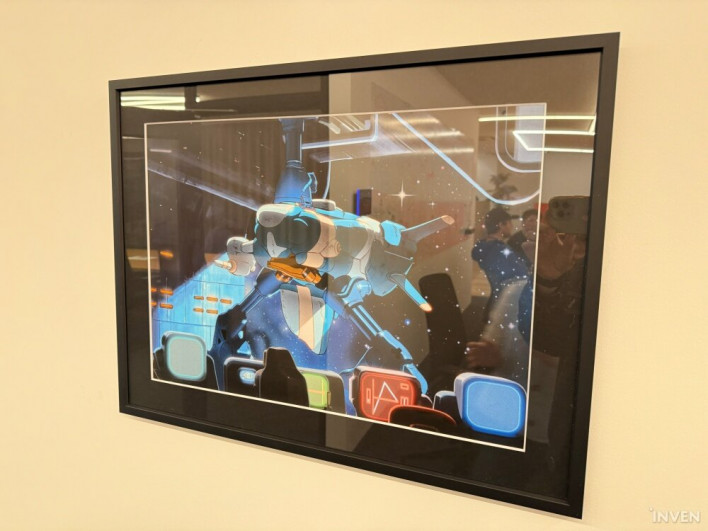
To explain specifically, since we were depicting an old world, the machines and mechanics have a rusty and worn feel, which we referenced from 'Venus Wars' and Doronjo (from the 'Time Bokan' series).
For characters, we aimed for distinct and simple designs like 'Ranma 1/2,' 'Sailor Moon,' and 'Inuyasha' so that children could also feel familiar with them.
As for the story, it is based on an adventure-centered, exciting worldview like early 'Dragon Ball,' with a simple and heart-fluttering storyline that anyone can relate to, ranging from strange experiences meeting mysterious creatures to sometimes sad or dark scenes. I'll stop here regarding animation inspiration, and it would be better for Jacob to answer about the game.
Jacob = As for the game, the team loves so many different games that it's hard to pick just one. Personally, in terms of building the co-op system, the co-op DLC for 'Portal 2' was a great reference.
And it might be unexpected, but we also referenced 'Mario Party.' Especially with 'Mario Party,' it's not a story-driven game, but there are many cases where players naturally talk to each other while playing mini-games. I always thought about how to study that player-centered structure and incorporate it into a story-driven game.
In addition, we were inspired by 'The Legend of Zelda' in terms of puzzle design and capturing the adventure feel.
Q. Since it's a way for two players to cooperate and solve puzzles, there might be room for arguments. You emphasize cooperation, but could it actually lead to discord? I'm curious if there are any countermeasures for this.
Jacob = We have devised many things. First of all, the equipment for solving gimmicks is not tied to a specific character, making it easier to help each other. In other co-op games, equipment is often tied to a character, and in that case, the only way to help is to switch controllers.
In 'Orbitals,' there are some sections where equipment is fixed, but for the most part, you can freely choose and change equipment, so if you feel stuck on a puzzle, you can just change tools. I think this naturally lowers the difficulty of co-op play.

On the other hand, I think that challenge is also part of the game's charm. Since 'Orbitals' is a game that values communication, we hope you feel the experience of growing together by talking about how to solve problems and overcoming them together. It's a game that makes you keep challenging yourself without being afraid of arguing.
To do that, we had to make it easy to try again without feeling stressed when failing. As a countermeasure, even if you fail at a difficult gimmick, we made it so that you can resume from just before the failed section immediately upon death, so that challenges and repeated play are not painful.
Q. What is the overall playtime of the game?
Jacob = Please understand that we cannot reveal that yet.
Q. There are quite a few gamers in Korea who are looking forward to the game, saying the anime style is eye-catching. Could you say a word to those Korean gamers.
Jacob = Above all, I hope you enjoy 'Orbitals,' and I hope that time becomes a time spent with precious family, lovers, and friends. As an aside, I personally love Korean culture. One of my favorite games since I was young was 'StarCraft,' and I watch a lot of K-pop and dramas. The trip I took to Korea when I was 18 to watch a 'StarCraft' tournament is one of my most precious memories. I hope Korean players feel familiar with 'Orbitals.'
Marcos = Shapefarm is a studio where people from many countries gather. I am from Argentina, and Jacob is from Sweden, but what connects this entire team is our passion for animation and games. I hope those who enjoy 'Orbitals'—those who cherish the experience of playing games with friends in their childhood or anime fans—feel connected to our development team. I think this game is a love letter to Japanese animation as a whole and to games. I would be happy if you could also find that connection through 'Orbitals'.

Sort by:
Comments :0