Dr. Park Se-young of Hanyang University pointed out that the criminal penalty provisions of the Game Industry Promotion Act are structured out of alignment with the legal interests the law seeks to protect. The statement was made on November 20 at the 25th Regular Academic Conference of the Korea Game Law and Policy Society held at BEXCO in Busan, during a presentation on Topic 2, "Review of Criminal Law Issues in Game Industry Regulations." Throughout the panel discussion, participants reiterated that the structure allowing prison sentences for mere administrative duty violations needs overhaul, reflecting a shared awareness across academia and the legal profession that the Game Industry Promotion Act—over 20 years after its enactment—has turned into a punishment-focused law despite its name.

From the perspective of a criminal law scholar, Dr. Park viewed the Game Industry Promotion Act through the lens of administrative criminal law—a system where criminal penalty clauses are embedded within administrative acts to punish regulatory non-compliance. The Game Industry Promotion Act has continuously added regulations over time, such as provisions on speculative games and mandatory loot box disclosures. Dr. Park categorized the penalty provisions into three tiers based on statutory sentencing limits: Article 44 carries up to 5 years imprisonment or a fine of up to 50 million won, Article 45 carries up to 2 years imprisonment or a fine of up to 20 million won, and Article 46 carries up to 1 year imprisonment or a fine of up to 10 million won.
Article 44, which imposes the harshest sentences, also mandates the forfeiture and collection of criminal proceeds. Dr. Park noted that acts fall under this article that are comparable to the crime of opening a gambling place under the Criminal Act or violations under the Act on Regulation of Gambling Acts. Because it relies less on administrative dispositions and directly punishes acts that violate protected legal interests, its purpose remains relatively clear.
The problem lies in Articles 45 and 46. Dr. Park explained that these provisions generally trigger criminal penalties directly upon a failure to comply with administrative orders. Under this framework—widely criticized by criminal law scholars—the mere act of violating a corrective order or business suspension order constitutes a crime. Furthermore, penalty conditions sometimes incorporate vague phrases such as "risk of significantly impairing national identity." Dr. Park pointed out that the standards under which these two articles mete out punishment are unclear.
At the root of the issue is a confusion of protected legal interests—the specific rights or societal values the law aims to safeguard. Dr. Park argued that the Game Industry Promotion Act attempts to lump together a complex array of legal interests, ranging from preserving healthy culture and public morals against speculative games to protecting user rights, youth protection, the economic interests of game companies, and gaming culture. "It is difficult to avoid criticism that the regulatory objectives themselves are somewhat ambiguous," he noted.
The disparity becomes evident when compared to legislation of a similar nature. The National Assembly categorizes the Game Industry Promotion Act alongside the Act on the Promotion of Motion Pictures and Video Products within the culture and arts domain. Dr. Park highlighted that while the video products act divides statutory penalties into six tiers, the Game Industry Promotion Act has only three, stressing the need for finer categorization. He offered a concrete example: manufacturing an unrated video carries up to 2 years imprisonment under the video products act, whereas distributing an unrated game carries up to 5 years imprisonment under the Game Industry Promotion Act.
The remedy proposed by Dr. Park is to re-establish the rationale for punishment. He argued that lawmakers must fundamentally re-evaluate which legal interests warrant punishment when violated and in what manner, while licensing dispositions should clearly specify what interest they protect rather than criminalizing mere non-compliance. He also suggested separating provisions entangled with gambling game regulations so the statute can be reorganized in alignment with its original goals: promoting the game industry and establishing a healthy gaming culture. He concluded, "Statutory penalties must be categorized more granularly, and the severity of punishment should be reduced."
Professor Hwang Sung-ki of Hanyang University School of Law remarked, "The overcriminalization in administrative law is a crucial problem today," praising Dr. Park for accurately pinpointing the issues in the gaming law from that perspective.
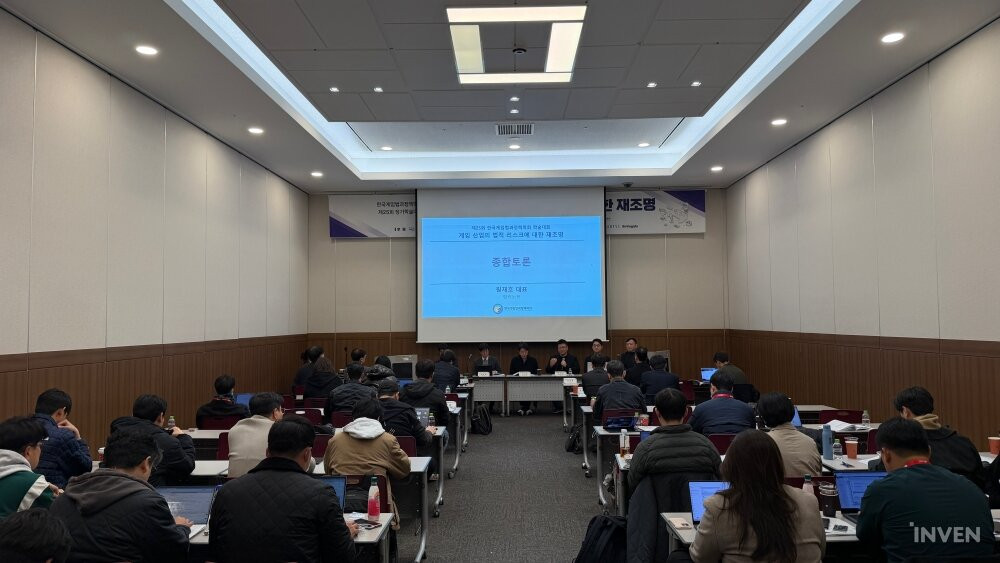
Attorney Park Joo-sung of Bae, Kim & Lee LLC (BKL) supported this view based on his practical legal consulting experience. The Game Industry Promotion Act contains criminal penalty provisions not only for severe violations of legal interests, such as illegal gambling or currency exchange, but also for administrative infractions involving age ratings, labeling, and registration or filing obligations. Attorney Park noted that while such infractions may pose risks to youth protection or sound distribution order, the mere violation of a duty must be evaluated separately from whether a substantive risk severe enough to warrant criminal punishment was created. He suggested clearly separating domains that require criminal sanctions from those that can be addressed via corrective orders or administrative fines.
Dr. Lee Sang-min of the Korea Information Society Development Institute (KISDI) highlighted how identical content regulations branch into criminal penalties through two separate tracks. Article 32, Paragraph 2, Item 3 of the Game Industry Promotion Act prohibits game products that risk disrupting social order by excessively depicting crime, violence, or obscenity. Manufacturing or importing such games carries up to 2 years imprisonment or a fine of up to 20 million won under Article 45, Item 6, with criminal courts determining whether a violation occurred. However, another path exists: if the Game Rating and Administration Committee denies a rating based on the same criteria pursuant to Article 22, Paragraph 2, distributing the game instantly constitutes distributing an unrated game, subjecting the offender to up to 5 years imprisonment or a fine of up to 50 million won under Article 44.
Dr. Lee pointed out that under the second track, the committee's content evaluation becomes the prerequisite for a harsher punishment without undergoing judicial interpretation by a court. If an overseas publisher denied a rating chooses not to contest the decision and abandons a domestic release, court rulings that could clarify vague standards never materialize. He questioned whether such a regulatory framework is appropriate in terms of proportionality and predictability of criminal punishment. He also called into question Article 46, Item 6, which punishes platforms that fail to comply with orders from the Minister of Culture, Sports and Tourism with up to 1 year imprisonment. Enforcing a blocking duty on intermediaries through criminal penalties creates fairness issues due to disparities in enforcement power between domestic platforms and overseas platforms like Steam.
Dr. Park Se-young responded that while criminal courts cannot invalidate administrative dispositions per se, the general academic consensus is that they can determine the legality of such dispositions. However, he noted that judicial rulings diverge depending on whether the disposition grants a benefit or imposes a detriment on the party, adding that he would reflect further on the question.
In his discussion paper, Won Jae-ho, CEO of Anchor Node, shifted the issue to a creator's perspective. He pointed out that while distributing an unrated game can lead to up to 5 years imprisonment—leaving creators who miss procedural requirements exposed to criminal penalties—the system fails to reach those who copy entire games outright. He wrote that the center of gravity of the Game Industry Promotion Act must shift from policing creators to protecting them.
Professor Lee Jung-hoon of Chung-Ang University School of Law framed the discussion around the identity of the law itself. Noting that many refer to the Game Industry Promotion Act as the "Game Industry Regulation Act," Professor Lee suggested that any future legislative reform should consider separating promotion and protection from regulation and punishment. As a criminal law specialist, he shared his personal view that "the Game Industry Promotion Act is, in effect, a Game Criminal Code."
Professor Lee noted that over the 20 years since the enactment of the Game Industry Promotion Act, technology and the industry environment have changed drastically. Rating classifications are transitioning to the private sector, and AI is reshaping both development and play environments. He stated that while laws must inevitably rely on generalized concepts, human judgment governs their actual operation, emphasizing the need to establish guidelines and standards shared and supported by both experts and users.