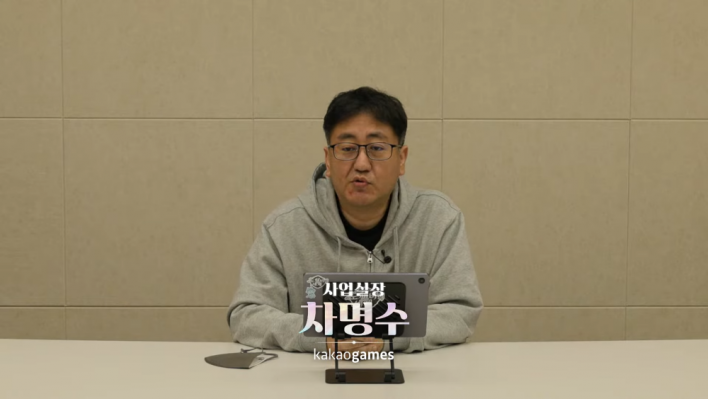
Cha Myeong-soo, Head of Business at Kakao Games, stated during a community live stream for 'World of Dokkaebi' on November 5 that the company would not block so-called 'ssal-meok' (real-money trading) players. The core message is that while multi-accounts, item farms, and accounts originating from overseas will be strictly prohibited, players who sell items while playing and enjoying the game will not face sanctions. By publicly addressing real-money trading between players, Kakao Games effectively shifted its enforcement policy focus from "whether trading occurs" to "who is earning, and how."
However, Kakao Games' official operational policy explicitly classifies attempts to monetize game data and real-money item trading as punishable offenses. A fourth offense results in a permanent account ban. The Head of Business's public statements directly contradict the written regulations officially published by the company.
Cha stated, "I tried not to use the word 'ssal-meok,' but I will be honest: if you enjoy the game and sell items in moderation, we won't stop you." He added, "Go ahead and earn while playing. What is wrong with that?" 'Ssal-meok' refers to players who make a profit by selling items or currency obtained in-game for cash.
He drew a line against interpretations that price ceilings on the in-game exchange were targeting real-money traders. Cha explained that price caps were not placed on all items, noting that if the intention was to prevent cash selling, equipment trading would also have been blocked. Equipment, he pointed out, remains tradeable even now.
As for the criteria for what is permissible, he cited character growth. Cha said, "Once your Combat Power reaches 250,000 or higher, go ahead and earn some money by selling." He added, "Hunt hard, grow your character, and sell." He also outlined plans to create an environment where lower-tier and new players can start earning money once they reach the Combat Power target set by the company.
The defining benchmark is real human players. Bringing up his earlier statement that he wanted to keep only real people in the game, Cha remarked, "Item farms and multi-accounts cannot really be considered real people." He explained that operating multiple accounts solely to sell items without actually playing the game is not what the company wants. While acknowledging that many games treat real-money trading with extreme caution, he emphasized, "No game has ever succeeded by blocking things like this."
He maintained a firm stance against item farms. Cha noted, "Right now, item farms are suffocating," adding that incoming new item farms are also decreasing. He explained that as the company cut supply rates and continued enforcement, item farms changed their tactics.
According to Cha, new item farm operations have recently emerged where they buy cash items, list them on the exchange, sell the resulting in-game currency to buyers, and then request payment refunds. The company is penalizing these accounts, explaining that in such cases, it has no choice but to block the buyers' accounts or confiscate the currency. While acknowledging that buyers could suffer collateral damage, he said, "We have no choice but to block them." He added that he is aware that lower-tier and new players might face difficulties during the process of tightening control over item farms.
Ultimately, Cha's vision is to filter out organized suppliers that disrupt the game's economy while accepting transactions by genuine players as part of the ecosystem. This indicates that the line is being drawn not by whether real-money trading occurs, but by who is trading and in what manner.
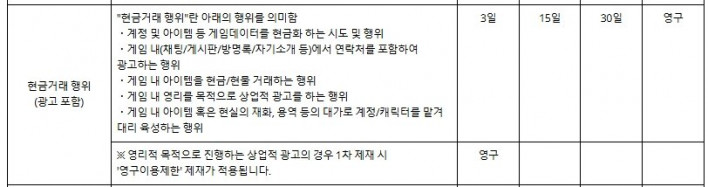
The problem is that this vision conflicts with the company's official documentation. Kakao Games' Operational Policy Sanctions Table defines 'real-money trading' as attempts or acts to monetize game data such as accounts and items, as well as trading in-game items for real money or tangible goods. Sanction periods are set at 3 days for a 1st offense, 15 days for a 2nd offense, 30 days for a 3rd offense, and a permanent ban for a 4th offense. There are no exceptions based on Combat Power or active gameplay.
The account management clauses are no different. The operational policy states that attempting to trade accounts or items for real money or goods may result in revocation of access rights. It also specifies that the company cannot assist with problems arising from such transactions, and that all responsibility lies with the registered account holder. Furthermore, members cannot conduct commercial activities using service content without prior approval from the company, and the company may recover any currency obtained in violation of the operational policy.
This is where the risks borne by players become clear. While Cha stated that players who sell items while playing will not be blocked, the operational policy contains no clause exempting such users from sanctions. Players who sell items trusting Cha's words could still face sanctions for real-money trading according to the written policy.
The criteria are equally mismatched. Conditions such as the 250,000 Combat Power threshold, selling "in moderation," or "while playing" offered by Cha do not appear anywhere in the operational policy. The same applies to buyer protection. While Cha stated that buyers caught up in item farm refund exploits could have their accounts blocked or currency recovered, the operational policy explicitly states that no assistance will be provided for problems arising from real-money trading.
The intention to filter out item farms and multi-accounts while leaving real players is clear. If, as Cha put it, no game has ever succeeded by blocking real-money trading, the remaining step is to translate that judgment into written operational policy. When spoken statements and official documentation diverge, it is far more likely that the document will serve as the legal basis for sanctions.