The Korea Association of Game Industry (K-GAMES) made its first appearance at the National Assembly Legislative Expo on November 5, presenting five key legislative initiatives, including the introduction of production cost tax credits for game content. The core request is to extend the production cost tax credits currently granted to films, TV dramas, OTT video content, and webtoons to game development. The association delivered policy briefing packages for each initiative to National Assembly members and government officials, calling for follow-up legislative discussions.
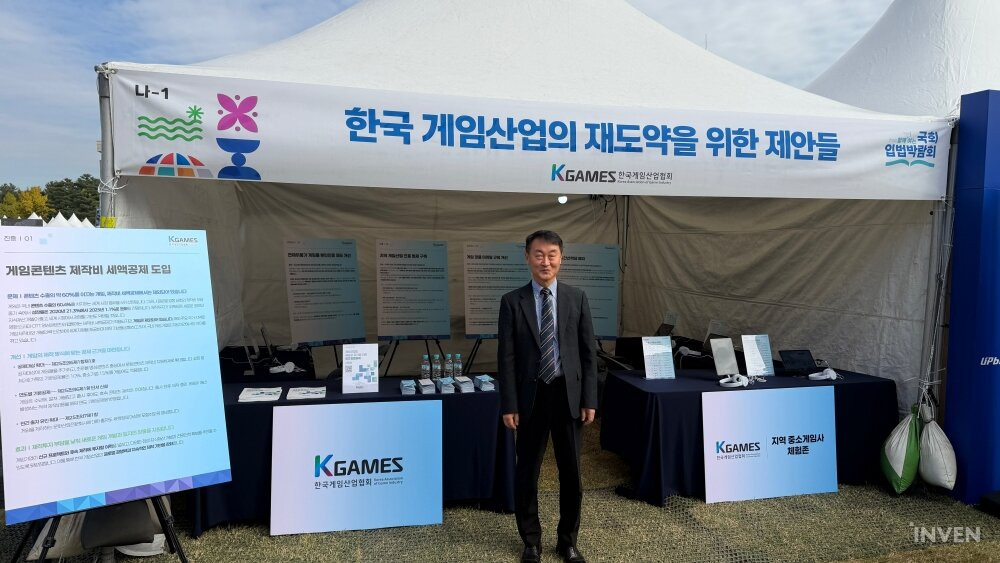
The National Assembly Legislative Expo is a public-participation event organized by the National Assembly to connect citizens' ideas to legislation and institutional reform. Now in its second year, the expo takes place from November 5 to 6 at the National Assembly Central Lawn. National Assembly Speaker Cho Jung-sik introduced the event, saying, "This is a venue where legislative proposals from the government, local municipalities, businesses, and civil society come together. In line with the era of AI and new industries, this year we have also created a space to support the challenges faced by innovative companies through legislation."
The association's booth was set up on the Central Lawn alongside the expo's main stage. Although taking place on the National Assembly grounds, the outdoor location allowed anyone to visit without a pass, making it easily accessible for passing lawmakers and legislative aides. K-GAMES displayed five informational panels detailing the problems, direction for improvement, and expected effects for each initiative, while distributing promotional leaflets. To key figures in the National Assembly and government, the association handed over a policy document titled "Five Key Legislative Initiatives for a New Leap in the Game Industry" to serve as a foundation for future legislative discussions.
The initiative placed front and center by the association is the tax credit for production costs. According to association data, games account for 60.4% of South Korea's content exports, ranking 4th in global market share. However, annual revenue growth is projected to drop sharply from 21.3% in 2020 to 1.1% in 2025. The association proposed adding game products to the tax credit coverage under Article 25-6, Paragraph 1, Item 1 of the Restriction of Special Taxation Act, applying a base tax deduction rate of 10% (15% for small and medium-sized enterprises) under Item 2(a) of the same paragraph. It also requested a new proviso to apply the base tax deduction to annual costs incurred during post-launch development, as well as pre-launch development expenses. Additionally, the proposal includes adding capital contributions to specialized cultural industry companies that produce games under tax credit coverage (Article 25-7, Paragraph 1).
Regarding the reform of promotional giveaway regulations in gaming, the association highlighted equity with other industries. While the financial and retail sectors offer giveaways like gold bars and automobiles tied to purchase history, even game events offering players who complete free missions a raffle entry for a gift voucher worth 20,000 won or distributing custom-made figurines are rejected. The association pointed to real-world rating practices as the cause, explaining that giveaways are blocked based on whether they are "tied to game outcomes" rather than whether they promote gambling.
The proposed amendment amends Article 28, Paragraph 1, Item 3 of the Game Industry Promotion Act to allow giveaway promotions in principle, prohibiting them only exceptionally when there are concerns about encouraging gambling. Specific prohibited targets were detailed, including giveaways tied to loot boxes (probability-based items) or paid purchases, virtual assets or blockchain-based certificates, gambling simulation games, continuous giveaways, and giveaways that are easily cashable or carry excessive monetary value.
The regional game industry promotion initiative calls for establishing a statutory growth foundation that spans from securing talent for regional companies to production, investment, distribution, and global expansion. K-GAMES pointed out that while the current Game Industry Promotion Act includes grounds for general infrastructure building and balanced development, it lacks concrete details on the roles of regional promotion entities and a continuous support system.
Accordingly, the association proposed creating new provisions in the Game Industry Master Plan explicitly outlining regional promotion (Article 3, Paragraph 2, Item 4-2), establishing duties and financial support grounds for national and local governments (Article 11-2), and providing legal grounds for designating regional promotion agencies and operating regular consultative bodies (Article 11-3). It also suggested introducing a provision in the Framework Act on the Promotion of Cultural Contents Industry (Article 19-2) to connect cross-genre regional policies and streamline redundant data submission and performance management procedures.
The remaining two initiatives focus on refining the operational methods of user protection systems. The association called for simplifying sign-up procedures for all-ages online games and abolishing the selective game hour system to alleviate operational burdens on game operators, under the premise of preserving principles against gambling and maintaining user protection.
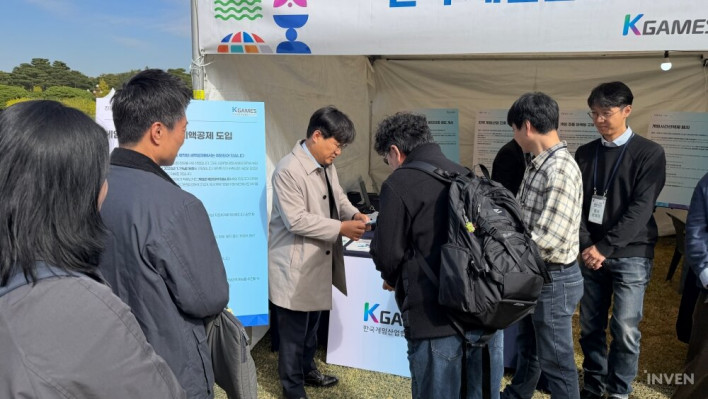
On one side of the booth, a hands-on trial zone was set up for regional small and medium-sized game studios. Twelve companies from North Chungcheong, South Chungcheong, Daejeon, North Jeolla, North Gyeongsang, and Daegu presented 12 games. Visitors could try RPGs, rhythm games, puzzle games, and management simulations on tablets. The setup aimed to demonstrate why regional promotion legislation is necessary through the tangible work of regional developers.
K-GAMES Chairman Cho Young-gi stated, "The gaming industry is South Korea's flagship cultural industry that has grown in the global market on the back of creativity and technology," adding, "However, our game industry recently faces a structural crisis where intensifying global competition, rising production cost burdens, and shrinking investment coincide, making it difficult to sustain continuous growth and new challenges." He emphasized, "Overcoming this requires not only efforts from companies but also legislative backing to stimulate production investments and update institutions to match the evolving industrial and user environments."
Chairman Cho also explained the purpose behind presenting these five key initiatives. He noted, "These initiatives aim to create conditions for production investment and second chances, while broadening the industry's foundation so that new companies and talent in regional areas can grow to create competitive games." He added, "By rationalizing regulatory methods while upholding the intent of user protection, we aim to build a virtuous cycle where a wide variety of games gain player selection, and that success leads directly into follow-up productions. This will serve as a foundation to boost our game industry's global competitiveness and expand the public's cultural enjoyment."