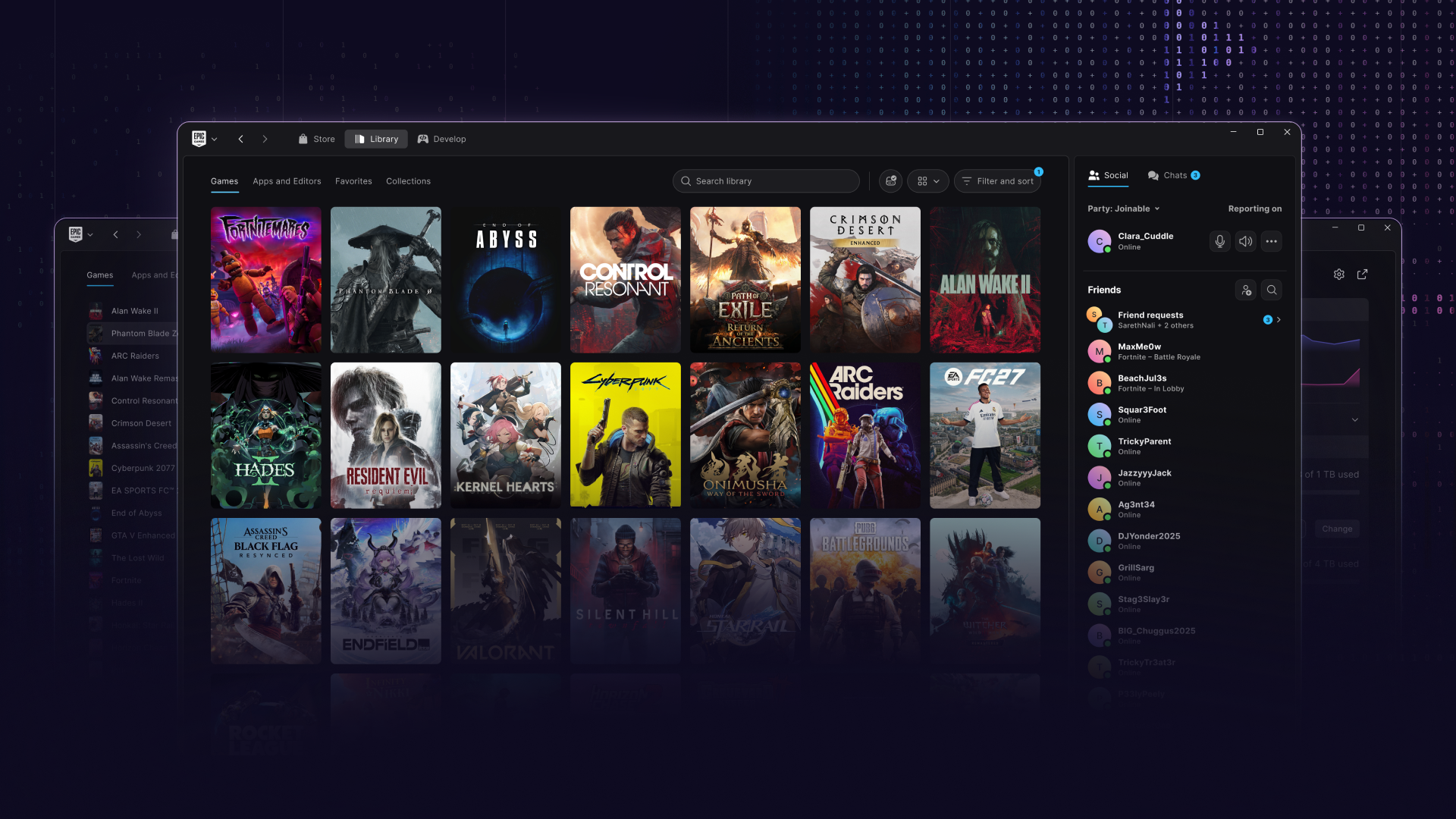
On October 14 (local time), Epic Games unveiled a preview version of its completely redesigned PC "Epic Games Launcher." In addition to Windows and macOS, it officially supports a native Linux client for the first time.
| 📒 | - Epic Games releases new PC launcher preview on October 14, marking first official Linux support - Redesigned using AI tools… Overhauled boot speed, library, and download management - Linux version of 'Fortnite' planned for future release following EAC Linux v2 security update |
This preview focuses on improving boot speed and responsiveness. According to internal measurement results from October published by Epic Games—commissioned through external testing firm Keywords Studios—the new launcher's initial cold boot time is 5.47 seconds, which is 1.8 times faster than Steam (10.07 seconds). The time to switch to the library from the system tray recorded 0.36 seconds, and the company stated that library navigation speed is 30 times faster compared to the existing launcher.
The interface and management features have also been revamped. Dedicated pages bringing game status, launch controls, and additional content onto a single screen have been introduced, along with real-time search, filters, and collection sorting features. Users can also link game libraries installed on other PC platforms to view them all in one place. The download management window displays real-time download and disk read/write speeds at a glance, as well as queued, scheduled, and failed task statuses.
In its official announcement, Epic Games stated, "Programming is hard. So, instead of doing that, we vibe coded a new Epic Games Launcher that's way faster and more responsive". Martin Keely, Vice President and General Manager of Epic Games Store and Epic Online Services, said in an interview with foreign media outlet The Verge, "We actually had AI agents write and review all the code, but the development team managed and supervised the entire process", explaining that AI tools were used to replicate core functionality and conduct testing.
However, as this is the first preview version, some social and account management features from the existing launcher are missing. Installing the preview automatically removes the existing launcher, but accounts, purchase history, installed games, and cloud save data are preserved. Epic Games recommended that players of competitive games such as Fortnite or developers working on live projects continue using the existing launcher during the preview period.
The newly introduced Linux version officially supports distributions including Ubuntu 22.04 LTS, Fedora 43, and Debian 12 or higher. While the launcher itself operates natively on Linux, running games released exclusively for Windows may require a separate compatibility layer. The macOS version supports only Apple Silicon (M1 or higher) devices, with Intel-based Macs excluded from support.
Plans to port Fortnite, whose Linux support had previously been put on hold due to anti-cheat issues, were also announced. On the same day, Epic Games revealed plans on its tech blog to build "Easy Anti-Cheat (EAC) Linux v2," which raises the anti-cheat environment for Linux to a level on par with Windows. The new security framework requires signed kernels and kernel modules, TPM 2.0, Secure Boot, and enabled IOMMU as mandatory requirements.
Epic Games plans to consult with major Linux distribution maintainers regarding security requirements before testing EAC Linux v2 first on Fortnite. Once its effectiveness is verified in a live service environment, the company intends to distribute it to other developers to expand Linux support for multiplayer games.
Meanwhile, Valve's handheld device, the Steam Deck, was excluded from the initial target list because it currently does not support the security features required by EAC Linux v2. Epic Games added that it is consulting closely with Valve to support Steam hardware and hopes to provide support in the future. Specific release timelines for the Linux version of Fortnite and the official release of the new launcher have not yet been disclosed.