Dayveil Games announced that it has released a Steam demo for 'CRADLE PLANT: First Year Operations', a factory automation simulation game. The game will participate in Steam Next Fest, which runs from October 19 to 26, 2026.
The full release is scheduled for February 2027. It is a single-player PC game that supports Korean in the game UI and store page. According to the developer, a single playthrough of the full game takes approximately 8 hours and features branching paths leading to multiple endings.
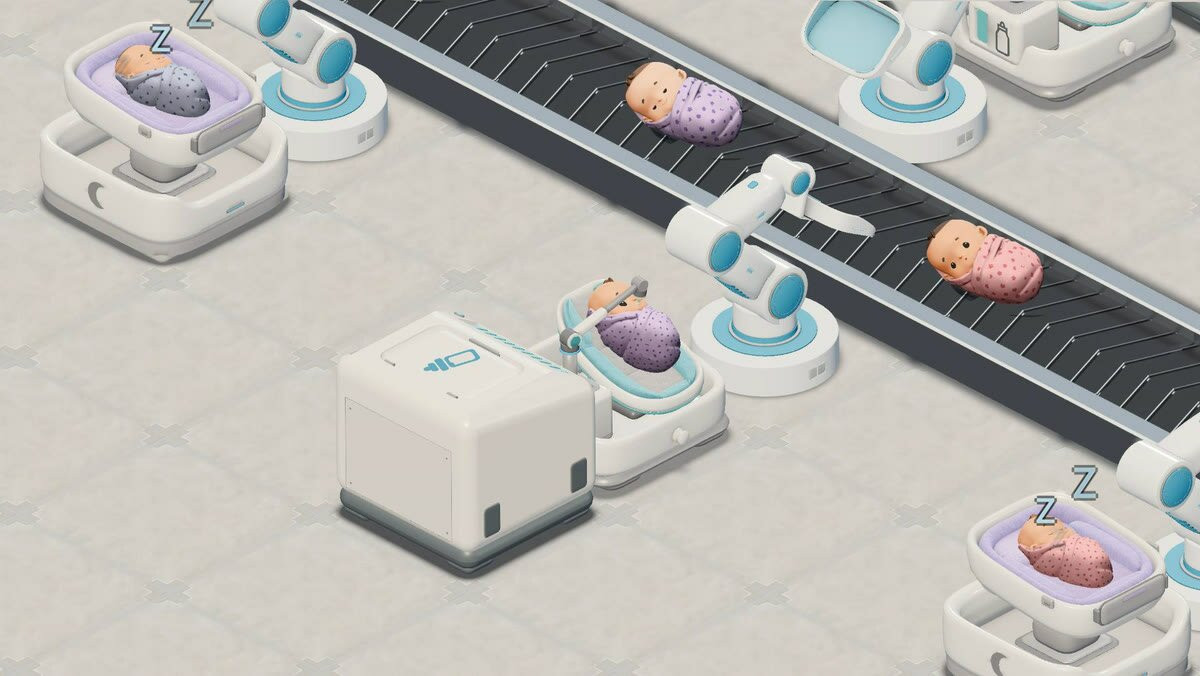
The game tasks players with managing a "childcare plant" where newborns spend their time until their first birthday. Players automate care by connecting facilities for feeding, sleeping, hygiene, and play via conveyor belts. Care arms transport the babies to the required facilities, with the goal being to design a facility where care continues seamlessly without requiring continuous manual operation.
As babies grow, their care needs and modes of movement change. Once babies begin to crawl, they can move backward along conveyors or crawl off the line. Consequently, players must monitor active facilities and modify equipment layouts and movement paths accordingly.
In the later stages of the game, different babies react differently to the same care. Players must observe each baby's reactions and adapt the automated lines to accommodate them. Even if players improve facility efficiency, the time it takes for a baby to reach their first birthday cannot be shortened, requiring players to maintain the life cycles of dozens of babies within limited space and funds.
The game is set in the near future, where parents entrust their babies' first year to specialized facilities so they can continue working. It tackles a society that has industrialized childcare through dark comedy and dystopian satire, and it contains no depictions of direct harm or death toward children.
The solo developer behind Dayveil Games is an engineer who develops industrial robots and measuring instruments, as well as a father of two. He conceptualized the game based on his work experience in factory automation and his personal experience raising children. Generative AI was used to create some of the visual and 3D assets as well as background music, with the developer editing the visual and 3D assets himself. The baby voices in the game are actual recordings of the developer's children.