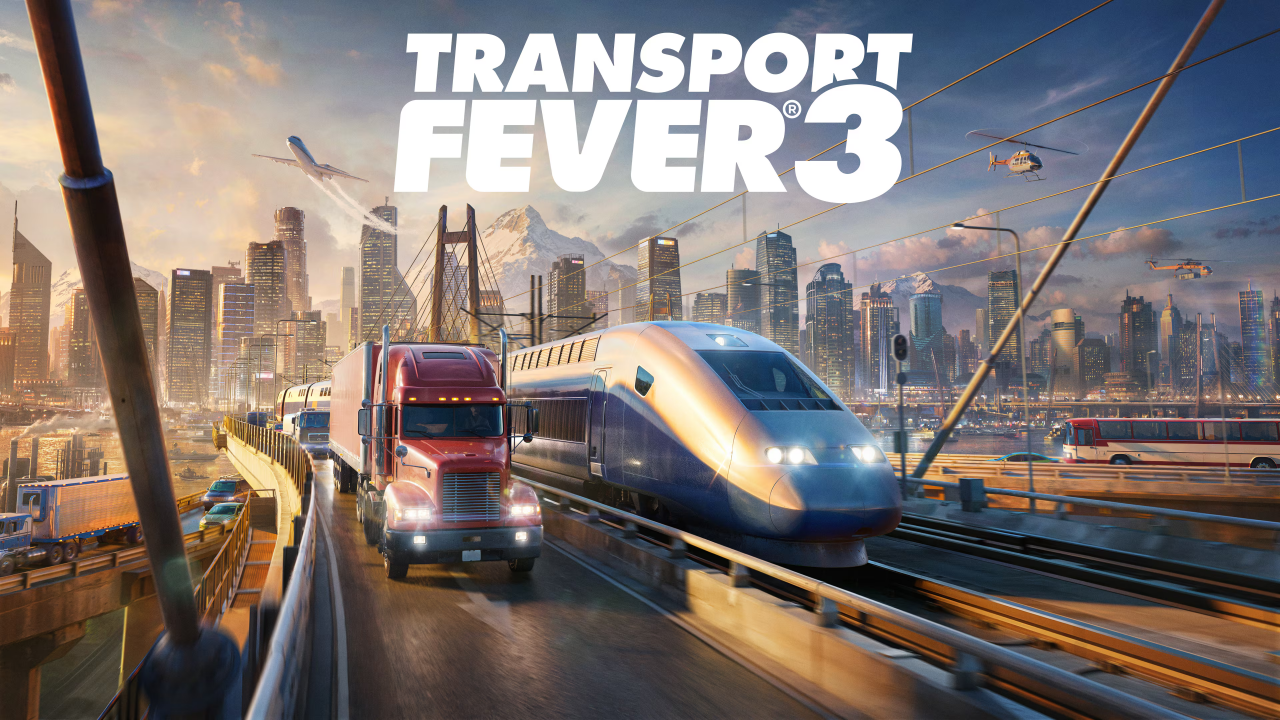
Railways, roads, shipping, and aviation. The 'Transport Fever' series, which builds transport networks across entire worlds rather than single cities, has returned with a new title for the first time in about seven years.
Developed by Swiss studio Urban Games, 'Transport Fever 3' is the sequel to 'Transport Fever 2', which sold millions of copies. The PC, Mac, and Linux versions are available on Steam, Epic Games Store, and GOG.com from launch day, while on console it launched on PS5 and Xbox Series X/S.
Urban Games described 'Transport Fever 3' as the largest and most ambitious entry in the series to date. Players manage their own transit empire while experiencing over a century of transport technology advancements.
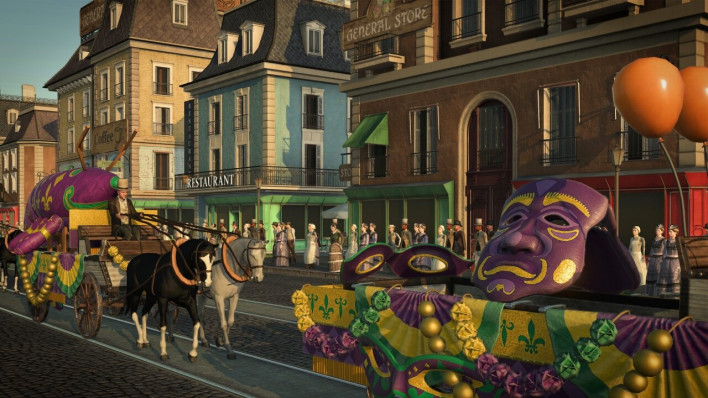
From Cargo to City Growth: A Deeper Transport Simulation
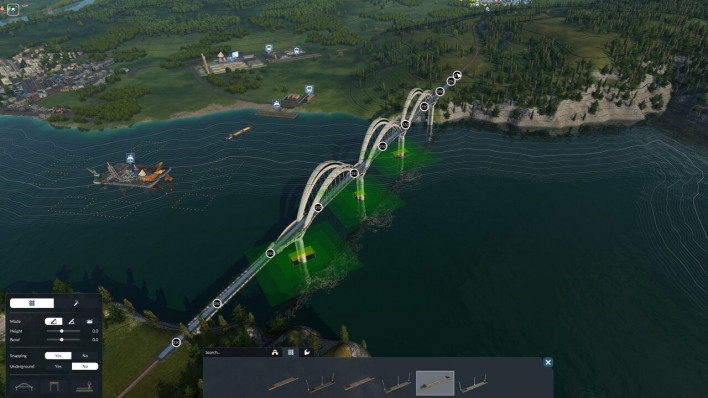
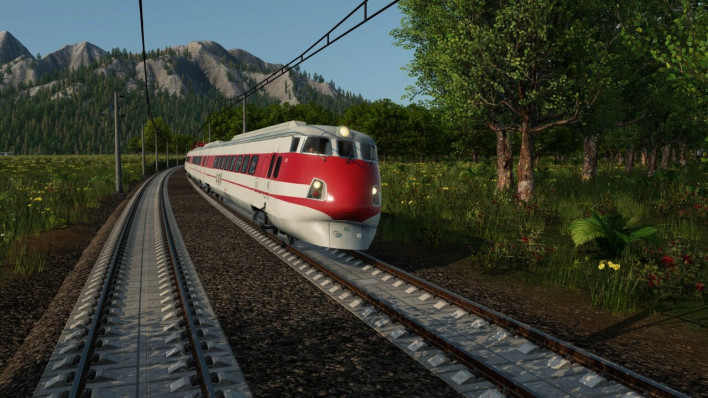
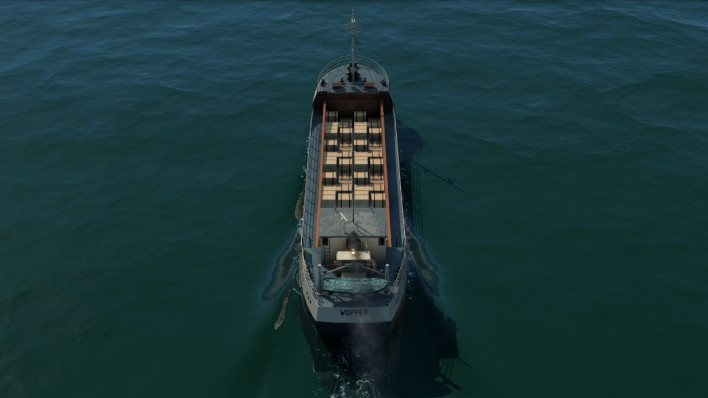
In the early eras of 'Transport Fever 3', players boost city transit using horse-drawn carriages and steam locomotives, but as eras progress, they can operate a wide variety of transport methods, including jet airliners, supertankers, high-speed trains, and helicopters. According to the developers, the game features over 300 types of vehicles, and building a transit network that spans the entire map using them forms the core of the game.
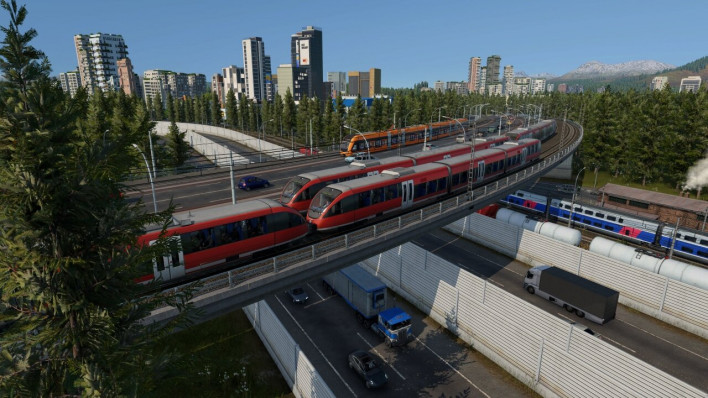
The game goes beyond merely expanding the roster of transport vehicles; it significantly broadens the overall simulation, from cargo and passenger flow to urban growth and transit infrastructure management. Players must directly connect railways, roads, shipping lanes, and air routes while managing revenue and maintenance costs generated by each network. As routes grow, issues such as bottlenecks, traffic congestion, noise, and pollution emerge, requiring players to continuously modify and optimize existing routes to match the changing demands of cities and industries.
The cargo transport system has also changed significantly compared to its predecessor. In 'Transport Fever 3', the destination of produced cargo is not predetermined from the start. Goods produced at industrial facilities are collected directly by the player and sent through their chosen logistics network, giving players full control over virtually the entire process of where and what goods to supply. Cargo is categorized by characteristics—liquids like crude oil and fuel, bulk cargo like grain and sand, and flatbed cargo like timber and steel—allowing players to utilize vehicles and storage facilities tailored to each cargo type. Cargo-specific vehicles and storage facilities come at a higher cost but offer loading and unloading time bonuses, while universal facilities and vehicles usable for various cargo offer no bonus but are cheaper, providing diverse tactical choices.
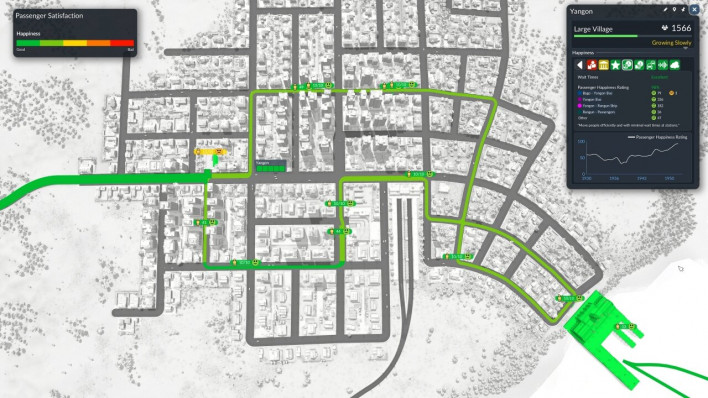
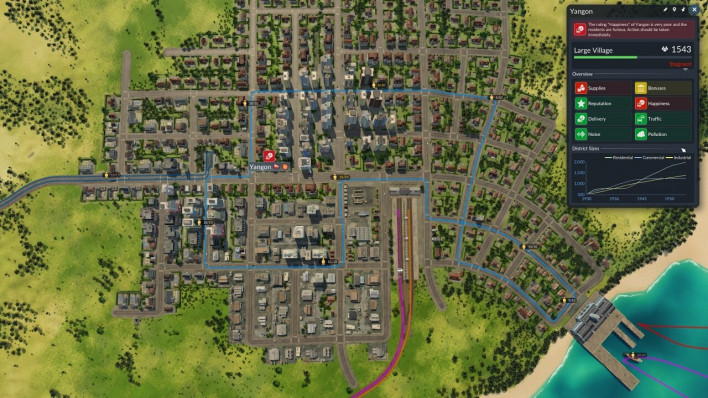
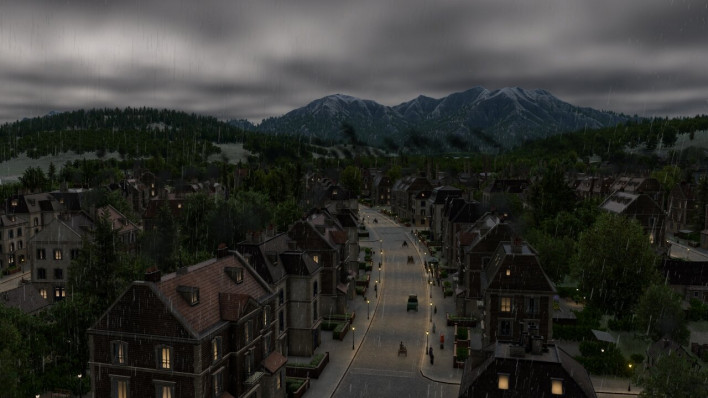
City building in Transport Fever 3 leans closer to guiding urban growth through transport and logistics, rather than placing individual buildings like a traditional city builder. Settlements start as small hamlets with fewer than 100 residents and evolve into metropolises across 18 stages. Transporting passengers and supplying needed cargo earns city experience points, while transit service quality, congestion, noise, and pollution limit the rate of growth. Therefore, simply supplying a large volume of goods does not guarantee city growth; players must also manage how conveniently citizens travel as well as the urban environment.
Passenger transport is also directly linked to city growth. In 'Transport Fever 3', individual citizens have designated homes, workplaces, and travel destinations, and they actually travel along the transit network established by the player. In addition to citizens commuting or shopping within the same city, there are also passengers traveling between different cities, and providing smooth long-distance travel delivers a greater boost to city growth.
Playstyles have also become more granular. In Tycoon mode, which focuses on the economy and company management, players can finely adjust difficulty and economic parameters, expanding company headquarters or unlocking landmarks and various perks as the business grows. Conversely, in Sandbox mode, players can disable the economic system altogether to freely build cities, stations, and transport networks. The game also offers a campaign with missions inspired by real historical events, as well as an in-game map editor to craft custom maps.
Hearing Directly from the Developer: The Appeal of 'Transport Fever 3'
'Transport Fever 3' launched on September 30 on PC, Mac, Linux, PS5, and Xbox Series X/S. Ahead of the release, we met with the dev team attending TGS 2026 to talk about everything from what they wanted to improve most from the previous entry, to cargo and transit AI, new vehicle types, mod support, and their extensive beta testing period.
To start, some players in Korea might not be familiar with the series yet. Could you briefly introduce Urban Games and the 'Transport Fever' series?
= This is the fourth title created by Urban Games. Our first game was 'Train Fever', which, true to its name, focused more heavily on rail transport.
Afterward, moving on to 'Transport Fever', we expanded the scope to cover transportation as a whole rather than just railways. When players build a transit network, people and cargo use that network, and if the transport system is built properly, cities grow based on the resources supplied.
We also significantly strengthened the tycoon elements. For those who remember the classic 'Transport Tycoon', our desire to recreate that experience in a modern form had a massive influence on us. In fact, it was one of the key reasons we started the studio.
Among the feedback from players of the previous game, what was the first area you felt needed improvement in the sequel?
= We rebuilt the cargo transport system almost from scratch. In the previous game, the cargo system wasn't as flexible as we wanted, and from a player's perspective, it was sometimes hard to understand why cargo wasn't moving in the direction they expected.
This time, we enabled players to handle cargo transport much more directly. Players can design the logistics flow themselves by moving cargo where they want, storing it at specific locations, and then moving it elsewhere. Internally, it was a major overhaul.
In the previous title, some noted that as cities grew larger, the pathfinding for vehicles and citizens didn't work as intended. How has the pathfinding system changed?
= The core pathfinding method itself uses the system we've relied on since earlier entries. To explain it more technically, it's closer to a line-based structure rather than a standard navigation grid. Vehicles, people, and cargo all move along lines underlying the roads or networks.
A major area we improved this time is vehicle overtaking. Technically, it involves shifting vehicles between different lines, allowing vehicles to change lanes and overtake more naturally.
Playing it firsthand, there was quite a lot to learn even in the tutorial. What starting method would you recommend to players approaching the series for the first time?
= What you saw while playing during this hands-on session is a slightly more advanced form of tutorial. On top of that, there is a dynamic tutorial in the game. It starts by teaching simple elements and, as you progress, guides you again through the features or solutions needed at that specific moment.
However, for first-time players of the series, we strongly recommend playing the campaign first. The campaign gradually introduces features while limiting certain game mechanics, allowing you to become familiar with the system much more naturally.
In the early stages, older transportation modes like horse carriages and steam trains feature heavily. How does progression work toward modern vehicles or airplanes?
= Players have a great degree of control over the flow of time. While the campaign progresses through fixed eras, time flows naturally in Free Play, and players can directly adjust that speed.
As eras change, new vehicles become available. For vehicles, we reference the actual period when those vehicles historically appeared as much as possible. While we base them on real vehicle data, we also adjust performance slightly for gameplay balance.
The game spans from the 1900s to 2050. In the later eras, futuristic transport modes imagined by our team will also appear.
This time, there are many elements to manage besides transit, including logistics, noise, and citizen satisfaction. Is it becoming closer to a city management game? We're curious about how the dev team defines the series' identity.
= Still, the core remains transportation. As you play, cities grow and demand more, and traffic volume increases, which naturally makes the system more complex. But 'Transport Fever' remains a game about managing transport networks rather than a city builder.
Of course, some players enjoy the game by creating dioramas or model towns. In this game, you can place buildings where you want to create scenic cities or use the map editor to build customized environments. But I want to clarify that those are optional avenues for players, not a shift in the game's focus toward city building.
It was also impressive to view the city from inside a vehicle. Since it can be viewed from such a close perspective, you must have put a lot of thought into crafting graphical details.
= We try to pack in as much detail as possible. However, since players view the game mostly from a high camera angle, making everything overly small and detailed could actually clutter the screen. So, to some extent, we exaggerate certain visual representations.
Our goal is to make it feel as much like a realistic world as possible within that framework. In this title, we also added new engine features to enhance the visuals.
Actually, the reason we value this so much is that players spend a tremendous amount of time playing our game. Connecting an entire world with a transit network can take dozens to hundreds of hours. In fact, the average Steam playtime for our previous title exceeds 150 hours.
Since players spend long periods looking at the world they built, we wanted to make that world beautiful and enjoyable to admire.
New vehicle types like cargo trams and helicopters have been added. Were they introduced to solve problems that were difficult to address with existing transit methods?
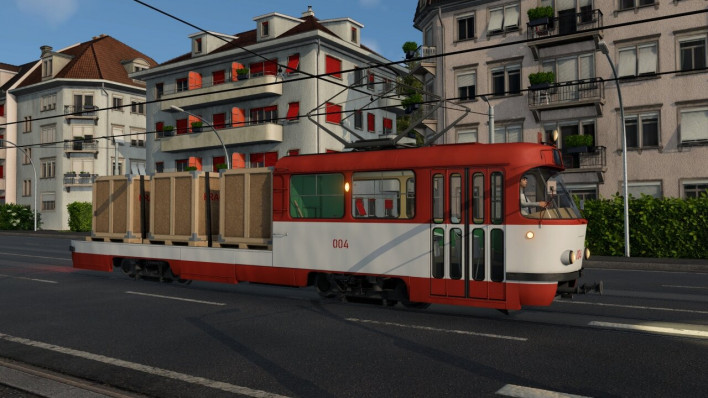
= Yes. Cargo trams have the advantage of hauling large volumes of cargo into cities while minimizing the impact on citizens. Utilizing electric trams means you don't have to keep driving diesel locomotives or heavy trucks into densely populated city centers.
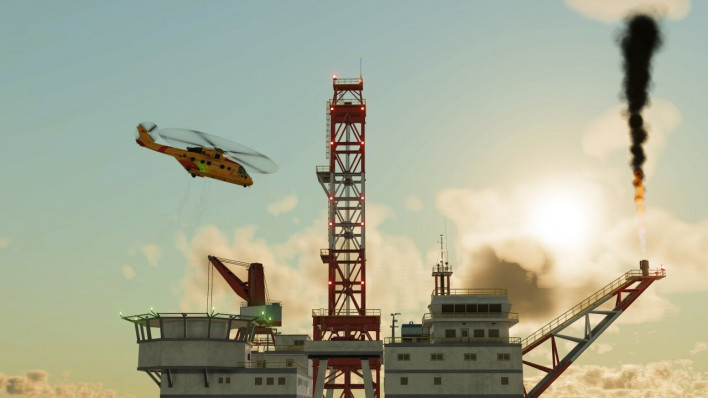
Conversely, helicopters are useful for transporting small amounts of cargo or passengers to hard-to-reach locations. For example, traveling to offshore oil rigs, mountain peaks, or areas beyond mountains usually requires building new infrastructure like roads or railways. Using helicopters allows access to those areas without creating such massive infrastructure.
Players can choose from various climates and terrains—are these purely cosmetic backdrops, or do they affect actual transport strategies?
= Weather itself is primarily a visual element. However, climate zones and terrain directly impact gameplay.
Even in temperate regions, high mountains or rivers can make rail access difficult. Tropical regions have abundant water, wetlands, and forests, making ships or aircraft a better choice.
Particularly in heavily forested areas, clearing too many trees can affect local populations, so you must construct routes with the natural environment in mind. Also, while flat regions like deserts can be relatively easy, encountering canyons or steep terrain requires bypassing them or overcoming them through other methods.
In short, rather than applying the exact same transport network to every map, the key is making tactical decisions based on terrain.
Mods are known to be a crucial element of the 'Transport Fever' series. Is there a reason you chose mod.io over Steam Workshop this time?
= The main reason is, of course, platforms. This title launches simultaneously across multiple environments—PC, Mac, and Linux, as well as Steam, Epic Games Store, GOG, PS5, and Xbox Series X|S.
What we wanted was mod support across all these platforms. Since that was impossible with Steam Workshop alone, we chose mod.io. We also aimed to bring over as many features used by the existing modding community to the new environment as possible.
We're also curious how much the development team values the modding community. Do you have future plans for the modding community you could share?
= We place immense value on the modding community and have supported mods since our very first game. With each entry, we've continually expanded modding features.
This time, we rewrote various functions buried in our internal code and exposed them externally for modders to utilize directly. In that sense, we believe this game is easier to mod than any of our previous titles.
We are also providing modders with the tools our dev team actually uses to build worlds and vehicles. Tools that weren't released externally in the past are now available to use.
For over a year, we worked alongside modders from previous titles, inviting hundreds of modders—including those active in other games as well—to participate in the development process.
We heard there's also a program offering financial support to modders.
= We run an internal Curated Mods Program. We wanted to offer guidance and support from the dev team so modders could create great mods, but we didn't want a relationship where we simply demanded modders to 'make it like this.'
Since we were asking them to work according to our requests, we felt it was right to compensate them for that work. Therefore, modders participating in the program receive financial grants as a token of appreciation and goodwill.
Playing in Korean, it was surprising to see so many actual Korean neighborhood and city names. How was localization handled?
= For localization, we utilize databases of real city names from each country. We pull city names from publicly available databases and configure the game so regional names appear in accordance with the player's selected language.
So players might randomly encounter the name of a neighborhood near where they actually live. That in itself is an intended experience. Even if in-game cities don't look identical to real locations, we hope familiar names make it easier to immerse oneself in the world.
Transport Fever 3 also features a map editor and functionality to import heightmaps, allowing modders to recreate real-world regions themselves.
You conducted beta testing for a considerable period before launch. Were there major changes driven directly by player feedback?
= We ran beta testing for over a year, with over 1,000 players—including new and returning fans—playing the game so far. And indeed, many things changed during that process.
A prime example is the line management system. Initially, feedback indicated it was overly complex and required too many clicks. Based on player feedback, we almost completely overhauled that UI.
We continue to receive feedback right up until launch. Recently, we received input on controller support and are actively refining it. We plan to release a post-launch patch to improve controller support and also plan to support keyboard and mouse on consoles.
Lastly, how would you describe the appeal of 'Transport Fever 3' to Korean players?
= First, I'm curious whether Korean players enjoy complex games. (Laughs)
'Transport Fever 3' is a game you can sink an incredible amount of time into. Players who enjoy optimizing systems and creating the most efficient transport networks will find plenty to dive into. On the flip side, it's equally enjoyable if you simply love building beautiful cities and transit systems and watching them flourish.
It can also be played as a very relaxing game. In North America and Europe, many streamers and YouTubers play while creating their own worlds, chatting with viewers about what to build next or how to solve emerging problems. Some players focus on creating stunning worlds, while others aim to earn as much money as possible to build a massive transport conglomerate.
Furthermore, this time we actively support challenging playstyles focused on satisfying city demands. Ultimately, think of it as a game where you dominate all transport networks in the world, from planes and ships to railways and automobiles.
There are no competitors along the way. Everything is yours to command.