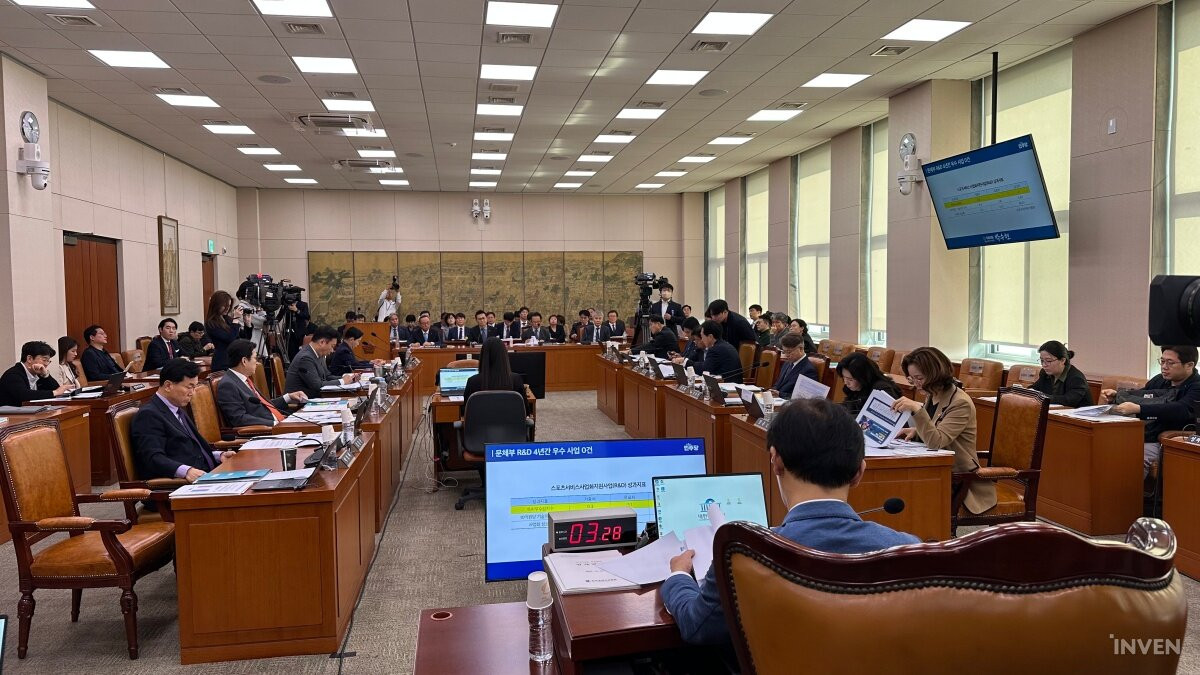
The number of games subject to post-management by the Game Rating and Administration Committee (GRAC) grew by nearly 30% in just one year, but the monitoring staff inspecting them was halved. This revelation was included in data submitted by both organizations to Representative Kim Seung-soo of the People Power Party on the 12th during the National Assembly's Culture, Sports, and Tourism Committee audit of the Korea Creative Content Agency (KOCCA) and GRAC. The materials also contained initial performance figures for the Probabilistic Item Relief Center and the agencies' diagnostics on the slowing growth of the gaming industry.
According to GRAC data provided by Representative Kim Seung-soo of the People Power Party, 2,019,426 games received age ratings in South Korea in 2025. This is an increase of 456,314 games (29.2%) compared to 1,563,112 in 2024. Of these, 2,018,659 games (99.9%) were handled by 11 self-classification entities—including Google, Apple, and Epic Games—and private classification agencies. User-generated content (UGC) from Epic Games alone accounted for 1,052,542 cases, representing 52.1% of the total.
Self-classification is a system where business operators directly rate games, and GRAC subsequently checks the appropriateness of those ratings. As volume grows, post-monitoring capacity directly impacts the credibility of the system. However, the budget for the 2026 online game monitoring project was cut by 970 million won (19.9%) to 3.9 billion won, down from 4.87 billion won the previous year. The budget for remote monitoring teams evaluating mobile game rating appropriateness dropped 44.7%, from 1.963 billion won to 1.085 billion won, while personnel was reduced from 205 to 103.
GRAC explained, "The decrease in remote monitoring budget led to a reduction in monitoring staff." The 2026 workforce includes 62 career-interrupted individuals and 41 people with disabilities, giving the project a welfare employment component for vulnerable groups.
Performance metrics declined alongside the cuts. Monitoring for rating appropriateness of self-classified games reached 119,934 cases in full-year 2025. In 2026, through the end of August, it stood at 40,980 cases—just 34.2% of the previous year's total. Even accounting for eight months passing, it remains roughly half the usual level. Over the same period, related administrative actions dropped from 6,978 to 2,531 cases. In response, GRAC conducted three special investigations into UGC games in 2026 and expanded its rating appropriateness advisory panel from 10 to 20 members.
GRAC's overall budget rose by 168 million won (1.0%) year-over-year to 16.378 billion won. While government funding grew by 889 million won, self-generated revenue fell by 721 million won. Operational expenditures decreased 1.7%, from 9.205 billion won to 9.051 billion won. Within that budget, 1.71 billion won was newly allocated to operate the Probabilistic Item Relief Center.
Conversely, funding for online game monitoring was reduced by 970 million won, and comprehensive information system development and operation lost 141 million won. Effectively, existing oversight budgets were cut to accommodate new duties within a shrinking operational fund.
The amended Game Industry Promotion Act, which took effect in August 2025, holds game companies liable for damages if they fail to disclose probability information or provide false disclosures. If intent is established, punitive damages up to three times the actual loss can be imposed. Based on this law, GRAC launched the Probabilistic Item Relief Center in February 2026.
Through late August, the center handled 737 cases of damage consultations. Of these, 25 cases (3.4%) progressed to formal filings. Among the formal filings, relief recommendations were issued in 6 cases, and 4 cases were resolved through agreements between game publishers and users. These 4 resolved cases included the first instance of relief involving a foreign game title. Another 4 cases were closed internally, while the remaining 15 ongoing investigations center on just two game titles. Separately, the operators of two titles voluntarily proposed compensation packages totaling approximately 650 million won for all 2,233 affected players.
The GRAC report provided no explanation for the gap between consultations and formal filings. The absence of established criteria for calculating financial damages also remains a variable. GRAC has been conducting a research study on 'Guidelines for Calculating Relief Amounts for Probabilistic Items' since August. The online relief application system went live on August 31. Case-sharing integration with the Content Dispute Resolution Committee is planned for 2027.
Administrative sanctions for probability disclosure violations have tightened. Corrective orders totaled 31 cases through late August 2026, already surpassing the 22 cases recorded in all of 2025. Corrective requests, the initial enforcement tier, stood at 1,226 cases, representing 77.0% of the previous year's 1,592 cases. Starting in 2026, GRAC streamlined procedures in consultation with the Ministry of Culture, Sports and Tourism by bypassing the intermediate step of corrective recommendations. Domestic distribution restrictions totaled 5 cases, down from 7 in 2025.
An internal GRAC audit in 2026 pointed out the need for more proactive administration when handling complaints regarding fake probabilities. Consequently, GRAC introduced a standardized probability verification system.
During the 2025 audit, the National Assembly cited negative growth in the gaming industry and demanded that KOCCA devise measures for export diversification and small-to-medium enterprise support. In its action report submitted to Representative Kim, KOCCA diagnosed that "export revenues decreased due to issues surrounding game publishing licenses (Panhao) in China." As countermeasures, KOCCA announced plans to expand international market participation from three events in 2025 to five in 2026, while newly introducing localization support based on global user evaluations for 30 games. It also stated it would continue advocating for amendments to the Restriction of Special Taxation Act to introduce tax credits for game development costs.
Civil complaints received by GRAC through late August 2026 totaled 2,783, reaching 81.1% of 2025's full-year total of 3,430. While incoming filings were lower than the previous year, unresolved complaints stood at 97—3.3 times the 29 recorded for all of 2025. Of the 97 unresolved cases, 51 were procedurally unprocessable complaints (compared to 29 in 2025), and 46 were under review/processing (compared to 0 in 2025). Complaints transferred to other agencies reached 606, already exceeding the full-year 2025 figure of 526.
As of August 30, civil complaints received by KOCCA reached 2,936 cases, surpassing the 2025 full-year total of 2,537 in just eight months. This figure combines petitions from e-People (Kookmin Shinmungo), applications for Content Dispute Resolution, and information disclosure requests. Resolved cases increased from 1,960 to 2,728, while transfers to other institutions decreased from 577 to 208.
Comparing the materials submitted by both agencies indicates that the focal point of gaming administration is shifting toward user damage relief. Budgets and organizational structures were newly established in line with legal revisions establishing grounds for compensation, and the execution of corrective orders also increased.
In contrast, post-classification verification capacity has regressed. While rating volume is surging due to self-classification and UGC, Phase 2 of the transfer—handing over mobile and simplified rating classification to the private sector—is set to take effect in November. While the responsibility for assigning ratings expands across the private sector, the workforce assigned to review them after release has been cut in half.