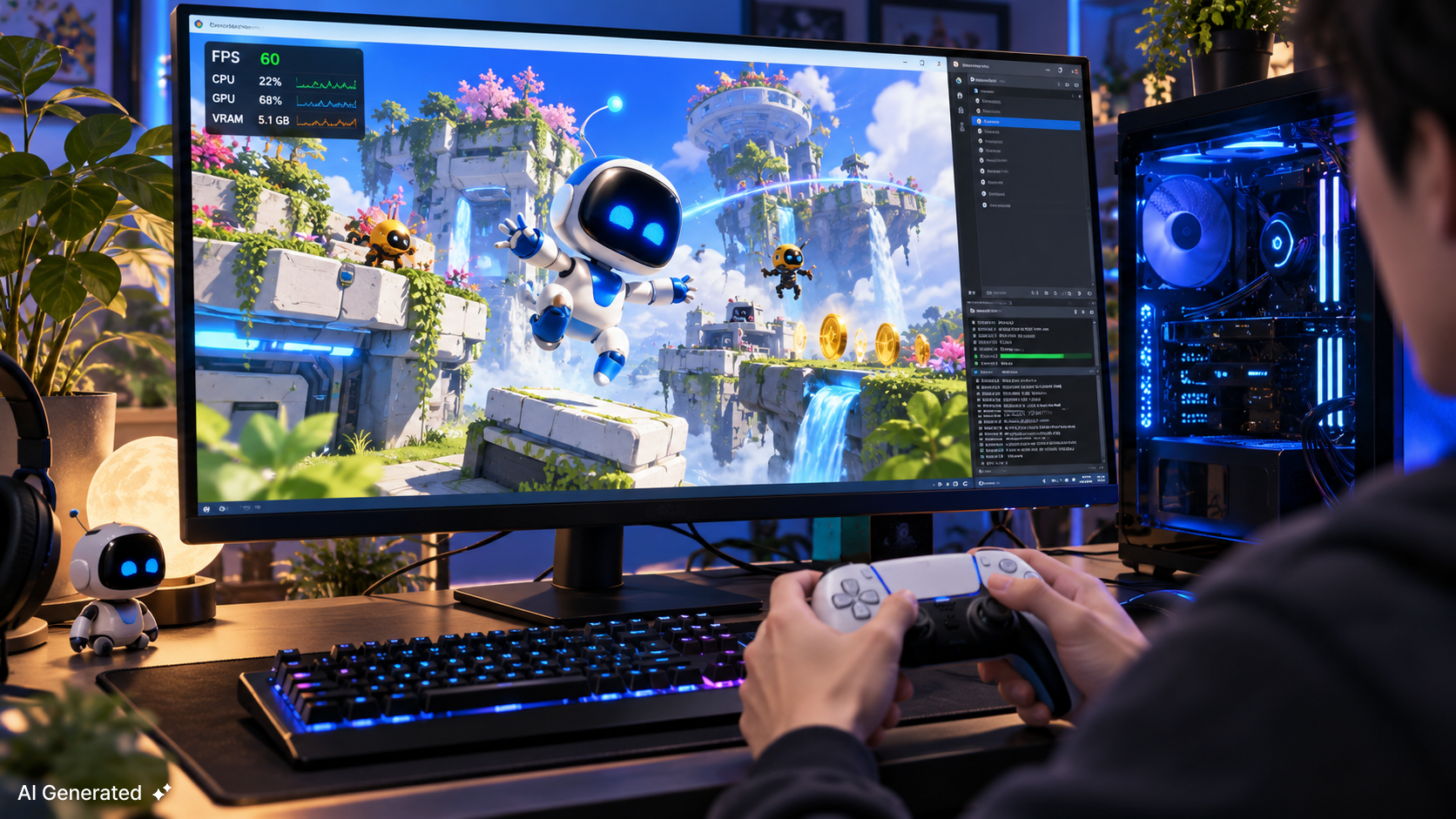
PlayStation 5 (PS5) emulator development is making rapid progress in October. The open-source emulator 'SharpEmu' released v0.0.5-nexus on October 3, after which major PS5 titles including 'Astro Bot', 'Astro's Playroom', and 'Demon's Souls' successfully booted into actual gameplay.
In this update, the emulator's core infrastructure—including GPU shader conversion, Vulkan-related processing, input handling, and memory management—has been significantly improved. With added compatibility enhancements for individual titles such as 'Astro Bot', 'Demon's Souls', 'GTA 5', and 'Gran Turismo 7', instances of running major 3D titles are increasing rapidly.
As of October 6, SharpEmu's official compatibility database lists 9,176 PS5 titles, with 62 games actually tested. Among them, 22 have reached the gameplay stage, and 12 have reached the 'Playable' tier as categorized by the developers.
In particular, both 'Astro Bot' and 'Astro's Playroom', tested on October 6, reached in-game gameplay sections. A day earlier, Bluepoint Games' 'Demon's Souls' also successfully ran in-game. However, none of the three titles are at a fully playable level yet, with various issues remaining, such as performance drops and graphical glitches.
Because of this, it is still too early to say that "PS5 games can be properly played on PC" via current PS5 emulation. SharpEmu also breaks down compatibility statuses into Bootable, Menu, In-game, and Playable, with "In-game" defining a state where game visuals and controls work, but progression-breaking issues remain.
Nevertheless, the recent developments are drawing attention due to the pace of development. Until recently, achievements were concentrated primarily around relatively simple 2D games, but now major 3D PS5 exclusives like 'Astro Bot' and 'Demon's Souls' are beginning to display actual gameplay. With other projects such as 'KytyPS5' and 'AnyPS5' being developed concurrently, overall progress across PS5 emulation appears to be accelerating.
▲ Video of 'Astro Bot' running on PC using KyTyPS5 @Unreal Gaming PC
Apart from technical advancements, however, legal issues remain. Emulator programs themselves are not inherently illegal under the law. In the 2000 case *Sony Computer Entertainment v. Connectix Corp.*, the U.S. Court of Appeals for the Ninth Circuit ruled that certain reverse engineering performed to develop PlayStation-compatible software constituted fair use.
The issue lies in the encryption and technological protection measures (TPMs) of modern consoles. Section 1201 of the U.S. Digital Millennium Copyright Act (DMCA) generally prohibits circumvention of technological protection measures that control access to copyrighted works. Therefore, replicating console functionality using independent code and illegally distributing firmware or encryption keys—or circumventing protection measures—can be treated as separate issues under the law.
A prominent case is Nintendo's 2024 lawsuit against the Switch emulator 'Yuzu'. Nintendo sued developer Tropic Haze, alleging that Yuzu bypassed technological protection measures using Switch encryption keys and facilitated piracy. The two parties settled before going to trial, with Tropic Haze paying $2.4 million to Nintendo while ceasing development and distribution of Yuzu. However, because the case did not end in a final judicial ruling, it cannot be used as definitive proof that "emulators themselves are illegal."
Ultimately, how PS5 emulators achieve functionality is expected to be just as important as how many games they can run in the future. While technical progress is clear with major PS5 titles reaching gameplay on PC in October, the issues surrounding firmware, encryption keys, and circumvention of protections mean that as development accelerates, legal controversies are also likely to grow.