The talk began like a story. Early in his career, he showed a finished manuscript to an editor, only to receive back more feedback than the length of what he had written. He recalled pacing around his living room that night, unable to sleep a wink. It was the first time in his life facing expert advice that he couldn't ignore. And that meticulous editor would go on to become a mentor who followed him like a shadow for years, offering endless advice.
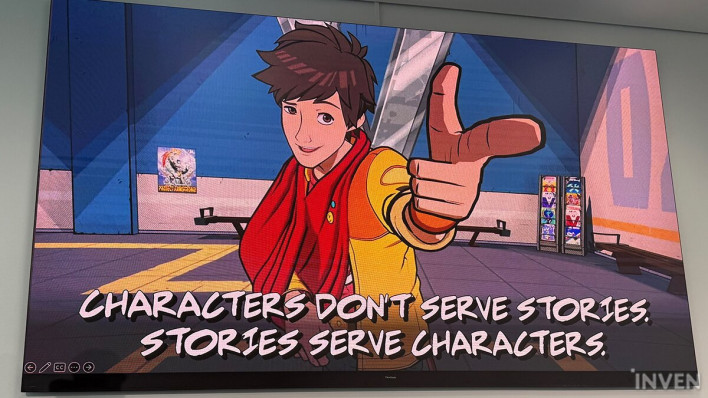
The talk was an occasion to explore the principles he learned from that mentor, drawn in parallel to his experience working as a writer on the game 'Hi-Fi RUSH.' At the start of the talk, he emphasized the core takeaway if there was only one lesson to remember: forcing characters into actions out of character simply because the plot demands it is the wrong order of operations.
For example, if you establish that a character has a fear of heights, you cannot have them fight a climactic battle on top of a skyscraper just because it looks cool. That fear must be dealt with head-on and become its own narrative arc.
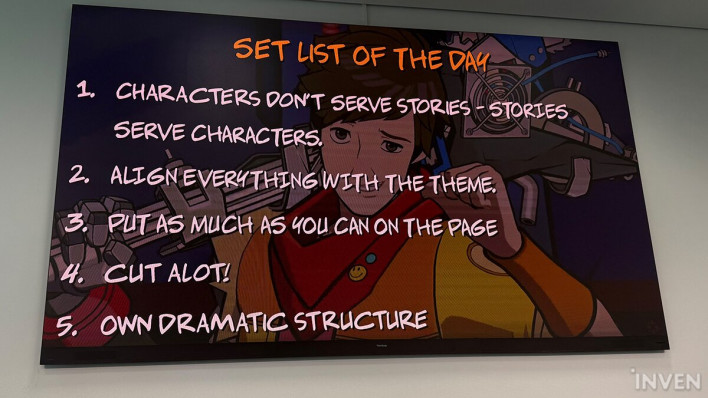
Characters do not serve the story. The story serves the characters.
He said that was the most important piece of advice he could share today.
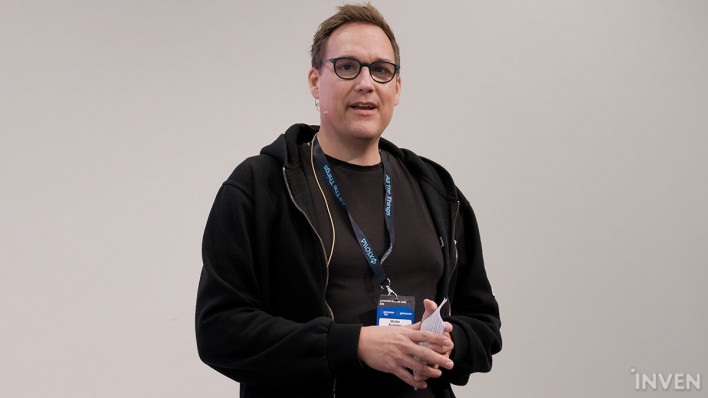
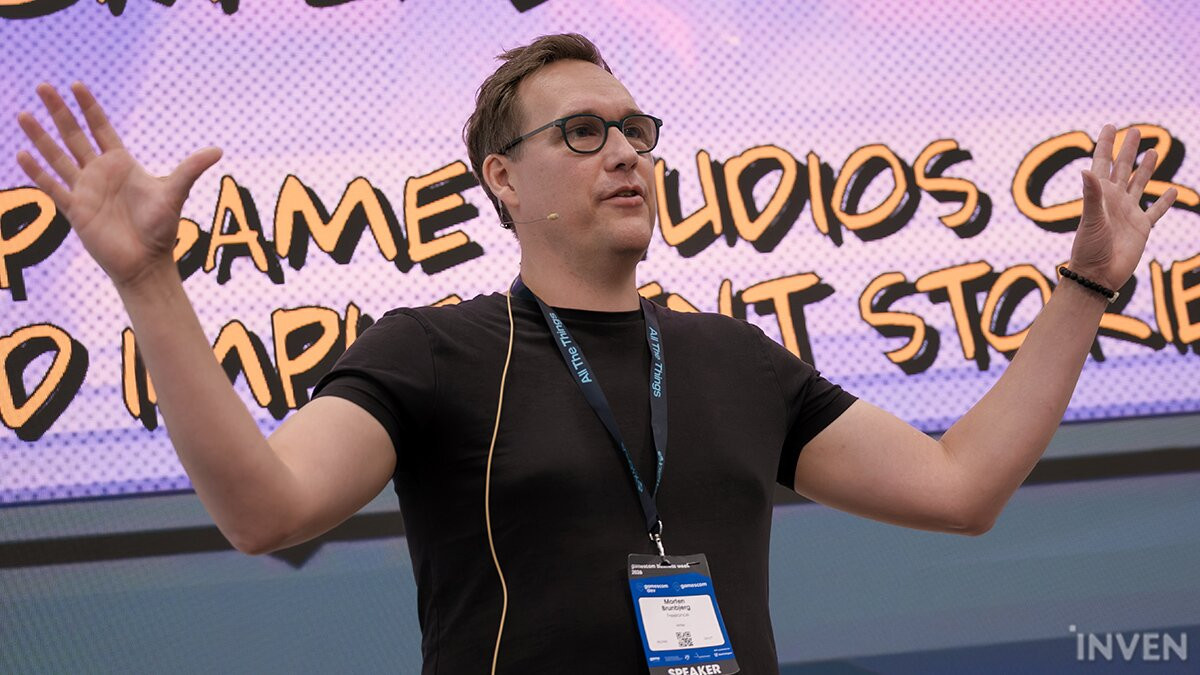
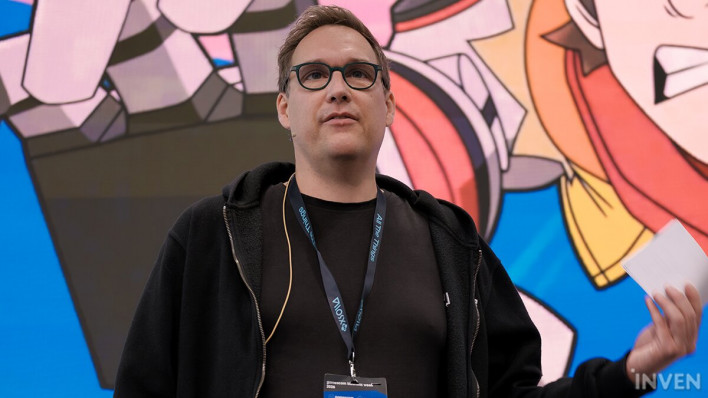
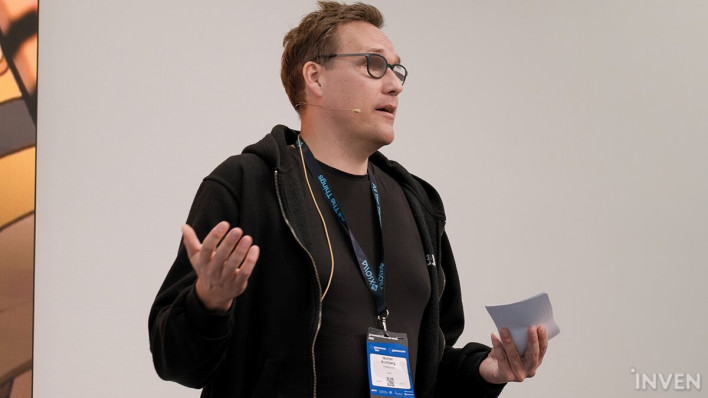
Morten Brunbjerg is a freelance game writer from Denmark. Over his 14-year career, he has worked on more than 30 games and introduces himself as striving to write tightly structured stories that carry emotional depth while landing lightly. Having participated in various game development processes, he was initially hired through an agency for 'Hi-Fi RUSH' to trim unnecessary content from the original script. However, he later gained the opportunity to directly write several scenes. Throughout the talk, he candidly walked through what he gained and what he felt was regrettable during this process.
Characters Come First, Story Second
'Hi-Fi RUSH' is the story of Chai, a young man who gets a robotic arm after having a music player embedded in his chest, using that power to rhythmically experience everything in the world to the music while pursuing his dream of becoming a rock star. Shooting back, "My name is Chai, not Defect!" to those who call him a 'defect' succinctly captures his character's attitude.
Chai, who initially believed he could become a rock star all by himself as long as he had his robotic arm, realizes as the story unfolds that he needs friends to stand by and a place to belong. Brunbjerg explained that 'nobody can be a rock star alone' is the central theme that runs through the entire story. On his journey, Chai meets many companions and changes his attitude toward life, but at the same time, he finds himself caught in a sinister conspiracy unfolding at the corporation, forced to fight for his life.
Brunbjerg viewed the characters themselves in 'Hi-Fi RUSH' as a bigger draw than the story. What mattered more than what the plot actually did was the relationships between Chai and the bosses. Thus, the team intentionally placed emotional moments throughout the game—moments that are often omitted in somewhat exaggerated comedy genres.
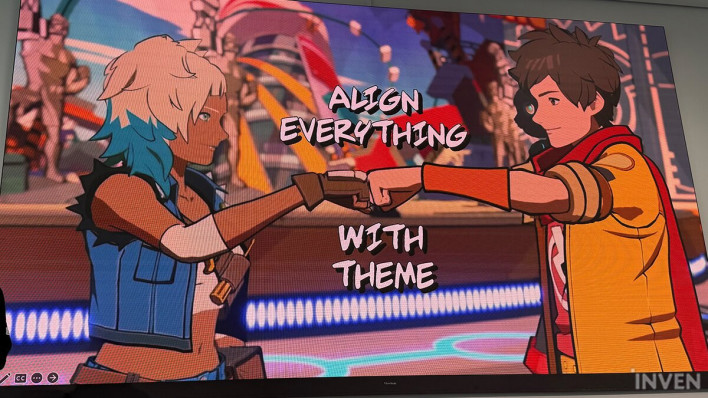
He assessed that this balance came alive especially around two characters: the protagonist Chai and his companion Peppermint. As the game progresses, Chai realizes on his own that he needs a team rather than going it alone, which is directly reflected in the gameplay mechanics. Right before the climax battle, Chai—who has been glib and nonchalant the entire time—has a single scene where he admits, "I don't know what to do." That is the first and only moment in the story where he reveals such vulnerability, and Brunbjerg said this single fracture firmly anchors the emotional weight of the game's overall theme.
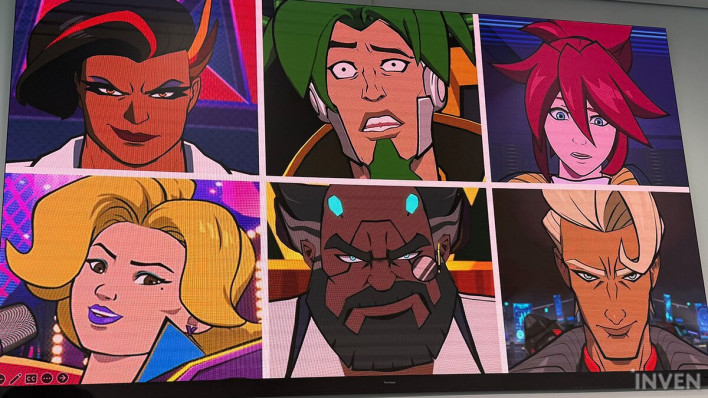
However, there were also points he found slightly regrettable. To maintain consistency with the theme, villains are typically portrayed as figures who fail to understand what the protagonist comes to realize until the very end. Yet the bosses in 'Hi-Fi RUSH' communicate and cooperate among themselves almost like a 'family.' In other words, writer and director John Johanas chose to use the villains for corporate satire—showing megacorp supervillains dealing with budget cuts or losing their minds on work-from-home video calls—rather than emphasizing the core theme through them.
While it did not fit the theme perfectly, Brunbjerg added that it was a far more entertaining choice, and that he fully agreed with the decision.
The Theme Must Run Through the Entire Script
His second principle is that once a theme is established, every single page of the story must pass through it. He shared a favorite anecdote about a writer who wrote down their story's theme on a piece of paper and taped it to their typewriter to make sure of it. That way, every page passing through the typewriter passed through that theme as well.
He reflected that the theme of 'Hi-Fi RUSH' was 'no one achieves anything alone,' which was well reflected in the gameplay itself. As the story progresses, more companions join, and the player gets to directly control multiple characters alongside Chai. In other words, the game proves through its very systems that it is by no means a one-man show.
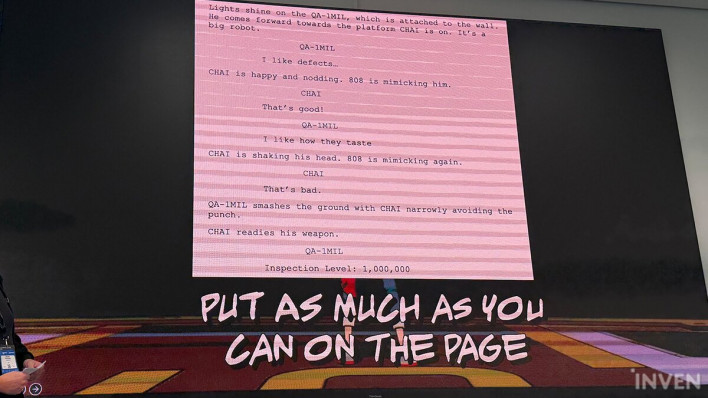
The next lesson is to 'put as much onto the script pages as possible.' When he first joined the project and received the script from Tango Gameworks, he couldn't understand what he was reading at all. There was a scene where Chai was facing off against a giant robot, but with almost no stage directions and having not seen the characters or heard their voices yet, he had no way of guessing how big the giant robot was or what was actually happening. He acknowledged that this was not a flaw in the script, but purely his own lack of understanding at the time.
Shortly after taking on the job, he was fortunate enough to visit the studio in Tokyo and see the actual artwork firsthand. There, he met legendary developer Shinji Mikami, who was one of his idols. Mikami stood up and greeted him with a joke, asking, "How are you doing? Everyone from Scandinavia is so handsome!"
Mikami then asked him what his favorite movie was, a question Brunbjerg noted Japanese developers love to ask based on his multiple experiences working with them. Having been unable to sleep on the 20-hour flight, he gave as his answer 'Thank You for Smoking,' a film he had rewatched for the first time in a while, but Mikami was not familiar with it.
Soon after, he met John Johanas, the writer and director of the game, in the adjacent office, and only after playing the demo did he fully understand why the script was written the way it was. During their conversation, when Johanas explained his preferred dialogue style and asked, "By any chance, have you seen 'Thank You for Smoking'?", Brunbjerg realized that it happened to be Johanas's favorite movie as well.
Similar coincidences kept happening after that. While brainstorming a scene showing the history of Vandelay Technologies, the company serving as the game's setting, Johanas mentioned he wanted the vibe of a cheap, crude museum exhibit—like cardboard cutouts wobbling along a track. He then asked if there was a good reference for that. At that moment, the work that came to Brunbjerg's mind was the animated series 'Futurama.'
It was an episode featuring a fake whale at an amusement park built on the Moon, and Johanas was already sliding a sheet of paper with that exact scene across the desk. Brunbjerg said he learned that when you experience moments like that, you should never let them slip away, and you should keep such people close to you for a long time—because finding someone with that kind of creative chemistry is rare.
Cut Relentlessly
The next principle is to 'cut heavily.' In fact, the reason he was initially hired for the project was to trim unnecessary weight from the script. In his words, there used to be far more dialogue than there is now, but they cut out expositional lines and filled those spots with jokes. He laughed as he explained that the cheeky humor distinct to 'Hi-Fi RUSH' consisted mostly of what director Johanas and he found funniest, and because the team's decision-making chain was short, if the two of them laughed, it went straight into the script.
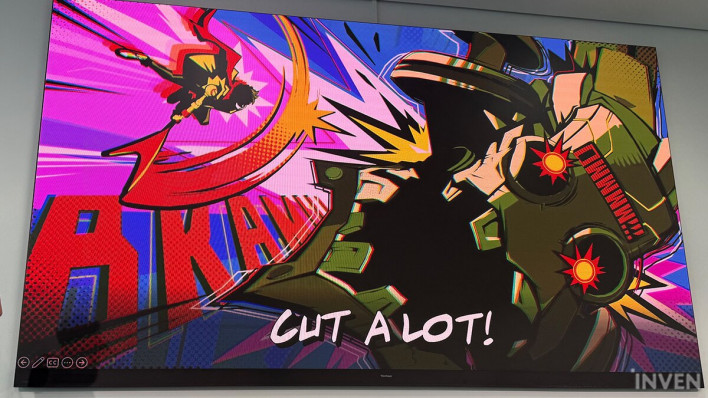
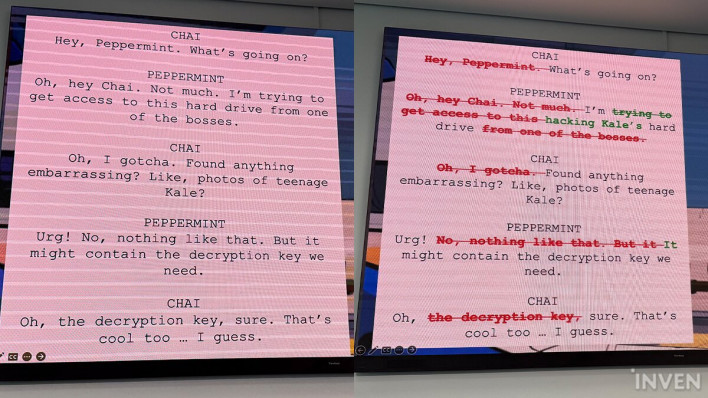
The easiest editing technique is to start by stripping away formal courtesies like greetings, small talk, and thank-yous. Looking at a single scene it might not seem like much, but accumulated over multiple pages, it adds up to a significant amount. One tip he particularly trusts is writing characters so they don't immediately answer each other's questions.
Brunbjerg demonstrated this by creating a hypothetical dialogue example not found in the actual game. In the original version, Chai walks into a room and asks, 'What's going on?', to which the other character replies, 'We're trying to access one of the bosses' hard drives,' followed by meaningless pleasantries and extra detail. When the courtesies were stripped and rewritten so the question wasn't immediately answered, the word count dropped from 59 words to 32 words—a reduction of about 46 percent—while retaining the exact same information and jokes.
The same principle applies to building tension. For example, if a character asks 'when the bomb will explode' and the other immediately answers 'there are 60 minutes left,' the information is delivered, but the tension vanishes. Conversely, if you don't answer the question right away, move on to other lines, and drop the information later, you achieve both far greater tension and stronger characterization.
Of course, he emphasized that while there are cases where the game requires clearly informing the player of a time limit, withholding information when such constraints don't exist is far better for keeping conflict alive.
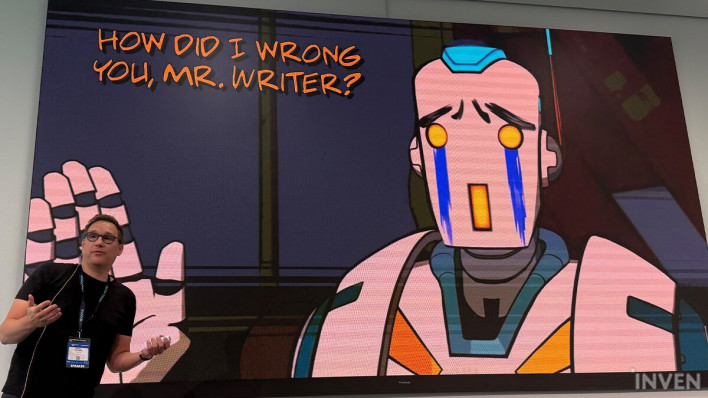
There was also an instance where an entire character had to be cut—or almost was. When he first joined, the robot character CNMN seemed to hold the least weight in protagonist Chai's personal journey according to the script, so he suggested cutting the character entirely. However, writer and director Johanas disagreed and fought for CNMN. Brunbjerg recalled that with every new script revision, CNMN's screentime and jokes only seemed to increase.
Ultimately, Johanas's judgment in defending CNMN proved to be right. CNMN became one of the fan-favorite characters, responsible for many of the funniest moments in the game. Brunbjerg said he was actually glad to have been wrong in this instance. He cited one of his favorite cutscenes as a moment where, due to budget constraints, an animation beat that was created once was reused twice.
It was also an homage to the fade-out direction typical of Saturday morning cartoons—something he hadn't understood during his childhood in Denmark, where television had no commercials. He realized only later that this technique was used to make room for commercial breaks. Using this device, he wanted to sneak the line 'Holy shit' into the game, and expressed satisfaction that the finished scene landed exactly as intended.
Dramatic Structure Is Everywhere
Before returning to the final story, he brought back the story of the mentor mentioned at the beginning of the talk. His name was Sten—meaning 'stone' in Danish—and he had passed away about ten years ago. Brunbjerg shared that in the process of discovering who he was as a writer, he came to view himself as a mosaic made up of the people he had met. The pieces left by that mentor formed a large part of that mosaic. Adding that people in the game industry seem uniquely adept at filling in this mosaic throughout their careers, he noted how much he loves the process of an image that is never truly complete yet continues to grow.
He chuckled, saying that the mentor even upheld narrative convention by appearing at the exact, perfect dramatic moment for a mentor to enter—right when he had finished his first novel and needed candid expert feedback.
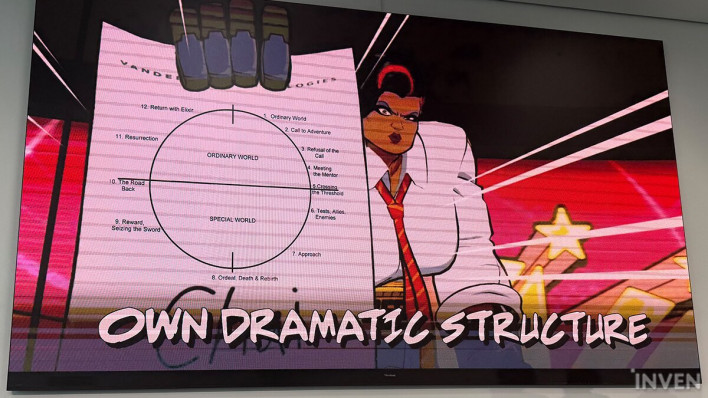
This naturally led into the final lesson: dramatic structure. He prefaced that he would not rehash basic theories like the Hero's Journey. Rather, the key takeaway is that everything benefits from dramatic structure—it's simply a matter of picking a structure you like and committing to it. What worked effectively in 'Hi-Fi RUSH' was a setup where defeating each boss served as an act, and every turning point was accompanied by an event such as a plot twist or the introduction of a new character.
However, he summarized that the game is not strictly a three-act structure, nor is it a Hero's Journey. While it didn't rigidly follow conventional dramatic formulas, it still possessed a clear structure of its own. The reason the game truly resonates is that its structure is tightly intertwined with the characters, never missing their emotional beats along the journey.
He added that dramatic shifts don't always need to be grand. Even tiny moments—like taking off glasses to view the world differently or stepping across a threshold—can serve as a turning point. With that, he broke down the structure of his own lecture on the spot.
An introduction opening with the mentor, establishing the theme that the story serves the character, the inciting incident of being invited to Tokyo to meet the team and play the game, Act 2 kicking off with a small transition like taking off his sweater, placing the story of failing to cut CNMN in the mid-point of Act 2 where things can drag, the moment of crisis and loss with the death of his mentor, and leading all the way to this climax—he revealed that the entire flow of his presentation was already following a dramatic structure.
Wrapping up the talk, he introduced himself as someone who helps studios with story planning and execution. Welcoming anyone who wished to talk more about 'Hi-Fi RUSH' or anything else during his stay over the next few days, he closed his presentation by thanking the audience for listening to his rambling.
■ Q&A
Q. In high-difficulty games like 'Hi-Fi RUSH,' failing repeatedly at the same spot makes it hard to maintain narrative flow and immersion. Do you have any tips for tailoring storytelling to a game's difficulty?
= There are broadly two ways. One is a relatively low-cost method: writing lines in advance that won't get annoying even after hearing them multiple times. The other is adding a system like a counter that tracks how many times a player has died in the same section, but that is a much larger undertaking requiring separate discussions with programmers or playtesters. If playtests have already confirmed that players struggle with a specific section, perhaps the issue that needs fixing isn't the narrative.
However, if it's already too late for that, you might consider inserting a line where a character subtly acknowledges the situation—saying something like, "Feels like we've been here a while"—to lighten the mood.
Q. At what stage do you start applying dramatic structure? From the first draft, or only during the editing phase?
= 'Hi-Fi RUSH' wasn't a script I wrote from scratch, but a project I joined mid-way and took over. So I worked by first examining the structure of the existing script to identify its beats, then fitting them as closely as possible to my preferred structure. For projects written from scratch, I prefer establishing the structure as early as possible.
Stories naturally change organically, so the earlier you map out the structure, the easier subsequent team discussions become. That's why I make it a habit from the start of a project to help team members stay aware of dramatic structure. If you write out and share ahead of time in headline form which beats belong where, then even if a request comes later due to budget constraints to 'cut the moment of crisis and loss,' you have a logical basis to ask back, 'Then what will replace it?' It serves as a lever to make invisible structure recognizable to the whole team.
Q. You mentioned trying to cut CNMN was your biggest mistake, but wasn't John fighting to keep him actually the best decision? Isn't the scene featuring that character the most memorable emotional moment in the game?
= It sounds like a leading question, but it's a great point. In the creative process, you often get frustrated with people who oppose your judgment—whether it's a director or a producer—but in reality, such figures are indispensable. Having someone pull like a stretched rubber band forces you to recheck yourself. We often see in the industry what happens to creative projects when they reach a point where no one challenges them.
Q. As a Dane writing a story in English in Japan, which is then localized into multiple languages, how do you ensure jokes survive across different languages?
= It's actually an easy answer: that's not my problem. I don't speak Japanese, and beyond English and Danish, I only know a bit of German and Swedish. I do know that relying heavily on puns means they likely won't translate, and while you could prepare alternative expressions for such cases, it comes with a steep cost.
Ultimately, it's something that has to be left to the translators—a luxury of a dilemma for me. However, John is an American living in Japan, so he possesses a unique sensibility that blends American and Japanese storytelling. I also learned that many of the writing rules I took for granted don't hold universal truth in other cultures. On other projects, what was familiar to the entire Japanese team differed from what worked for European and American audiences, requiring discussions to reconcile those differences.
Q. While reviewing the script, were there any scenes or moments where you felt, 'This is tailored specifically to the Japanese market, so it might not work globally'?
= There were no such moments. However, when I first read the script before seeing the artwork, I felt the cliches were excessive, the action over-the-top, and Chai seemed selfish—but once I saw and heard the actual game, it finally made sense. After moving past that point, nothing particularly caught my friction.
We did, however, have multiple discussions within the team about what territory jokes could venture into—such as deciding not to push the tone as far as 'Family Guy.' The standard for drawing that line was less about cultural differences and closer to whether it fit the genre and tone of the project we were working on.
Q. When friends show you draft writing and ask for feedback, you don't want to discourage them even if you see flaws. Do you have a way to advise without damaging motivation?
= Even now, when time allows, I continue reviewing dialogue for novice writers. It's tough, but I believe the reason someone asks me for feedback is ultimately because they want to improve, so I try to deliver the facts as plainly as possible. Back when I worked as an editor, I often struggled because I could point out what was wrong but couldn't explain why. Since then, if something catches my eye, even if I don't know the exact reason, I leave a comment saying 'there's an issue here' and move on, trusting the approach of coming back to explain once the reason comes to me later.
When delivered plainly alongside accurate reasons, people generally accept it well. Before starting feedback, I always ask what the goal of the writing is. The approach differs completely depending on whether it's a hobby story for family to enjoy or an ambition to move into publishing or professional work. If it's the former, I hold back most critiques; if it's the latter, I ask for understanding in advance that I will treat it professionally.
Q. You need to keep dialogue short and punchy while retaining essential information for players, whether it's plot or instructions. As someone who knows all the cut content from earlier drafts, how do you gauge the perspective of a first-time reader?
= It really is a challenge. You don't easily forget what was in the first draft. The rule I set for myself is to always place core information related to the mission at the very end of the scene, pushing it back as far as possible. Even if you want to unleash a barrage of jokes, at the end of the scene, the player must accurately receive the necessary information.
That's because you can't expect players to remember information given right at the start. In addition, I also apply the principle of building tension by having characters not answer questions immediately. For longer scenes, I design the dialogue so that it 'pivots' at a certain point—creating a spot where the tone shifts, such as starting on a positive note and flipping to negative. I place the crucial information right after that pivot point, while focusing on setting the tone and mood prior to the pivot.
Q. The approach you introduced today is close to a tightly orchestrated script style like a film score. However, many games are built on live-service models lasting over five years, or non-linear structures where players discover stories out of order. How would you adjust your approach for such structures?
= If anyone knows that answer, I'd love to hear it myself. It's no easy problem. However, I am a very structure-oriented person, so even on projects where the order can be jumbled, I try to keep the big picture in my head as much as possible by drawing flowcharts and visual breakdowns of characters. Dramatic structure itself remains valid even in non-linear setups. Regardless of the sequence in which the story unfolds, if you map it out like a chart beforehand—showing how many paths exist in Act 1 and how many transition points lead to Act 2—you can ensure players experience a dramatic structure in some form no matter which path they choose.
I heard an analogy back when I worked at an airline regarding how pilots are taught to respond when an airplane enters a stall. When speed drops and lift is lost, the aircraft begins to shake, and novice pilots instinctively panic and pull back on the stick. In reality, you must push the stick forward to lower the nose, which quickly recovers speed so you can climb again. This analogy gave me comfort in accepting that you cannot fully control narrative. Ultimately, there comes a point where you have to let go of some control, trust the team and process, and dive in.
Q. In the process of shaping dramatic structure, at what stage does theme emerge? Is it clear from the beginning, or does it naturally reveal itself through writing and discovery?
= It feels like a bit of an excavation process. While starting with a clear theme from the beginning is ideal, as with all game development, situations constantly change. It's common to think a story is about one thing initially, only to realize later that it has headed in a completely different direction. Thus, the theme must evolve along with that process.
However, if possible, the very first question I ask upon joining a team is, 'What is this story about?' Like the typewriter analogy mentioned earlier, I want everything to pass through that theme and take on its color. I've even experienced cases where, years into a project, people finally react with, 'Ah, now I get what this story is about.'
Q. 'Hi-Fi RUSH' heavily features rhythm combat, and you mentioned the original script had far more dialogue. At what point do you judge that players will start to get bored and need to move to the next rhythm fight? Do you also account for players who skip dialogue entirely?
= A player with that tendency likely won't enjoy even half of 'Hi-Fi RUSH' in the first place, because if they don't like the characters and story, they'll choose another game. You can't write with those players in mind, but you still need to control the volume. I always write while imagining how many clicks it takes to finish a conversation and how long until gameplay resumes. Since I'm also someone who sets down the controller on the coffee table during cutscenes and waits around thinking, 'When do I get to play again?', that wait feels endlessly long unless the scene is deeply engaging.
However, while I could suggest what to cut, whether to actually implement those cuts wasn't my decision to make. One rule I strictly adhered to was never delivering important information during combat. You cannot handle storytelling while characters are trying to kill each other, so you must carefully select the timing to convey crucial narrative.
And you must always be able to explain to yourself why you cut a line. Usually, lines are cut because they repeat something already mentioned in another way; if information must be repeated for mission progression, it stays, but otherwise, I always trim it. Knowing that someone might challenge that decision someday, I've developed the habit of giving myself a reason for why a line was cut. It's not about cutting blindly—you must be able to state why you cut it.