What if a neuroscientist who used to help amputees regain movement in their hands ended up designing unique Augments in League of Legends one day? That is the story of Noor Amin, Senior Game Designer at Riot Games. How did someone who observed the world through neuroscience end up designing ARAM: Mayhem—a hit game mode that topped 5 billion cumulative play hours less than a year after release?
Amin is a trained neuroscientist who, before entering the games industry, worked in disability research designing accessible interfaces for people with somatosensory impairments. Later, after contributing to the development of titles like 'Five Nights at Freddy's: Security Breach' and 'Battlefield 2042', she now works on League of Legends. She turned her unique background and path into gaming into her strength.
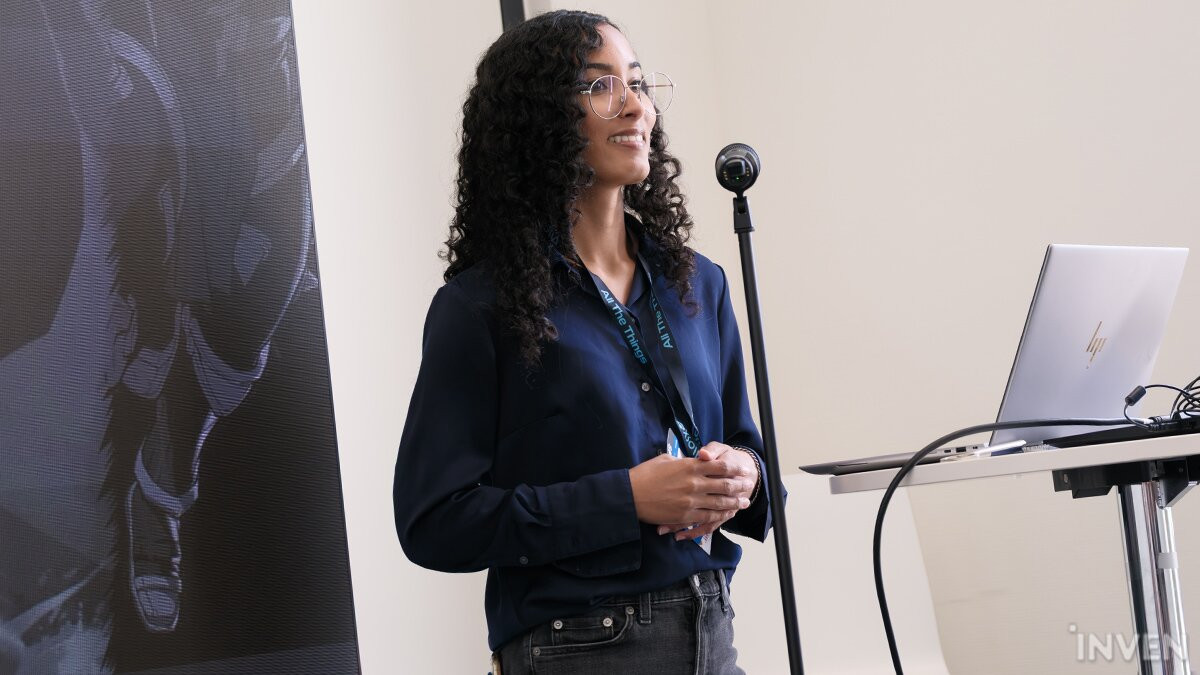
As she puts it, 'If neuroscience is a way to understand the world, design is a way to create it.' Rooted in the shared foundation of systems thinking, she analyzes ARAM: Mayhem and continues to create its Augments.
Through this session, she breaks down the design of ARAM: Mayhem, which evolved from modest expectations of 'lasting just a few weeks if we're lucky' into the most popular game mode in League of Legends history.
ARAM: Mayhem, a Product of Intentional Design, Not Chance
The talk began with a story from April 2025, when the speaker had just joined the game modes team. At the time, the development team was brainstorming ideas to revitalize ARAM (All Random on Mid; All Random), one of the oldest game modes in League.
First released in 2012, ARAM is a mode where two teams of five randomly assigned champions battle on a single-lane map to destroy the enemy Nexus. ARAM has consistently accounted for around 20 percent of overall player time, serving as a sanctuary for players seeking a more social, casual League experience. The team's goal was to refresh the mode in a way that authentically resonated with players who had stood by it for nearly 14 years.
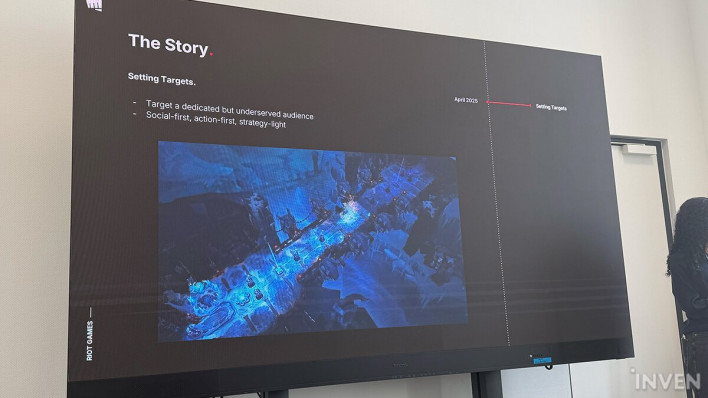
What the team ultimately chose was a progression system called 'Augments.' Augments offer choices presented at specific level-up milestones during a match, where players select one out of three options and re-roll if needed. Divided into Silver, Gold, and Prismatic tiers, they deliver distinct play fantasies.
For example, players can create bizarre combinations impossible under existing game systems, such as playing a favorite tank champion and growing so large that their body covers 30 percent of the screen, or giving a mild-mannered healer champion a menacing execute effect. ARAM: Mayhem was launched after just five months of development by a small team with a modest budget, and the team watched the initial reaction closely. Expectations were so low at first that they anticipated maintaining the service for only a few weeks.
However, the results far exceeded expectations. In its first week alone, ARAM: Mayhem generated twice the expected player time, even accounting for a majority of total play time in China. Like other League modes, it experienced organic growth during its first patch as players brought in friends and content creators, prompting the team to introduce an additional small content update for the Lunar New Year.
Normally, engagement would be expected to decline once the holiday boom waned and novelty wore off, but engagement rose again instead. Ultimately, game leadership decided to keep the mode indefinitely, and over the following months, ARAM: Mayhem continued to bounce back time and time again.
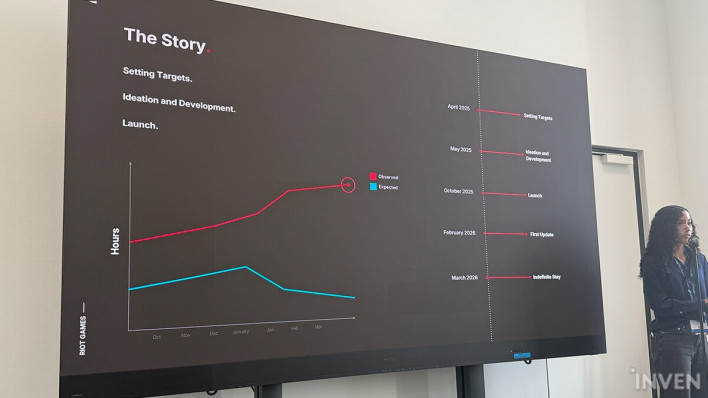
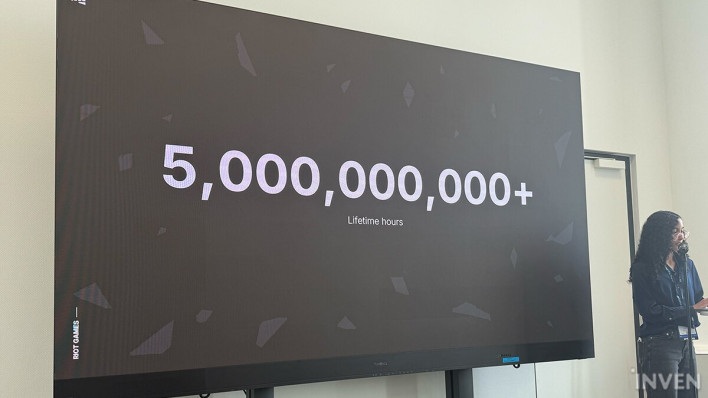
Today, less than a year after its release, ARAM: Mayhem has surpassed 5 billion cumulative play hours, establishing itself as the most popular mode in League of Legends history.
What the speaker highlighted as truly surprising was that this success was not merely an initial hit. She noted observing numerous games over the past year spike right after launch only to immediately plummet due to unforeseen market conditions. In contrast, ARAM: Mayhem saw engagement incrementally increase with every single update after release. Amin attributed the secret of this success to the design team's systematic and repeatable approach to evaluating design space and setting goals.
Dimensionality Reduction: Making Complex Problems Manageable
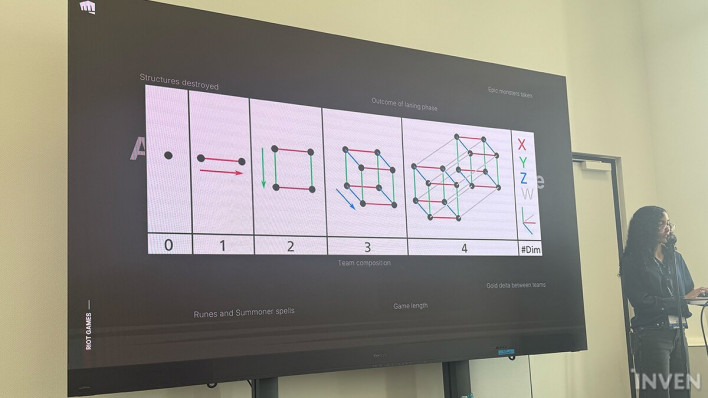
Amin explained that a single match of League of Legends can be characterized by numerous variables, including team composition, overall game length, item and level scaling over time, and skill variance. All these variables can be visualized as a multidimensional space where each plane represents the relationship between two variables.
To put it simply, gold income over time can map to one plane, while kill potential relative to gold maps to another. Here enters the concept of 'dimensionality reduction,' drawn from Amin's expertise in neuroscience. This is the process of reducing the number of variables describing a space while preserving core information, commonly used in machine learning when training algorithms on complex datasets. At the same time, system designers can leverage it to understand complex design spaces.
She shared an example of applying this concept to combat pacing issues in ARAM: Mayhem. Combat pacing refers to the temporal characteristics of interactions between champions. Initially, when Augments were added, a pattern emerged where damage was high but cooldowns were long, frequently causing highly attrition-heavy skirmishes. This made players hesitant to engage in PvP, diminishing the game's fun.
Looking into the problem, combat pacing was influenced by countless variables: chosen champions, selected Augments, champion power scaling over time, and environmental contexts such as terrain or obstacles. For a system designer, identifying which variables to adjust for healthier pacing is no easy task, especially when time to craft good solutions is scarce, as in R&D projects.
The first question to ask here is: 'What dependent variables can be consolidated?' In neuroscience, if multiple circuits produce the same output, they are considered connected, meaning only the most upstream circuit needs to be considered—a process called 'feature extraction.' In system design as well, a single variable often produces multiple downstream effects, making it useful to focus on the root variable.
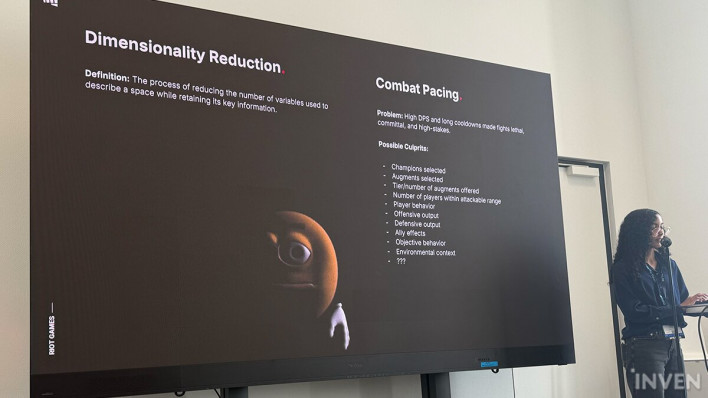
Amin explained that she dramatically trimmed the list by introducing new variables: one consolidating object behavior, environmental context, and players within target tracking range, and another for team composition consolidating selected champions, ally effects, and player behavior.
The second question is: 'What variables can be altered from a design value perspective?' Since the core issue was that Augments were shifting combat pacing in an undesirable direction, it was tempting to tweak the Augments themselves. In fact, changing every game to start with low-power Silver Augments would allow champion power scaling to be controlled much more strictly, technically solving the issue.
However, Augments were one of the core identities of ARAM: Mayhem. The team decided not to sacrifice novelty and variance to improve pacing, and as a result, all items related to Augments were excluded from the list.
The third and final question is: 'What is the highest-leverage solution?' Leverage is defined as value divided by cost, helping prioritize among feasible solutions. It is a method of finding the minimum required components to drive the behavior of the entire system. She explained that damage output curves and durability curves were the highest-leverage solution, being relatively easy to implement while delivering comparable value.
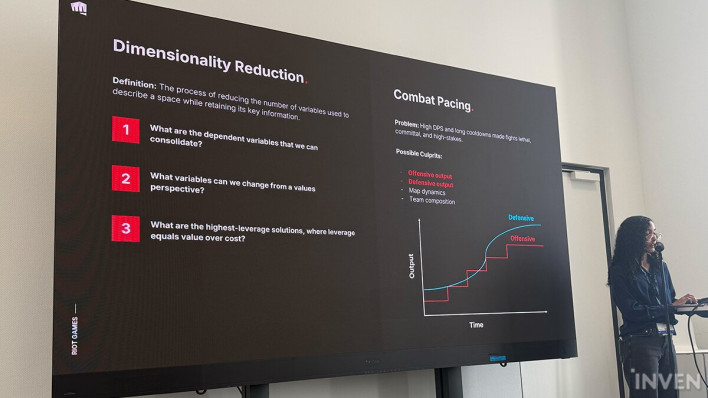
In League of Legends, a champion's damage output curve consists mostly of items and skills, drawing a step-like pattern because items can only be purchased after death. Conversely, the durability curve draws a much smoother curve because experience gained immediately upon leveling up is its primary component.
In ARAM: Mayhem, particularly early after obtaining skills when skills were at low levels and had long cooldowns remaining, the damage curve excessively outpaced the durability curve, resulting in disproportionately high damage relative to the match progression stage.
Reversing this relationship created more frequent yet lower-intensity PvP combat with a higher likelihood of death at lower damage numbers. Even though total kill potential was reduced in practice, the added bonus was giving players the impression of a faster game pace as Augments and skills activated earlier.
Dimensionality Expansion: Rapidly Producing Content
In contrast to dimensionality reduction, which simplifies complex spaces, 'dimensionality expansion' is a technique that increases the number of dimensions in data to enhance analytical precision. While classification algorithms in machine learning use it to make data more separable, for system designers, it serves as a tool to uncover nuance in new or untapped design spaces.
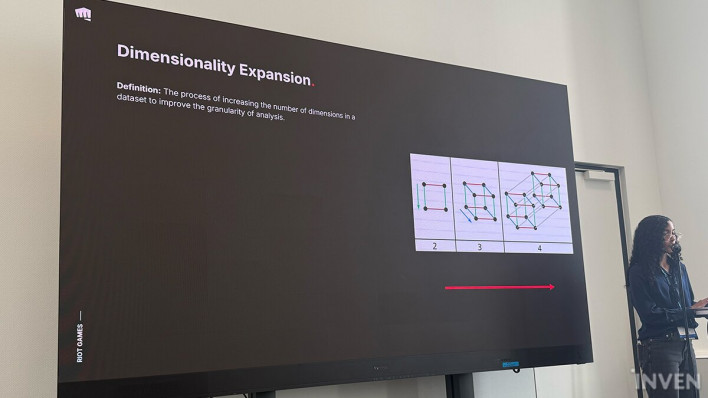
Amin introduced how she evolved her thinking by applying a systematic framework to content design in ARAM: Mayhem.
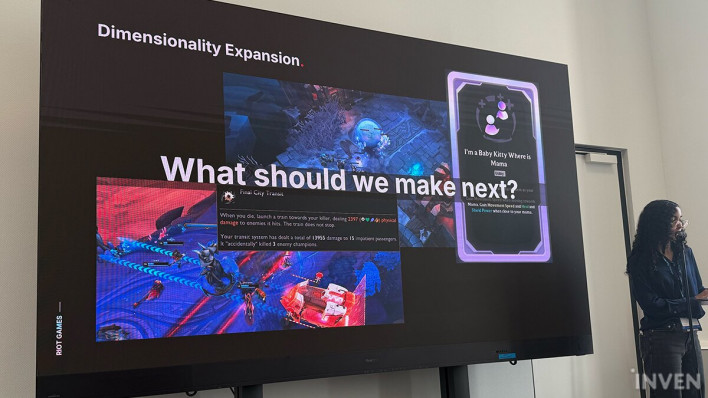
During the first month of development, the team simply tried to produce good Augments, seeking answers to the open-ended question: 'What should we make next?' Great ideas arising from this open-ended question—such as an Augment where a train spawns from a dying champion during a dive, or becoming a kitten looking for its mother—were actually shipped. However, as the team grew, a more intentional approach to content creation became necessary, and the team explored this space through three goals.
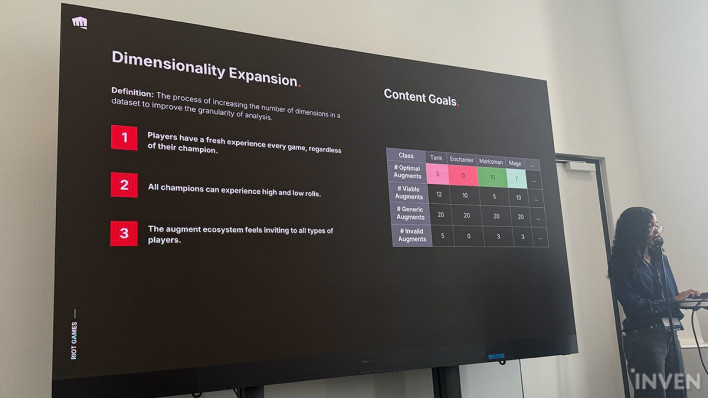
The first goal was ensuring that every match felt fresh, regardless of which champion was played. To achieve this, they built a 1D array categorizing the number of available Augments per champion and crafted dedicated Augments for underserved classes. This approach was effective in ensuring players had ample choices in every game.
The second goal was giving every player an opportunity to experience highs and lows in their role. To this end, they divided each class's full Augment pool into four subcategories. 'Optimal' Augments are rare options that create thrilling power moments; 'Viable' Augments appear often but aren't optimal; 'Average' Augments are frequently offered, solid options; and 'Invalid' Augments are unusable options filtered out completely from specific champion class pools.
The team identified which classes lacked or overflowed in the Optimal category and produced content to reinforce outlier classes. For instance, they adjusted Enchanters (roles supporting allies with heals, shields, and buffs; Amin categorized champion roles into Enchanters, auto-attack-focused ranged physical Marksmen, skill-based magic Mages, and Tanks) so they didn't feel unfun or, conversely, hit huge spikes too frequently. Expanding the 1D array into 2D enabled the team to impart both choice and variance to the Augment ecosystem.
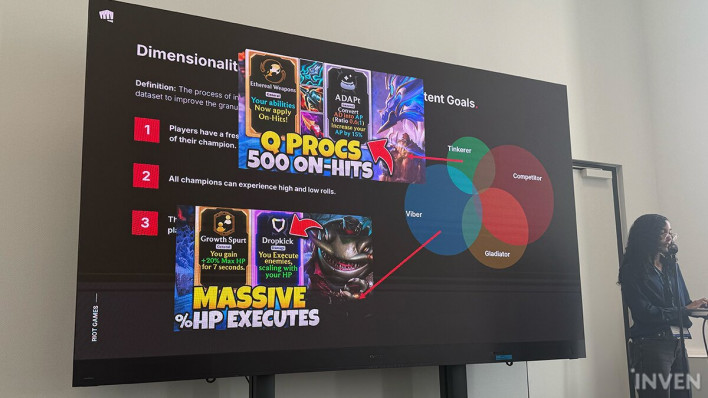
The final goal was designing Augments that appealed to every type of player. To accomplish this, the team categorized players into four primary archetypes.
'Competitive' players are focused on quantitative achievements such as win rates, forming the largest group; they are unsatisfied if they lose a match even after crafting a flashy build. 'Experimenters' find joy in testing various content and combinations, representing the smallest group that remains satisfied even through multiple losses as long as they get to see a unique build come together.
'Gladiators' value being the center of attention for other players, willingly choosing non-optimal builds if it creates a thrilling moment for the lobby. Finally, 'Vibe Players' want low-pressure quality time with friends, preferring low-execution-difficulty Augments even if it means sacrificing potential power.
By matching content types to these four archetypes, the team uncovered unfulfilled motivations, expanding the 2D array into a 3D array in the process. For example, an Augment stimulating 1v1 duels might appeal to Experimenters but not to Competitive players. Similarly, flashy, high-execution Augments like Dropkick appeal to Gladiators looking for spotlight moments, but not to Vibe Players who prefer to avoid embarrassment.
While noting that this example was tailored to her specific project, Amin stressed that in R&D projects—where large amounts of content must be generated early on to quickly validate ideas, whether characters, levels, or upgrades—dimensionality expansion can be used to churn out high-quality content in a short timeframe.
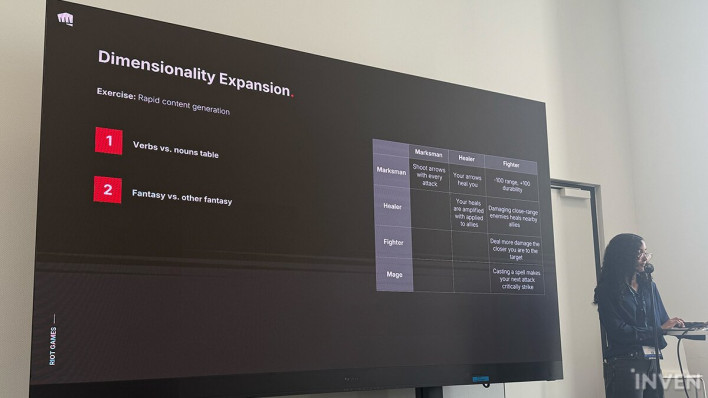
She also shared a content generation exercise she actually teaches her team's designers. First, build a 2D grid placing game nouns (such as keywords) on one axis and verbs (core player actions) on the other. Each cell serves as a prompt to create a new Augment. While combinations like 'Attack + Burn' or 'Ability + Burn' yield intuitive ideas, unintuitive combinations like 'Movement + Burn' or 'Kill + Burn' make for even better prompts.
For instance, ideas like an Augment leaving a trail of burn effects when dashing, one causing enemies to explode and burn nearby targets upon a kill, or one scaling burn damage higher with each kill can emerge from this exercise.
Another useful grid places fantasies on both axes, which is especially handy for character or theme-driven design. For instance, a Marksman seeking a ranged DPS fantasy would find an Augment that fires additional shots on attack intriguing, while a Marksman seeking a healer fantasy would be drawn to an Augment where attacks heal nearby allies. A Marksman wanting to transition into a Fighter fantasy might welcome an Augment that sacrifices range for boosted durability and damage, whereas one seeking a Mage fantasy would appreciate absorbing health through magic damage.
She added that this systematic approach is widely used in content design to rapidly develop ideas across multiple League modes, and similar techniques were applied when testing new sets in 'Magic: The Gathering', developing new recipes in culinary school, or even discovering new elements on the periodic table long ago.
Repeatable Systems as Design Principles
Summarizing the session, Amin noted that dimensionality reduction and dimensionality expansion served as powerful tools for system designers to conceptualize problems in ARAM: Mayhem. Dimensionality reduction is used when multiple promising candidate solutions exist and a single answer must be reached as quickly as possible, guided by three questions: What dependent variables can be consolidated? What variables can be altered from a design value perspective? And what is the highest-leverage solution defined by value divided by cost?
Conversely, dimensionality expansion is a technique for refining new spaces and uncovering new opportunities, inherently accompanied by player analysis in some form—whether based on game rule classes, characters, or psychological motivations. She concluded the talk by stating that this technique is commonly used to guide designers toward churning out high-quality content quickly in early-stage projects, followed by an interactive exercise where attendees experienced group-based content creation firsthand.
Q&A
Q. What was your experience working with other teams using Augment systems similar to ARAM, and did that experience influence the direction of Mayhem?
= Augments have been used across several League modes, most notably 'Arena', where Augments were first introduced. The biggest difference between Arena and Mayhem lies in their target player motivations. Arena focuses on Experimenter motivations—players who enjoy personalization and customization—aiming for a draft-centric experience centered on deeply understanding stat systems and creating builds that twist or break those systems.
In contrast, Mayhem targets a much more social audience, intentionally pursuing a low-pressure experience focused on doing the best with randomized options rather than elaborate theorycrafting and structured builds. As a result, numerous Mayhem-exclusive Augments were created that do not exist in Arena—social content emphasizing fun moments over winning, such as an Augment where a train spawns from a corpse during a dive or one that transforms a player into a Poro.

Q. When were the analysis and applications presented today actually conducted, and how strongly did that analysis correlate with the player growth graph? How much was live/test player feedback reflected during the adjustment process?
= The analysis took place across the entire development process. From a design value perspective, ARAM: Mayhem was set from the beginning to target a social, casual fanbase rather than Gladiators or Experimenters. This was a different direction from other League modes, which generally target competitive players, and was a value established early in the design process prior to release.
Post-launch, a lot of feedback was received regarding the level of hype and excitement in the mode. Players wanted a whackier, lighter feel than the initial release, so the team responded by experimenting with lighter, more casual systems—such as adding fireworks effects when securing specific Augment combinations. The team judged that the initial launch version carried too competitive a tone for a social mode.
Recent feedback mainly concerned the volume of content itself—specifically the number of Augments encountered in a match. Players wanted far more content than originally anticipated, and the Augment pool grew from 196 at release to slightly over 300 today. While external feedback continually asked for greater game-to-game variety, internal playtest feedback interestingly yielded relatively few mentions regarding a lack of variety between games.