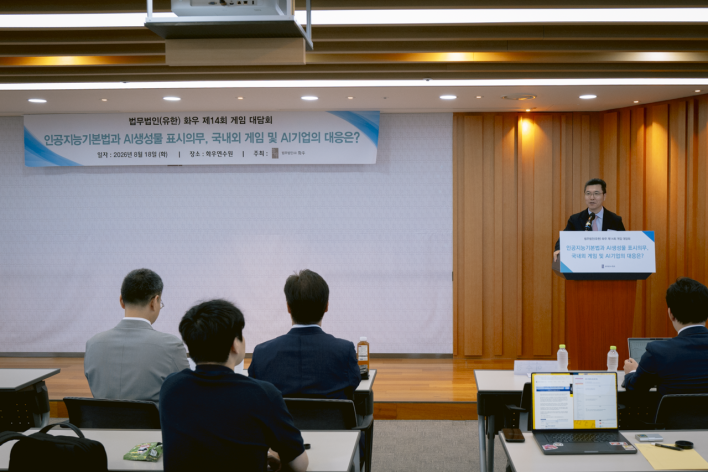
On the 18th, YOON & YANG LLC hosted the '14th YOON & YANG Game Seminar' at the Asem Tower in Gangnam-gu, Seoul. During the event, attorney Jung Ho-seon presented on 'Labeling Obligations for AI-Generated Content in Games,' while attorney Lee Soo-kyung discussed 'The AI Basic Act and Practical Aspects of the Local Representative System.'
The event highlighted that the 'AI Basic Act,' which took effect on January 22 of this year, serves both regulatory and industrial promotion purposes. Although a grace period is currently in effect, it was emphasized that game companies need to proactively review their obligations regarding content labeling and the local representative system.
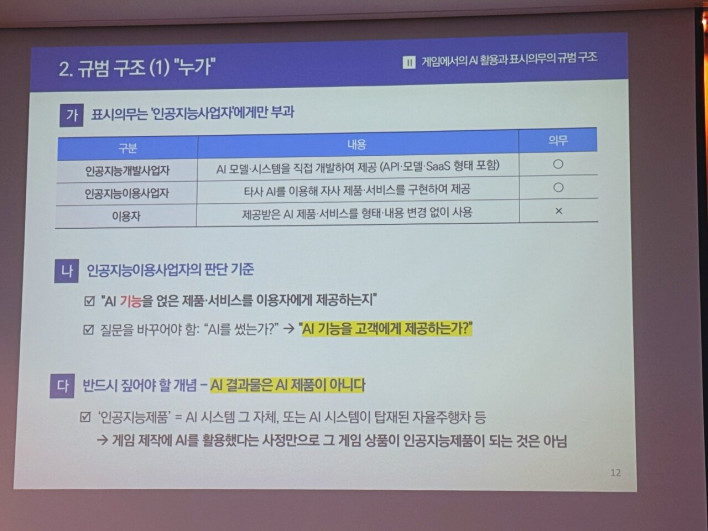
Not "Did you use AI?" but "Did you provide AI features to users"
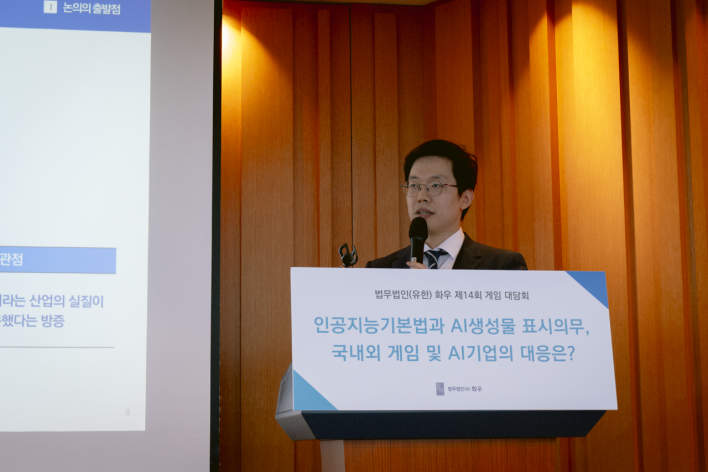
Attorney Jung Ho-seon, who led the first presentation, explained that AI usage in games should be categorized into three types: real-time interaction between users and AI during gameplay, the use of AI during the game production phase, and backend development/operation automation where users are unaware of AI's presence.
The regulatory status of these three types differs. Real-time interaction is highly likely to be subject to labeling obligations, while production-phase usage is generally exempt but may fall into a gray area depending on the circumstances. Development and operation automation, which remains invisible to users, is in principle exempt from labeling requirements.
The core issue is not whether 'AI was used' in game development. Under current regulations, labeling obligations are imposed on AI business operators; companies using third-party AI are only subject to these obligations if they qualify as an 'AI service provider' that offers those AI features to customers.
Jung explained, "The criterion is not whether AI was used, but whether AI features were provided—simply put, whether they were provided to the customer." This means that just because AI-generated results were used in the production of a game, the finished game itself does not automatically become an AI product or service.
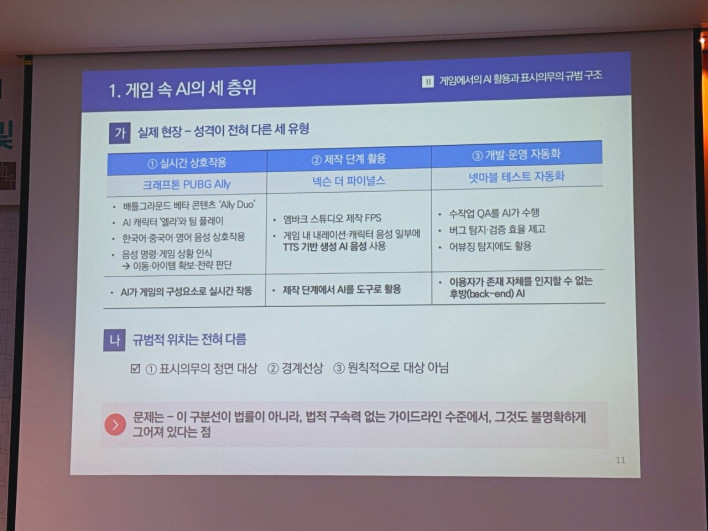
When applied to games, the boundary becomes clearer. The Ministry of Science and ICT's transparency guidelines classify game companies as 'users' when they utilize generative AI results during the production process, but as 'AI service providers' when the game includes features that allow direct interaction with AI or dynamic generation of AI content.
For example, a developer using generative AI to create background images or assets for insertion into a game is treated differently than a game that allows users to engage in conversations with AI NPCs that generate new responses in real-time.
Jung explained, "The dividing line is not whether AI-made assets were put into the game, but whether the user interacts with AI in real-time or if the AI dynamically generates content while the user is playing."
Labeling methods may also vary depending on whether the AI output is exported outside the service. If content is provided only within the game, relatively flexible methods are possible, such as labeling AI-driven NPC names or providing a notice during the first conversation. However, if the output is provided or shared externally, human-readable labels or machine-readable watermarks and metadata must be considered.
However, a question remains regarding the scope of 'external export.' For instance, if a user takes a screenshot of a screen containing a conversation with an AI NPC, can the entire image be considered an external export of AI-generated content.
Jung expressed the opinion that it is difficult to view features like screenshots, recording, and sharing as the 'external export' intended by Article 31, Paragraph 2 of the AI Basic Act. This is because the law primarily envisions features that provide the AI output itself, and what the user shares is a game screen, not the AI-generated text in isolation.
He also argued that the nature of the gaming medium must be considered. If one of the key risks the labeling obligation aims to prevent is users mistaking AI-generated content for real-world information, that risk is relatively low in games, where users are already aware they are in a virtual world.
Jung explained that while the source of information (human vs. AI) is a critical factor in areas where reliability is paramount, such as news or advertising, games are different. Since game users are already aware they are entering a virtual world constructed by creators, the possibility of confusion with reality is relatively low.
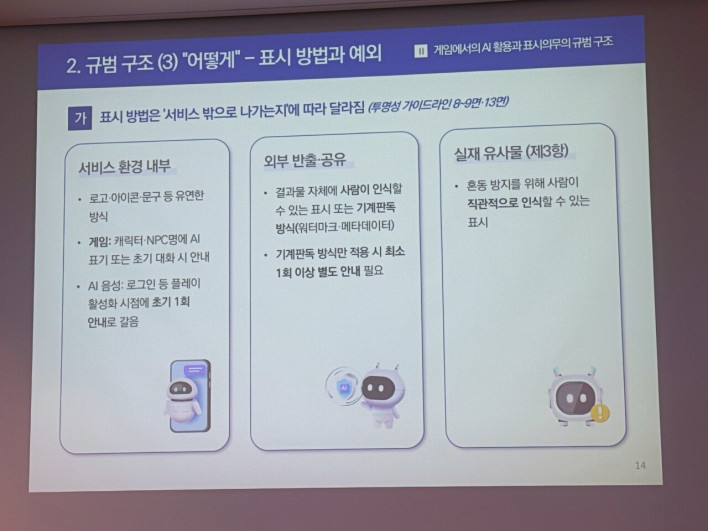
In fact, excessive labeling could potentially harm the gaming experience. If a 'Generated by AI' notice appears every time an AI NPC performs an action or speaks, it could constantly break the player's immersion in the character and the game world.
Jung argued that since the AI Basic Act allows for labeling in ways that do not hinder the exhibition or enjoyment of artistic and creative works, there is room to apply similar exceptions to games.
He noted that the specific nature of games should also be considered in light of international regulations. Jung introduced the EU AI Act's Article 50 and related guidelines, which separately consider situations like video games where users can clearly perceive that the environment is generative and fictional.
He explained that there are cases where one-time content generated in real-time can be notified on an experience or session basis, and AI NPCs in single-player games are sometimes viewed as exceptions to labeling obligations. He added that California's regulations also consider business scale, imposing obligations primarily on larger operators.
Jung suggested that rather than waiting for legal amendments, domestic authorities should actively interpret exception clauses in enforcement decrees or establish paths through Ministry of Science and ICT notifications to reflect the characteristics of the gaming industry.
He emphasized, "The AI Basic Act imposes uniform obligations without considering the type of industry or the nature of the content. The harm of confusion with the real world is based on different foundations in news/advertising versus games. We need differentiated regulations that balance industry characteristics with business capabilities."
Foreign game companies also under regulation: "A local representative must be more than just a name on paper"
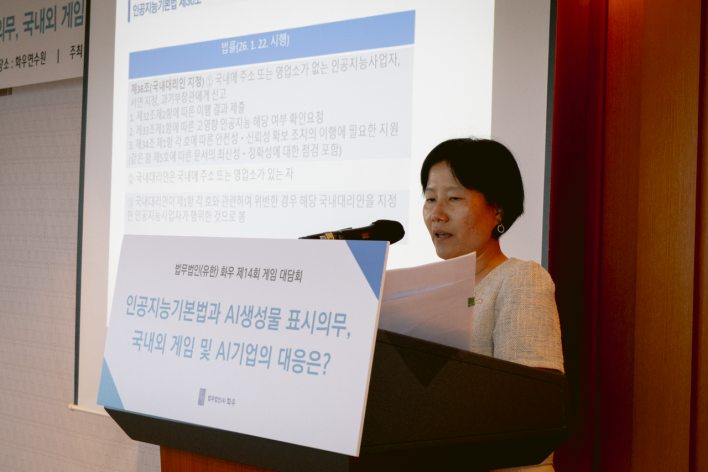
Attorney Lee Soo-kyung then introduced the practical aspects of the local representative system stipulated in Article 36 of the AI Basic Act. The act can apply to overseas operators if they affect domestic users; those meeting certain criteria without a domestic address or place of business must designate a local representative in writing and report it to the Minister of Science and ICT.
The local representative requirement applies to businesses that meet one of the following: #1 total annual revenue of ₩1 trillion or more, #2 annual revenue in the AI sector of ₩10 billion or more, #3 an average of 1 million or more daily domestic users over the three months prior to the end of the previous year, or #4 a history of being fined for failing to comply with corrective orders.
Failure to designate a local representative can result in a fine of up to ₩30 million. The event explained that under the enforcement decree, a fine of ₩20 million is applied regardless of the number of violations.
Designation is not the end of the process. Operators must disclose the local representative's name (or corporate name), representative's name, address, phone number, and email address on their website. A separate report must be filed with the Ministry of Science and ICT, and if multiple representatives are designated, all must be reported; any changes must also be updated.
Lee emphasized that while no specific professional qualification is required for a local representative, it is crucial that they function as a practical point of contact. Legally, any individual or corporation with a domestic address can serve as a representative, but the Ministry of Science and ICT guidelines stress the importance of relevant operational capabilities and fluent Korean communication.
Notably, having a domestic subsidiary or liaison office does not automatically exempt a company from the local representative obligation. If the domestic entity acts as the actual business operator handling relevant tasks and decision-making, a separate representative might not be needed; however, if the domestic entity only handles marketing or support while core operations remain with the overseas headquarters, a separate representative is likely required.
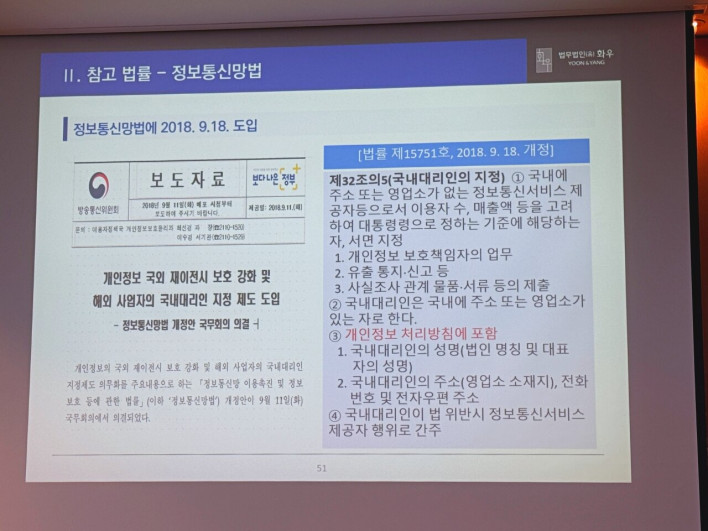
Lee pointed out that the local representative system has gradually become more specific as it has spread across various laws, starting with the Information and Communications Network Act and extending to the Telecommunications Business Act, the Personal Information Protection Act, and the Game Industry Promotion Act.
As cases emerged where the system was operated only formally—meaning contacting the local representative did not lead to the overseas headquarters—additional obligations such as securing 'effective means of contact' and ensuring headquarters' management and supervision were introduced.
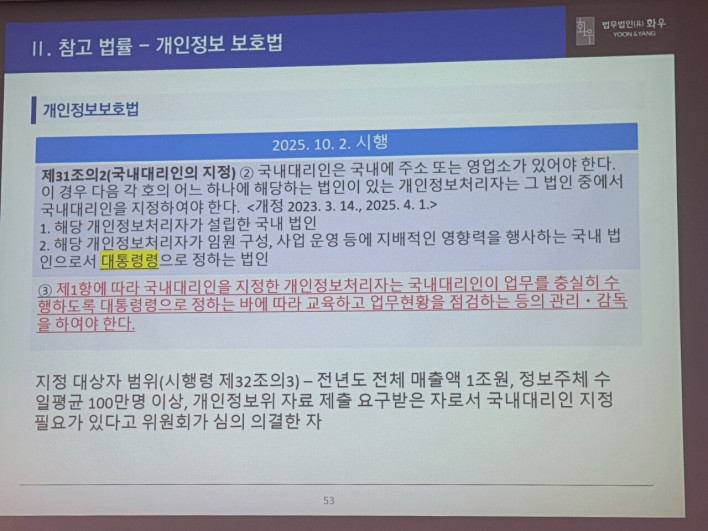
Consequently, she advised AI operators to go beyond merely designating a representative on paper. They should document compliance measures—such as risk management plans, user protection and damage relief, and human oversight systems—in stages and ensure the local representative has the structure to verify them.
Lee emphasized, "To actively explain your position to the government, you need to prepare and maintain documents for each stage," adding that it is vital to have a system where the local representative can communicate smoothly with the headquarters and verify relevant data.
Finally, she shared an experience from the autonomous vehicle research field, where the idea of labeling autonomous driving status on the vehicle exterior was criticized by the industry as 'administrative convenience.' She warned that the same problem could repeat with AI labeling in games.
Since excessive watermarks or labels on domestic games could harm design and immersion, she explained that it is necessary to continue discussions with the Ministry of Science and ICT, considering not only regulatory goals but also actual user experience and industrial competitiveness.
Game companies developing their own AI: Where does 'internal use' end?
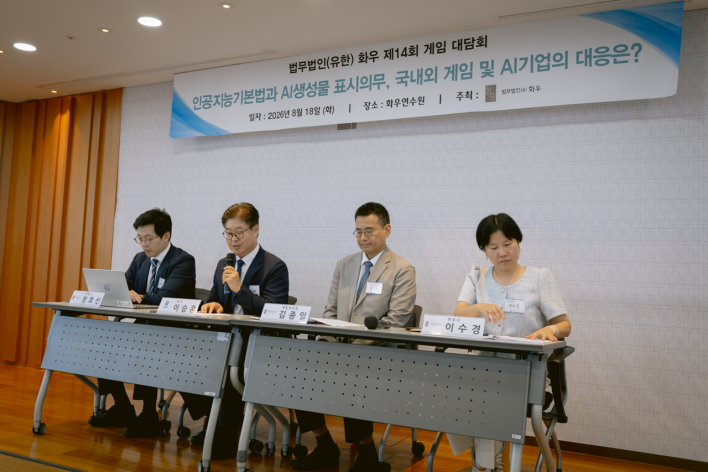
Following the presentations, a discussion was held, moderated by Lee Seung-hoon, professor of Game Contents at Anyang University and chairman of the Game Content Rating Board. Attorneys Jung Ho-seon and Lee Soo-kyung, along with Kim Jong-il, head of the YOON & YANG Game Center, discussed the legal status of game companies under the AI Basic Act, practical challenges of generative AI labeling, and the role of the local representative system.
The first topic was the legal status of game companies under the AI Basic Act. Professor Lee Seung-hoon explained that the act seeks to promote the AI industry while ensuring safety and reliability, but noted that companies using generative AI might face confusion in determining whether they qualify as 'AI business operators' subject to regulation.
Attorney Jung Ho-seon explained that to determine if a game company bears obligations under the AI Basic Act, it must first be determined whether it qualifies as an 'AI development business operator' or an 'AI service provider.'
If a game company uses commercial AI tools as internal development tools, it is in principle merely a 'user.' Since it is not providing AI products or services to external customers but using them for internal development, it is difficult to view it as an AI service provider, and thus it bears no related obligations.
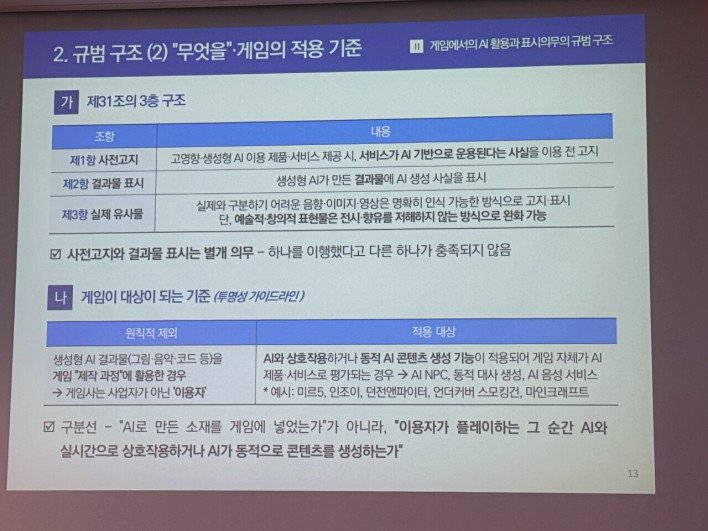
Conversely, if the company uses AI features to generate real-time content, such as AI NPCs, and interacts with users through them, the situation changes. The likelihood of being viewed as providing an AI-based product or service to users increases, as does the applicability of various obligations under the AI Basic Act.
Jung explained, "For game operators, the process of determining whether we are subject to obligations under the AI Basic Act is more important than worrying about how to implement labeling obligations."
In this regard, Kim Jong-il, head of the Game Center, noted that the AI Basic Act differs in nature from existing game industry regulations.
The game industry already has long-established labeling obligations, such as the content rating system and gacha items, with some violations leading to criminal penalties. In contrast, the AI Basic Act is in the early stages of institutional formation, meaning there is a strong need for the industry and the government to work together to define the intent of the system.
Kim said, "It is necessary to grasp the institutional intent, such as ensuring safety and guaranteeing the user's right to know, and use that as a basis to build the system with government authorities."
Professor Lee raised the topic of large game companies moving beyond using general-purpose external AI to building their own AI and LLMs. He noted that when a company trains AI on its own accumulated game data, uses it to develop new content, and ultimately provides the game to users, the question of where 'internal use' ends could become a new point of contention.
Jung explained that the Ministry of Science and ICT's current basic stance is that internal use of AI models or services does not qualify a company as an AI service provider. However, he added that no clear criteria have yet been established for the scope of 'internal use.'
He suggested that if the AI supports the work of developers or internal staff and the final service provided to users is not an 'AI service,' there is a strong possibility it will still be viewed as internal use. However, he premised this by saying the government has not yet clearly defined this, and future interpretations should be monitored.
He pointed out that if more labeling obligations are imposed simply because a company built its own LLM, it could discourage companies from developing their own AI, which would be counterproductive to industrial development.
Are game screenshots with AI dialogue 'AI-generated content'?
The second discussion focused on the practical challenges of generative AI labeling in actual game services.
Professor Lee explained that while technology for inserting watermarks or encrypted markers into generative AI is advancing, there are technical limitations: markers can disappear if text is rewritten or the format is changed, and identification becomes difficult when multiple AIs are mixed.
The problem is even more complex in games. In-game screenshots, video recording, and clip sharing are universal features supported by most games. It is unclear whether the entire captured screen should be viewed as 'externally exported AI-generated content' simply because it contains some AI-generated backgrounds, characters, or NPC dialogue.
As the culture of watching games via streaming or video grows alongside playing them, the extent of the labeling responsibility when a user broadcasts or posts game screens containing AI elements will be a future point of contention.
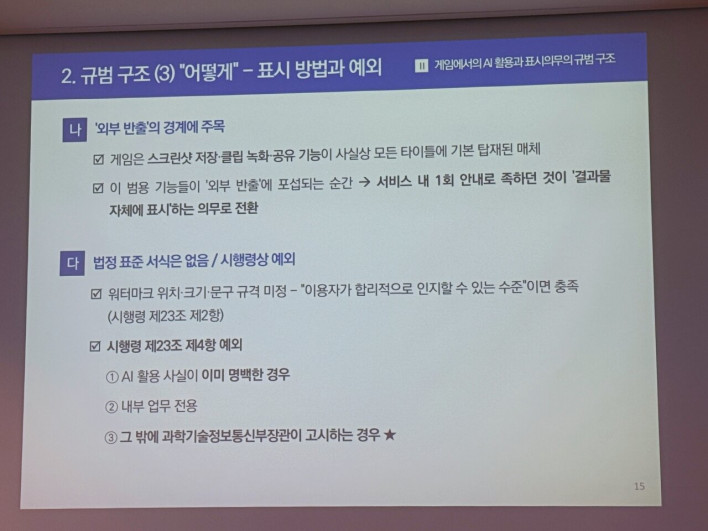
Jung emphasized that when interpreting the law, one must look not only at the text but also at the legislative intent—the "why" behind the law.
Article 31, Paragraph 2 of the AI Basic Act targets AI-generated content or results. However, his interpretation is that what a user exports via a screenshot feature is fundamentally a 'game screen,' and it is difficult to conclude that it is the AI result itself.
He also noted that if a key purpose of the labeling obligation is to prevent third parties from mistaking AI results for real-world information when they are circulated outside their original service context, that risk is relatively low for game screens.
Game users encounter content with the premise that it is a virtual world from the start, and screenshots shared externally are easily recognized as game screens due to UI, items, and characters.
Jung pointed out that if the entire game screen is judged as an AI-generated result simply because it contains even a small AI element, the scope of regulation could become excessively broad.
He explained that the issue of users circulating posts externally and the labeling obligations borne by game companies providing AI services should be viewed as different layers. While he sympathizes with social concerns about the circulation of false information, he believes caution is needed in regulating content that is clearly identifiable as a game screen under the same standards.
Professor Lee predicted that while various interpretive controversies remain regarding the AI Basic Act, the system will likely be refined to fit industrial reality over time, as it is still in the early stages of implementation.
During the Q&A, a question was raised about how to label works where AI usage is the core of the game's fun. For games like Relu Games' 'Mimesis,' where AI learns the user's voice to mimic other players, it may be difficult to avoid labeling if real-time AI usage is central to gameplay. The question was how to fulfill the obligation without ruining immersion.
Jung suggested that repeatedly displaying a phrase every time an AI result is generated would significantly degrade immersion. Instead, he expressed the opinion that notifying users upon entering the game or service, or labeling on an experience/session basis, is preferable so that users are aware of AI usage without it hindering gameplay.
Regarding whether notifying AI usage on external platforms like Steam or in terms of service is sufficient, he replied that 'prior notice' and 'content labeling' must be distinguished. Since informing users that a service uses AI and labeling the actual AI output are separate obligations, labeling the output should, in principle, occur during the process of using the game service.
"The local representative system: Formal operation is actually dangerous"
The final topic discussed the commonalities and differences of the local representative system scattered across various laws, including the AI Basic Act.
Lee Soo-kyung explained that when the local representative system was first introduced, determining the scope of those subject to it was a major concern. Since then, methods based on scale—such as total annual revenue, sector-specific revenue, or user count—have spread to other laws, with slightly different criteria applied based on industry characteristics.
For example, in the gaming sector, download counts might be considered, while in the Personal Information Protection Act, the number of data subjects is a key criterion. For the AI Basic Act, given the high proportion of overseas operators, it appears that criteria used in existing laws like the Telecommunications Business Act or the Information and Communications Network Act were largely referenced.
The roles performed by local representatives also vary by law. Common roles include serving as a communication channel between overseas operators and domestic government/users and submitting necessary data, but specific obligations are added depending on the area regulated by each law.
In the AI field, they must be able to submit data on risk management plans, potential risks, and user protection measures when requested by the government. In the Game Industry Promotion Act, they must respond to industry-specific regulations like gacha items, and some laws even require securing effective means of contact with the headquarters or headquarters' management and supervision of the local representative.
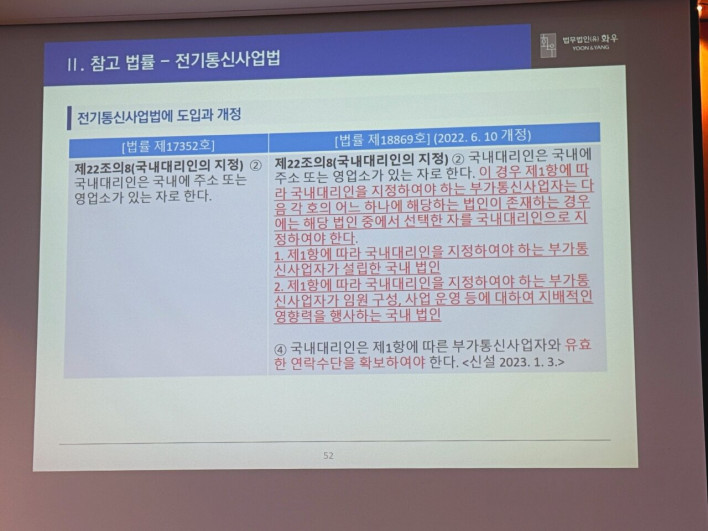
The attorney explained, "There is a trend where more recently enacted laws impose increasingly stringent obligations on local agents."
Professor Lee Seung-hoon also emphasized that local agents must play a role that goes beyond serving as a mere point of contact. He argued that because a local agent under the AI Basic Act must have a certain level of understanding of an AI service's technical structure and be capable of responding to government requests for data, it is necessary to appoint entities that possess the relevant expertise and competence.
Kim Jong-il suggested that the local representative system should be viewed not only from the perspective of regulatory compliance but also from the perspective of domestic companies using AI.
It remains difficult for industry stakeholders, including domestic game companies, to contact actual personnel when problems arise while using overseas AI services. If the local representative also functions as a practical communication channel connected to the overseas AI operator, domestic companies using AI could operate in a more transparent environment.
Kim also pointed out that overseas game companies exceeding a certain scale could be subject to multiple local representative systems simultaneously, including those for the Information and Communications Network Act, Telecommunications Business Act, Personal Information Protection Act, Game Industry Promotion Act, and E-Commerce Act. He noted that overseas operators are currently contemplating how to integrate these various local representative duties.
Lee advised that operating the local representative system only formally could be dangerous.
She noted that there are actual cases where companies respond quickly to government inquiries but fail to properly handle user complaints, or direct users back to general customer service even after they contact the local representative. Even if an office and contact information are provided formally, if practical complaint handling or connection to the headquarters does not occur, regulatory authorities may judge that the local representative's duties are not being performed properly.
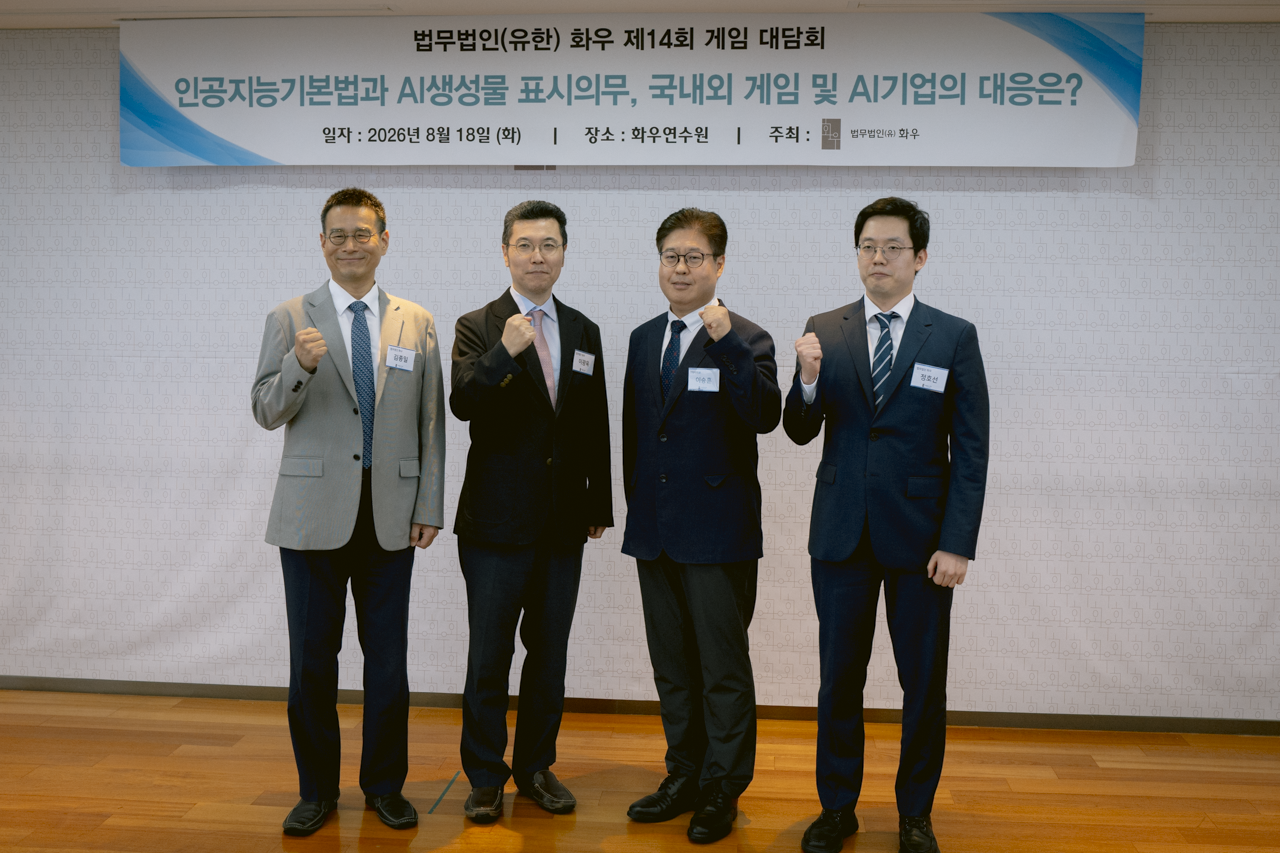
Lee Seung-hoon, Chairman of the Game Content Rating Board; Attorney Jung Ho-seon of YOON & YANG LLC ©INVEN