Brain: The foul stench of yesterday's booze is rising from your mouth.
Limbic System: And with the smell comes a splitting headache! Ugh!
Broken Window: Don't remember trashing the place while you were drunk, either?
Mirror: Really? You want to look in the mirror? Brace yourself! Yikes, you're ugly.
Ugh... it’s true. My head feels like it’s going to split open, forcing my eyes to snap open. The first thing I see is a disaster zone littered with empty bottles. A damp breeze carrying the salty scent of the sea blows in through a broken window. Who am I again? Am I even human? I look down and see arms and legs. I guess I am human. But the sight of myself in nothing but underwear and socks is horrific.
I get up, put on the clothes scattered like trash around the room, and notice the bathroom door is smashed in. Did I do that? What kind of train-wreck life have I been living? I head out, hoping to find someone to ask, and see a tired-looking blonde woman smoking a cigarette. Did I smoke? As I stare blankly at the falling ash, unable to even remember my own name, the woman speaks nonchalantly: "Hello, Detective."
I’m a detective?!
Though I have no memory of it, those around me say I’m a failure as a detective and a disgrace as a human being. Released on October 16, the indie game 'Disco Elysium' is the story of an amnesiac detective. The project garnered significant attention when it was first announced in 2016, back when it was titled 'No Truce with the Furies.'
With a massive story and text volume that belies its indie status, along with charming oil-painting-style graphics, it took the indie developer ZA/UM a staggering 16 years to create 'Disco Elysium.' The first 13 years were spent purely on world-building, followed by years of testing the game's framework through pen-and-paper TRPG sessions.

The studio ZA/UM itself began with a group of friends who gathered to play Dungeons & Dragons, and they have cited 'Planescape: Torment' as a major inspiration. Consequently, the game is packed with a vast world and text-heavy gameplay. Considering a thorough playthrough takes about 90 hours, the sheer volume of text is immense.
Since its release, 'Disco Elysium' has received critical acclaim, currently holding an 89 on Metacritic. The only drawback is the lack of a Korean localization. While the English vocabulary and sentence structures are not as difficult as those in 'Divinity: Original Sin 2,' the sheer volume of text, combined with literary expressions, can become quite fatiguing after long sessions.
YOU KNOW NOTHING, Detective
The Detective's Quest for Lost Memories: Gameplay in 'Disco Elysium'
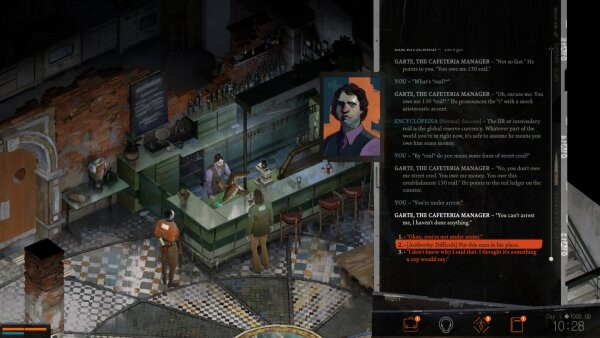
I was a detective... right. I don't remember a thing, but I pretend I do and head downstairs. The lobby bar is quiet for a morning. There’s a bartender who looks like he has a bad attitude, a few drunks sprawled out, and a handful of people murmuring quietly. A bartender would know who I am, right? Excuse me?
Bartender: Ah, Detective. I’m not a bartender; I’m the cafeteria ma.na.ger. And you know you owe me 130 Reals, right?
1. "What do I owe 130 Reals for?"
2. "What... is a Real? Is it like money? How philosophical. What is money, anyway?"
3. "I don't owe you anything, you prick." (Punch him) -> Physical Instrument: 0 / Chance: Very low 3%
4. "Forget it, you're under arrest."
Not-a-Bartender Manager: Let's see. First, your room rate is 20 Reals a day for three days, that's 60. And you saw the broken window, right? That's 40. Considering the mess you made at the bar, it should be more, but I agreed to charge you only 30. You have a job to do, after all.^^ That brings the total to 130 Reals. And yes, Reals are money.
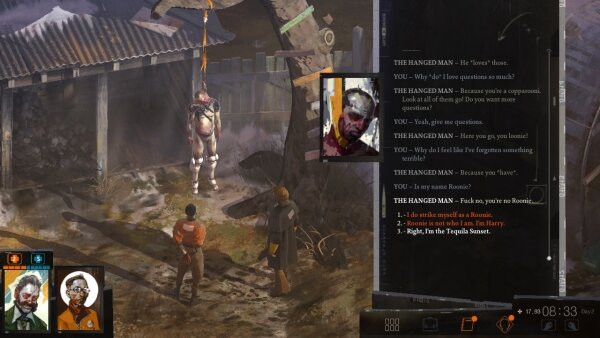
The gameplay is similar to 'Planescape: Torment.' However, there is almost no combat; it is entirely focused on exploration and text. The key elements are your stats and the choices you make. In 'Disco Elysium,' you don't just talk to NPCs; you interact with objects, and your own 'skills' talk to you directly.
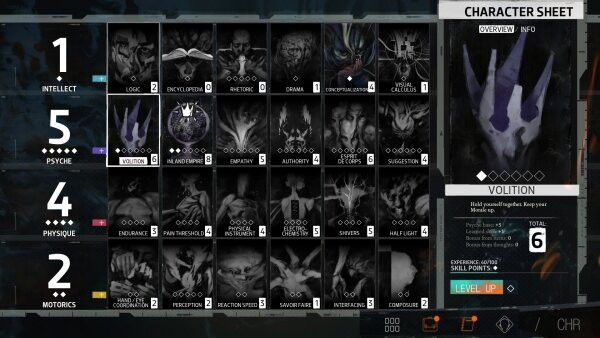
These skills are the core of the game. They are personified with icons that look like 'faces,' each with their own distinct personality and tone—like the unhinged, dramatic 'Drama' skill or the fascist-leaning 'Endurance.' Because these skills constantly chime in, the detective's mind is incredibly noisy despite his memory loss. They act as both gameplay constraints and guides that help you understand the situation. Their chatter is constant, and because their personalities are so varied and the writing is so entertaining, it’s a joy to read.
These skills also determine how you progress through the game. At the start, you decide what kind of 'detective' you will be. Depending on which skills you focus on, you can become a powerhouse or a genius. There are four main categories, each with six sub-skills, totaling 24 unique abilities.
There is the Intellect category, which helps you notice details and deduce facts; the Psyche/Sensory category, which helps you read people and navigate conversations; and categories focused on raw physical power or quick reflexes.
Your available choices depend on which skills you have and how high they are. This affects everything from how much you can observe at a crime scene to whether you can see through someone's lies or win a fight. Important decisions often involve a dice roll to determine success, with probabilities ranging from 80-90% down to single digits, depending on your stats.
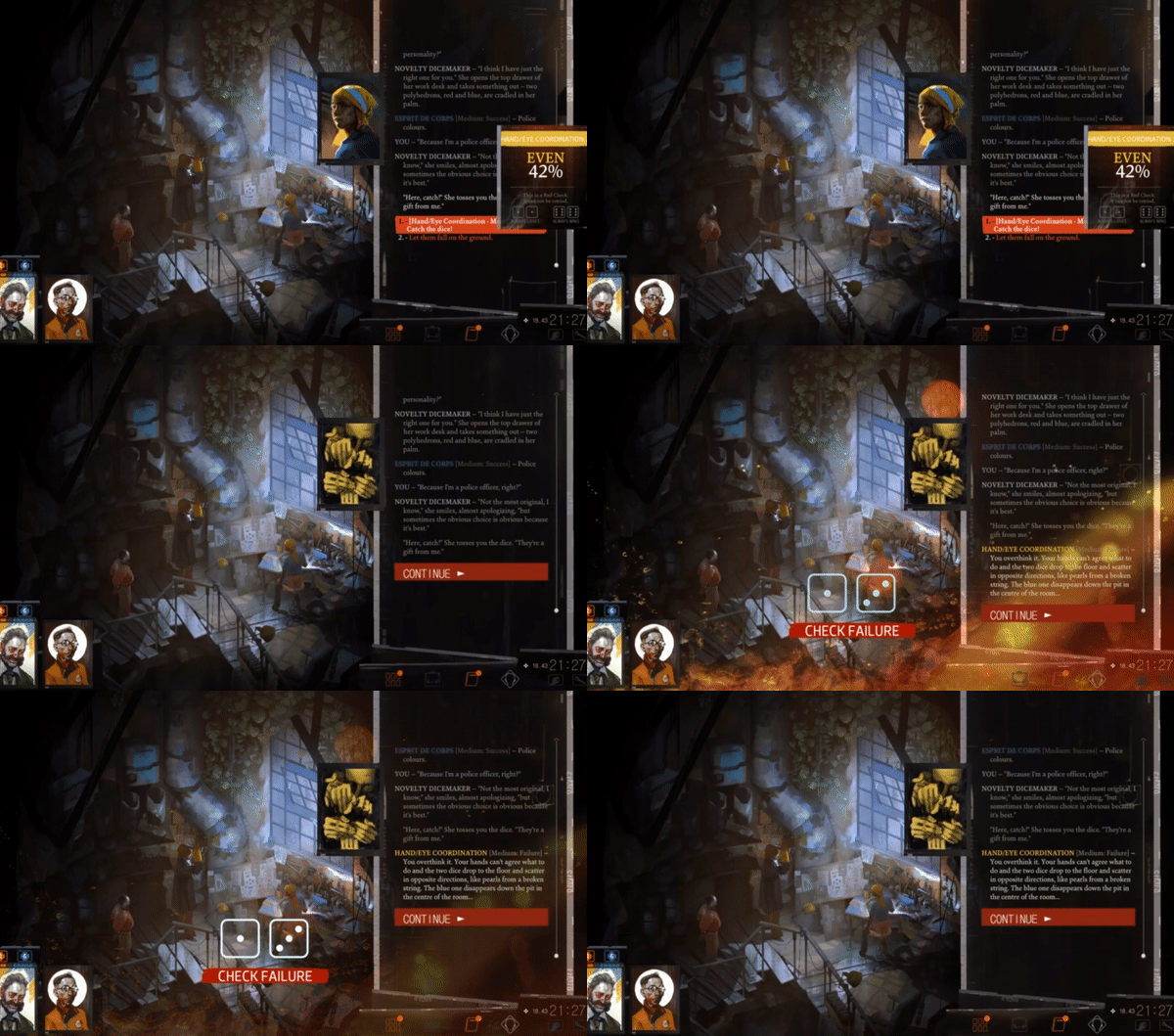
Personally, I went with a 'sensitive detective' concept and focused on emotional stats. It definitely has a huge impact on gameplay. For example, when trying to enter the harbor, I needed to flip a switch behind a large guard. A colleague who focused on strength just fought and knocked him out, but my sensitive detective couldn't even make a dent with his punches. I had to learn the guard's theories, pass his test, and grovel my way into the harbor.
Stats can unlock quests or provide solutions. The charm of 'Disco Elysium' lies in the internal conflict and dialogue happening inside the detective's head. This aligns with the developer's intent. Robert Kurvitz, the lead designer, explained that 'Disco Elysium' was developed with the goal of being an RPG where the player assigns their own quests.
"I wanted to make an RPG where you give yourself quests. I actually hated the concept of quest-giving NPCs because it always made me feel like I was pushed to the sidelines of the world. Even though I was a great hero in the game, I didn't like that there was always someone telling me, 'Go do this for me.'" - Robert Kurvitz
Of course, the game system still provides quests, but through the game's design, many of them originate within the protagonist's own mind. Quest triggers vary, and they change based on how you play. The skills don't just explain the game and help with judgment; they enable a more autonomous narrative progression.
A World 16 Years in the Making
Exploration, Text, and More Text Hidden Everywhere

'Disco Elysium' takes place in a city called Revachol. It’s a place where a fierce but failed socialist revolution took place, and the scars of war remain everywhere. Today, the city is plagued by extreme wealth inequality, racism, and simmering labor-class rage.
You can learn about the world as you play. Of course, you can skip it if you want. You can ask the old men playing boules in a corner of the village for stories, or debate the city's situation at a protest in front of the harbor.
Beyond the main story and world-building, there are hidden elements everywhere. You can find and read books to unlock new quests or stories, and there is fun to be had in discovering hidden locations. Sometimes you can open doors with your skills, get keys from NPCs, or force them open with strength. There are mysteries everywhere, including a strange phenomenon called 'The Pale.'
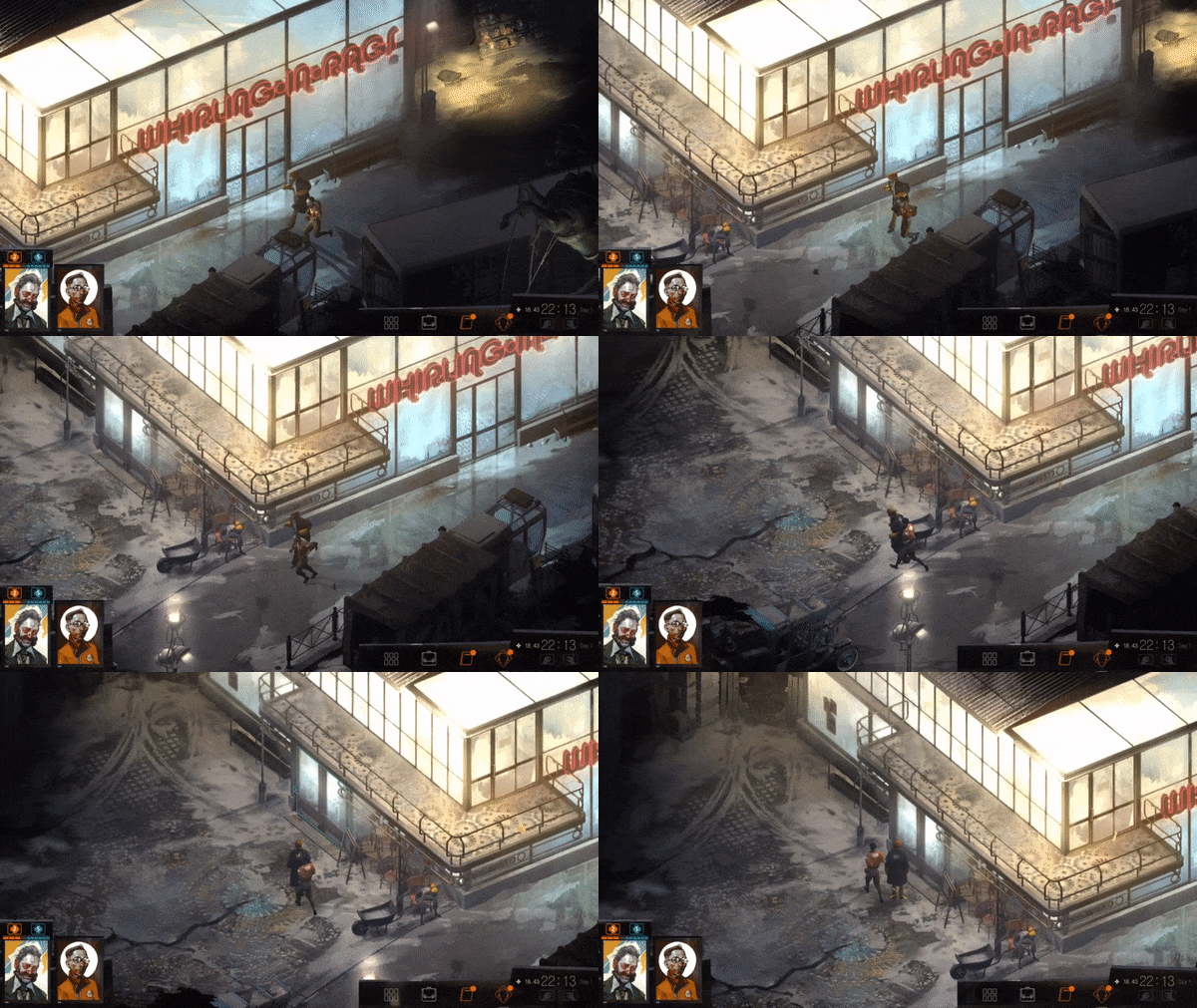
It’s also a joy to wander through a world rendered in an oil-painting style. Not just the characters, but the entire world looks like a work of art, with brushstrokes visible everywhere. The atmosphere changes with the time of day, which is a treat for the eyes.
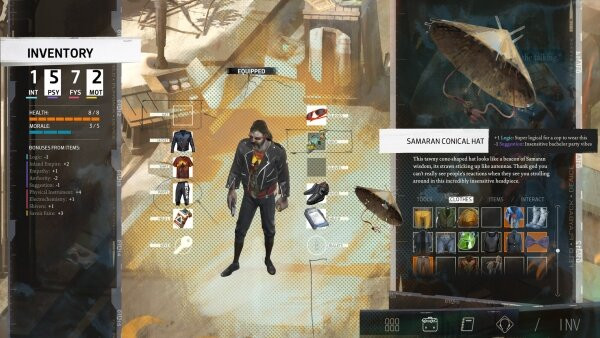
And, as mentioned, there is the detective's debt-repayment project. You can pick up bags on the street and collect bottles to trade for money—it’s a bit pathetic, but it adds up. You can also sell items found during exploration to buy new gear or clothing. Clothing provides stat bonuses, which can be very useful when you need a boost in a specific area.
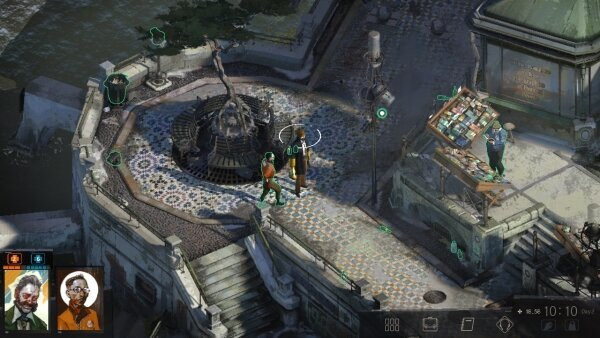
There are other quests, like singing on stage or finding cigarettes. They might seem meaningless, but each side quest is packed with so much text that they are fun to read if you take your time. 'Disco Elysium' is a game where the text itself and the TRPG-like experience are the main attractions; the more slowly and deeply you read, the more you get drawn in.
However, the sheer volume of text makes it quite fatiguing. This is especially true since there is no Korean localization. While there are occasional animations and actions based on your choices, they are relatively sparse.
Another factor that increases fatigue is that in-game time only passes during dialogue. 'Disco Elysium' progresses day by day, from morning to night. At 9 PM, you can finish the day with your partner, Lieutenant Kim Kitsuragi, and go to sleep. You can sneak out after Kitsuragi goes to bed to explore on your own, but many locations are closed at night, limiting what you can do.
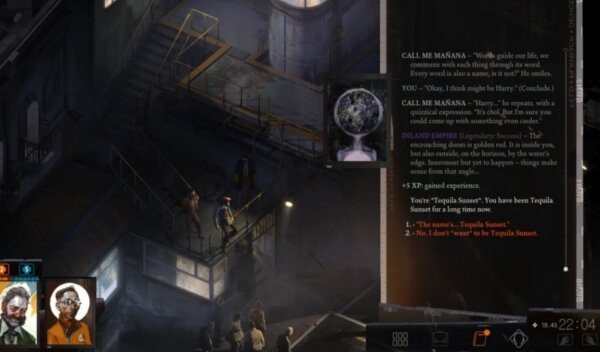
The problem is that time only moves when a dialogue window is active—whether it's the voices in the detective's head, conversations with others, or reading a book. At first, it’s satisfying to have plenty of time to move around, but as time goes on, the pacing can feel slow. Some quests require you to visit a place at a specific time or only after a certain day, so you have to read books or keep talking to people just to pass the time. Still, there is a sense of accomplishment in having spent your time productively.
This, combined with the character's somewhat slow movement speed, can make the game feel tiring. There are many choices, but having to revisit locations, talk to people, and face walls of text just to pass the time for a quest you wanted to skip... it feels like reading a book after a long time, and it takes a while to get used to.
Like Reading a Book After a Long Time: 'Disco Elysium'

'Disco Elysium' is a detective game featuring an amnesiac protagonist accompanied by 24 skills, each with its own personality. As you progress, the skills that chime in change, the direction of the story shifts, and the sheer volume of text makes it feel like you're exploring the world with a magnifying glass. Personally, it felt like reading a really good book.
Playing 'Disco Elysium' forced me to completely abandon my usual habit of skipping through the 'text' in games. It’s a game that reminded me of the joy of playing slowly, savoring the meaning of every single line of dialogue. It was a pleasure I hadn't felt in a long time.
The game is incredibly detailed, and the developer blog shows just how meticulously the world is crafted. From the geography to the history, culture, economy, and the thoughts and lives of the people, everything is intricately woven together.
'Disco Elysium' was a game I could enjoy like reading a book or playing a role-playing game. I look forward to the day when a Korean localization allows more players to fully enjoy this world.

Sort by:
Comments :0