In Lineage Classic, the hottest keyword right now is a force commonly known as “workshops”—organized gold-farming operations. They set up offices domestically or overseas, then use VPNs, illegal programs, stolen personal information, and other means to mass-produce accounts. Their signature pattern is automated Adena farming on a huge scale, followed by selling it off and cashing out.
This kind of abnormal play shows up across genres in many forms—hacks, bots, auto-play, and more—and in today’s always-on online service games, it’s a never-ending “spear vs. shield” problem. Especially as the saying goes, “In the fight between hacking and security, hacking always has the advantage.” From a game company’s perspective—where you have to protect everything and respond after the fact—it’s also true that perfectly blocking illegal programs is effectively impossible.
That said, Lineage Classic right now is suffering severe damage from the flood of workshops. NCSoft is pouring effort into the issue, but players are insisting that far more aggressive action is needed. What kinds of problems are workshops causing that have so many people calling for “harsher measures”?
I’m Grinding Like This—The “Deprivation” Felt by Legit Players
At the root of the problem, workshops—especially automated play powered by illegal programs—damage the experience of players who actually put in the time and effort to play normally.
Lineage Classic does support limited auto-hunting in “Contaminated Land,” but fundamentally it’s a fully manual game. You have to click monsters one by one and use skills as you slowly build experience and grow. It’s labor-intensive, and the fatigue is real.
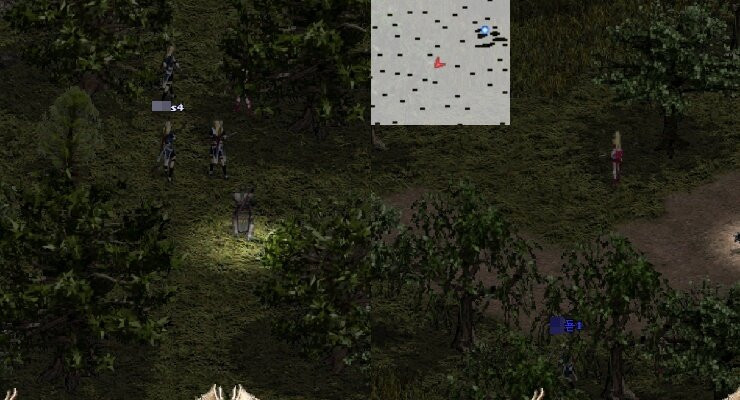
Workshops, though, are free from that stress. The system finds mobs, attacks, loots, sells, and even handles post-hunt maintenance on its own. And it’s not like they’re running one or two characters. If you just go to a hunting ground, you’ll see the field dominated by obviously mass-generated names—short English IDs with nothing changed except the trailing numbers, from 1 all the way to 40.
Even under normal circumstances, players already have to stare at their monitors until their eyes burn just to tag mobs first and land attacks. With program-run characters swarming in, it becomes difficult to even get a single proper hit off in a hunting zone. Progress falls behind, fun disappears, and the result is a vicious cycle where players quit—making the game’s environment even worse.
Way Too Many—Login Failures and a Shortage of Hunting Spots
Another issue is that workshops, playing through illicit routes, mass-produce enormous numbers of accounts and characters. Because Lineage Classic is overwhelmingly manual-play driven, most regular users run a single character. Workshops, on the other hand, aren’t constrained by the limitation that you can’t normally control multiple characters at once—because their programs can.
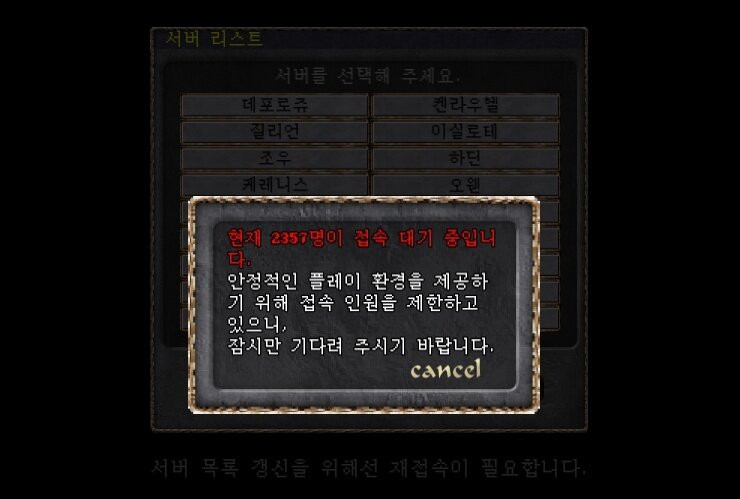
When a space that should hold 10 people suddenly has 20, 30, or even 50 bodies packed in—run by automated scripts—the server naturally hits saturation. On servers that were already crowded—like Deporoju and Ken Rauhel—restrictions became so severe that logging in was effectively impossible. On weekends, it got to the point where it took more than 10 hours just for the queue to clear. Eventually, character creation restrictions were applied.
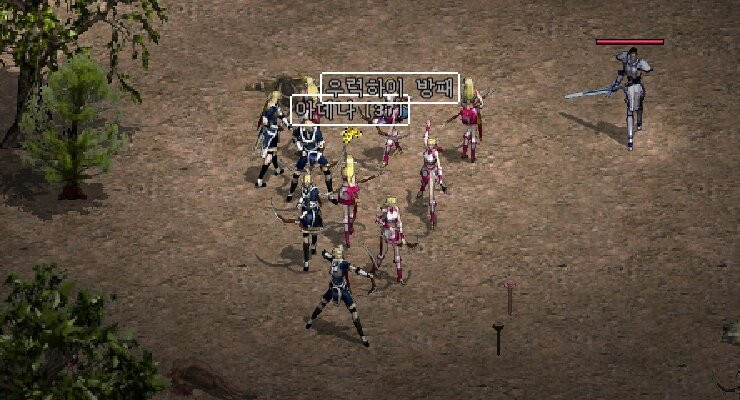
And once they fill the server, workshop characters immediately seize hunting grounds. From the area around Talking Island—an early beginner region—to Orc Field, the Talking Island Dungeon, and countless other key hunting spots, players found themselves surrounded by rows of workshop characters that differ only by their numbers. Legit players are left with no choice but to wrestle with machines that move and claim targets automatically—just to tag a single monster.
Prices Crashing Overnight—Eroding the Value of Currency & Items
When that many accounts and characters keep hunting nonstop, Adena and items begin piling up inside the server at a rapid pace. Supply that vastly exceeds what normal play could ever produce inevitably leads to falling value—and inflation.
The problem is that item-value erosion also affects the act of playing itself. In Lineage Classic, you have to hunt while continuously consuming potions, whether you buy them from NPC shops or through player-to-player transactions. That’s why the basic loop matters: obtain items in the field, sell them to secure Adena, then restock potions to keep hunting.
But as item prices collapse, players can’t earn meaningful money by selling materials or gear they pick up. Market prices converge to only barely above what you’d get by selling to an NPC shop for Adena. Outside of a few rare, high-priced items, the very value of getting a drop declines—dampening the fun of play.
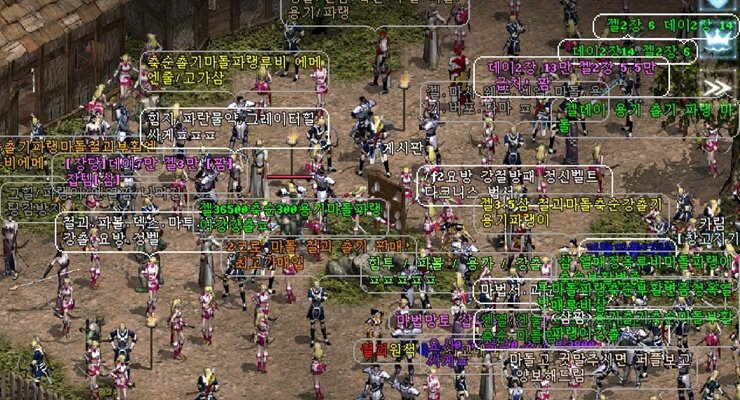
How Do You Keep Up Now?—A Growth Gap Driven by Trading
A decline in currency value quickly turns into a growth-gap problem. Real-money trading (RMT) of items is, in principle, a terms-of-service violation—but Lineage Classic allows player-to-player trading, and cash-based Adena and item transactions are happening openly, including so-called “rice farmers” (players who focus on farming in-game wealth to convert it into real cash).
As workshops pour Adena into the economy, prices keep dropping—yet key growth items used for progression, like Scroll of Enchant Armor and Scroll of Enchant Weapon (commonly referred to as “Zel/Dai”), are sold through NPC shops and retain a relatively fixed price. When Adena is expensive, only a small number of people can widen the gap through RMT. But when Adena’s value crashes, it becomes possible to attempt similar enchant upgrades at a much lower real-money cost—dramatically increasing the “accessibility” of growth-through-RMT for a wider population.
If this repeats, players who don’t engage in RMT stagnate, while more and more people take advantage of cheaper prices to buy their way forward—and the gap widens at speed. The argument that “Lineage has always been a game that requires heavy investment, so people who don’t spend money naturally fall behind” doesn’t fit this situation. This isn’t a case where players grew over time and the supply of currency increased organically, shifting value as a natural result.
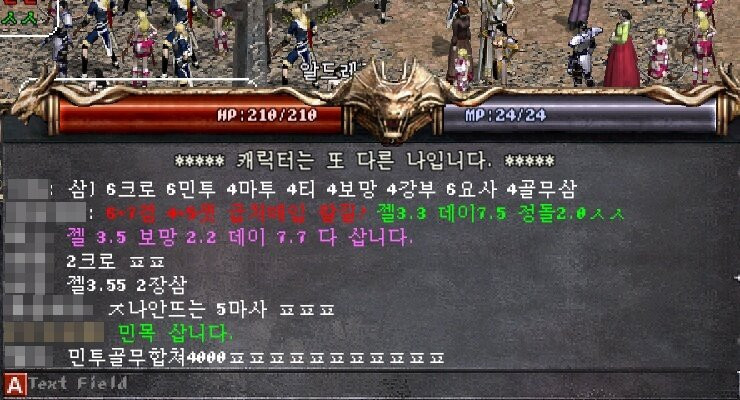
“Hey, That’s My Spot”—Players Growing Increasingly On Edge
Shrinking hunting space and falling farming efficiency directly raise player fatigue—and make everyone more sensitive. Within the “line” (the dominant alliance seeking profit and power), groups try to protect their influence through stricter controls. Neutral players, meanwhile, try to carve out any foothold they can, even clashing with other neutral players as they shout things like “This spot’s taken!” to secure a hunting area.
Ultimately, as emotional conflicts intensify, the joyful nostalgia players once chased after begins to vanish. In its place comes hostility, frustration, and a relentless series of angry clicks. And whenever disputes break out, farming efficiency drops yet again. Competition between players can certainly help invigorate a game’s economy—but that dynamic must be rooted in the enjoyment of combat under normal conditions, where players fight and derive satisfaction from victory. When the pie itself has been unnaturally shrunk, and players are forced to divide it while under constant stress, irritation accumulates—and that frustration inevitably feeds into player attrition.
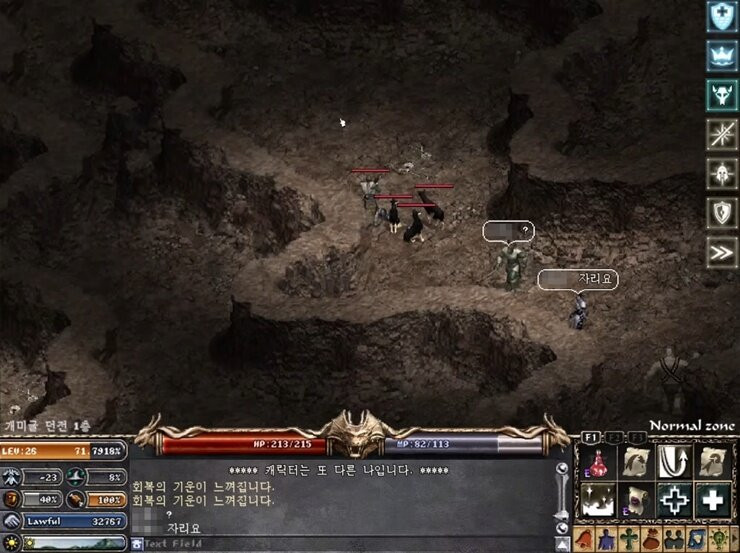
Searching for Solutions—The Endless Spear-and-Shield Battle
As noted earlier, the battle between illegal programs—including workshops—and the security measures designed to stop them has no clear end. Unlike workshops, which pursue profit with little to lose, the defensive side—tasked with protecting individual rights, preventing wrongful sanctions, and preserving game systems—must tread far more carefully. Structurally, it is an uneven fight.
According to confirmed information, modern workshops have become extraordinarily sophisticated. In recent cases, they are even known to circumvent IP bans and hardware bans. Their pattern is simple but effective: initially masquerade as legitimate players by paying monthly subscription fees, then, once program usage is detected, refund the subscription and reconnect using newly created accounts. One small consolation is that attempts to exploit partnered PC cafés via VPN connections are largely ineffective, thanks to the relatively swift termination of café partnerships when abuse is identified.
Under such conditions, game companies suffer significant operational strain. Even when enforcement efforts are visible, public sentiment often turns cynical, with comments suggesting that “they intentionally avoid sanctions to make money.” Players, too, feel exhausted. Many simply wish to relive fond memories through the game, only to find themselves competing against waves of automated characters that disrupt the monsters they hunt, the spots they occupy, and the items they trade.
This is precisely why players are increasingly vocal about the need for stronger sanctions. Calls for improved reporting systems, more aggressive monitoring, and faster punitive action continue to grow. Some proposals even suggest separating “prison servers” or implementing automatic disconnections for idle characters lingering in towns, thereby improving server rotation and alleviating queue congestion—at least as a temporary measure.
NCSoft, for its part, has indeed begun tightening its stance. Enforcement waves have reached their 15th iteration, with the number of restricted accounts surpassing 1.38 million. On February 25, the company launched its “Clean Campaign,” partially reflecting player feedback. Measures include the addition of guard NPCs that selectively track abnormal players, improvements to reporting functions, and immediate action for sufficiently verified targets upon report submission.
Further reinforcing this approach, NCSoft introduced the “I Am the Report King” event, offering rewards tied to player reporting activity. The initiative aims to encourage broader community participation in server-cleanup efforts. In what increasingly resembles a Sisyphean struggle against endlessly resurfacing workshops, the central question remains whether the combined efforts of developers and players can uncover a decisive, widely satisfying “silver bullet.”
This article was translated from the original that appeared on INVEN.