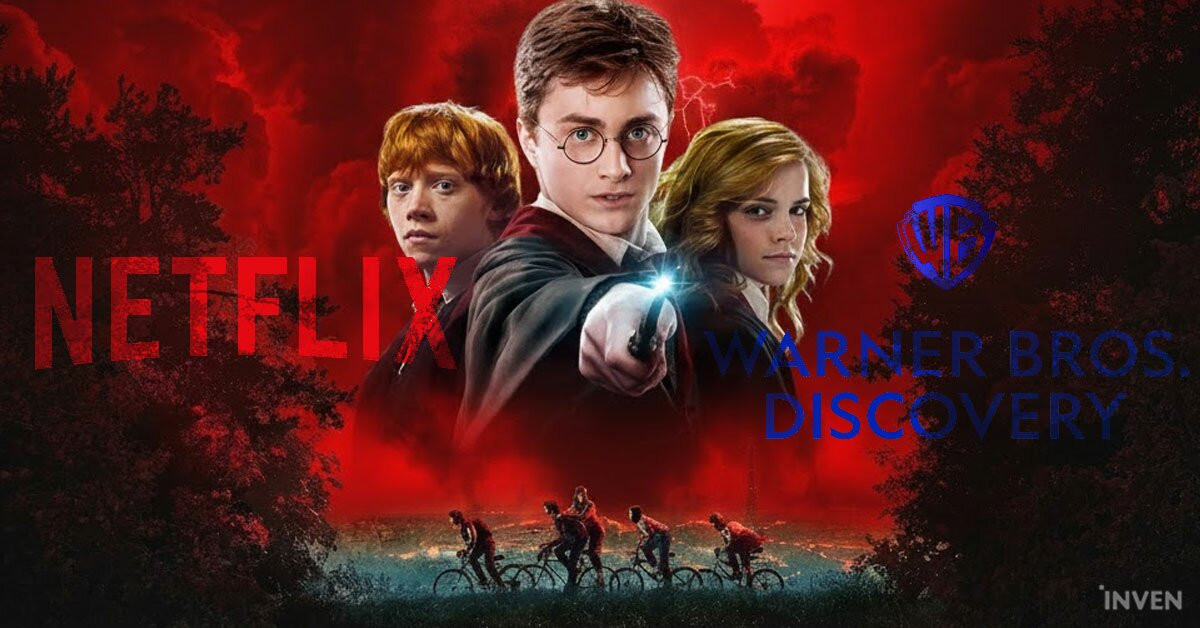
Netflix has completed one of the largest acquisitions in the streaming market to date. Netflix announced on Dec. 5 that it would acquire Warner Bros. Discovery’s (WBD) studio and streaming division for $82.7 billion (about 121 trillion won). Both companies' boards of directors unanimously approved the transaction, and a termination fee clause of $5.8 billion was included in the event that the acquisition falls through. This effectively demonstrates a commitment to ensure the acquisition's success by any means necessary.
The acquisition covers WBD’s entire studio and streaming division, encompassing Warner Bros. film and TV studios, as well as HBO and HBO Max. Discovery Global, which includes CNN, TNT Sports, European terrestrial broadcasters, and Discovery+, will be spun off as a separate listed company. Netflix will be able to secure content from Warner Bros., which has separated its slower-growing business units. WBD will also be able to alleviate its long-term debt and focus on content production.
Netflix co-CEOs Ted Sarandos and Greg Peters emphasized the deal’s significance, stating, "Two of the world's best storytelling companies have come together." WBD CEO David Zaslav responded to Netflix, saying, "We will define the way stories are told for the next 100 years." However, the industry is focusing on potential side effects as much as on "defining the future of storytelling."
The expansion creates new business opportunities but also concentrates market power.
Content Gathering Under One Roof, Film Industry Expresses Concerns
Netflix’s acquisition of WBD is expected to create unprecedented content synergy. Netflix's original flagship series like 'Stranger Things', 'Squid Game', 'Wednesday', and 'One Piece', along with its license-based original series, will be joined under one roof by Warner Bros. and HBO's core IPs, including the 'Harry Potter' and 'Lord of the Rings' film series, 'Game of Thrones', 'The Big Bang Theory', and the DC Universe.
In addition, Netflix will be able to host Warner’s theatrical films and HBO/HBO Max series on its platform. Given that existing works have been sufficiently re-consumed in the global market when registered through Netflix, this opens the door to expanded secondary and tertiary uses, including spin-offs and reboots. Particularly, with the addition of Netflix Originals and the Warner/HBO library, the lock-in effect, which retains consumers, is expected to become even stronger.
However, the theater industry's backlash erupted most swiftly immediately after the acquisition announcement. Cinema United, a global association representing theater operators, issued a statement describing the deal as an "unprecedented threat to the global exhibition business." Concerns were also raised that if Warner Bros. films transition to the limited theatrical release model promoted by Netflix, up to 25% of the domestic U.S. box office could evaporate at once.
Netflix's official announcement also fueled anxiety. Netflix stated that it would maintain Warner Bros.' existing operations, including theatrical releases, but simultaneously mentioned consumer-friendly viewing options, raising concerns about a faster shift to streaming services than before.
Cinema United criticized Netflix for currently allowing theatrical releases of its films only for a limited number of titles. It also noted that Netflix typically screens films for roughly 17 days before moving them to streaming If this model were applied to Warner Bros.' entire lineup and combined with HBO titles, it would cause a ripple effect, shaking the entire structure of theater-distribution-ancillary rights contracts.
The Directors Guild of America also expressed concerns following the acquisition announcement. In a statement, the guild emphasized that "a vibrant industry that fosters creativity and encourages genuine competition for talent is essential to protecting the careers and creative rights of directors and their teams." The guild suggested that consolidating major platforms and studios could create a dominant force with outsized influence over creative work.
Weakened market competitiveness — will it lead to price increases?
While consumers may benefit from more content on a single platform, analysts warn that market competition could weaken.
WBD competed with Netflix through its streaming service, HBO Max, while also serving as a crucial content provider for Netflix. Concerns are rising that the framework in which major studios like WBD negotiated prices and service terms with Netflix has collapsed, inevitably weakening the negotiating power of other content providers with Netflix.
Analysts also predict that subscription fees could rise as competition diminishes. The streaming market has long suffered from price increase pressures. The average price of the top 10 paid streaming services in the U.S. rose by 12% last year. This occurred despite companies being hesitant to actively raise prices due to intense market competition. Analysis suggests that Netflix, with over 300 million subscribers worldwide, has embraced Warner Bros. content, thereby removing obstacles to price increases.
There is another factor contributing to price increases. With Netflix's acquisition announcement, Comcast and Paramount, already engaged in a survival struggle in the U.S. market, are being forced to integrate their streaming services, Peacock and Paramount+. In response to Netflix’s growing dominance, these mergers could further shrink the number of major competing platforms. Specifically, with less platform competition, price increases and diversification of subscription plans are expected to become easier than before.
The diversification of pricing plans begins with the inclusion of advertisements or the addition of low-cost plans, but there are concerns that in the long term, it could lead to price increases for premium ad-free plans and high-Grade products bundled with popular IPs.
Antitrust Concerns?
With concerns mounting over market dominance, regulators’ response to the deal is now a key focus.
Disney, which previously acquired Fox for $71.3 billion, also faced significant concerns regarding the merger and acquisition. At the time, discussions about defensive acquisitions by various media groups continued, and opinions were raised that regulatory approval might not be granted. Regulatory authorities in the U.S. and EU could scrutinize larger mergers and acquisitions, and further business expansion by the top streaming service provider, more closely. Reports also emerged that the Trump administration held a skeptical view of the acquisition.
However, many analysts believe the deal will ultimately be approved. This stems from concerns that if EU regulatory authorities were to prohibit a merger between purely American companies, it could ignite significant geopolitical controversy, which has expanded considerably in recent times. Furthermore, the fact that the EU has rarely blocked such mergers in the past is also cited as a signal increasing the likelihood of the acquisition.
Instead, there is a strong possibility that certain remedies may be imposed during the acquisition process. Examples cited include allowing Warner Bros. content to be serviced on competing platforms, restricting Netflix's exclusive provision of popular IPs such as Harry Potter and DC Universe works, and imposing an obligation to maintain fairness in transaction terms between content production companies.
The final structure of the merger will depend on upcoming regulatory reviews.
This article was translated from the original that appeared on INVEN.