This is the second installment of our underwater series. Last time, we looked at how game mechanics make arrow attacks unrealistically powerful based on the physics of shooting underwater. We concluded that for underwater archery to be effective, you would need a super-powered bow, a character with maxed-out strength, or a modified crossbow that fires harpoons instead of arrows.
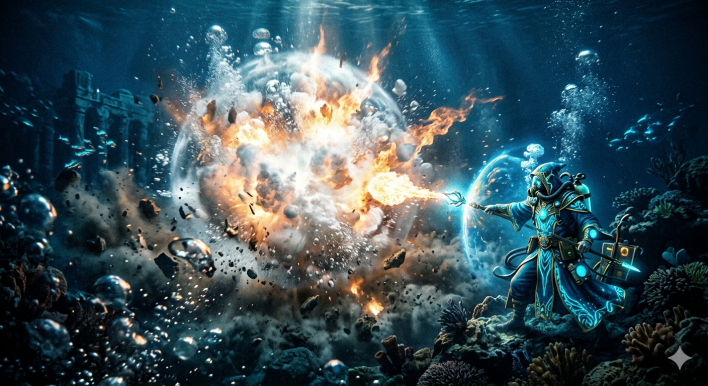
So, are there cases where magic is designed to be weaker than reality? Yes: the Wizard’s fire spells, most notably Fireball. What would actually happen if such a powerful heat source were generated underwater?
※ Lin-cle Science' is a fun, curiosity-driven series where a reporter with a science background (though only a grade 4 in high school math) uses AI to analyze the boundary between game logic and reality. Please keep in mind that this is for entertainment purposes and may contain plenty of scientific inaccuracies. :)

= If a powerful heat source is generated underwater, the result is an explosion
When a mage uses magic underwater to form a powerful fireball, the surrounding water instantly boils and vaporizes. This phase change causes a rapid expansion in volume; as water turns into steam, it expands by up to 1,600 times. In an underwater environment, such an instantaneous 1,600-fold increase in volume effectively results in an 'explosion.'
This is known as a steam explosion, which is cited as one of the causes of the catastrophic explosion at the Chernobyl nuclear power plant. For more details on the Chernobyl disaster, check out the HBO series 'Chernobyl.'
= This creates an 'underwater pressure bomb' effect that tears enemies apart
The mention of Chernobyl should be enough to convey the scale, but the power is immense. While a single Fireball from a wizard might not reach that level of destruction, it would certainly generate a shockwave from the powerful underwater explosion.
Water is an incompressible fluid. Because it cannot be compressed, the energy from a powerful underwater explosion doesn't dissipate like it would in air; instead, it is transmitted directly through the water as a shockwave. This energy radiates outward rapidly, literally crushing any nearby enemies. That is how terrifying an underwater Fireball can be.
= The wizard is at risk, too! A special shield is essential
Since the wizard is also underwater, this shockwave will hit the caster as well. Therefore, before casting a Fireball underwater, the wizard must create a 'shield' to protect themselves.
Don't worry. Wizards are super-powered beings who can manipulate wind, not just fire and electricity. While casting the Fireball, the wizard can surround themselves with a layer of wind to create a low-density barrier. This air layer prevents the shockwave from reaching them, saving the wizard from the unfortunate fate of having their internal organs ruptured.

= Become the ultimate wizard: using science to make Fireball even stronger
A wizard is already overwhelmingly powerful just by forming a fireball underwater, but even more potent modifications are possible. Try wrapping the fireball in magic to contain the explosion, then pack it with liquefied gas before launching it at an enemy. If you time the shield to break upon impact, you can induce a Boiling Liquid Expanding Vapor Explosion (BLEVE). What does that mean? Think of the explosive power of an LPG tank.
You could also throw a thermite core (a mixture of aluminum powder and iron oxide) held together by magic, then hit it with a Fireball to create a 2,500-degree underwater welding torch that won't go out.
That's right. A true wizard doesn't just force fire to work underwater; they turn the water itself into an explosive to crush their enemies. Buff the mages, please.

Sort by:
Comments :0