


At CEDEC 2026, which began on July 22, Cygames shared the development process behind the battle systems for its action RPG 'Granblue Fantasy: Relink' and its major expansion, 'Granblue Fantasy: Relink Endless Ragnarok.'
'Granblue Fantasy: Relink Endless Ragnarok' is a 3D console action RPG based on the 'Granblue Fantasy' IP. Developing an action game featuring a large cast of characters presented a significant challenge: balancing the preservation of character appeal with the depth required of an action game, while simultaneously lowering the barrier to entry for fans of the IP who may not be accustomed to the action genre.
In their presentation, Lead Developer Toru Miki and Engineer Satoshi Hirate explained how they crafted battles to maximize character appeal, the approaches used to expand gameplay depth beyond the previous title, the AI design for reliable companions, and the creation of an 'Assist Mode' that allows even those who have never held a controller to enjoy the game. The two speakers provided a cross-disciplinary look at both game design and engineering.
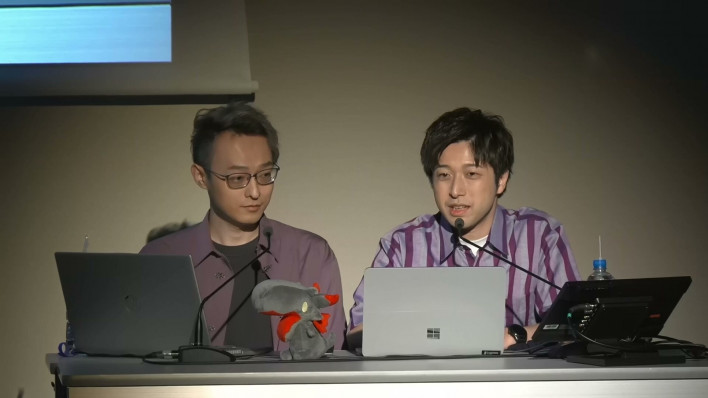
Two Core Pillars for the 'Ultimate Character Game'
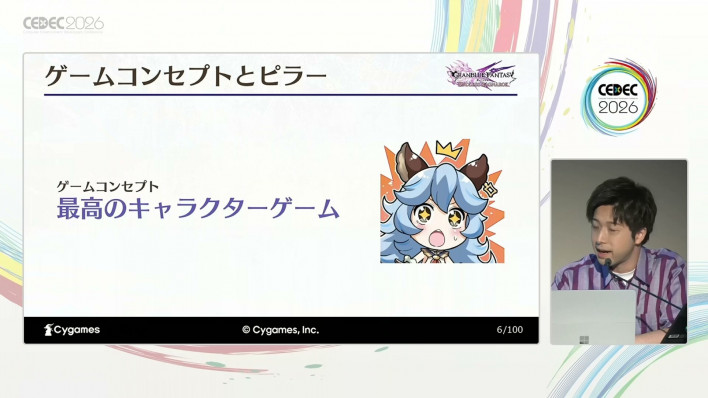
At the time, the development team defined the game concept as the 'ultimate character game' and established two core pillars to implement this through battle design: first, allowing players to experience the charm of the 'Granblue Fantasy' IP through action; and second, ensuring that users unfamiliar with the action genre could still enjoy the game, given that it differs in genre from the original work.
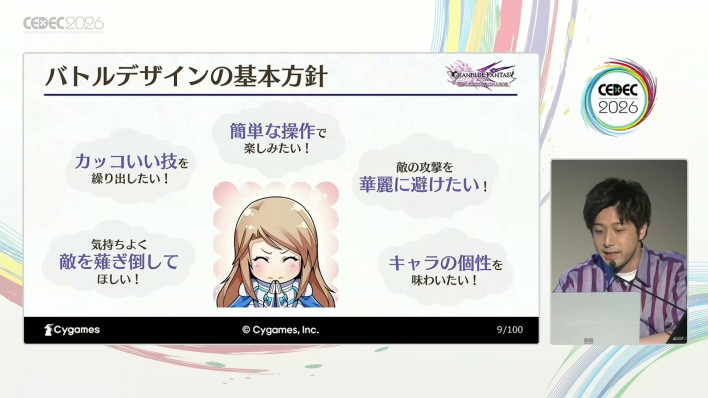
Based on this, the team set a fundamental policy of creating 'battles that prioritize the satisfaction and exhilaration of attacking, where anyone can fight in style.' Most characters were designed to perform flashy combos simply by mashing the standard attack button, and strong directional and proximity corrections were applied to enhance the sense of impact.
The priority of evasion maneuvers was increased to allow for dodging at almost any point during an attack, and mechanisms were implemented to lower the risk of attacking, such as automatically triggering a guard motion if hit while attacking during a guard.
28 Characters x 3 Master Styles: The Volume of "84 Ways to Play"
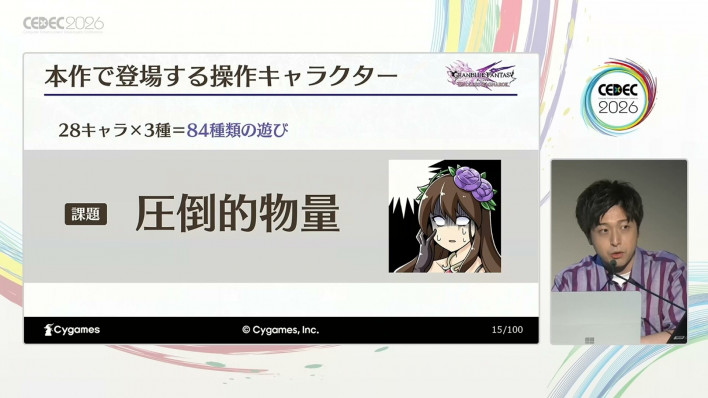
However, there was a challenge. The game features 28 playable characters, and with the addition of three 'Master Styles' for every character in Endless Ragnarok, the team had to develop a total of 84 distinct ways to play. Lead Developer Miki noted that this "overwhelming volume" was the greatest challenge in development.
The team responded with a production flow that prioritized rapid iteration. From the character planning stage, the entire player team—including directors, planners, engineers, and artists—participated in defining basic mechanics and combo structures. They were careful to ensure that roles like tanks or healers did not become overly dominant, allowing any character chosen as the main to contribute through their amount of dealt damage. This approach was also effective in reducing the performance gap between characters and the cost of balance adjustments.
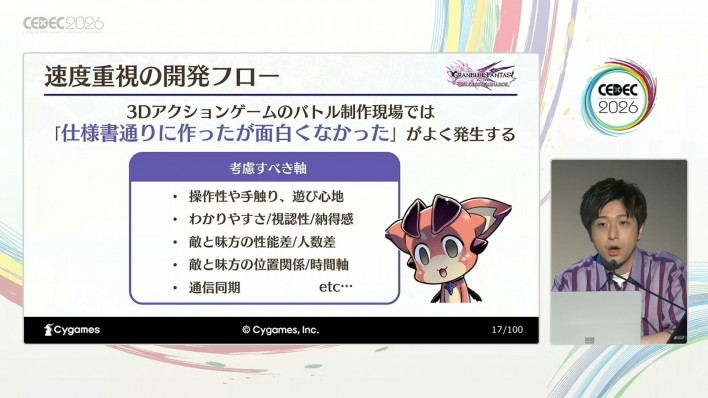
Once the direction was set, they began creating prototypes based on temporary logic. The goal was to verify the feel of the controls with minimal resources within a day, or at most two to three days, focusing on producing a 30-point result as quickly as possible rather than aiming for 80 points from the start. By verbalizing the 'target fun' during the idea phase to form a common understanding, they significantly reduced the need to redefine the direction even if rework occurred later in development.
Master Styles are a system where players choose and grow one of three combat styles that specialize in a character's traits. For example, for the ranged character Rackam, players could strengthen an aggressive style centered on charge attacks or implement a high-risk, high-reward style that accepts the risk of self-damage. Due to the sheer volume, the development of these Master Styles could not be handled by the battle team alone and was conducted in collaboration with the game cycle team, which handles numerical balance from the design phase.
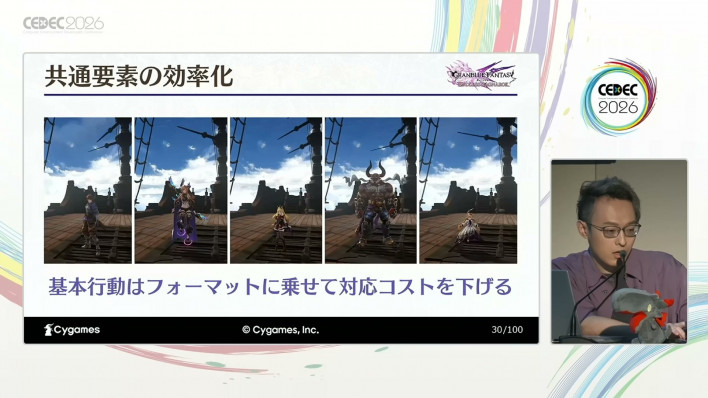
Hirate explained that they organized character action elements into 'common elements' and 'character-specific elements.' Basic actions like movement, evasion, and jumping were formatted into data structures to be common across all characters, and even individual exceptions were regularized, allowing for flexible responses to future additions. Ultimate skills were structured into a three-stage format—startup attack, cut-in, and presentation—which was applied identically to 25 of the 28 characters, allowing artists to verify basic character movements simply by outputting data according to established rules.
For unique elements where control methods vary by character—such as melee single-hit attacks, dash attacks, or location-based attacks—they operated on the premise that 'there are parts that can be standardized even within different elements,' grouping data by 'action' units based on the programming control method. After selecting the basic control method, they input motions, status effects, and combo derivatives to standardize control across characters, aiming for a structure that could be recycled for other characters when creating new unique actions.
4 Types of Linked Actions and Ultimate Skill Chains: "Immersion Completed by Camera Work"
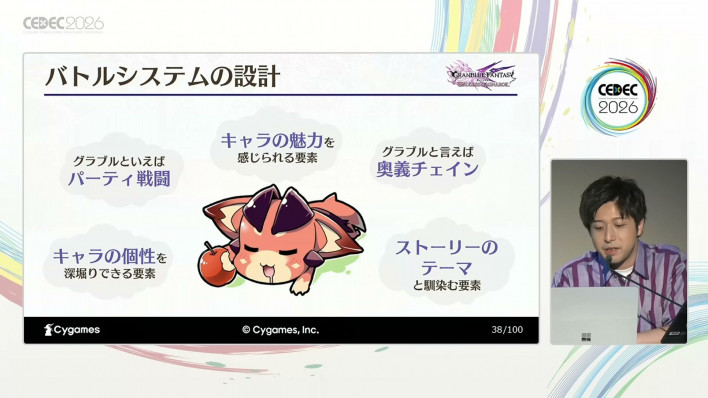
The second topic was the 4-person party linked action. After summarizing keywords such as 'party combat,' 'elements that delve into character personality,' 'elements that allow players to feel character charm,' and 'elements that blend well with story themes,' the team aimed for a 'battle system centered on linked actions between allies.' They sought to deepen the sense of cooperation unique to party combat and the fun of 4-player multiplayer, while also aiming to recreate the 'ultimate skill chain'—the highlight of the original Granblue battle system—with the overwhelming impact unique to a console title. When various linked actions are triggered, character dialogue (banter) also plays.
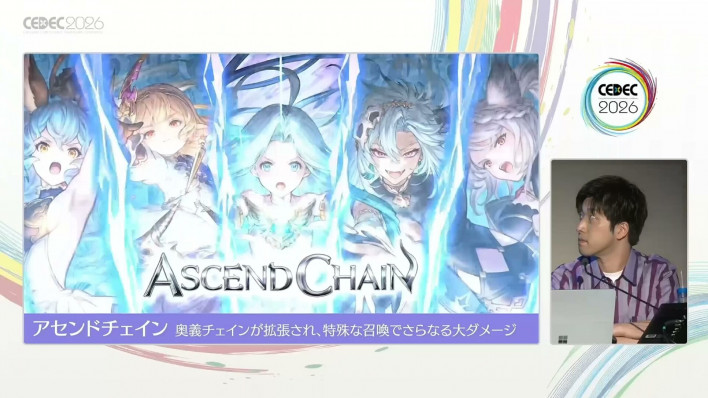
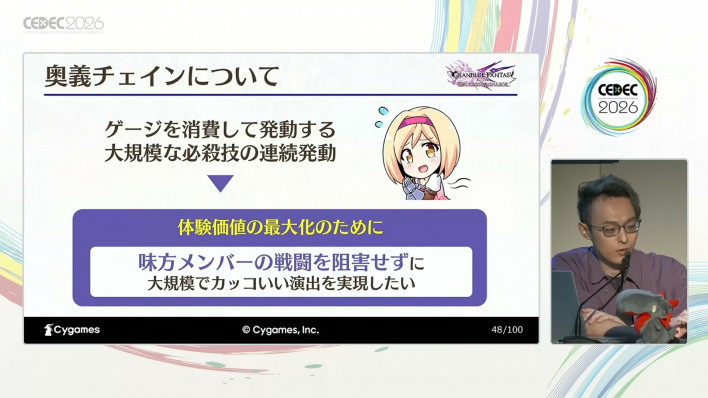
Four levels of linked actions were designed, ranging from small-scale attacks that occur frequently to large-scale ones with lower frequency. By repeating standard attacks and link attacks, players can use an 'ultimate skill,' and if all allies use their ultimate skills in succession, a powerful follow-up attack called an 'ultimate skill chain' occurs. When these links are repeated, a bonus time called 'link time' is triggered, and in Endless Ragnarok, a higher-level link called an 'ascend chain' was added, triggered by link time.
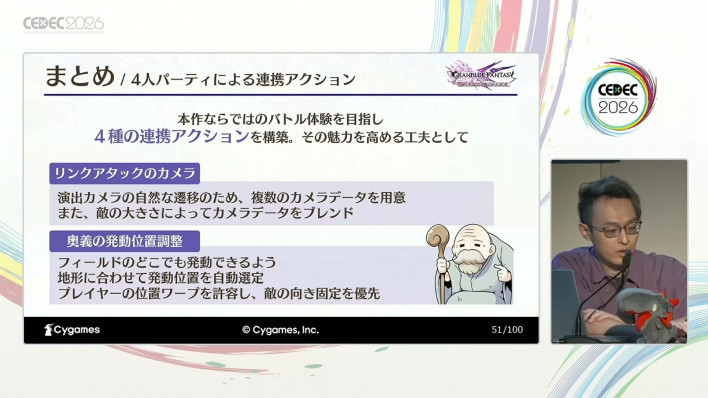
Engineer Hirate explained that for frequently occurring link attacks, they were simplified using only camera animation control due to concerns that flashy presentations might hinder the game's tempo. However, since a single camera pattern did not properly capture the character in action, they improved it to dynamically select the closest of four camera data sets based on the positional relationship between the enemy and the camera. Later, when the camera became too close during battles with giant enemies, they added a structure that blends near and far camera data based on the enemy's size, refining the link attack presentation with a total of eight motion data sets.
For ultimate skill presentations, the challenge was to display large-scale effects smoothly in a multiplayer environment without moving to a dedicated field. They built a mechanism that calculates the positional relationship with the enemy in real-time to find the optimal activation position on a circumference centered on the enemy. Early in development, they tried rotating the enemy toward the player to prevent the ultimate skill user from warping, but this caused the enemy to appear to suddenly change direction from other players' perspectives. Ultimately, they changed it so the enemy's direction remains fixed and the activator warps to the enemy's front, prioritizing the playability of the other three players over the slight discomfort of the one activator.
"Strong and Smart" Companion AI: Character AI and Meta AI
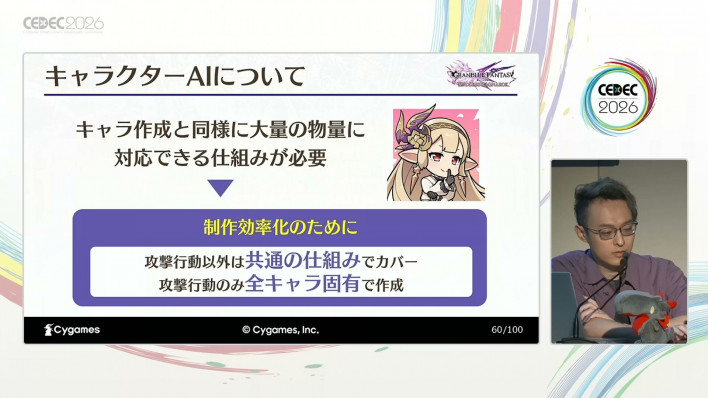
The third topic introduced was companion AI. Lead Developer Miki stated that they set the policy for 'AI with strong, reliable combat power that links intelligently' by adding two pillars—'allowing characters to perform without damaging their charm' and 'being helpful to players who are not good at action'—on top of goals like damage contribution, ally rescue, healing/buff utilization, and responding to links.
Companion AI was implemented on two axes: 'Character AI,' which handles individual character control, and 'Meta AI,' which acts as a command center that oversees the battle situation. Character AI adopted a method of emulating player key inputs directly, fearing that if AI-specific logic were written separately, bugs would arise where adjustments made for players would not be reflected in the AI. Decision-making is handled by a 'Behavior Tree,' while actual button input and timing control are handled by an 'FSM (Finite State Machine).'
During development, there was a problem where the AI's aggression was too high, causing them to finish off enemies before the player could participate. They secured a delay by using a 'ready stance and walk' motion, where the AI moves while preparing its stance. Judging that detecting and dodging every enemy attack was too costly, they adopted a method where the moment an attack hits, it is treated as 'not hit' and an evasion motion is played. The problem of needing individual responses for up to three patterns per character due to the introduction of Master Styles was solved by expanding the FSM.
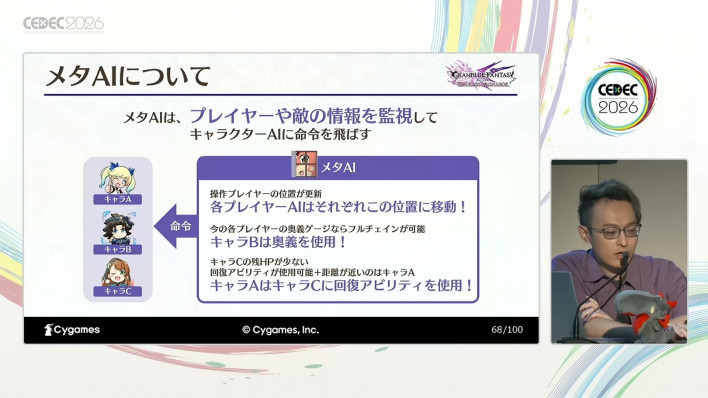
Meta AI performs roles such as tracking position control to calculate individual destinations so allies do not overlap, issuing ultimate skill link commands only at timings where a full chain is guaranteed by calculating ultimate skill gauge increases, and selecting healing/rescue characters by detecting ally downs or low HP. Furthermore, prioritizing player movement convenience, they removed collision detection between ally characters, and instead, Meta AI calculates each character's destination individually to ensure they disperse naturally.
The problem of binding-type abilities being wasted by ignoring enemy debuff immunity was improved by having Meta AI check activation conditions in advance, such as whether the enemy accepts debuffs and if a character with the same instruction is present. The problem of AI failing to join within the ultimate skill chain time limit because the boss moves to the air or a wide field was solved by lifting the ultimate skill participation distance limit for AI, which was applied to players.
Engineer Hirate judged that "it is better not to cause the stress of missing a full chain due to a broken chain than the visual awkwardness of suddenly warping from afar," adding that since the ultimate skill in this work has a structure where the camera cut switches before and after the cut-in, the AI's warping is not very noticeable.
'Assist Mode' for Action Beginners'
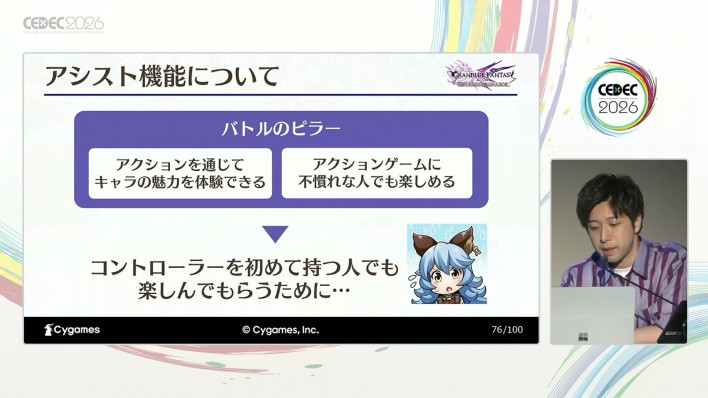
The final topic introduced was the assist function that lowers the difficulty of controls. The original 'Granblue Fantasy' is a mobile turn-based RPG, which is very different in genre from this title, so they prepared 'Assist Mode' and 'Full Assist Mode' so that IP fans without console action game experience could enjoy it with peace of mind. Assist Mode automatically performs various skills and evasions with just movement and arbitrary attack buttons, while in Full Assist Mode, combat proceeds with only movement input.
The core of Assist Mode is a "system that replaces attack button inputs with appropriate operations." Unlike companion AI, since movement is controlled directly by the user, decision-making was configured using only FSM instead of a Behavior Tree. Attack abilities without special bonus effects were included directly in the attack combo FSM, while abilities where timing is important, such as stat buffs or debuffs, were implemented to be activated according to Meta AI commands.
There was a problem where the assist character, always exposed in the center of the screen, looked monotonous by repeating the same optimal actions, so they built a separate 'Assist Mode-exclusive attack combo FSM' to diversify combo routes and bring out character personality. However, they advised that this method should be done in the latter half of development when the basic battle policy and character specifications are somewhat finalized, as it is costly to implement and vulnerable to specification changes because a dedicated FSM must be written for each character.
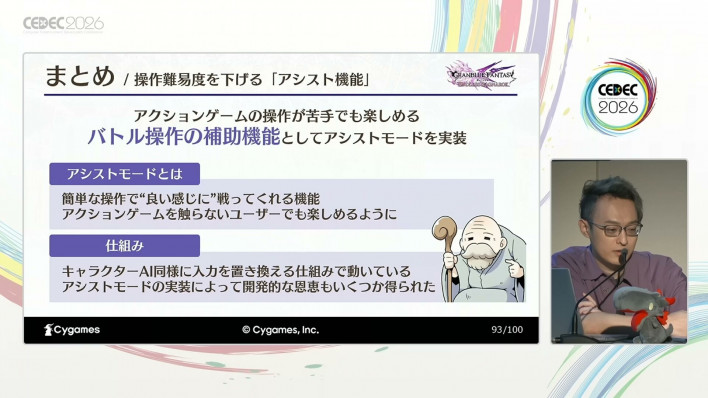
Since the essence of Assist Mode is 'to allow players to enjoy the main story without problems,' they also had to take care of movement gimmicks and minigames outside of combat. Special battles where players control the giant robot Tayu'tarr or the primal beast Proto Bahamut were completely different from the existing structure, so they wrote dedicated automation logic separately in the source code. For 'Ether Cannon' sections with shooting elements, they applied a two-stage process of aim assist and auto-aim so that users who are not good at shooting could pass without difficulty.
In Full Assist Mode, there was a problem where movement to the destination was blocked because the AI automatically prioritized attacking nearby enemies, so they reduced the auto-combat recognition distance of ranged characters in problem areas. They also registered whether obstacles that needed to be destroyed for progress were present in the layout information in advance so that only necessary objects were automatically attacked.
The assist function also had advantages in the development process. It was highly compatible with automated testing by utilizing Assist Mode in combat sections for verification-use auto-play, and thanks to the characteristic that the automatic control state is continuously exposed in the center of the screen, abnormal behaviors were reported immediately, allowing them to catch the root cause of Meta AI logic early.
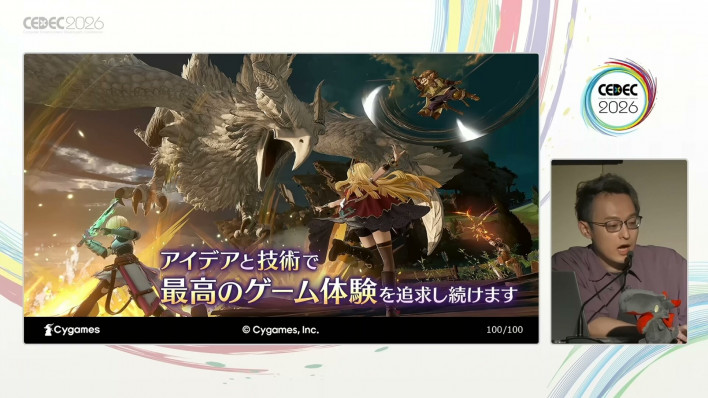
Concluding the lecture, the two developers from Cygames summarized, "To realize the concept of the 'ultimate character game,' we designed the battle design, battle system, companion AI, and Assist Mode based on the two pillars of experiencing character charm through action and accessibility for action game beginners." They ended the lecture by expressing their determination to "continue to pursue the best game experience through ideas and technology."



Sort by:
Comments :0