



In just one year, advertising costs have surged. The cost per install (CPI)—the amount spent on ads to get a single user to install an app—has jumped 48% on Android and 3.5 times on iOS. Yet, game revenue has not kept pace.
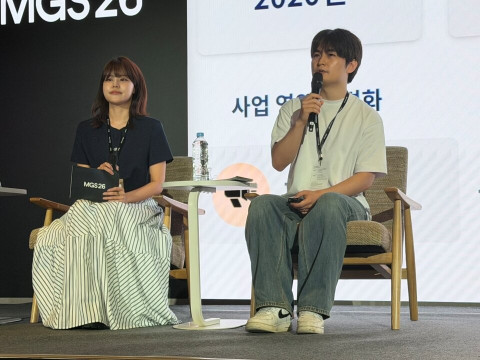
Kim Sun-woo, a director at Mistplay, addressed this gap during his lecture, 'Beyond the ROAS Wall,' at 'MGS WEEK 2026' held at the Westin Seoul Parnas in Gangnam District on the 21st. The challenge is how to overcome the 'wall' where the cost of acquiring users continues to rise, while the target for Return on Ad Spend (ROAS)—the metric measuring how much of that ad spend is recovered through revenue—remains stagnant. Director Kim proposed finding the answer in 'play time' rather than 'installs.'
Mistplay is a marketing platform that acquires new users by offering rewards for playing games. This practice of using incentives to secure users is known in the industry as 'reward-based user acquisition (UA).' Leveraging a global monthly active user (MAU) base of over 40 million, Mistplay has supported marketing for everyone from major domestic publishers like Netmarble to Chinese and European studios entering the Korean market for the first time. Kim based his presentation on data observed from actual campaigns rather than theory.
Installation is the beginning, not the end
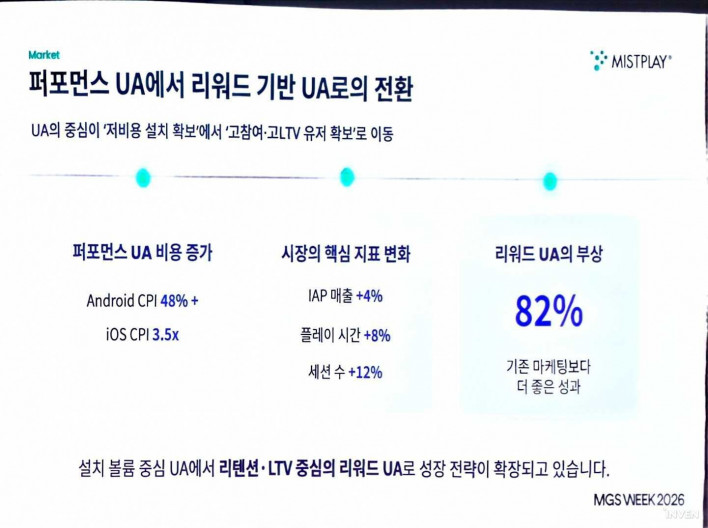
Kim began by asking the audience, "Has anyone here run a campaign this year where the cost per install was lower than last year?" No one raised their hand.
The problem he highlighted is a misalignment of numbers. During the same period, in-app purchase (IAP) revenue grew by only 4%, while the frequency of user logins increased by 12% and total play time by 8%. This means that while the cost of acquiring new users has skyrocketed, market growth is actually being driven by existing users playing longer and more frequently. In short, the center of gravity for growth has shifted from 'installs' to 'engagement.
This aligns with a Mistplay survey in which 82% of marketers who have executed reward-based campaigns reported better results than with traditional channels. Kim explained, "It is not that reward marketing has suddenly improved, but that the value the market measures has changed."
The issue is that most marketing budgets still tie rewards only to the initial 'install' hurdle. Users actually settle into a game much later, at the stage where they achieve specific milestones. There is a disconnect between where rewards are offered and where actual value is created.
Rewarding 'after play,' not 'after install'
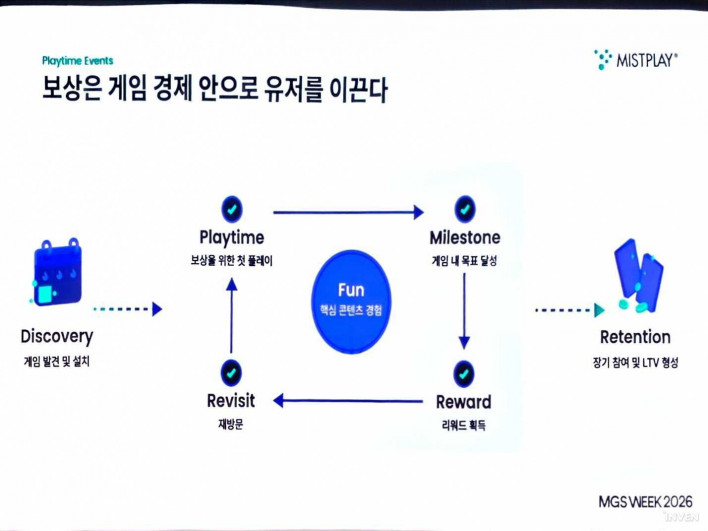
This led to the concept of 'Playtime Events.' The structure is simple: it combines rewards given at set intervals of playtime with rewards for achieving meaningful in-game goals, such as completing a tutorial, reaching a level, or joining a guild. While the former helps predict 'when and what' a user will receive, the latter draws them deeper into the game's content.
The key is that changing the 'location' of the reward alters user behavior. In the traditional model (install = reward), the user's goal is met the moment they receive the reward, giving them a reason to leave. Kim diagnosed the industry's common belief that 'reward-acquired users are low quality' as a flaw not in the rewards themselves, but in tying them to the 'install.'
Conversely, when rewards are placed after gameplay, users naturally pass through the core fun of the game while chasing those rewards. Kim stated, "Rewards should not be a glue that holds users in place, but a bridge that leads them to the fun. Once they cross the bridge, it is the game itself that keeps them there."
Early campaign data confirmed this effect. Average playtime per game increased by 30%, and ROAS at the 30-day mark rose by 20%. Kim asked the audience to note the order of these two figures: playtime increased first, followed by revenue. He concluded, "ROAS is ultimately the goal, but playtime is a reliable leading indicator that signals success in advance."
Netmarble's 'Seven Knights Re:BIRTH' was presented as a case study. During its global expansion, the challenge was to secure 'monetizable users' who would go beyond simple installs to actual purchases. Through AI-based campaigns, active users who consistently logged in and played increased by 10%. Kim emphasized, "For global launches of major IPs, success is determined not by the number of installs, but by the number of 'living users.'"
High-quality users, at sufficient scale
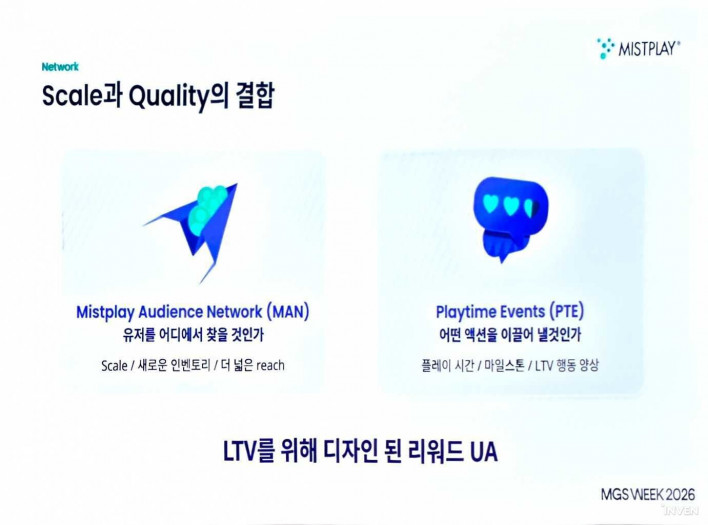
Even if you find good users, growth stalls without scale. Kim's second topic was 'scale.' Large ad networks have many users but high quality variance, while high-quality channels quickly run out of inventory. Marketers are all too familiar with the experience of finding a good channel only to exhaust it in a month.
Mistplay's answer is to expand its proven reward model beyond games. Users who respond to rewards are not just in games. Users who collect points in finance apps, get cashback in e-commerce, or open membership apps daily are already accustomed to 'reward-driven habits.' By connecting these app categories, the 'Mistplay Audience Network (MAN)' opens a new touchpoint with over 40 million users that game ads previously could not reach.
Kim noted that in practice, the operational method is what matters. Expansion is difficult if increased touchpoints lead to increased management burdens. This network is designed to distribute a single campaign across the entire network while automatically adjusting ad unit prices based on the acquisition path, rather than creating separate campaigns for each app.
In summary, this network answers 'where to find users' (scale), while Playtime Events answer 'what behavior to elicit' (behavioral design). Kim said, "Even if you find good users, they will churn without behavioral design, and even with good design, growth will stop without scale. Using both is the 'equation for Reward Marketing 2.'"
The case of 'Inferno Nine' by Chinese developer Leniu Games was presented as a validation in the most difficult market. Challenging the Korean MMORPG market—the world's most profitable yet highest-barrier market—the game achieved 2.5 times its target ROAS at 30 days post-install. Furthermore, its Day 1 retention rate was 40%, and its 30-day retention rate exceeded 10%. A 40% Day 1 retention rate is 16% higher than the average for other ad channels using similar methods. Features like tournaments and guild quests were found to be major contributors to long-term retention.
Korea and Japan: Digging 'deep' rather than 'wide'
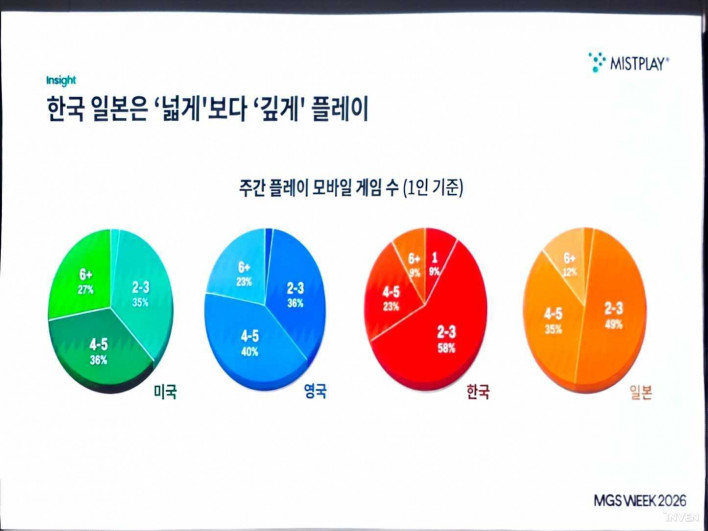
The final point was 'to whom and how.' Kim shared an analysis of play data from millions of users, broken down by country and genre.
Looking at the number of games a person plays per week, users in the U.S. and U.K. tend to enjoy multiple games simultaneously, whereas users in Korea and Japan show a clear tendency to dig deep into a small number of games. In Korea, 58% of users play only 2–3 games per week.
This difference dictates strategy. In Western markets, it is valuable just to be one of many games a user enjoys. In Korea and Japan, however, you must compete for the user's 'main game' spot. The barrier to entry is high, but once that spot is secured, the depth of value a single user provides over time is completely different. Therefore, in Korea, rather than campaigns that only scratch the surface with installs, a well-designed onboarding process that leads users deep into the game is necessary.
The 'bait' to bring them back must also differ. For Western users, short-cycle freshness like new content or events works, but for Korean and Japanese users, assets that grow with time—like my character, my ranking, and my guild—are more effective. Kim said, "Even with the same reward budget, you should invest in 'reasons to return' in the West, and 'reasons you cannot leave' in East Asia."
The speed of monetization also varies by genre. According to Mistplay platform data, the puzzle genre has the fastest and strongest conversion, with 7.4% of users spending money within 30 days of install and a first-purchase time of 1.6 days. RPGs are 'monetization-balanced,' with 5% of users paying and a first-purchase time of 1.7 days. Strategy games are the slowest, with 4.3% of users paying and a first-purchase time of 2.2 days, but they have the highest number of sessions per user. In this genre, engagement builds first, followed by payment.
Kim pointed out, "If you evaluate a strategy game campaign at the 30-day mark using the yardstick of a fast-monetizing puzzle game, you will kill a perfectly good campaign. You must align the performance measurement period with the genre."
"Reward vs. Performance' is the wrong frame"
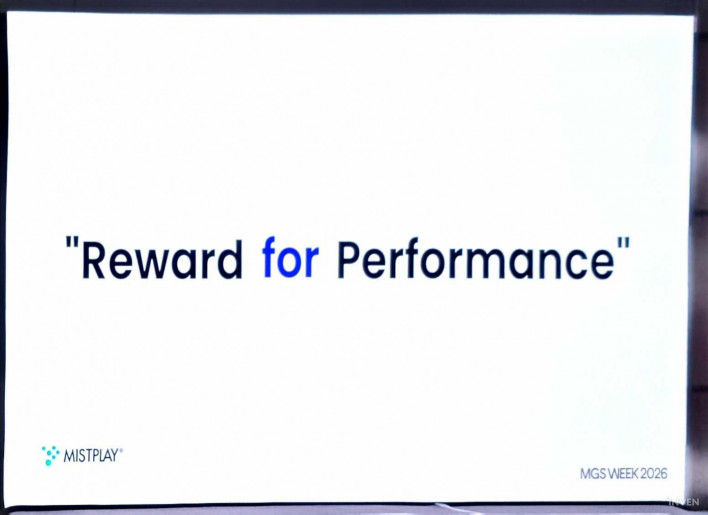
Kim argued that the industry's long-standing view of 'reward-based marketing vs. performance-based marketing' as a conflict is fundamentally wrong. The issue is resolved the moment you change 'vs.' to 'for.' The message of his entire presentation can be summarized as 'Reward for Performance'—meaning rewards are not the opposite of performance, but a tool to create it.
He proposed four checklists for immediate practical application: △Change the primary performance metric from CPI to playtime and user behavior metrics; △Have the marketing team directly design the path for users to reach core fun after installation; △Do not copy the same campaign structure across different markets and genres; △Scale up proven models by diversifying touchpoints.
Kim concluded the presentation by saying, "If you experiment with even one of these this quarter, today's session will have been worth it."
![]()
- Byungho "Haao" Kim
- Email : haao@inven.co.kr
-



Sort by:
Comments :0