


"In the future, humanity will no longer need to work. AI and robots will produce everything necessary for survival, leaving humans free to simply enjoy their lives"
You have likely heard this sentiment before. Once considered a somewhat optimistic prediction for the future of humanity, this argument has shifted from a 'nearly unimaginable future' to 'one of many possibilities' as we undergo a paradigm shift driven by the rapid advancement of AI.
However, whether life in such a 'future paradise' would truly be happy is impossible to know without experiencing it firsthand. 'D-TOPIA,' an indie game developed by Marumitu Games, depicts life in this paradise—or rather, it reflects on the facets of 'D-TOPIA,' a residential facility that everyone envies.
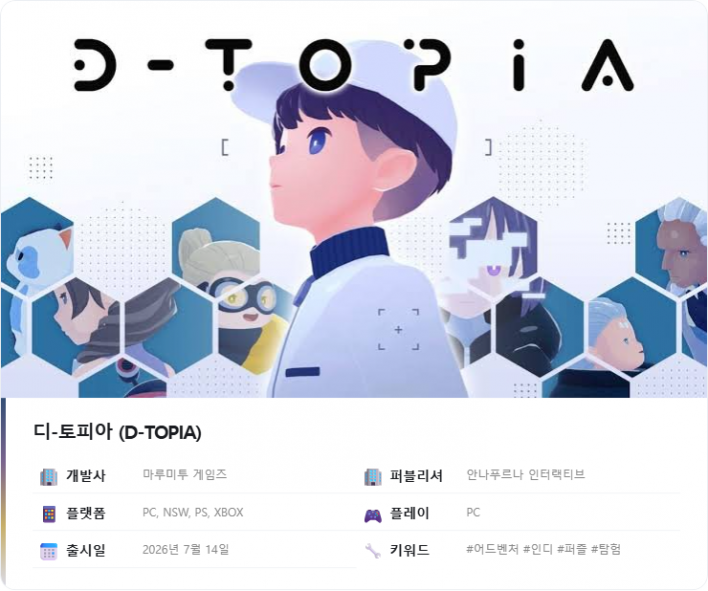
The game begins with the 18-year-old protagonist, Shiro, arriving at 'D-TOPIA.' Renowned as a paradise among countless residential facilities, D-TOPIA is a massive complex operated by cutting-edge AI. Every resident is issued a registration number and lives in a room corresponding to that number. Shiro’s role is that of a 'Facility Manager.' Also known as a 'Coordinator,' this is a rare position granted to only a few residents, tasked with resolving and mediating the various conflicts that arise within the facility.
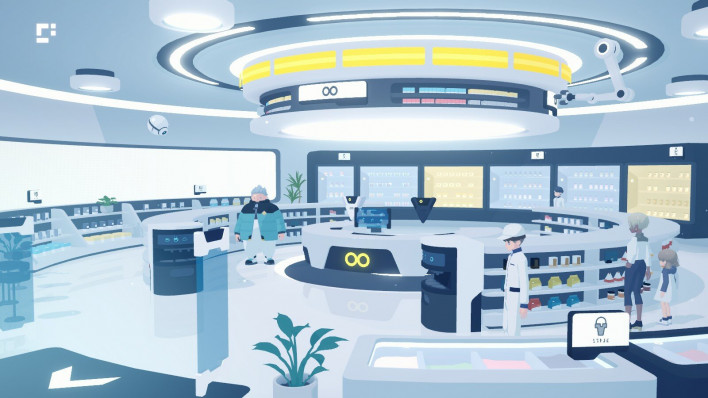
As depicted in the game, D-TOPIA is a paradise in the literal sense. Every member is assigned housing and provided with three meals a day, which are delivered directly to their homes so there is no need to visit a cafeteria. In the morning, students head to school and adults to the factory. While these tasks are technically unnecessary, the facility was designed under the theory that people without purpose become unhappy and hollow; even these activities conclude by the end of the morning. From lunch onwards, it is free time. Residents can play games in their rooms, enjoy food amidst the beautiful landscaping in the gardens, or socialize with others. D-TOPIA is, in essence, a place where a peaceful life is guaranteed until the very end.
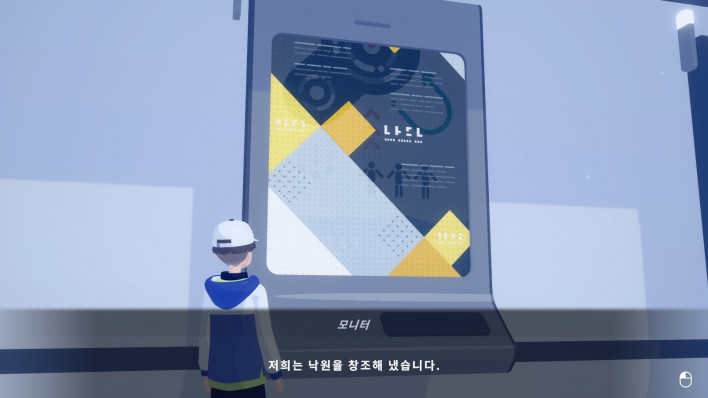
And yet, as Shiro spends day after day in this designed paradise, its contradictions and hidden underside slowly begin to emerge.
Every element of D-TOPIA is curated based on big data regarding what makes humans feel happy, and this extends to the residents' 'five senses.' A prime example is D-TOPIA's pristine, serene appearance, which is a visualization model generated by AI rather than its true state. The 'Troids' that float in the air to assist residents are actually drones suspended on long poles or flying via propellers, but to the residents, they appear to be simply floating.
The olfactory system is not yet fully refined and cannot mask odors. Furthermore, because the entire paradise is a projection of a hidden reality, there are instances where the system fails to respond immediately to real-world changes, such as objects simply vanishing or being blocked by invisible obstacles. As a Facility Manager, the protagonist, Shiro, has the authority to access 'Blockside,' a restricted area where this visualization mode is disabled.
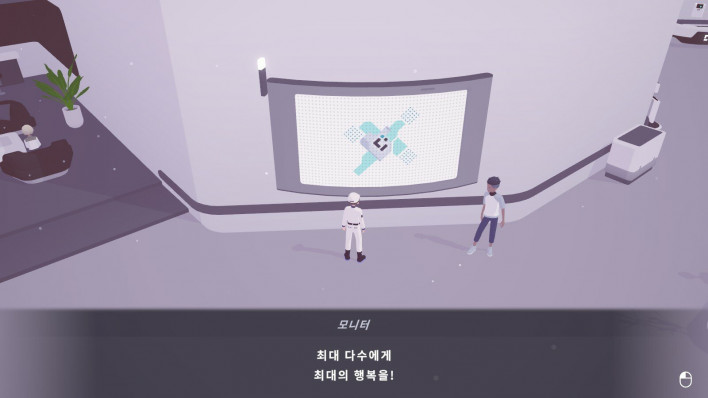
D-TOPIA looks quite different when viewed from 'Blockside.' Complex wiring and drab, raw machinery are laid bare, and the AI Troids—who usually address residents with a gentle tone—treat the protagonist with a rather curt and abrasive demeanor. Delving deeper, D-TOPIA reveals itself to be more than just slightly clumsy; it shows a highly suspicious side. There are billboards openly preaching Jeremy Bentham’s utilitarian philosophy of 'the greatest happiness for the greatest number,' a grading system that discriminates based on location and forces residents to be 'exemplary,' and even an expulsion system for those who cause trouble three times.
As players spend their days in D-TOPIA, interacting with various characters and building relationships, they are forced to confront the dark side of this paradise. Through this process, they face critical choices that will determine the future of D-TOPIA and its residents.
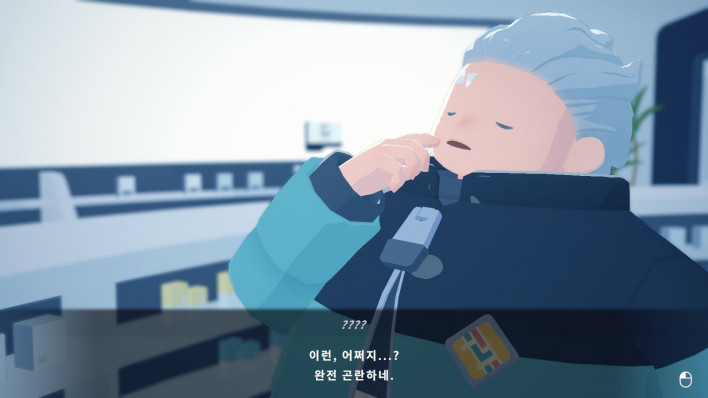
The game’s progression follows a dual track of adventure and puzzles. The process of identifying and investigating problems follows a traditional Adventure game style, while the solutions take the form of casual 'puzzles.' The game focuses primarily on the 'adventure' aspect, and puzzles can be easily solved using hints. However, interacting with other characters, winning their favor, and making decisions about the future are not as easy as they seem, and it is difficult to predict which choices will lead to better outcomes.
The pacing is not particularly fast. Shiro’s running speed is modest, and even with speed-boosting drinks, the effects are only temporary. Fast travel is extremely limited, and since there are quite a few events to discover while moving, it is not necessarily recommended even if it were possible. For players seeking instant dopamine or high-octane thrills, D-TOPIA is not exactly a perfect fit. Given the somewhat static art style, it may not be ideal for those looking for something more heart-pounding, either.
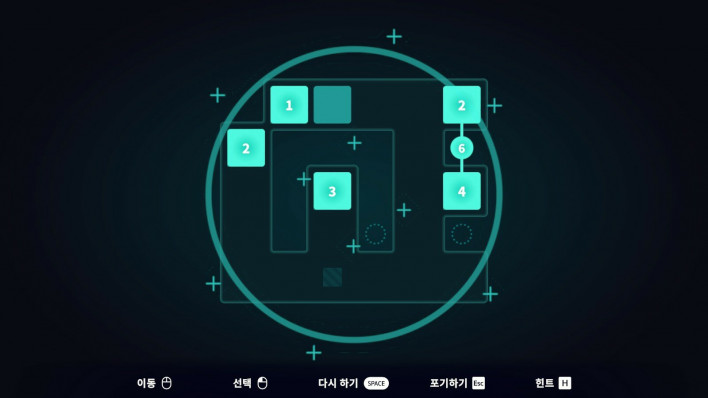
However, for players prepared to enjoy the game at a leisurely, relaxed pace, D-TOPIA can be quite captivating. The secrets hidden within this artificial paradise, the narratives of its inhabitants, and the process of deciding its future are deeply intriguing and demand careful contemplation from the player—though it is difficult to explain further without venturing into spoilers.
To give a slight hint, however, D-TOPIA is a game that poses questions to the player. What is true 'happiness,' and what direction does the happiness I feel take? Depending on the player's choices, D-TOPIA takes on various forms. It can evolve into a meticulously 'Designed Utopia,' or it can devolve into a 'Dystopia' where individual opinions are suppressed and residents live lives bordering on brainwashing. The choice is yours.

- Deep and lingering narrative
- Satisfying visualization of paradise and its hidden side
- Game flow that changes based on choices
- Sometimes excessively slow tempo
- Simple art style compared to the depth of the narrative
- Lacks internal challenging elements
Review Platform: PC (Launch Build)


Sort by:
Comments :0