


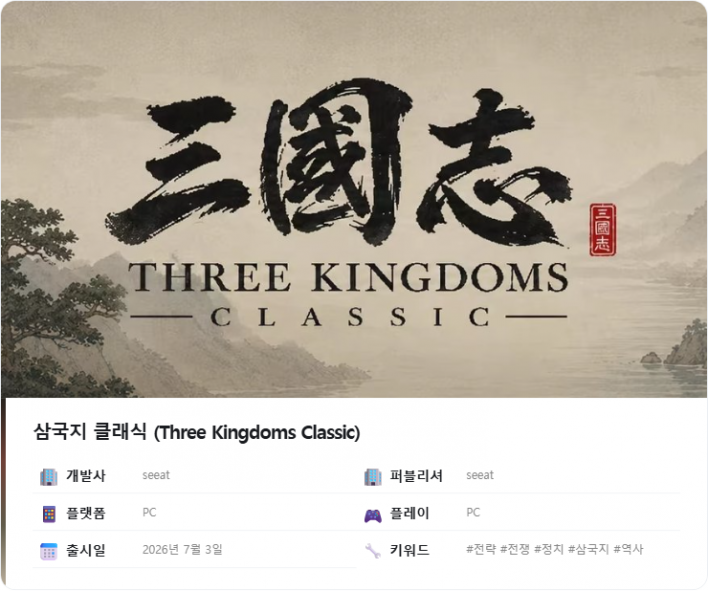
I recently discovered 'Three Kingdoms Classic.' At first, I wondered if it was a Koei title, but the developer was someone else entirely. Curious, I looked it up and found it wasn't from Japan or China, but a Korean indie game created by a solo developer.
I bought this game for a price that barely covers a meal these days, but after just a short time playing, it hit me. The old Romance of the Three Kingdoms series was incredibly fun, so why haven't the recent ones been the same? This 'Romance of the Three Kingdoms Classic' captures that pure, simple essence—the very 'fundamentals' that made the originals great.
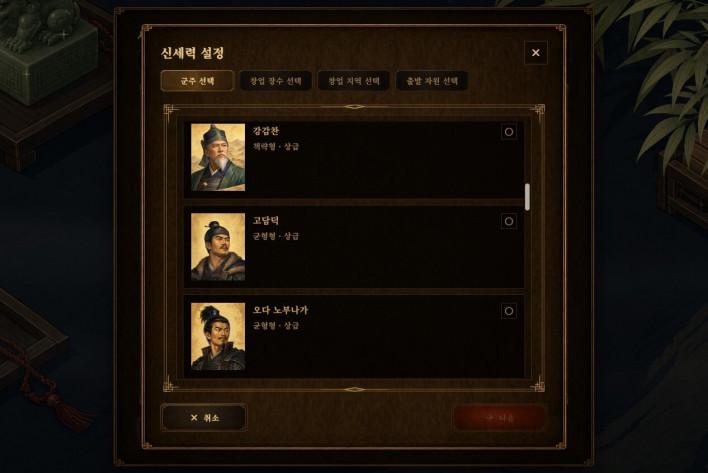
The interface of Three Kingdoms Classic is minimalist. It looks like a throwback to the older titles from our neighbor across the sea. Instead of hiding the UI like modern games, the main map is small, while the UI and notification windows are always visible. And that’s it—nothing else changes. When a battle breaks out, it switches to a combat screen, but even that is incredibly simple. Within this single screen, about a century of history unfolds, from the Yellow Turban Rebellion to the fall of Shu Han.
The player is left to focus entirely on 'grand strategy.' There are no side activities like building friendships through social interactions or wooing female officers. Three Kingdoms Classic focuses solely on recruiting talent, domestic affairs, diplomacy, and war to unify the Central Plains; it does not deal with individual narratives.
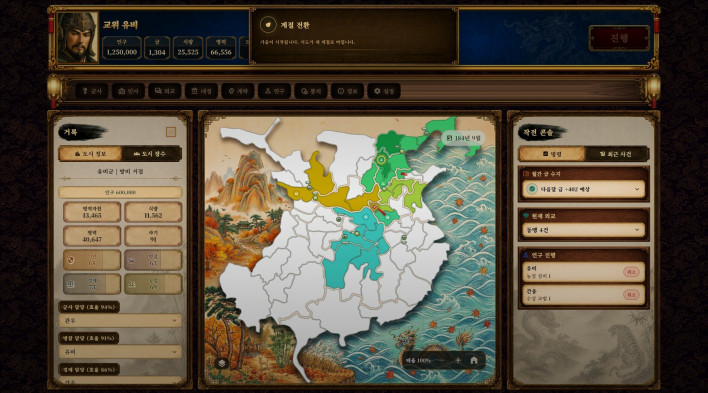
This is precisely what evokes the charm of the old Three Kingdoms games. All the player has to do is manage their forces, climb the ranks, and keep pushing toward hegemony over the Central Plains. Because of this, the game’s setting feels closer to the 'Records of the Three Kingdoms' (the official history) than the 'Romance of the Three Kingdoms' (the novel).
You won't find the dramatic heroics of the three sworn brothers charging at Hulao Pass, Lu Bu’s one-man army, or the back-and-forth between Zhang Liao and Sun Quan. Like the 'Records of the Grand Historian,' only pure, dry records remain on the right side of the screen: "In year XXX, General So-and-so led X number of troops and occupied such-and-such location."
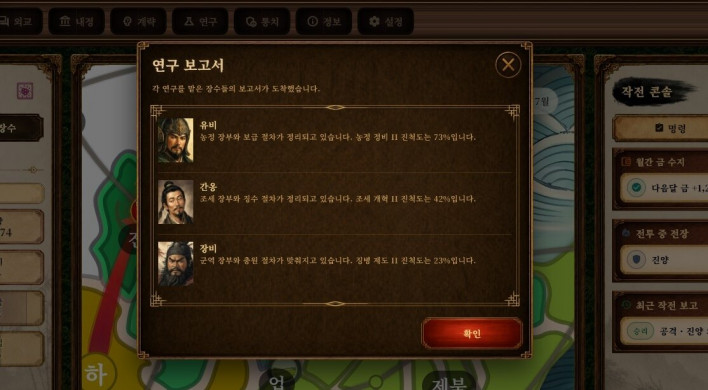
And this is the defining characteristic of 'Three Kingdoms Classic'—both its greatest strength and its potential weakness.
The 'Romance of the Three Kingdoms' has been continuously reimagined long after its adaptation into video games. Lu Bu, once simply defined as an 'unrivaled warrior,' has gained a new identity as the 'Locust of Hulao Pass' through countless reinterpretations. Zhang Fei, who in reality came from a well-to-do family, respected scholars, and was quite learned, has been transformed into a hard-drinking, loyal, and reckless brawler. While these distortions may be far from historical fact, it is undeniable that they have become a source of entertainment in their own right.
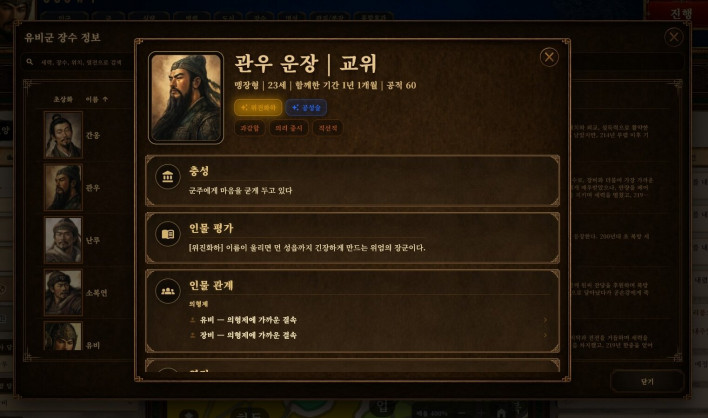
However, all these distortions and reinterpretations are just flavor; they aren't the 'fundamentals' of the Three Kingdoms. Looking past Luo Guanzhong’s novel and back to the dry records of the late Eastern Han compiled by Chen Shou, 'Three Kingdoms Classic' views the Central Plains with a relatively detached eye—the process of achieving unification.
This will be appealing to some, but not to others. Those who enjoy simulations set in a fact-based world will be pleased, but those who enjoy the deeper, richer, and more embellished media of the Three Kingdoms might find it a bit boring.
However, as long as it bears the name 'Classic,' one cannot say the direction 'Three Kingdoms Classic' has chosen is wrong. The game maintains the core of the 'Three Kingdoms' subject matter, solidifies its fundamentals, and sticks to its basic direction without trying to add more than it can handle.
From that perspective, the level of polish in 'Three Kingdoms Classic' is excellent. Being a solo indie project, there are inevitably some shortcomings. The AI of other factions can be overly aggressive, and the diplomacy and combat systems feel slightly lacking. Since the pool of officers isn't very large yet, there are frequent moments where your faction struggles simply because there are no talented people to recruit.
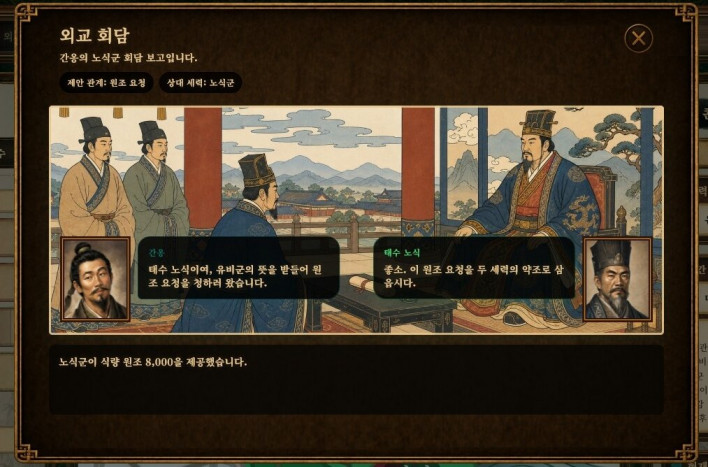
But even considering all that, 'Three Kingdoms Classic' is a genuinely good game. The illustrations—which don't feel awkward despite the active use of AI—the event scenes drawn in a classical style, the inclusion of the Eastern Han rank system (pre-dating the Nine-Rank System), and the long but rewarding process of unifying the Central Plains all provide a sense of satisfaction.
It doesn't contain everything, but it fulfills the necessary and sufficient conditions that a 'Three Kingdoms' game should have. I believe 'Three Kingdoms Classic' is a game that has achieved this brilliantly, especially for a solo indie project.
- Extremely high level of polish for a solo project
- Elegant illustrations and intuitive screen layout
- Officers modeled after historical records
- AI level is somewhat disappointing
- Detailed systems are still lacking
Review Platform: PC (1.3)




Sort by:
Comments :0