


Team Leader Mo is the type of person who plays everything from rhythm action games to fighting games. While others jokingly say he should just stick to bullet-hell shooters (though I suspect he plays those in secret, too), I honestly envy that. He claims to be a listener with deeper tastes than anyone, yet when it comes to rhythm action games, he barely manages to finish a single track while burning through all his stamina. Clearing a song with a perfect streak while notes pour down like crazy? Those kinds of monsters are a world away from me.
That’s why, for a rhythm-game klutz like me, Rhythm Heaven is like a ray of hope. I mean, a rhythm game where you just have to bob your head to the beat and press a button? And it’s actually fun, too. Back in the Nintendo DS days, Rhythm World (it was called 'World' back then, not 'Heaven') was one of the few joys of my long bus rides to school.
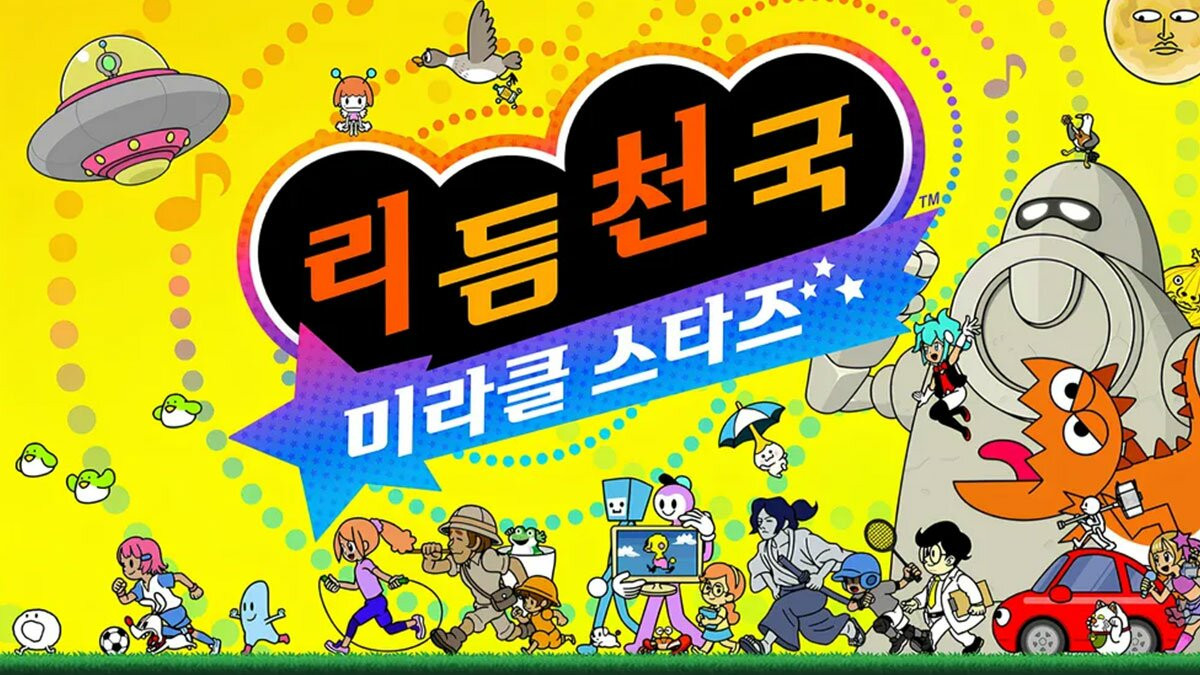
Enough with the embarrassing stories. I only bring this up because Rhythm Heaven is finally back with a new entry. Rhythm Heaven Miracle Stars, launching on Nintendo Switch, is the first new title in 10 years if you count the 3DS 'Best+' version, or about 13 years since the Korean release of Rhythm Heaven Wii. It is high time for a trip down memory lane.
The long wait of over a decade, devoid of any major news or new releases, turns into instant satisfaction the moment the game's cheerful beat kicks in.
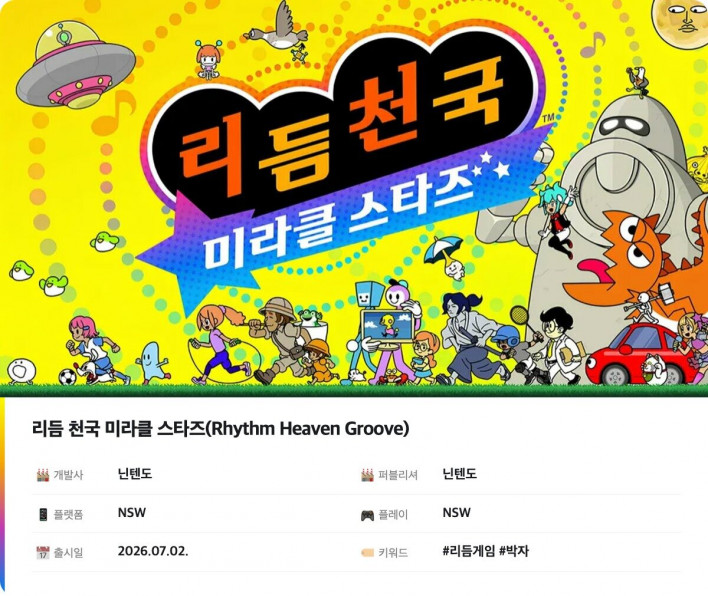
The beat is what matters: A game that changes when the rhythm kicks in
The core of Rhythm Heaven is, as the title suggests, the rhythm—the beat. There are no notes to slash, and you do not need to alternate between multiple buttons to match the direction of falling notes. Usually, you just press one button, or at most two, in time with the beat.
It is fundamentally in 4/4 time. In this structure, the final beat usually leads naturally into an input—like pressing on the 'rest' beat of a 'one-two-three-rest' pattern. Rhythm Heaven bundles this into a variety of mini-games, all rendered with the uniquely dizzying, quirky design characteristic of Nintendo, much like the WarioWare series.
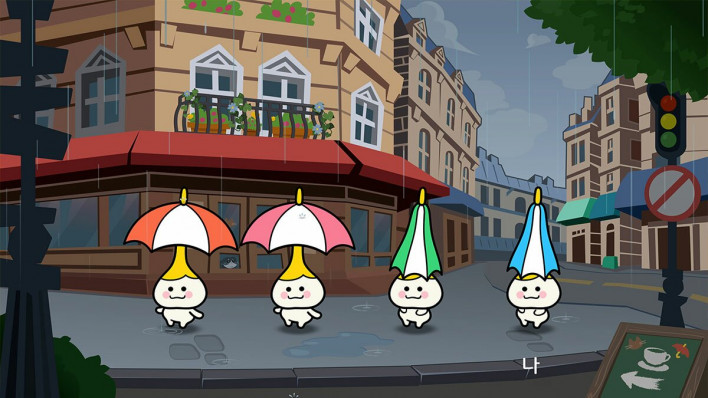
The single-player stages in the demo version also play with rhythm and input in various ways. There are games where you open and close a parasol to the beat, or play as a dog jumping to catch a frisbee thrown by your owner. The first game you play before diving into these various rhythm challenges is 'Ring Toss.'
This was also the game revealed when the title was first announced at last year's Nintendo Direct. It serves as a sort of tutorial. You simply press the A button to pass through the flying rings.
However, in the practice section of this first encounter, there is no music. You only hear the 'whoosh' of the rings cutting through the air; you have to rely solely on your eyes to dodge them. It is surprisingly difficult. Even after multiple attempts to learn the timing, I kept getting caught. After failing a few times, I hit 'skip,' and only then did the game offer a hint: 'It's pretty hard, right?' Yes, it is very hard...

This isn't just to tease the player. A character identical to yours appears on screen, music starts playing, and as they begin to jump to the beat, the timing for clearing the rings slowly starts to sink into your hands and your senses. As you jump in sequence to the 'pa-pi-pu-pe-po' rhythm, you start clearing the rings more often than you get caught.
Rings that were impossible to clear by sight alone become easy once you sync with the beat. It is a clever introduction that makes you feel, in your bones, just how important the rhythm is in this game. So, let's find the beat.
Splitting the beat, syncopation, and variations
Once the music fully enters the game, the gameplay gains momentum. You find yourself tapping your feet, nodding your head, or drumming your fingers on the desk, following the beat with your body as you press the buttons. And that button input is the heart of the game.
While the game's rhythm is based on the aforementioned 4/4 time, if that were all there was, it would just be a metronome with cute graphics. Rhythm Heaven adds various variations to this basic beat. A prime example is splitting the beat into eighth or sixteenth notes, forcing you to tap 'tap-tap' instead of a single input. On top of this, it uses syncopation—often called 'off-beat'—to vary the intensity and timing of your inputs.

The visuals on the TV screen aren't just for show, either. The way the characters move to the beat, or the way the game tries to help or confuse you—like by tossing food off-beat or having a character who was keeping the rhythm suddenly disappear from the screen—adds layers to the challenge.
Even slightly off-timing inputs are sometimes accepted within a margin of error. In fact, this leniency is the biggest difference from other typical rhythm games. If you press the button outside the allowed window, you might miss the frisbee, bump into another character, or hear the music change slightly, letting you know you made a mistake.
However, in most single-player games, you won't see extreme failure states like a health bar depleting or the game ending after one or two mistakes. When the game ends, you are graded with results like 'Good' or 'Superb' based on your success rate. It feels less like the pressure of success or failure—like a '75% success rate'—and more like a playful report card.
Fun alone, intense together
While single-player mode allows for a relatively relaxed, personal experience, multiplayer ('Play Together') mode shows more direct wins, losses, and performance metrics. After all, you have a common goal or a winner to determine.
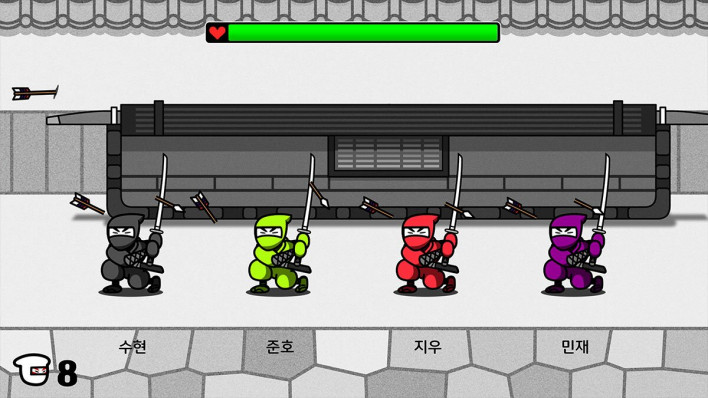
In the co-op game 'Ninjas,' where you slash incoming arrows with a sword, your health drops if an arrow hits the lord's palanquin. Since the health bar is shared, a single person's mistake can end the game. In fact, during my demo, the game ended because we couldn't block a single arrow.
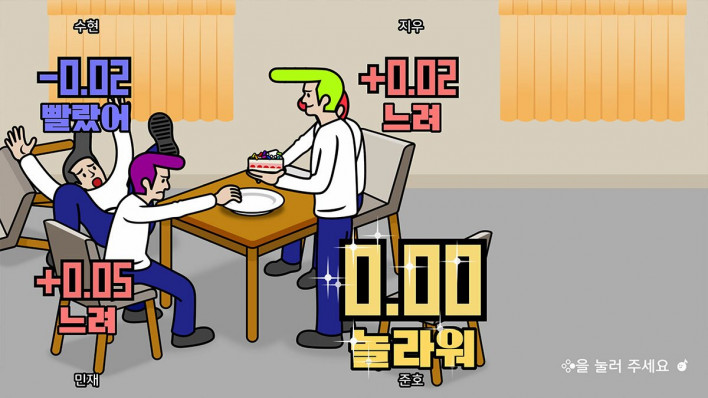
In competitive games, you feel the superiority of the winner instead of the pleasure of cooperation. The game 'Snack' requires you to press the button at the exact 10-second countdown mark to grab a snack. It is not just about who presses first; victory goes to the person with the most accurate timing. If three out of four players press the button with 1, 0.8, and 0.5 seconds remaining, the one who pressed at 0.5 seconds grabs the snack first. But if someone else presses 0.1 seconds slower than the 10-second mark, they steal the snack and become the winner.
In the demo, I nailed the 'Snack' game with zero margin of error, but I couldn't slice a single arrow. It wasn't just a matter of input lag or music sync; it really highlighted the game's unforgiving nature—once you lose the beat, it’s hard to get back on track. You miss the rhythm slightly, and then you end up pressing the buttons to that same off-beat tempo for the rest of the round.
Magic, like this: Dealing damage and healing with rhythm
The Rhythm Heaven series has always been composed of various mini-games. You clear them one by one, and play boss-style stages that remix several mini-games. While you could enjoy these freely and repeatedly, that was about it. The new 'Beat Spell' mode is a mode you can really sink your teeth into, and I had high expectations for it.
And in reality, the idea of learning a sense of rhythm and having to choose the right beat for the situation definitely added a different kind of fun.
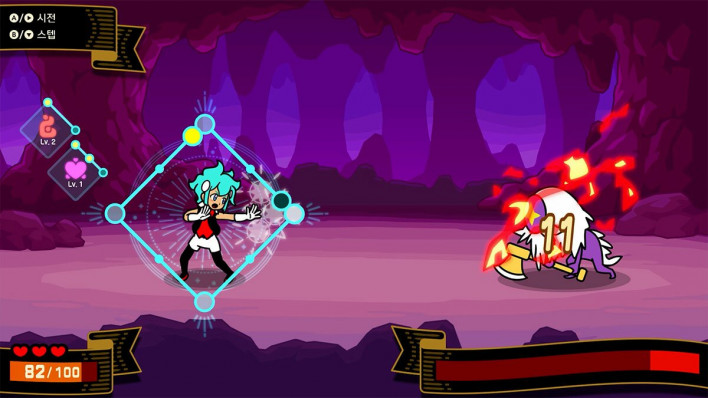
Beat Spell is a mode where you cast magic by pressing the A and B buttons to the beat. Both the protagonist and the enemy have health, and the concept is to defeat the enemy before your own health runs out. The way you select and cast magic, combined with the rhythm, adds to the excitement. I could only play chapters 1 and 2, so I couldn't use many spells, but even with just 'Heal' and 'Fire,' I could intuitively feel the changes in rhythm and the fun of the inputs.
The square moves in four beats, which is then divided into two; 'Fire' is cast by pressing B and A on the beat. 'Heal' was designed to be triggered by inserting an extra button between the B-A of the Fire spell, making it B-button-A. If the enemy's attack pattern occurs once every two bars and you need to heal twice, you can balance damage and healing by using the spell with the following rhythm. Since the button also works by pressing B, you can effectively keep the beat with just two buttons.
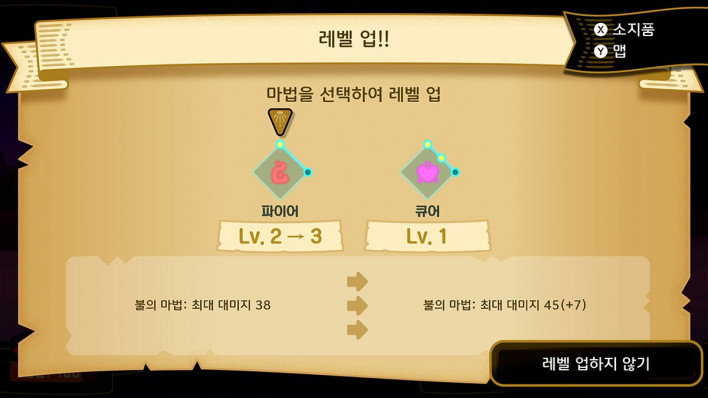
The critical hits and increased healing for perfect timing make it clear that this is a mini-game within Rhythm Heaven that centers on the beat. The fact that stage completion is clearly distinguished by score and rewarded with a star rating further shows that Beat Spell uses a different approach than other mini-games.
The rhythm of heaven remains the same
I couldn't play many types of games during the short demo. However, even a brief play session confirmed that Rhythm Heaven Miracle Stars is not a completely different game, nor does it emphasize an experience unlike its predecessors. Conversely, it feels like a display of confidence that maintaining the series' signature fun and color is enough. And indeed, I could feel the joy of that rhythm.
This game, launching on July 2, will also have opportunities for anyone to try it out in advance. Store demo events will be held at Daewon Shop (I'Park Mall Yongsan, Hyundai Premium Outlet Songdo) on June 27 and 28, and at Toys 'R' Us Lotte Mart Suwon on July 4 and 5. You can check out for yourself, before or after the launch, what the return of a rhythm game that anyone can enjoy as long as they can find the beat looks like.
![]()
- Seungjin "Looa" Kang
- Email : looa@inven.co.kr


Sort by:
Comments :0