


In a world teeming with barbarians, a kingdom barely surviving through the magic of protection, and a mysterious device that traverses time and space—'The Adventures of Elliot: The Millennium Tales', the first-ever original action RPG from SQUARE ENIX's 'Asano Team' (creators of OCTOPATH TRAVELER), makes a striking first impression.
Its signature HD-2D visuals, which combine pixel art with 3D, paired with real-time action instead of turn-based combat, reach out simultaneously to fans of classic JRPG series and players who prefer the tension of real-time action. Based on my experience with the prologue demo released on Steam on May 19 and the early stages of the main game, I would like to outline what this title has to offer.
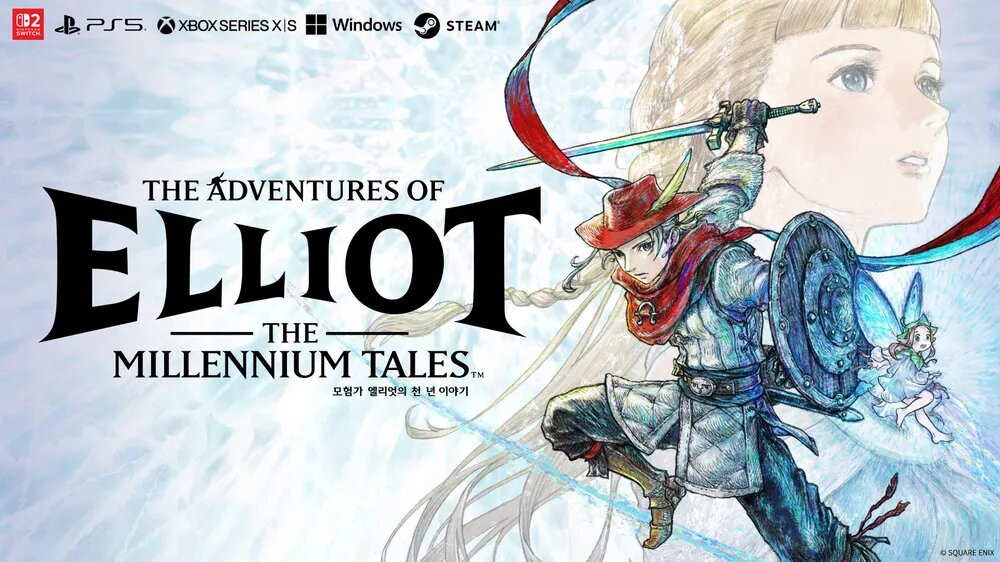
A Journey of an Adventurer and a Fairy Across Eras

The story is set in a world overrun by barbarians. The Kingdom of Huder continues to prosper in a corner of the continent, protected by the Princess' magic of protection. While investigating ruins outside the castle under royal orders, the adventurer Elliot discovers a 'Gate of Time' that connects the present to the past. He then begins a journey across multiple eras with his partner, the fairy Fay.
Elliot will step into four eras spanning a thousand years, including the 'Era of Protection,' the 'Era of Reconstruction,' and the 'Era of Magic,' with each era presenting a completely different world. From the Kingdom of Huder in the Era of Protection to the magical land of Weizen in the Era of Magic, each period features unique cities and cultures, actively utilizing the concept of time travel as a central pillar of the world-building rather than a mere gimmick.
The prologue demo available on Steam depicts Elliot's journey to find the Gate of Time. Players are free to explore the world, whether following the main story or wandering into unknown lands to collect weapons and magic stones. With about 4 to 5 hours of content including the main story and some field exploration, I highly recommend trying the demo if you are considering purchasing the full game. Save data can also be carried over to the retail version.


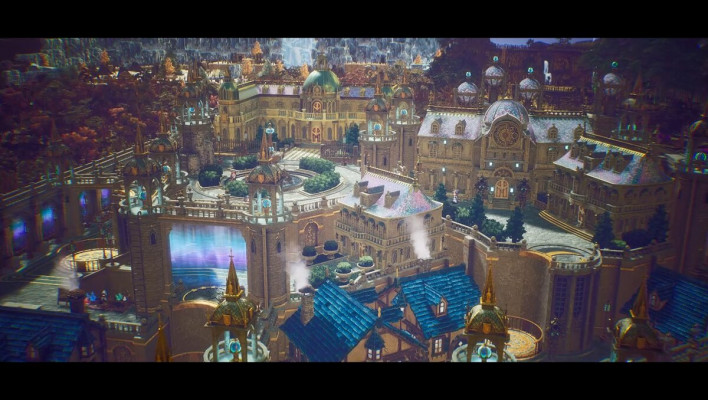
A Living World Realized in Pixel Art and 3D CG

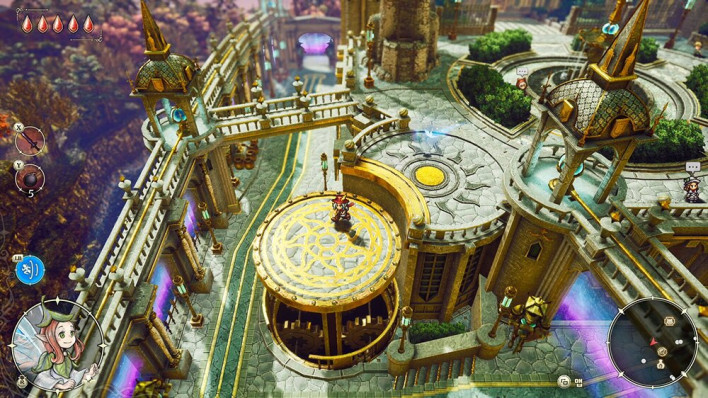
The first thing that catches the eye is undoubtedly the visuals. While combining 3D backgrounds with 2D pixel characters is a long-standing formula for the HD-2D series, this title stands out by designing the 3D backgrounds themselves to match the pixel texture, minimizing any sense of dissonance.
Pixel characters blend naturally into the screen even as camera angles shift, and the background functions as part of the gameplay rather than mere decoration, thanks to a structure where elevation differences affect combat mechanics. Attacks from high ground may not reach enemies below, and vice versa. This level of detail significantly boosts immersion.


The jump mechanic is another major highlight. By introducing jumping while maintaining the signature HD-2D art style, the game adds the fun of a platformer. Terrain gimmicks utilizing jumps are placed throughout the map, and given that elevation affects combat, we can expect even more diverse applications, such as boss patterns, in the full game.
The delicate motions of the pixel characters also enhance the quality. Scenes where NPCs laugh or get angry are so refined that you can feel their emotional shifts just by looking at the sprites. This title is particularly noteworthy for players who love the classic feel of the Mana series or the OCTOPATH TRAVELER series but have felt distanced by turn-based systems.
Furthermore, the voice acting and BGM quality were impressive; with dubbing and direction applied to both main and sub-quests, there was no shortage of immersion in the world, even in the demo version.
Depth Hidden in Simplicity: Combat and Magic Stone Systems

The combat structure seems simple at first glance. In the demo, it consists of basic attacks, charge attacks, guarding, and movement, with no separate dodge or roll. You cannot simply block indefinitely, as depleting your guard gauge leads to a guard break state.
Weapons consist of seven types—swords, spears, hammers, chain sickles, bows, boomerangs, and bombs—plus a shield, each with distinct characteristics. Swords have short reach but fast attack speed and decent range, while spears excel in both reach and speed but are vulnerable to attacks from the sides due to their linear nature. Hammers are slow with short reach but are specialized for stunning enemies, and chain sickles offer average speed and damage but excel in area-of-effect attacks.
Players can acquire higher-level weapons of each category through exploration, which are equipped automatically and provide special effects such as enhanced charge stages.

The evolution of the shield is noteworthy. As the game progresses, the shield is upgraded to include a 'Just Guard' or Parrying function. Parrying, which requires inputting a guard at the exact moment of an enemy's attack, is a trend in modern action games, and its natural integration into a JRPG makes for a much more thrilling combat experience. It is the moment when the shield, which was merely a defensive tool early on, transforms into a core element of combat.


The moment the 'Magic Stone' system is added to this simple framework, the nature of combat changes. Magic stones are farming elements equipped individually to each weapon (sword, spear, boomerang, bow, etc.), and weapons do not share cost limits. You can freely combine magic stones within the cost limit, and the variety of effects is substantial. From leaving trails of fire on the ground during charge attacks to emitting shockwaves upon completing a charge, or increasing reach when switching between weapons, the demo already offers a wealth of stones that change the combat style itself. Since even the same type of stone can have different stats, there is also the fun of farming for better ones.

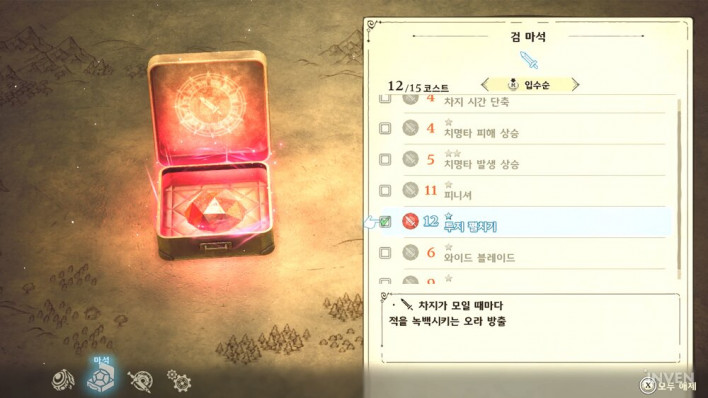

The depth of combat is further highlighted by the difficulty settings. While past real-time action JRPGs often prioritized exploration and puzzles over combat, this title seems to aim for both. On Hard difficulty or higher, the tension rises to the point where you can be defeated by just three or four hits from a monster, requiring active use of Parrying, weapon and magic stone effects, and Fay's abilities to survive. It is designed to cater to a wide range of players, from those who want to enjoy the world lightly to those who crave thrilling combat.

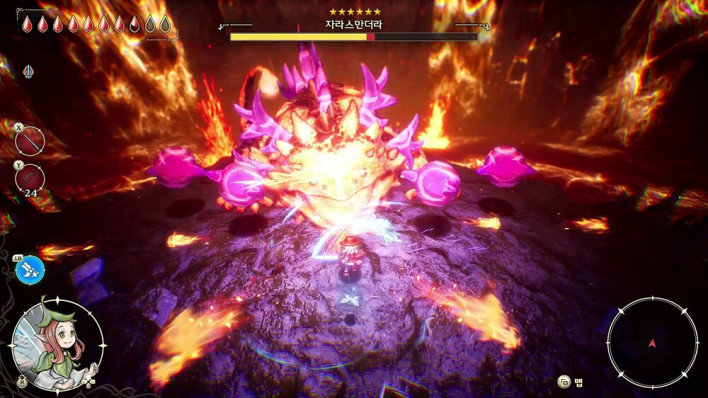
Potion management is another element that makes combat strategic. The number of empty bottles determines the total capacity of potions you can carry, and players must decide for themselves how many healing potions versus buff potions to stock. This is compounded by the setting where your partner's healing abilities become unavailable when moving to different eras, making resource allocation even more critical. Given the strategic nature of this resource system and the patterns of the late-demo boss, it is clear that the bosses in the full game will be quite challenging.
A 'Stay-at-Home' Princess and an Unusual Journey with a Mysterious Fairy

One of the game's hidden charms is the relationship between Elliot and Princess Huria. The Princess casts a spell on Elliot's earring to gain a form of remote vision, witnessing the world Elliot experiences through it. Watching the reactions of a princess seeing the world outside her room for the first time is a fun aspect of the game.
This journey with a princess who doesn't hesitate to offer 'advice' (?) goes beyond mere atmosphere. The Princess also plays a practical support role in combat, using magic to restore Elliot's HP. There is also a small joy in watching the Princess' expression, located at the bottom left of the screen, change in real-time according to Elliot's situation.

The journey with the Princess reaches a new phase around the end of the demo. Due to certain events, the Princess loses her powers and her connection to Elliot is severed. Then, after meeting the mysterious fairy 'Fay' in a past era, the true partnership of the main game begins.

Fay does more than just talk like the Princess; she participates directly in combat and acts like a magnet pet, automatically absorbing nearby items. You can also issue behavioral commands depending on the situation, such as having her follow Elliot, lead the way, or stay in place.
There is also the fun of unlocking Fay's hidden abilities one by one through adventure. Skills that set objects or enemies on fire or make Elliot run faster are unlocked sequentially, and field gimmicks utilizing these are placed throughout, constantly stimulating the joy of adventure. In particular, once the Warp skill that teleports Elliot to Fay's location is unlocked, more creative play becomes possible in both exploration and combat. It is also possible to control Fay directly using the right stick on a controller.
The adventure with Fay can also be enjoyed in 2-player co-op. One person controls Elliot while the other controls Fay, and the fun is maximized when the two players coordinate to utilize Fay's skills, such as Warp.
Will It Be a Successor to the JRPG Lineage?
'The Adventures of Elliot: The Millennium Tales' is a game that feels significantly polished even from just the prologue demo. The harmony of excellent HD-2D visuals and sound, beautiful illustrations, the potential for build diversity in the magic stone system, the time-traveling narrative structure, and even the voice acting that covers all sub-quests—it all comes together.
It is true that the basics of combat feel concise in the demo version. However, the magic stone system, which we only got a small taste of, is already showing its presence. Even with just the magic stones acquired in the demo, countless combat styles can be created, and if the full range of combinations and various weapons are fully realized in the main game, concerns about the depth of combat are likely unfounded.
The game also stands out for inheriting the sensibilities of classic JRPGs while incorporating modern play experiences. By choosing real-time action, players who love the pixel aesthetic but are not accustomed to turn-based systems can enter naturally, and modern convenience features—such as a magic compass that guides players to collectibles and fast teleportation—break down the barriers to entry of classic JRPGs. It is a design that lowers the threshold for both long-time fans of the genre and newcomers.
Furthermore, games featuring time travel are a genre that SQUARE ENIX has handled best. The solid time-travel narrative of CHRONO TRIGGER and the structure of restoring the past in Dragon Quest VII are proof of this. Whether 'The Adventures of Elliot: The Millennium Tales' can become a work that continues that lineage is exactly why I am looking forward to the full game.
'The Adventures of Elliot: The Millennium Tales' will be released on June 18, 2026, for PC, PS5, Nintendo Switch 2, and Xbox Series X|S, and on June 19 for Steam. The prologue demo is currently available for free, and progress data can be carried over to the retail version. I hope you check out the game's quality for yourself through the demo before the full release.
![]()
- Donghwi "Kobee" Kim
- Email : kobee@inven.co.kr



Sort by:
Comments :0