


"What is the 'best' entry in the Assassin's Creed series?"
Even among fans who have played every title, the answer is likely to vary. Those who prioritize narrative might point to the 'Ezio Trilogy' set in Italy, while those who value the satisfaction of the open-world systems introduced in the reboot era might favor 'Odyssey.' However, there is one title that, despite being sandwiched between these eras, offers no less satisfaction. It is the game that fully established 'sailing,' long a secondary feature of the series, and is occasionally cited as a candidate for the best Assassin's Creed game of all time.
That game is 'Assassin's Creed IV: Black Flag.'
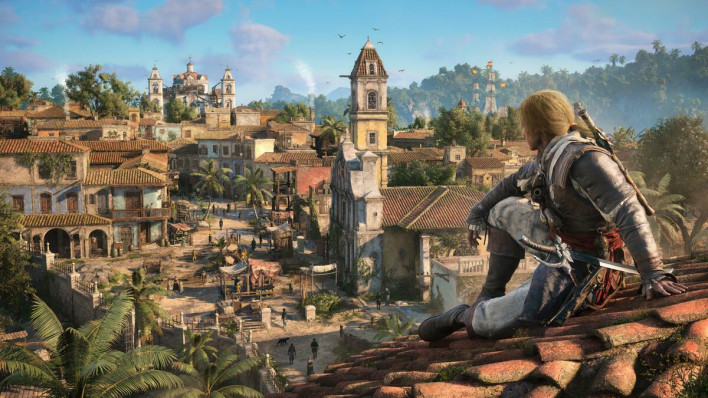
The story of Edward Kenway—grandfather of the third game's protagonist, Connor Kenway—follows a Caribbean pirate who finds himself caught between the Templars and the Assassins, eventually evolving into both a pirate and an Assassin. While the narrative itself is not necessarily more profound than other entries in the Assassin's Creed Series, it remains a fan favorite. This is because it masterfully captured the naval warfare of the Age of Discovery, delivering a sense of scale and intensity—complete with the thunderous roar of cannon fire—that no other game had achieved before.
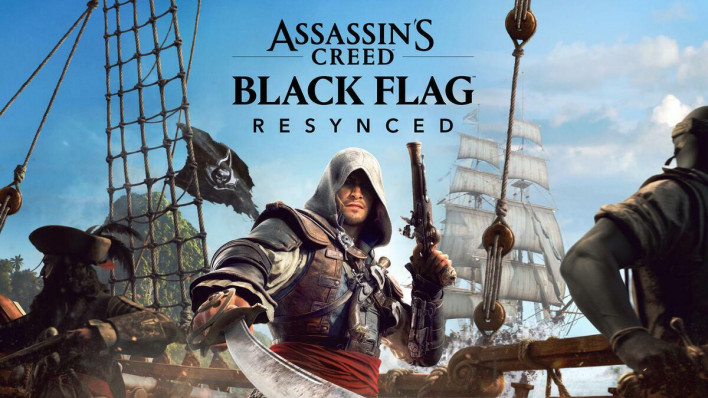
Now, this beloved title returns as 'Assassin's Creed IV: Black Flag Rethinked' on July 9. Remakes never simply port the original work, so let's examine the changes and additions revealed through Ubisoft's showcase.
'Combat, Parkour, and Stealth' — Through a 2026 Lens
The most noticeable change is the combat system. While the original 'Black Flag' featured a relatively simple, counter-focused structure, this remake has completely overhauled it into an action-oriented experience. The core flow involves neutralizing enemies with parries followed by chain executions, redesigned into a 'rhythmic combat' style where a single response can clear out multiple foes.
The integration of environmental elements is also striking. Players no longer fight with just swords and pistols; they actively utilize walls, ledges, and destructible objects. Consequently, combat has shifted into a structure where 'timing' and 'positioning' are equally critical.

This change is less about increasing difficulty and more about expanding combat into a process of choice. Instead of waiting passively for enemy attacks to trigger counters as in the past, the structure now requires players to actively create opportunities.

Parkour has also been significantly improved, reflecting the flow of the latest entries. Basic movement speed and responsiveness have been enhanced, allowing for precise actions based on various inputs. Advanced maneuvers like free jumps, backward, and side dodges now flow naturally, making traversing urban and natural environments much smoother—to the point where players can intuitively plan and execute better assassination routes than before.
Stealth has also undergone a structural change. The biggest addition is the 'permanent crouch' feature introduced in later series entries. Stealth actions, which were limited in the original, are now a basic player option, allowing for more sophisticated infiltration.

Mission design has also evolved. Previously, eavesdropping or tailing missions resulted in immediate failure upon detection; now, the situation continues, forcing the player to adapt. Even if a tailing attempt is compromised, the player can potentially salvage the mission through quick thinking rather than facing an instant game-over.
Ultimately, combat, parkour, and stealth all share a common direction: moving away from the 'prescribed solutions' of the past and redefining the experience as one where players construct their own solutions.
'Open World and Naval Warfare' — A Deepened Stage for Black Flag

The sea was already a core element in Black Flag, but in 'Rethinked,' its status is elevated further. It is no longer just a space for travel or a stage for combat, but a system that defines the gameplay itself. A prime example is the environmental factors: waves and weather are no longer just visual effects but impact actual sailing and combat. Rough seas make ship handling difficult, and storms act as variables that shift the tide of battle.
These changes make naval gameplay a more unpredictable experience. Even when facing the same enemies, the flow of battle changes based on the environment, requiring situational awareness rather than rote repetition.

Edward's flagship, the 'Jackdaw,' also sees changes that go beyond simple upgrades. Each weapon receives a new 'alternate fire mode,' allowing for different choices based on the situation, shifting the focus from simple firepower increases to tactical loadouts.
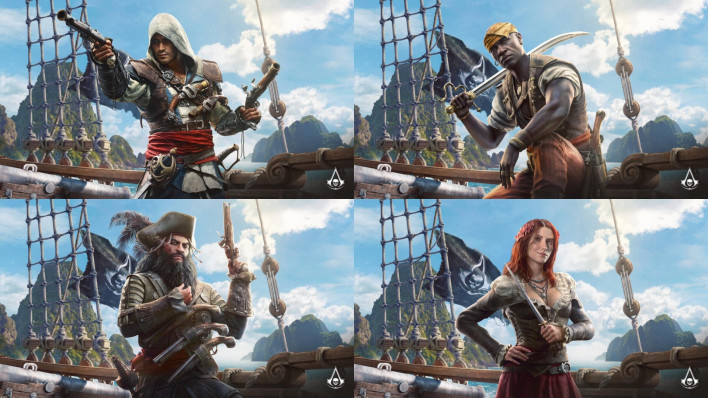
A new 'lieutenant' system is also introduced. Each of the three lieutenants possesses unique abilities that can serve as powerful game-changers in specific combat scenarios. The three lieutenants—Lucy Baldwin, Father, and Deadman Smith—each come with their own backstories and recruitment quests. Earning their trust and bringing them aboard the Jackdaw unlocks new features and equipment.
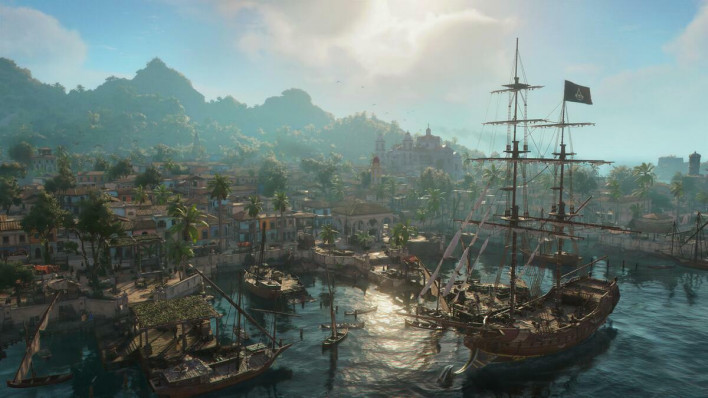


The open world has also been reconstructed based on technological advancements. 'Black Flag Rethinked' has been polished with the latest Anvil engine, rendering the entire Caribbean with high-resolution textures and improved lighting, while a dynamic weather system makes the environment feel truly alive.
In particular, the seamless transition between cities and regions makes the entire world feel like one continuous space, further strengthening the 'uninterrupted experience' the original aimed for.
Underwater exploration has also been expanded. It now functions as an independent gameplay area where risk and reward coexist, rather than just a collection of gathering tasks, adding density to the world.
More narrative, less multiplayer
The most sensitive part of any remake of a classic is deciding 'what to add and what to remove.' This title makes those choices relatively clear.
First, there is definitely new content. New missions and chapters have been added, including scenes that supplement the existing narrative. In particular, new scenes involving Edward and his wife, Caroline, serve to deepen the character's emotional arc.
The narratives of existing characters are also expanded. New story arcs for key characters like Blackbeard provide fresh perspectives on familiar tales. The development team asked themselves during the creation of this 'additional content': "Would this scene feel natural if it had been in the original?" Only content that passed this test was added to 'Rethinked.'
In other words, the new content is not an independent expansion but is designed as a seamless extension of the original. This ensures that players do not feel a sense of dissonance while watching these 'new scenes.'
Conversely, some elements have been boldly removed. Notably, multiplayer and the original DLC are excluded from this remake. This is not merely a reduction in content; the developers have redefined this title as a 'pure single-player, story-driven experience.' They have chosen to trim peripheral elements to focus on the core experience.
The modern-day segments are also being reconstructed. While the basic structure remains, their weight and role have changed. In this title, the modern-day segments function less as a device to explain the entire franchise and more as a tool to complement Edward's inner journey.
This makes the focus of the story much clearer. Instead of a complex external narrative, the structure focuses on a single character. Music also acts as an important expansion element; while existing sea shanties are retained, new tracks have been added, and a new theme has been composed.
Ultimately, the content changes in this remake are simple: rather than adding more, the goal is to refine the experience by keeping only what is necessary. And this choice leads to one conclusion.
"This game is, once again, the story of Edward Kenway."





Sort by:
Comments :0