Topic: Developing Different Games Simultaneously
Speaker: Park Yong-hyun - Nexon Games
Presentation Category: Development Culture / Organizational Management
Recommended Audience: Developers, planners, and organizational leaders interested in game development direction and competitive expansion
Tags: #NDC25 #DevelopmentLeadership #OrganizationalManagement #MultiStudio
[🚨 Presentation Topic]
This session explores why Nexon Games develops multiple projects simultaneously and how the experience gained in the process is translated into organizational competitiveness. Through the multi-studio system and examples of cross-project knowledge sharing, we discuss organizational management strategies for consistently creating high-quality games in a changing global market.
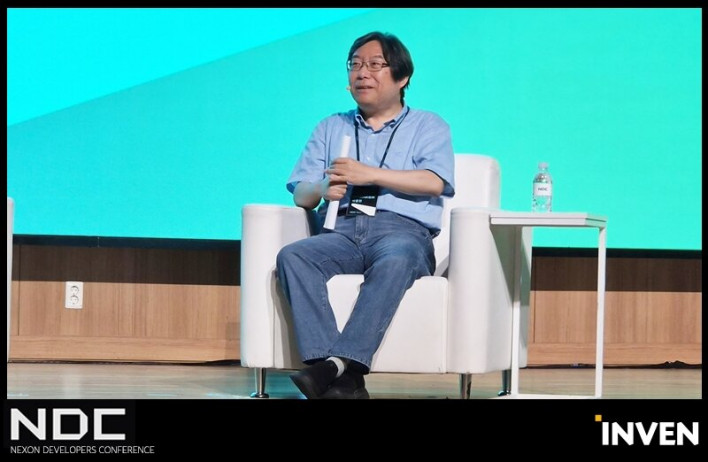
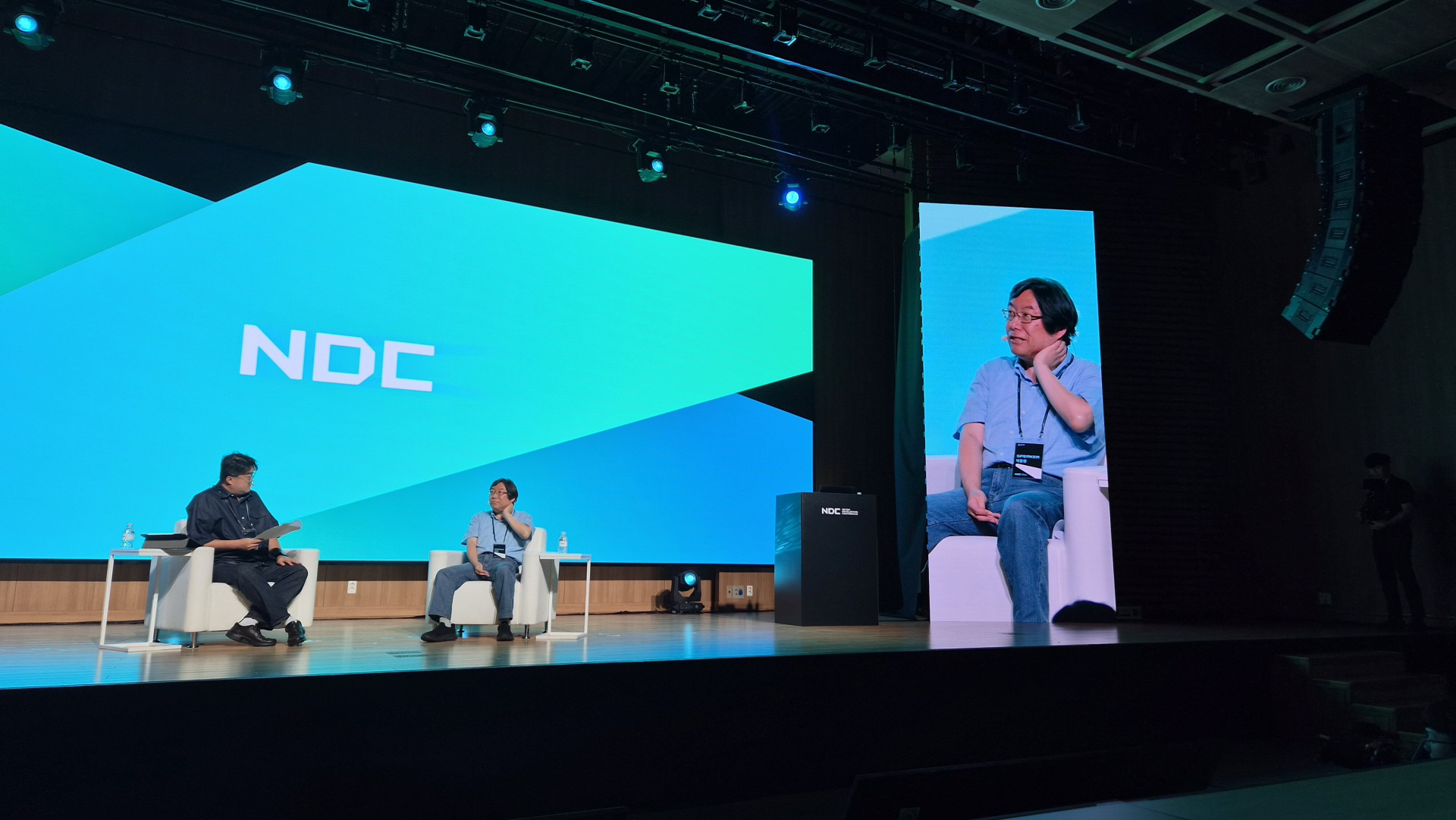
On June 16, 2026, the first day of NDC 2026, Nexon Games CEO Park Yong-hyun took the stage. Moderated by G-Generation Editor-in-Chief Lee Kyung-hyuk, the session focused on the theme of "Developing Multiple Games at Once." Unlike the past, when a single studio would focus on a single game, the surge in demand for live services and longer development cycles have made running multiple projects simultaneously the new norm. The discussion covered the common challenges that arise in this environment and the processes for resolving them.
The 70-minute session was conducted as a 1:1 conversation between Editor-in-Chief Lee Kyung-hyuk and CEO Park Yong-hyun without a slide deck. Park shared his perspective as the head of a developer managing multiple projects, offering insights into current trends in the game industry.
※ This article has been edited to feature only the responses of CEO Park Yong-hyun.
Multi-Project Development: A Matter of Survival, Not Strategy
CEO Park opened the conversation with a surprisingly nostalgic story about an old game. When asked about the most memorable game from his career as a developer, he chose 'EverQuest.' It wasn't just because he enjoyed playing it, but because the experience influenced how he views games today. He recalled spending dozens of sleepless hours on a quest just to obtain a specific item. Although the process was so grueling that he often wondered, "Why on earth did they make content like this?" he reflected that the final reward left him with a profound sense of achievement.
This experience later shaped his perspective as a developer. He explained that the key is not to copy specific quests or systems, but to understand the process through which users derive satisfaction. What is needed in game development is not the replication of individual content, but the underlying principles and direction. He compared this to the average value of a die roll; while the actual game exists as a concrete result, the developer must focus on the flow and principles that lie in between.
This perspective carries over into how Nexon Games currently manages multiple projects. Outsiders often interpret the simultaneous development of various genres as a strategic portfolio operation. However, Park explained that rather than a grand strategy, it is more of a natural outcome born from the structure of the domestic game industry.
He cited the characteristics of the Korean game market, which grew primarily around online games. While developers of package games can move on to the next project after launch, online games are different. Even after a game is released, a significant portion of the workforce remains dedicated to live service operations, including content updates, balance adjustments, and user support. This means that even if one game is being serviced successfully, the development organization is not necessarily free to focus entirely on a new project.
In such an environment, insisting on a model where one project must be completely finished before starting the next would lead to excessively long development cycles for the company. If it takes years to launch one game and move to the next, it becomes difficult to respond to a changing market. Park explained that the current structure of running multiple projects is, ultimately, a process for the company to grow and survive.
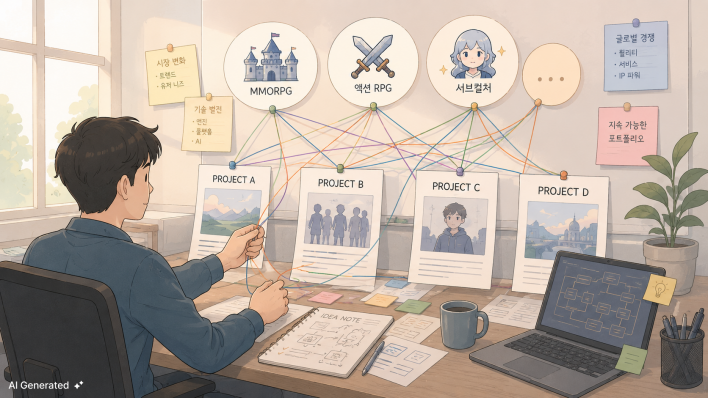
He noted that genre diversification should be understood in the same context. While it may appear from the outside that Nexon Games is challenging itself with various genres like RPGs, subculture games, and shooters, the internal perspective is slightly different. He explained that rather than pioneering entirely new genres, it is more of a process of exploring new areas based on the RPG development experience they have accumulated.
In fact, he mentioned that while the various projects currently in development may look like different genres on the surface, their core structures are built upon the grammar and experience of RPGs. Whether it is a shooter or a subculture game, they all ultimately align with RPGs in terms of user growth, rewards, and long-term motivation.
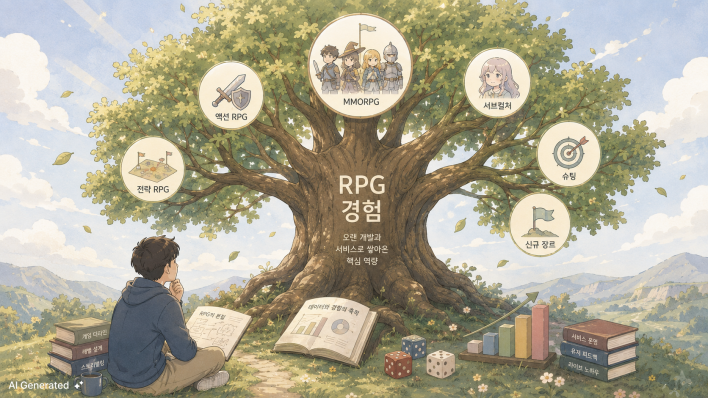
The recent changes in the game market are another background factor for managing multiple projects. He analyzed that as the speed of information delivery has increased, user tastes have become much more segmented. In the past, a single mass-market game could cover a broad user base, but now the market tends to be split between games that strongly satisfy specific tastes and massive, large-scale titles.
The problem is that neither path is easy. Large-scale games require massive development costs and manpower, while games focused on specific tastes carry both high potential and high risk. Park's diagnosis is that developers must constantly explore new possibilities, making a structure that runs multiple projects in parallel a necessity.
He added that this shift is not unique to Nexon Games. Major global developers have been running multiple projects simultaneously for a long time, and large domestic developers are moving in a similar direction. The domestic market is simply catching up a bit later due to its strong focus on online games.
Park described the current period as a transition. The market is changing rapidly, and developers are adapting accordingly, but experience and know-how regarding this new environment have not yet fully accumulated. Ultimately, running multiple projects is a process of adapting to a changing market, and the current trial and error will become an asset for moving to the next stage.
Managing Multiple Projects: Ultimately a Process of Trusting People
Although CEO Park Yong-hyun currently manages several live games and new projects simultaneously, he does not define himself as the one who makes the games. Instead, he explained that the PDs and directors are the ones who create the games, and the CEO's role is to help ensure the projects move in the right direction.
He takes on the role of setting the broad direction in the early stages of a project, such as market size, target audience, and service strategy. Once development begins in earnest, he tends not to intervene in detailed content or system design. Deciding which characters to create or which quests to include is ultimately the responsibility of the production team on the ground.
This principle goes beyond simple task delegation. Park explained that a structure where the people making the game are separate from the people taking responsibility for it is difficult to maintain for long. If the people actually in charge of development do not have sufficient authority, the entire project is bound to falter.
Of course, this is not always the easiest choice for a CEO. Even when a project goes off track or the results fall short of expectations, he must trust the production team and wait rather than stepping in directly. He said that, in the end, running multiple projects is similar to the process of trusting people.
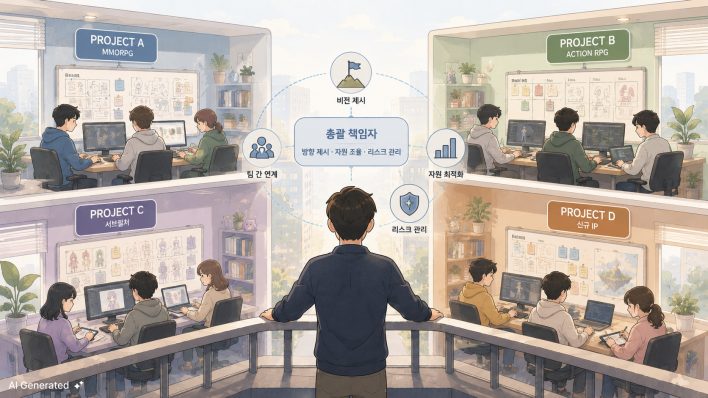
That does not mean he is completely hands-off. He receives regular progress updates on all ongoing projects and participates in discussions when major issues arise. However, he emphasized that his role is to help solve problems, not to do the work of building the project for them.
Interestingly, Park does not have a designated office and moves between various studios to work. He explained that he often sets up his workspace near projects that are nearing launch.
The reason is surprisingly simple: as the launch approaches, non-development issues arise far more frequently than development ones. Countless decisions regarding platform support, marketing, publisher collaboration, and business planning converge at once, increasing the need for the CEO's judgment.
He said that simply sitting next to the project team during this period solves many problems. He can grasp the current situation without needing separate reports, and the production team can focus on development rather than spending time on explanations.
In fact, he stated, "Reporting to the CEO is a resource in itself." Since the process of explaining the current situation and organizing information is a cost for the project team, the more the CEO understands the situation on the ground, the less unnecessary work is required.
Sharing experience is also considered the most important part of managing multiple projects simultaneously. He explained that even if the genres are different, the problems projects face are often surprisingly similar.
For example, if one project is struggling at a certain stage, it is highly likely that another project will face the same problem around the same time. Simply passing on the trial and error and solutions from the team that experienced it first is of significant help to other teams.
Park said he has frequently witnessed such cases while running multiple projects. He explained that after watching the team that started development first solve a problem, subsequent projects often avoid repeating the same mistakes.
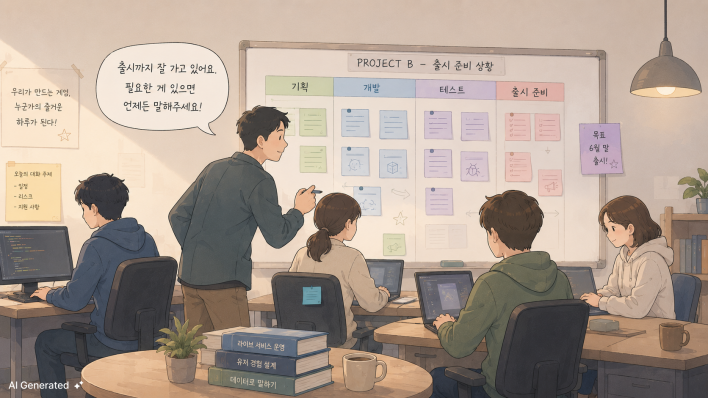
This accumulation of experience does not just affect the success of individual projects. Over time, it becomes a company-wide capability and plays a role in reducing trial and error for new projects.
He said this is one of the biggest advantages of running multiple projects simultaneously. While outsiders might think that complexity increases as the number of projects grows, internally, it actually increases opportunities to share experience.
Of course, running multiple projects simultaneously does not only increase efficiency. Resource allocation issues also arise constantly.
In the past, many game companies operated shared organizations for UI or specific feature development, but Park explained that excessive centralization can actually create problems. This is because situations arise where teams must compete for the same resources the moment their schedules overlap.
He said that designing an organization based solely on efficiency can be dangerous. Even if it looks like it saves manpower on the surface, it often creates larger bottlenecks in the actual development process.
Therefore, he explained that Nexon Games tends to maintain relatively strong independence for each project. They decided that it is more important to create a structure where each project can move on its own, even if it means accepting some inefficiency.
Ultimately, the conclusion Park reached from running multiple projects was clear. What matters is not controlling every project, but creating an environment where each project can function properly. At the center of this are delegation of authority, experience sharing, and trust in people.
What the Industry Needs Now Is Experience, Not Answers
In the latter part of the conversation, CEO Park Yong-hyun discussed the difficulties the game industry is currently facing. He diagnosed that the entire industry is in the midst of a structural change.
In the past, there was a relatively clear formula for the domestic game industry. The market was formed around specific genres, and user tastes were much easier to predict than they are now. However, the situation has changed significantly.
The market has expanded globally, and the user base has become much more diverse. The factors developers must consider have increased, and success formulas can no longer be explained by a single model.
Park identified personnel as the most difficult problem in this process. To respond to new markets and new genres, developers with the appropriate experience are needed, but it is not easy to secure such talent given the structure of the domestic industry.
The problem is not just recruitment. The process of existing developers adapting to new methods is also a daunting task. He explained that while many developers agree on the need for change, they often feel burdened when they are actually in a situation where they must challenge themselves in a new area.
In particular, development organizations must now consider a much wider range of users than in the past. Unlike the days when games were made only for domestic users, they must now understand the tastes, cultures, and play styles of global users as well.
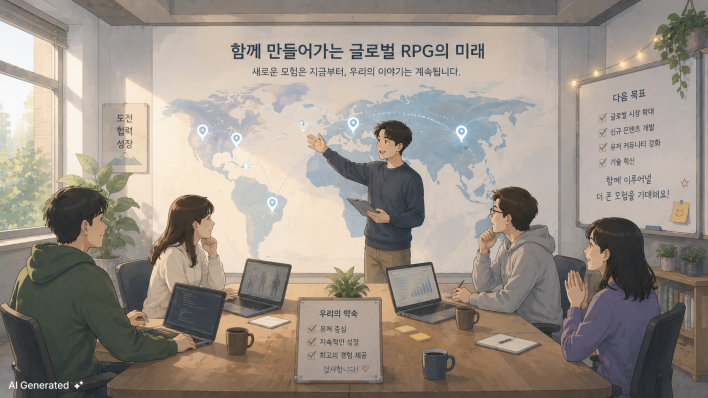
He said this change is not just a matter of market size. It is more of a problem where developers' perspectives on games themselves must change.
While schedules, productivity, and development efficiency were important tasks in the past, delivering the quality desired by the target users has become a more important issue today. However, quality is an area that is difficult to measure with numbers, and finding the right answer is equally difficult.
Park said that many developers, including himself, are currently working to solve this very problem. No one has the perfect answer, but they are accumulating experience little by little through repeated trial and error.
He explained that Nexon Games is no exception. The reason for running multiple projects is not simply to make more games, but largely to accumulate diverse experience.
In that process, experience sharing between projects plays an important role. The failures and successes experienced by one team become assets for others, which in turn leads to the competitiveness of the entire company.
Park explained that he has actually seen recent projects identify and respond to problems faster than in the past. While he doesn't think it's enough yet, he believes things are gradually improving as experience accumulates.
He specifically mentioned the case of 'Blue Archive' to emphasize the importance of long-term service. Launching a game and operating a service that is loved for a long time are completely different areas, and the latter requires a different kind of know-how.
Looking back, he acknowledged that while Nexon Games succeeded in entering the market in the past, there were areas where it fell short in terms of long-term service. He said the next goal is to go beyond simply launching games and create services that can stay with users for a long time.
He predicted that once the projects currently in development begin to settle into the market, the company will move to a stage of strengthening its long-term operational capabilities.
Ultimately, he emphasized that what the industry needs now is experience, not answers. The market keeps changing, and users are changing too. The important thing is to constantly learn and adapt within that change.

Park said that the current difficulties are not a problem for any specific company, but a challenge the entire industry is facing together. Therefore, he added that he does not believe any single company has a special solution.
However, he predicted that if the current trial and error and experiences are accumulated, the next generation's development environment could be much better than it is now. He explained that the reason for running multiple projects simultaneously is, in the end, a process to accumulate more of that experience.
He concluded the conversation by emphasizing that what the industry needs now is not to wait for someone else's answer, but for each individual to accumulate and share their own experiences.

Sort by:
Comments :0