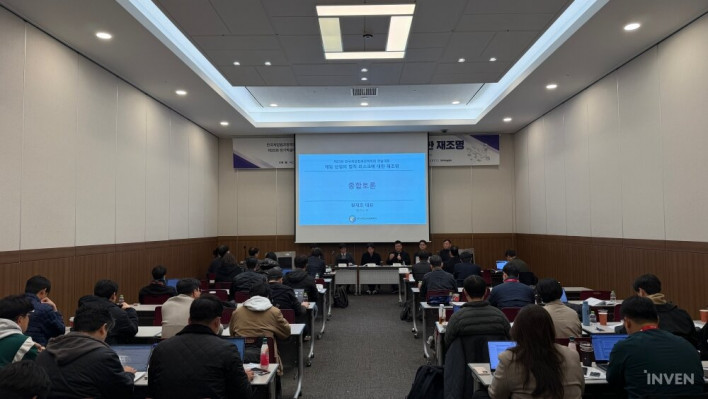
The focal point of game imitation disputes is shifting from 'like games,' which copy genres and rules, to 'AI cloning,' which uses artificial intelligence to replicate games in their entirety. At the 25th Regular Academic Conference of the Korea Game Law and Policy Association held at BEXCO in Busan on November 20, attorney Lim Chul-keun of Yoon & Yang LLC summarized that legal principles regarding 'like game' disputes have expanded over time toward protecting creators. However, panelists pointed out that because AI dramatically changes both the speed and scale of replication, it is difficult to address the issue through these existing legal principles alone. While disputes previously centered on how similar a game was, the core issue has now become how fast it can be cloned.
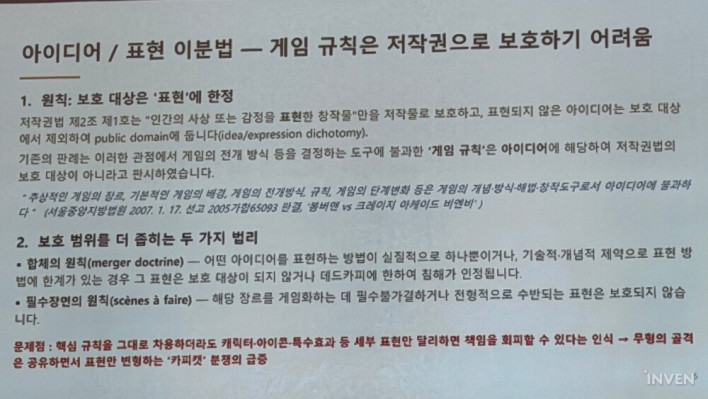
The starting point of 'like game' disputes lies in the legal distinction between ideas and expression. In his presentation titled 'Issues in Game Disputes Under Intellectual Property Law,' attorney Lim explained that copyright law protects only expressions while leaving ideas free for anyone to use. Game rules and genres fall under ideas, whereas the concrete results implementing them constitute expressions. Consequently, it was difficult for a long time to block games with similar genres and rules under copyright law. A 2007 ruling by the Seoul Central District Court cited by Lim similarly viewed a game's genre, setting, progression, and rules as mere ideas.
The turning point came with the 2019 Supreme Court ruling on the match-3 game 'Forest Mania.' The appellate court had refused to recognize copyright infringement in a game that merely altered character designs while copying special rules verbatim, ruling that it had merely borrowed ideas. In contrast, the Supreme Court ruled that even if individual elements are mere ideas, the selection, arrangement, and combination of those elements can be protected if the resulting creation demonstrates original individuality.
Once that door opened, copyright issues surfaced in high-profile game disputes. Representative examples include NCSoft and Webzen's litigation over 'Lineage M' and 'R2M,' Nexon and Ironmace's lawsuit over 'Dark and Darker,' and lawsuits filed by 111%. However, copyright infringement was not recognized in any of these three cases. Lim noted, "Although the door has been opened, securing rights remains difficult," adding, "Courts in Korea are still somewhat conservative." Because courts demand distinct creativity clearly distinguishable from prior games, it is difficult to secure copyright protection when a genre has evolved or is already mature.
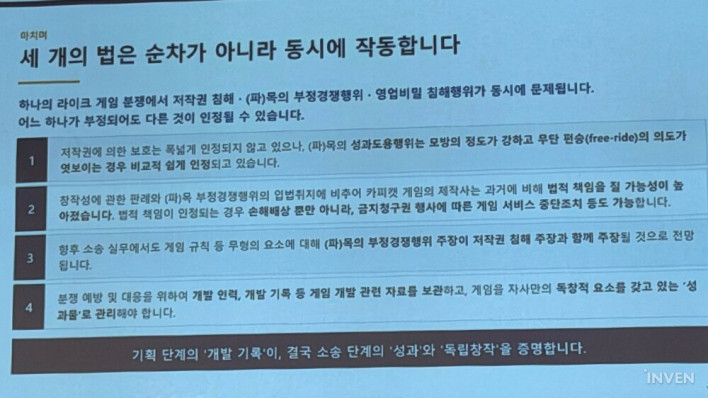
What filled this void was Article 2, Item 1, Sub-item (k) (formerly Sub-item (l)) of the Unfair Competition Prevention and Trade Secret Protection Act, commonly known as the misappropriation of achievements clause. This general clause prohibits unauthorized use of another party's achievements created through substantial investment and effort in a manner contrary to fair trade practices, thereby infringing upon economic interests. Lim remarked that after this provision was introduced, the legal community "used it like a treasure." Today, nearly all game lawsuits assert copyright infringement as the primary claim while concurrently alleging misappropriation of achievements as a backup. The first-instance ruling in the 111% case also rejected copyright infringement, but recognized misappropriation of achievements, holding that the systematic combination of game rules, UI, and progression mechanics constituted an achievement possessing economic value.
However, Lim noted that because this clause operates as an "all-purpose tool," courts draw a firm line so that it is applied only in cases of egregious imitation. Substantial criticism exists regarding current practice, which relies heavily on a supplementary provision for legal relief. He added his personal opinion that the 111% case could potentially have been resolved under copyright law as well.
When the method of copying shifts from looking at a game and recreating it to directly taking internal assets, trade secrets come into play—such as when developers take source code or design documents when changing companies. According to Lim, while misappropriation of achievements lacks criminal penalties and can only be contested civilly, trade secret infringement carries criminal penalties of up to 10 years in prison for domestic use and up to 15 years for overseas use.
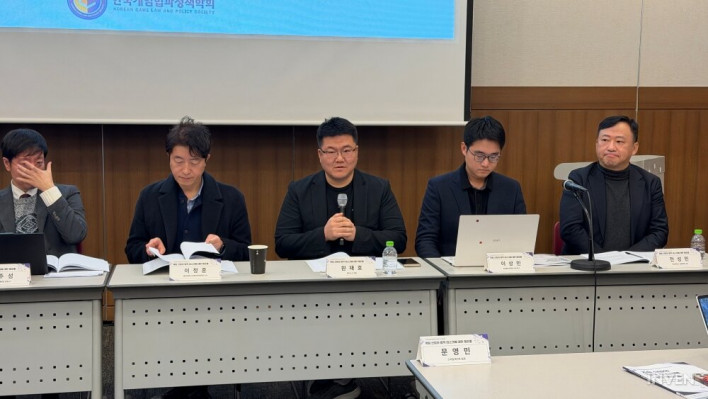
The practical concerns raised during the panel discussion took a different angle. Won Jae-ho, CEO of Anchor Node, shared that decompilation was the central topic at a recent lecture attended by around 100 indie developers. As instances recurred of games built with immense effort being copied within a single day and launched on Chinese platforms, developers asked, "How are we supposed to make a living?" Won stated that since games are software, instructing AI to extract source code has made duplicating a successful game absurdly easy. It goes beyond creating a similar game by referencing rules; it is outright cloning by tearing open the client and transferring it whole.
Won welcomed the evolution of legal principles itself. He explained that game companies rely more on discovering great combinations than on groundbreaking tech, meaning they hold few patents. He recalled that in the past, courts evaluated plagiarism based solely on on-screen visuals, leading developers to say, "As long as the visuals look slightly different, it doesn't matter if everything underneath is identical." Seeing recent rulings on misappropriation of achievements made him feel that legal systems and social consensus have advanced significantly.
The real issue is speed. Won pointed out that obtaining legal relief takes 1 to 2 years—or even several years—by which time small and medium-sized studios have already collapsed. In his discussion paper, he noted that the 111% case took 1 year and 5 months from the launch of the imitating game to the first-instance verdict, highlighting that while cloning takes just two months, obtaining a verdict takes over a year. He also cited cases where domestic indie studios halted demo releases out of fear of AI imitation. Won suggested establishing reporting and assessment mechanisms so that small, under-resourced developers lacking legal expertise can effectively combat overseas cloning.
The similarity generated by AI also presents a problem in the opposite direction. Won noted that developing with AI can unintentionally produce output similar to existing games, creating a need for clear criteria to distinguish accidental similarity from intentional copying. He suggested that if a game was truly stolen, even the source code would match, meaning AI itself could be utilized to analyze source code similarity.
Professor Jeon Seong-min of Gachon University's Department of Business Administration raised the issue of costs incurred after disputes surge. He stated that generative AI has led to a flood of patent applications submitted without patent attorneys, pushing intellectual property administration to its limits. Professor Jeon predicted that as AI makes cloning easier, disputes will multiply, leading to increased demands for development logs to prove independent creation. The problem is that documentation itself represents a direct cost burden for small studios. He emphasized that rising compliance costs will raise barriers to entry for startups and ultimately tilt the playing field in favor of large corporations, underscoring the need to discuss governance tailored to the era of generative AI.
Attorney Park Joo-sung of Bae, Kim & Lee LLC (BKL) also called for balance. While recognizing misappropriation of achievements aligns with the principle of protecting a developer's investment and effort, he noted that the gaming industry has historically grown by iterating on existing systems and genres. Park suggested that rulings must comprehensively weigh the generic elements of a genre, the independence of the development process, and the impact of a latecomer's actions on fair market competition.
When Dr. Lee Sang-min of the Korea Information Society Development Institute (KISDI) asked where the line is drawn between free imitation and unfair competition, Lim replied that courts examine both the degree of imitation and the intent of unauthorized free-riding. The turning point lies in whether a developer merely utilized genres and rules favored by consumers, or quickly released a similar game to capitalize on a rival's success and steal market share. He highlighted 'substitutability' as a key criterion evaluated by courts—specifically, whether playing one game makes playing the other redundant, effectively siphoning away the competitor's revenue. He advised latecomer developers to maintain written documentation explaining why a game was conceived and which elements were intentionally made distinct.
Regarding ways to keep pace with the speed of cloning, Lim expressed that civil procedure itself is unlikely to change. Since all legal fields are important, gaming lawsuits cannot be fast-tracked alone, and developers can find themselves as either plaintiffs or defendants. Instead, he noted that administrative support could assist in gathering evidence and analyzing similarity. While investigative authorities can do little beyond search and seizure warrants, agencies such as the Ministry of Small and Medium-sized Enterprises and Startups (MSS) and the Special Judicial Police of the Intellectual Property Office are increasingly assisting rights holders through administrative investigations and remedies. Lim added, "To become a powerhouse in the AI era, Korea must take the lead in establishing administrative remedy procedures to protect rights holders," promising to submit formal proposals in this regard.