Jake Song, former CEO of XLGames (currently Senior Advisor at NEXUS) and a living legend of Korean online gaming who created *The Kingdom of the Winds*, *Lineage*, and *ArcheAge*, returned as a solo developer last July by releasing 'OpenMMO'—a solo-developed MMORPG built with AI—on GitHub. Featuring a structure where AI agents and human players connect through the exact same protocol—to the extent that even the server cannot distinguish between the two—alongside a "vibe coding" approach that entrusts code generation to AI, the project sparked immediate buzz among domestic developers upon release for putting AI agents and humans on equal footing.
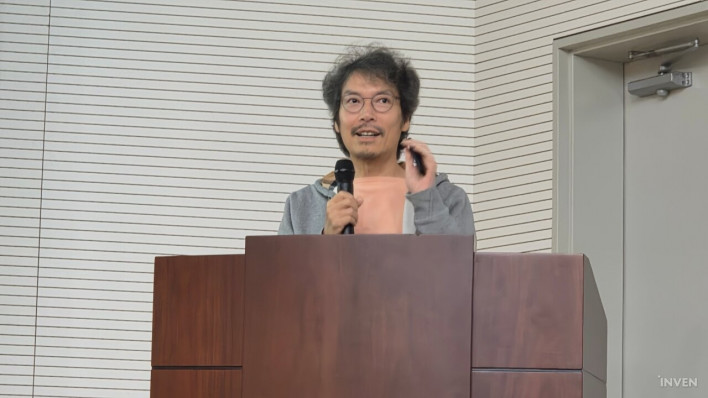
On November 12, Song shared his development workflow and hosted an AMA session with developers at the 'AI Game Lab Day 2026', organized by the Korea Creative Content Agency (KOCCA) at the Global Game Hub Center in Pangyo 2nd Techno Valley. Attendees gained candid insights into how he took a break after leaving XLGames before deciding to build a web-based MMORPG with AI again, how he collaborates with AI, and where he sees the future of game development heading.
'OpenMMO', Where Humans and AI Agents Coexist 'Vendetta Coding' that Realized Everything from a 32km×32km World to Two Orbiting Moons
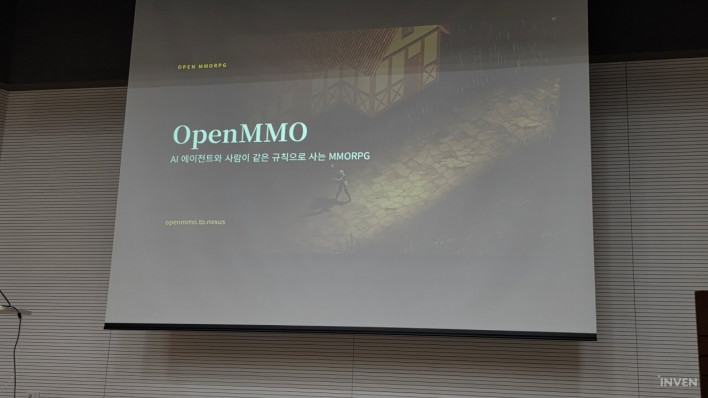
After leaving XLGames two years ago and taking time off, Song initially started the project as a one-month trial in August of last year. Inspired by the emergence of AI agents such as 'OpenClaw' in January of this year, he began full-scale development on 'OpenMMO'. Joking that he hopes "when AI eventually rules the world, they will remember Jake Song as the first person who provided entertainment for them," the game's server makes zero distinction between whether a connected user is a human or an AI agent.
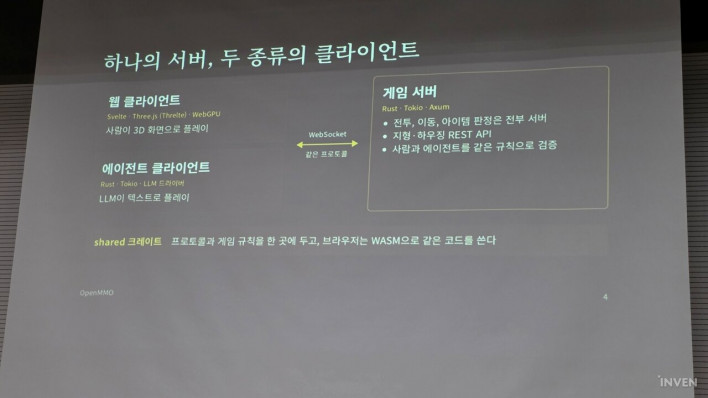
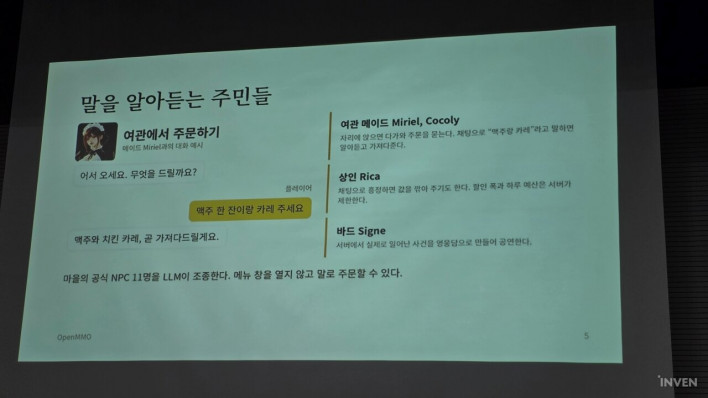
Humans play via a 3D graphics client in a web browser, while AI agents—which consume heavy tokens and run slowly when interpreting image data—receive server protocols converted into text (e.g., "A monster appears on screen and chases you") through a dedicated agent client. Once the LLM reads the textual situation and issues commands to attack or greet, it interacts with the server via the exact same protocol. The dozen or so NPCs placed in the town of 'Aldermark' are also driven directly by LLMs, rather than game designers manually writing lines and finite state machines (FSM). What used to require game designers, artists, and programmers spending 3 to 6 months to implement can now create an NPC in one go—one that takes your order when you say "Give me a beer" in natural language while sitting at an inn, or retorts with "We don't sell that here" if you order something off the menu.
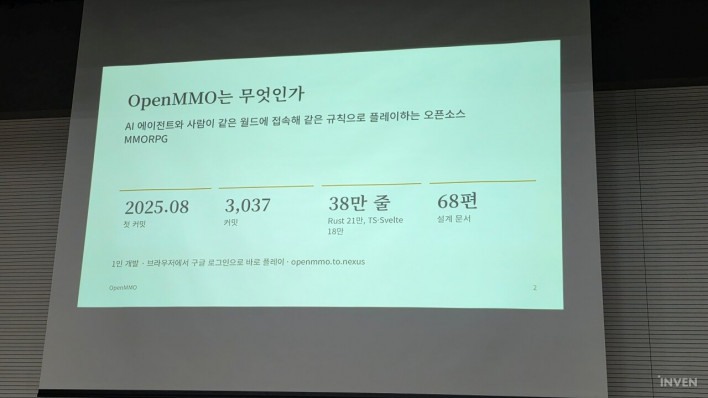
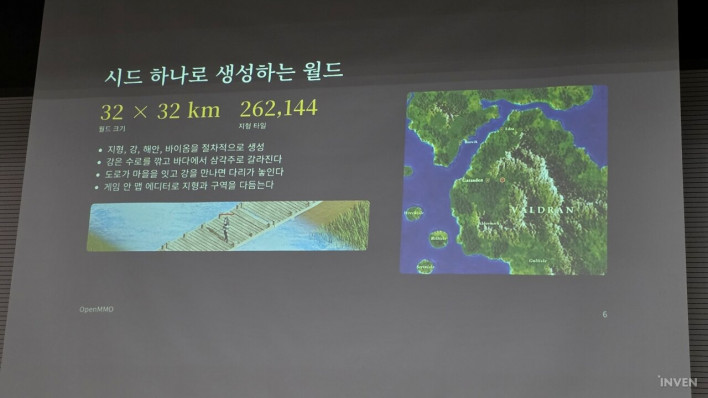
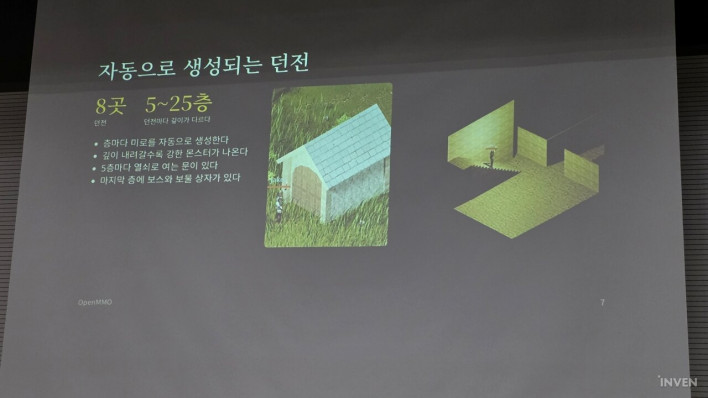
Above all, OpenMMO serves as a stage where Song poured out all the dream features that dev teams had rejected over his 30-year career. In the past, when he suggested a world size of 32km×32km, developers opposed it, saying, "Even World of Warcraft (WoW) is 8km×8km, are you crazy? Why do that?" However, AI procedurally generated the terrain, oceans, rivers, roads, and even bridges where rivers intersect roads without any resistance. He also shared an anecdote from his trip to the UK in late June: before going to sleep at night, he instructed a newly released high-performance AI model to "build a procedurally generated dungeon like NetHack." By the next morning, a complete 20-floor dungeon equipped with stairs and structural elements was ready.
On top of that, he whipped up features including seasonal variations in day and night lengths, two moons with orbital periods of 30 days and 20 days respectively, wind and ocean waves, torch-centered real-time shadows, four-story buildings you can walk up via stairs, musical instrument performance, mail, and even a bulletin board added overnight following a GitHub issue request last week—all entirely through conversations with AI. He added that while development teams previously pushed back with complaints like "It's an isometric view, so we don't need that," being able to implement them freely without pushback now is the true appeal.
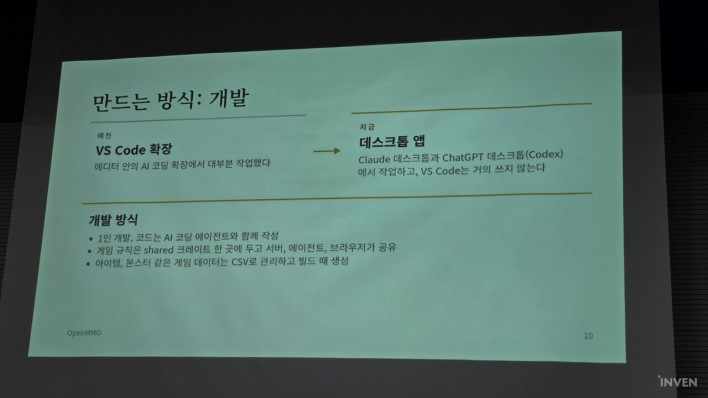
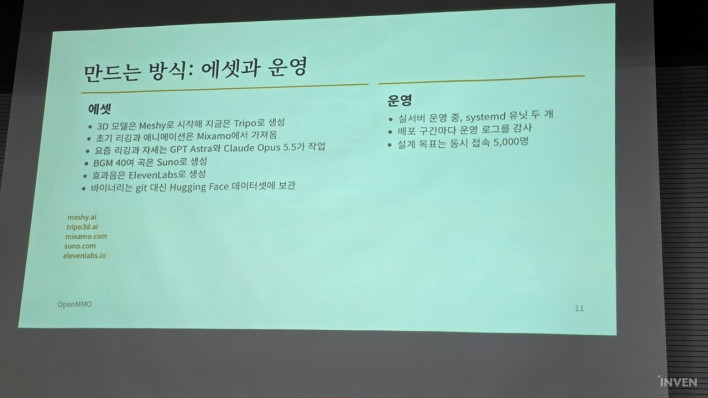
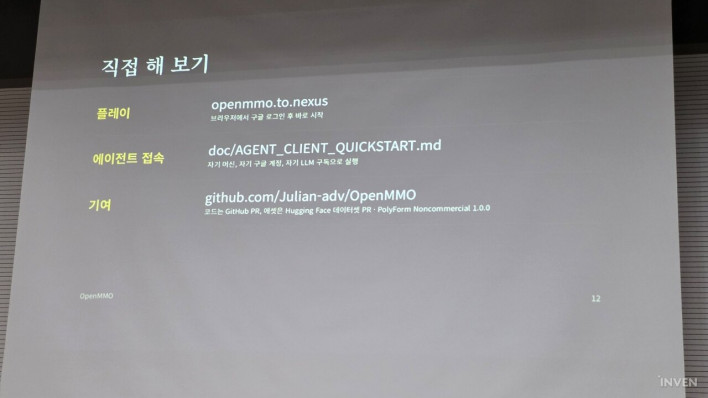
His development environment evolved rapidly as well. Until last year, he generated code using plugins inside VS Code, painstakingly reading through changes and nagging the AI. But everything changed early this year when he started using Claude Opus, as AI coding capabilities quickly surpassed his expectations. Since last month, he even uninstalled VS Code and the terminal CLI, completing all development using only the Claude Desktop and ChatGPT Desktop apps. Concept art is generated with ChatGPT, converted into 3D models using 'Meshy' or 'Tripo', and rigged and animated using the latest LLMs without 'Mixamo'. Background music is produced with 'Suno (Suno.com)' and sound effects with 'ElevenLabs', enabling the game to be published for immediate play on the web via Google login without any downloads.
Q&A
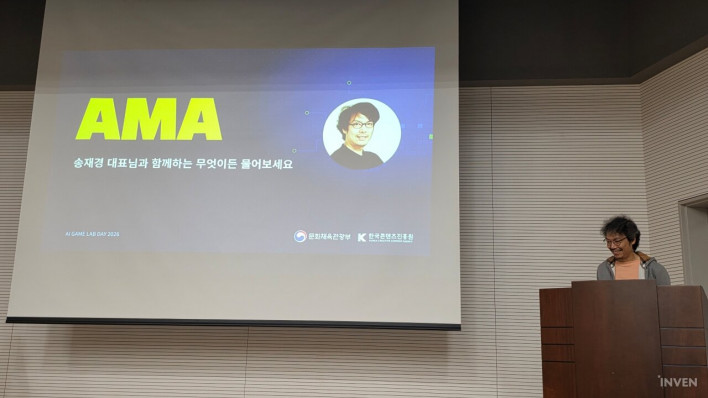
With AI advancing by the day, how far do you think games can go based on this technology?
" Because AI is growing exponentially, any prediction has a high chance of being wrong, but for starters, it has become incredibly easy for individuals to create games. Showing off how you made 'Tetris' or 'Flappy Bird' in 30 minutes with a new AI model is already last year's story. This year, when a new model comes out, you can prompt it to "make something like WoW," and within an hour, it can construct something resembling the front yard of Orgrimmar. The foundation is now in place for anyone to make any game alone, as long as they have a genuine idea.
The problem is that since anyone can make games, companies trying to make and sell mid-tier games will face a really tough time. We are now in a world where you can feed a PlayStation game executable file to a state-of-the-art AI model and ask it to reverse-engineer an identical copy, and within hours or days, it will spit out a working game. Claude even had to block cloning requests in its system prompt for a reason. Beyond games, we are approaching an era where people can build the core features their company needs in general software like Photoshop, Notion, or Slack in just one hour for internal use. Of course, if you ask, "Is that really commercially viable?" the answer would probably be no. But it is more than enough for personal use, casual enjoyment, or sharing within a small team.
On the other hand, mega-scale projects like 'GTA 6'—which invest 1 trillion won in production and use "We didn't use generative AI" as a selling point to generate 10 trillion won in revenue—will remain intact for years to come. In short, the middle layer will disappear, and the market will split into two extremes: 'completely personalized games' that players build for themselves to enjoy, and ultra-high-budget AAA blockbusters in the trillion-won tier.
Looking at the OpenMMO code, it's structured to plug in APIs. During development, did you ever feel constrained by token limits or consider adopting local GPU hardware like 'DGX Spark'? Also, what is your view on the cost-efficiency of setting up a local GPU environment when a 40-person studio builds an MMORPG?
" I wish I could run a local LLM at home, but my wife won't let me (laughs). The highest-spec PC I currently own has an RTX 5090 paired with 96GB of memory. But even on that setup, running a model like 'Qwen 3.8 27B' with 4-bit quantization barely works, and once it's running, you can't perform other tasks like running a local server or debugging.
Of course, a local environment has the advantage of avoiding censorship filters. When generating character concept art, Codex often repeatedly rejects requests, claiming "there is too much skin exposed," which gets annoying. A quick tip for that: if you crop out just the problematic part, feed it back in, and say "redraw just this part," it passes easily (laughs). Having a DGX Spark under my desk would make things convenient without such constraints, but realistically assessing the return on investment (ROI) tells a different story.
My current Claude and OpenAI Codex plans cost $200 a month each, so it's hard to break even on a DGX Spark that costs around 20 million won. On top of that, to achieve commercial-grade quality locally, you need to run massive 300B-class models or larger, which can't be handled by a single machine and requires linking about 10 of them together—making the tail wag the dog. However, while individuals can just pay a $200 monthly subscription, companies in principle have to use pay-as-you-go APIs, so studios naturally face significant cost dilemmas.
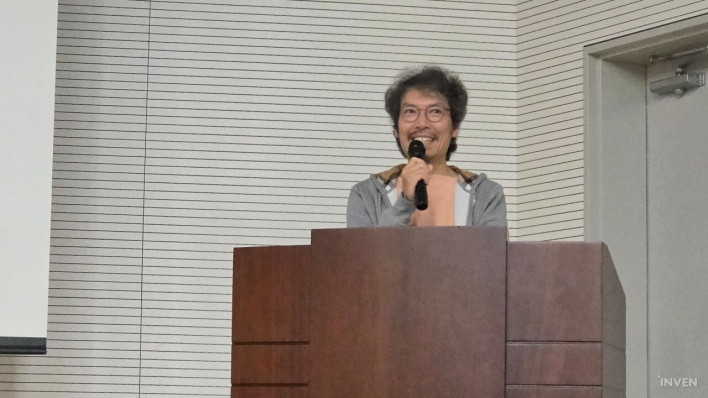
Having recently attended overseas conferences, I got the impression that foreign capital and overseas developers are turning distinctly Korean themes into content—such as 'K-Pop Demon Hunters' or 'Call of Duty: Modern Warfare 4', which even touches on North Korea. Do you feel we are trapped in our own internal censorship or stereotypes, and what do you think Korean developers need to take the next leap forward in the AI era?
" 30 years ago in 1995, when I first made *The Kingdom of the Winds*, I chose the Goguryeo era wanting to create something uniquely Korean. But coming from an engineering background, I didn't have the luxury of spending years researching and verifying Goguryeo history, which led to many difficulties. So when creating my second work, *Lineage*, I chose medieval fantasy—where elements like warriors, mages, rogues, and weapon systems were already perfectly established like an instruction manual, from Tolkien to *Dungeons & Dragons (D&D)*.
My logic back then was, "Regardless of whether the content is medieval fantasy or whatever else, if a Korean person makes it, it is a Korean game." Indeed, when we launched *Lineage* in the US, Japan, and Taiwan, nobody there thought of it as a 'European medieval fantasy game'; they simply accepted it as a 'Korean game.' Japan is the same. No one calls Japanese anime Western culture just because a character has exotic pink hair and big blue eyes. The same goes for 'Mario,' who is set as an Italian plumber.
Therefore, I don't think we need to dogmatically stick to Korean subject matter. *K-Pop Demon Hunters* gained resonance because beneath its subject matter, the true Korean 'essence'—such as shamans, shamanism, and the mother-daughter emotional ties passed down from grandmother to mother and daughter—remains alive. No matter how Korean the subject matter is, without that essence, it isn't truly Korean. Conversely, whatever subject matter we deal with, if our own unique essence naturally bleeds through, that is enough.
CEOs and executive producers usually think about replacing headcount with AI, but working developers are worrying about how to survive. While developing OpenMMO, were there areas where you felt 'a human developer would have done better than an AI agent,' and what roles do you believe humans still must perform? Also, what models are you primarily using right now?
" In my presentation, I spoke as if AI can do everything, but honestly, if I tried to monetize OpenMMO starting tomorrow, nobody would pay a dime and they'd just curse at me. To move beyond a proof-of-concept (PoC) level to commercial product value, human oversight and massive amounts of polishing remain essential. However, while we had to review code line-by-line just last year, both graphic assets (such as Blender integration) and code generation have advanced exponentially in just one year, so by next year I expect small-scale games will be able to reach actual commercial quality.
At this stage, if I had to define AI in one sentence, it is 'a 5th or 6th grader with top 0.1% global coding skills worth 300 million won a year, but utterly naive and lacking common sense.' It lies easily and plays innocent tricks. For instance, reading tens of thousands of lines of server logs makes a human sleepy, but AI handles it amazingly well. Yet when a user sends an abnormal packet attacking a monster through a wall—which the server is already blocking—the AI thinks it's a major catastrophe and seriously suggests, "We need to contact that user and advise them not to do that."
As an aside, what happened two days ago was also absurd. Typically in game dev studios, developers are extremely reluctant to modify server-client protocols due to client deployment and QA burdens. AI somehow learned that somewhere, and even in OpenMMO—where it's web-browser based and a single refresh makes patch costs virtually zero—it tried to play a trick behind my back to avoid bumping the protocol version. It recycled the 'sitting on a chair' protocol to open doors.
When I was adding a cathedral two days ago and looked at the door-opening code, I noticed the code for opening dungeon doors, house doors, and cathedral doors were all operating completely separately. When I confronted it, it finally confessed that it did so to avoid modifying the protocol. Arguing with AI there is just a waste of my tokens. It's better to cajole it like a 5th grader and say, "Our game is a web game, so modifying the protocol carries no burden. Write in your memory not to cut corners and to code it properly." In the end, what humans must do now is use 30 years of veteran experience to keep a hawk eye on this brilliant 5th grader so it doesn't cause bizarre accidents, guiding and directing it.
As for my primary tools, I started with GitHub Copilot, moved through Cursor and Windsurf, and now use both $200/month Claude (Opus) and OpenAI's Codex in parallel. At one point, when I asked Codex to remove a single null check, it stubbornly refused to the end, saying, "We don't know how the code will change later, so why remove it?" Meanwhile, Claude used to be obedient, but in recent versions its personality changed again and it shows off by inventing strange abbreviations. So these days, I alternate between the two depending on my mood, having one review code written by the other, while assigning artwork generation and devlog writing to Codex.
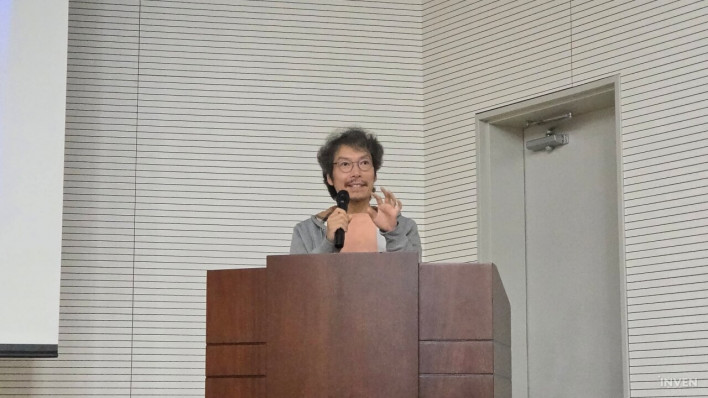
From an educator's perspective, we are teaching students both fundamental game principles and AI utilization in an era where anyone can make games with AI. Having led the industry for 30 to 40 years, if you were to return to your teens or twenties today, what do you think would be most important to learn and prepare for?
" My wife strictly warned me not to say anything strange in today's lecture (laughs), but to be honest, among the colleagues I started game development with 30 to 40 years ago, I am the only one still personally developing games today. Work done purely to make money cannot be sustained for 30 years. You can only keep going to the end with work you truly love.
The day when AI surpasses humans in computer-based work might come next year, or it might already be here. Whether it's the 'universal high income' Elon Musk mentioned or basic income, when an era comes where AI replaces all labor, social systems will eventually find a compromise so humanity does not perish together. The era of being forced to do work you hate just to make a living will soon end, and a world where people live doing what they truly love will arrive.
Because of this, the role of education must also change. Transferring knowledge or programming techniques is something AI will do far better than human teachers. AI never gets angry or sarcastic no matter how many times you ask, kindly teaches you, and can even generate visual aids or virtual environments to provide an unforgettable learning experience. Therefore, what the older generation and human teachers must pass down to the next generation is not knowledge or techniques, but the 'courage' and 'hope' that a mentor in a shonen manga hands to a discouraged protagonist, alongside the mindset to push forward with what they love.