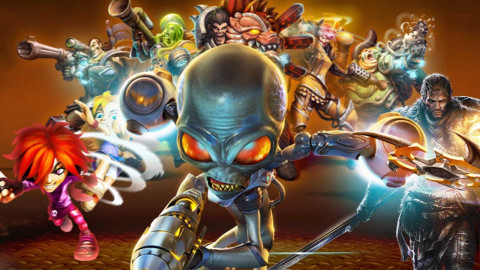
Can a global AAA open-world game like GTA ever emerge from Korea?
Jamyung Noh, CEO of Moontansoft—who served as a character designer on Rockstar Games' Grand Theft Auto V and Red Dead Redemption series before taking on roles as Vice President and Executive Director at YOOZOO Games—took the stage on November 12 as a speaker at "AI Game Lab Day 2026," hosted by the Korea Creative Content Agency (KOCCA) at the Global Game Hub Center in Pangyo 2nd Techno Valley. Posing this question to the audience, Noh reflected on Rockstar Games' AAA production processes and the key success factors of iconic open-world titles, while sharing real-world production cases from Moontansoft's upcoming AI-driven title, Vagabond.
Before delving into his main talk, Noh cited "improved relationships with developers" as the most noticeable change on the ground since adopting AI. In the past, artists and developers experienced significant stress when directors repeatedly asked for revisions. Now, however, team members can quickly verify revisions or generate draft concepts themselves using AI, creating a much more flexible development environment, he explained.
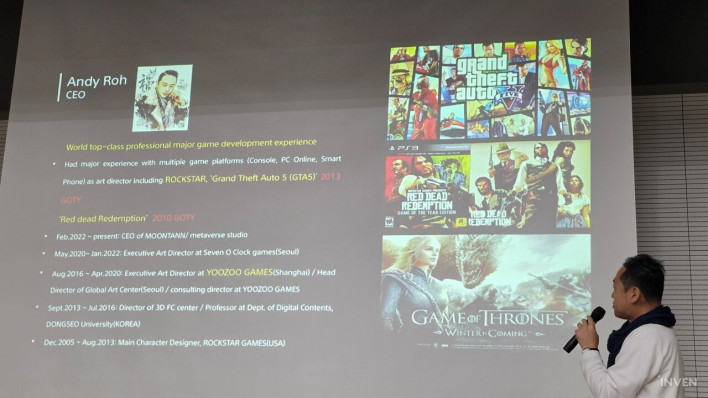
The Power of Systems and Detail Over a Single Genius Rockstar's Worlds Built Through Rigorous Research, Detail, and Parallel Production
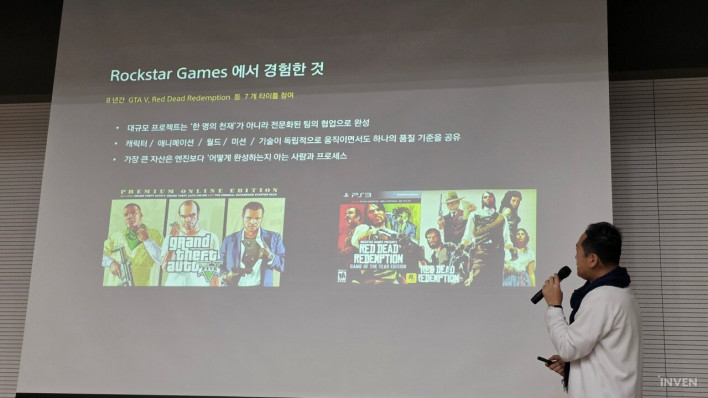
"Large-scale projects are not completed by a single genius, but through the collaboration of specialized teams and a process that shares a single standard of quality," Noh said, defining the essence of AAA production he experienced at Rockstar Games as "the process of people who know how to finish." Under a clear creative vision maintained over long periods, senior talent iteratively works through short development milestones, immediately fixing issues and elevating quality.
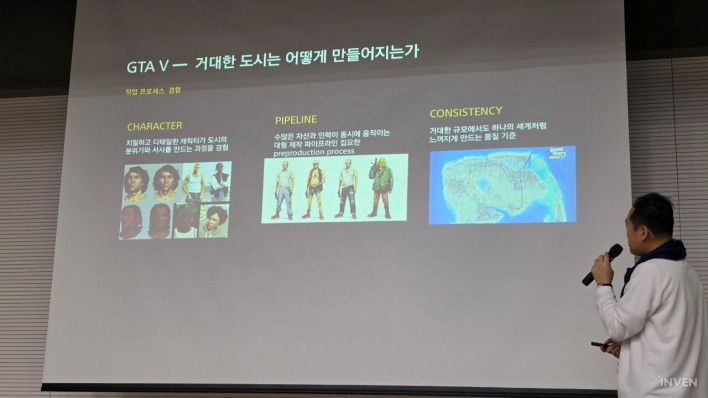
Rockstar Games' signature vibrant open worlds stem from relentless preliminary research and attention to detail. During the production of GTA 5, around 25 designers alone were assigned to meticulously plan everything from public transit in Los Santos—unrelated to the main missions—to minor side-mission scripts. Character design was no different. Noh recalled that while he initially thought gangsters were all similar, actual research revealed that only Hispanic gangsters got facial tattoos, and each gang possessed its own unique attire culture, which was then reflected in the character design.
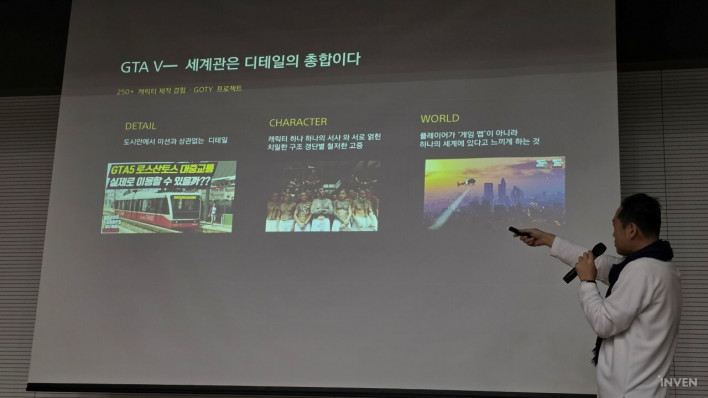
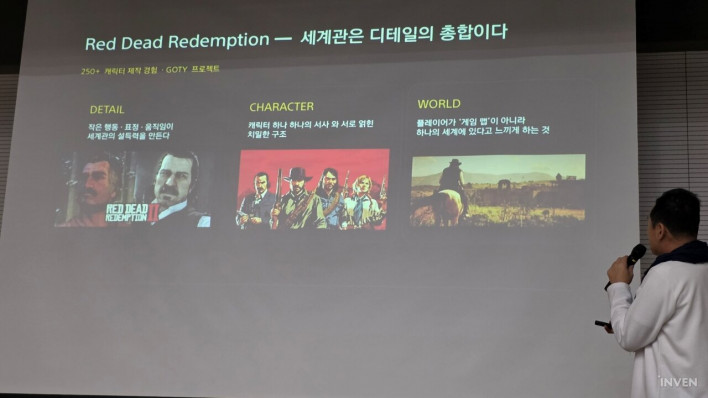
On Red Dead Redemption, around two years were spent solely on pre-production. The team studied the history of outlaws migrating from the East to the West and the background of the Gold Rush era, watching Western movies together every two to three weeks to absorb the atmosphere of the period. The story written by co-founder Dan Houser was designed from a time when the success of the first game was still uncertain so that the narratives of Red Dead Redemption 1 and 2 would seamlessly connect as a single IP.
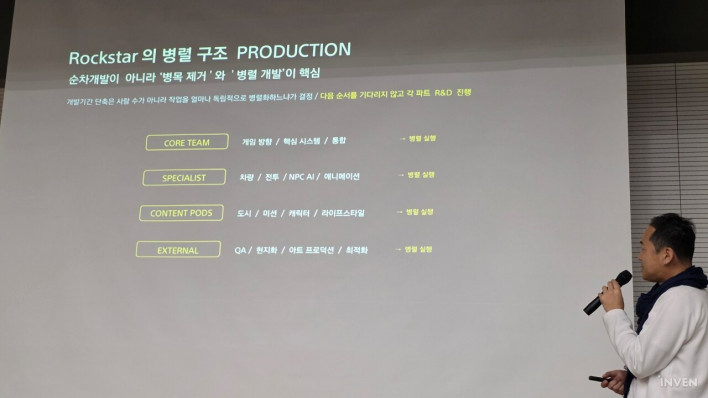
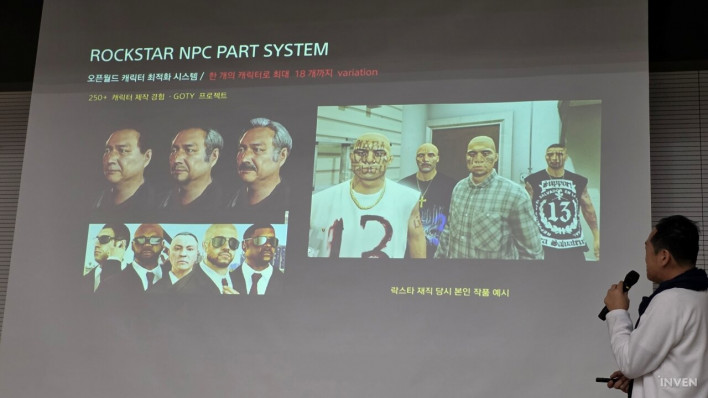
He highlighted "parallel production structure" and the "NPC parts system" as particularly impressive development approaches. Instead of waiting for preceding stages to finish, concept design, character modeling, animation, VFX, and editing teams all begin work simultaneously, elevating quality through independent R&D before combining their efforts. Furthermore, because creating countless unique NPCs individually is impractical in open-world games, they utilized a parts system that takes a single base character model and combines skeletal frames, eyebrow shapes, nose widths, hairstyles, clothing, and accessories to generate more than 18 variations. Noh added that in Vagabond, currently under development, they actively apply a similar method—taking the same face base and altering hats, hairstyles, and accessories to make characters look entirely distinct.
'San Andreas': Developed in Just 1.5 Years, Sold 90 Million Copies The Power of Worldbuilding Over Technology; Structural Limitations in Korean Gaming
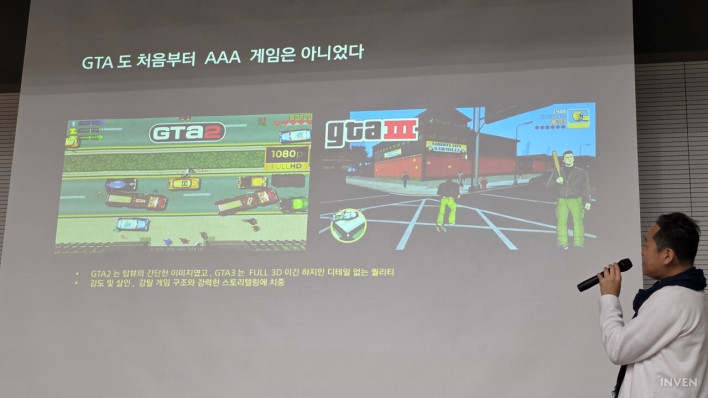
Noh stressed that the Grand Theft Auto series was not a massive-budget AAA title from the start either. The original GTA began with a team of five, and neither top-down GTA 2 nor GTA 3—which introduced 3D for the first time—featured top-tier graphics or technical fidelity by contemporary standards. However, because the core concept and worldview—where a villain takes center stage to commit robberies and heists—were so solid, the series was able to continuously elevate its technical polish with subsequent installments.
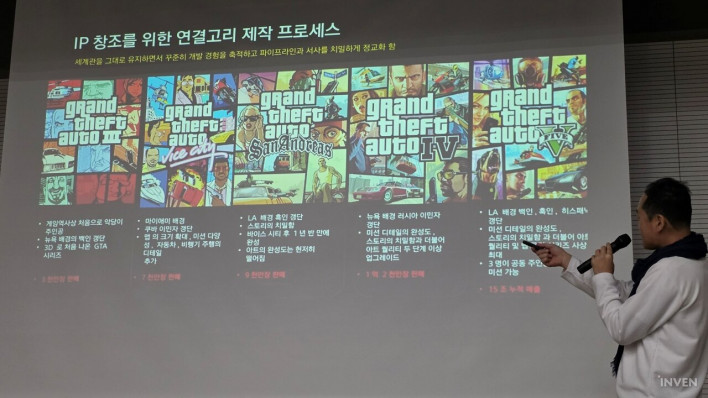
A prime example is GTA: San Andreas. While smaller in technical scale compared to GTA 5—which generated 1 trillion won in revenue within just three days of release—or subsequent titles selling over 120 million copies, San Andreas was developed in just a year and a half and achieved an astounding combined sales figure of 90 million copies across Xbox and PlayStation. Noh noted that if he had to choose games he wants to replay today, he would choose San Andreas or Vice City without hesitation, pointing out that beyond flashy new tech, a masterpiece is defined by meticulous narrative and mission structure, as well as a cohesive worldview depicting the city's culture and lifestyle. The expansion from Red Dead Revolver—finished after acquiring Angel Studios—to the Western open-world Red Dead Redemption series was likewise the result of a solid IP foundation.
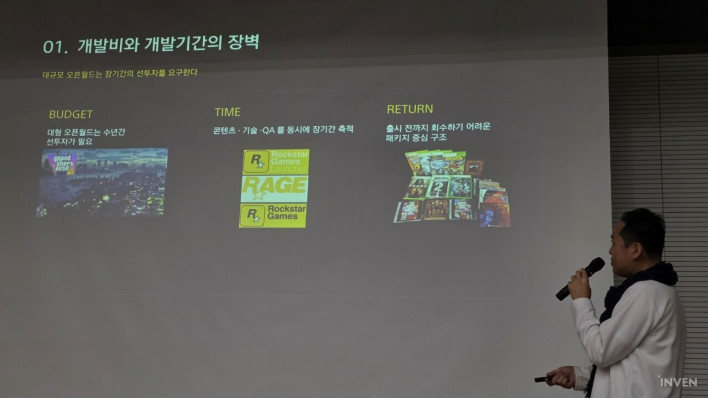
Why, then, haven't open-world games like these emerged from Korea? Noh pointed to the differences in investment structures and accumulated industry formulas for success rather than a lack of technical capability. Because Korea achieved massive success in online and mobile MMORPGs, there was little incentive to take on the risks of buy-to-play boxed models with uncertain revenue returns prior to launch, or developing proprietary engines (such as Rockstar's RAGE engine) that require investments exceeding 100 billion won.
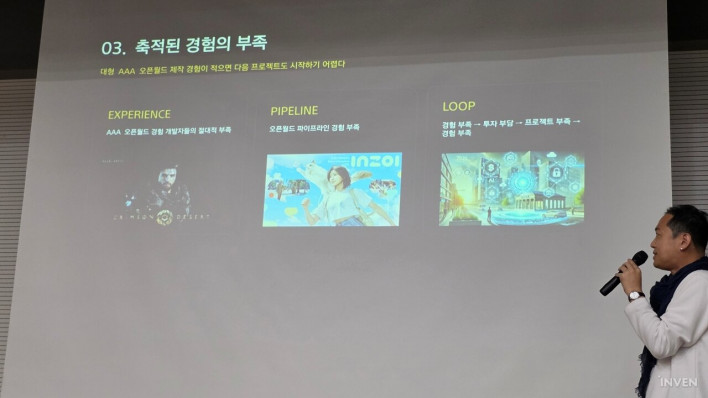
"The greatest enemy isn't failure, but a structure unable to absorb failure," he said, citing the scarcity of talent with hands-on experience in AAA production pipelines and the lack of experience in crafting intricate open-world narratives as further limitations.
Capital Alone Cannot Replicate an Open World Combining Lessons From Major Publishers' Failures With Korean Development Strengths Is Key
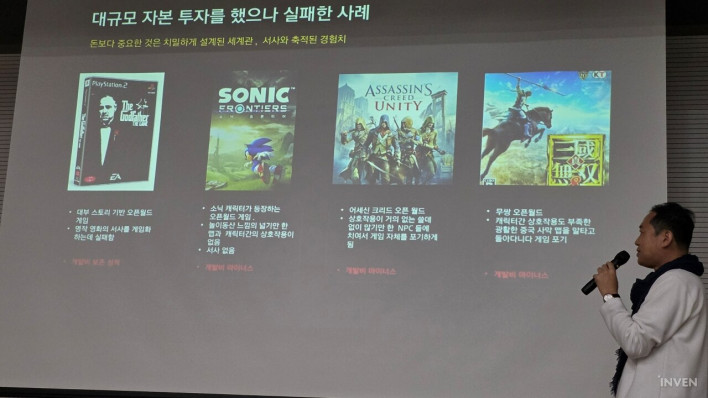
Pouring in capital and famous IPs alone will not spawn an open world like GTA either. Noh examined cases of global studios that attempted to imitate GTA following its success, only to fail. EA's open-world game based on the film of the same name, The Godfather, ended up mediocre as it merely followed the original movie story word-for-word, while Sonic Frontiers, which utilized the Sonic IP, suffered from having a vast map but lacking character interactions and narrative depth.
Ubisoft's Assassin's Creed Unity and Koei Tecmo's open-world attempt, Dynasty Warriors 9, suffered similar fates. In Assassin's Creed Unity, hundreds of NPCs wandered the streets without interacting with the player, serving only as movement obstacles, while Dynasty Warriors 9 featured an expansive map with a lack of minor missions or activities, leading players to abandon the game out of boredom. All four cases merely mimicked the appearance of an open world while lacking narrative density and worldbuilding.
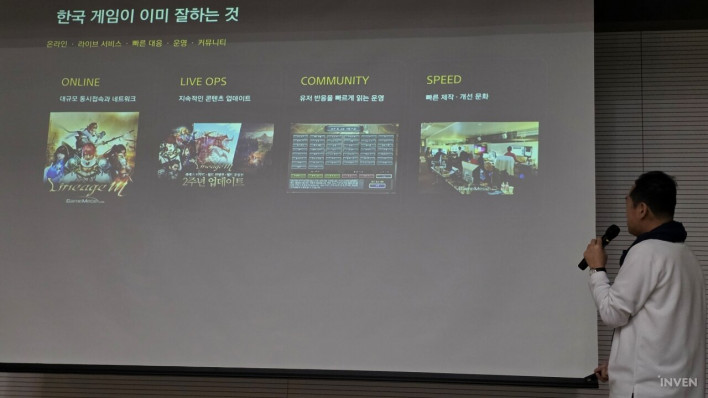
Therefore, Noh emphasized that instead of copying Rockstar Games directly, developers should combine the strengths of Western AAA production with the unique advantages of the Korean game industry. Korean developers already possess expertise in continuous live content updates, rapid player-feedback operations, and a signature fast-paced production and iteration culture. Just as Korea successfully reinterpreted the dark, gritty grammar of the Diablo style into its own flashy, dynamic fashion in the past, combining a unique worldview and characters with an AI-driven interactive world and Asian outsourcing networks can produce a Korean-made global blockbuster.
Avoiding the 'Uncanny Valley' and Matching In-Game Pacing The AI Pipeline of Upcoming Title 'Vagabond' and the Diversity of Korean Games
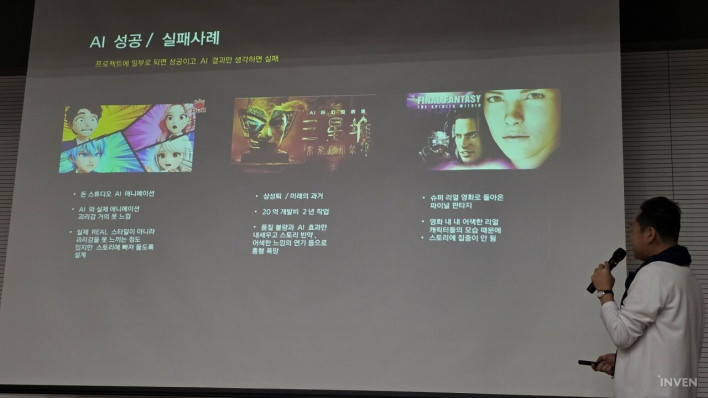
Regarding practical AI implementation, Noh advised dropping the obsession with "super-realism." He cited a recent failure in China where a photorealistic film produced 100% with AI over two years with a 2 billion won budget flopped, alongside the limitations faced by the early-2000s photorealistic 3D animated film Final Fantasy: The Spirits Within. Because humans look at human faces every day, even minor misalignments in the proportions of eyes or noses create an immediate sense of uncanny dissonance. Unlike creatures, clumsily attempting to make human characters photorealistic risks falling into the "uncanny valley," where flaws are highlighted.
Conversely, an animation studio founded by a senior colleague from Noh's studying days in San Francisco integrated AI processes into cartoon and casual styles from the early days of AI, and its works are currently being broadcast to critical acclaim on channels like SBS and EBS. Within stylized genres rather than extreme realism, audiences naturally accept the content without being conscious of whether AI was used, he explained.
Moontansoft's upcoming GTA lifestyle-oriented project Vagabond actively implemented AI under these same principles. The team quickly navigated the early concept art phase—where asking for repeated redraws was previously difficult—using AI, and utilized AI for over 40% of the 3D modeling process, drastically reducing cost and time. AI was also introduced into cutscene production, which is typically expensive, with a focus on naturally aligning the generated output's visual standard with the quality of in-game characters and environments to prevent cutscenes from looking overly photorealistic and creating a disconnect with gameplay.
"Changes in Korean games have already begun, as seen in titles like Lies of P and Dave the Diver," Noh said, emphasizing that the future Korean games industry must evolve into an ecosystem capable of creating "more diverse games" rather than simply larger-scale ones. At the end of his lecture, he concluded his presentation by showcasing an early demo video on-site of Vagabond, a new Mature-rated open-world title containing profanity and gritty direction.
Q&A
When do you plan to release Vagabond, which is currently in development?
"We still need to secure a bit more additional investment. We are aiming to develop as quickly as possible and release it in two years.
As a 3D action game developer, I have many concerns about how far we should utilize AI. Existing projects already have established processes, and the more complex the systems and diverse the content, the harder it is to gauge how far AI can be applied, leading to hesitation in adopting it. To what extent are you currently using AI, and how much of the process do you think AI could cover in a complex, large-scale game like GTA?
" Since I come from an art background, it's difficult for me to give a 100% precise answer regarding programming. However, looking at my fellow programmers, while individual experiences vary, the general feedback was that development time is shortened by 30 to 40%.
Beyond that, the process itself feels somewhat relaxed. In the past, when the art team made requests, programmers would often say it couldn't be implemented, leading to frequent friction. But after wrestling with AI myself and looking into code structures, I came to understand the programmers' hardships a bit better. Programmers, too, can now reflect requested revisions quickly using AI, making communication much smoother.
Of course, the areas with the biggest time-saving effects are art and assets—such as animation, characters, backgrounds, concept art, and design. Casual games like Candy Crush Saga could probably be made in a single day now. That said, having a massive open-world game pop out instantly with AI is impossible as of right now. Still, no one knows how things might change next year. What's clear is that even in programming, we are seeing incredible effects in reducing development time.
You emphasized the importance of narrative and worldbuilding—how do you plan to reflect this in Vagabond? Also, with the rise of the short-form content era, I'm curious if you are building systems that mirror this trend.
" I'm giving a lot of thought even now to fast-paced content like Shorts. This is because users nowadays mostly consume short-form content. Personally, I believe it drains creativity and would prefer to avoid it, but at the same time, it's something I constantly grapple with—figuring out how to help players digest the game quickly.
Vagabond features a villain narrative like GTA, but it allows players to choose whether to be good or evil. Making good choices leads to a series of righteous missions, while choosing evil brings mostly villainous missions. We plan to introduce AI to reflect the results of player choices in the world, with NPCs remembering the player's past actions and adjusting their interactions and reactions accordingly.
To be honest, previous open-world games felt somewhat lacking in NPC relationships. In Vagabond, my ambition is to bring out realistic interactions as much as possible—such as NPCs reacting accordingly when you commit bad deeds.