“Rather than viewing AI merely as a cost-reduction tool, we should see it as an opportunity to build a 10 billion won game with 1 billion won and challenge the global market.”
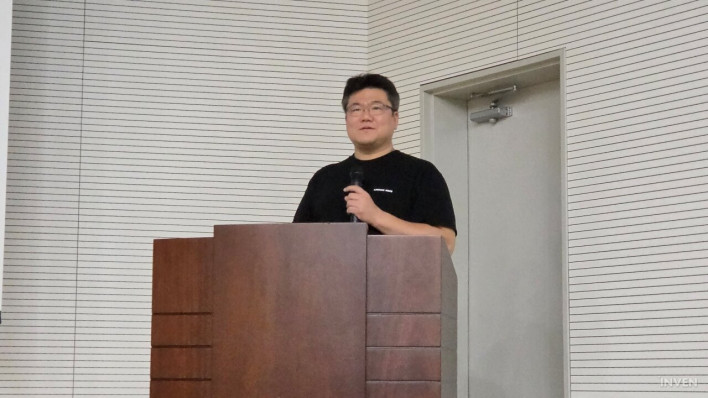
Jaeho Won, CEO of Anchor Node, who has spent 26 years on the frontlines of game development at companies like Nexon and Neowiz, compared the changes in the gaming industry during the AI era to a "supply-side revolution" and the media industry's "YouTube moment." He assessed that just as small development teams—rather than mega-capital—discovered new game design conventions and reshaped the market during past technological advancements and platform shifts, the present moment, where AI lowers development barriers, represents a renewed opportunity for small teams and Korean developers.
On the 12th, Won delivered the opening keynote address at "AI Game Lab Day 2026," hosted by the Korea Creative Content Agency (KOCCA) at the Global Game Hub Center in Pangyo 2nd Techno Valley. Under the theme "Small Development Teams Changed the Game in Every Upheaval," he walked through the history of how game development has become increasingly accessible—from legendary early-stage startup origin stories to DirectX, commercial game engines, and now AI—and offered a strategic direction for the Korean gaming industry currently trapped in development cost inflation.
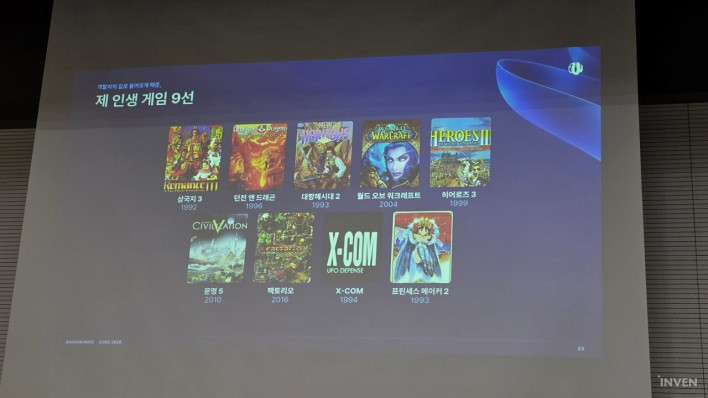
He noted that during developer job interviews, he never fails to ask candidates to quickly name 10 games they have played. This is because the experience of playing and loving games shapes a developer's identity, serving as the foundation for creating new titles. During the Q&A session following the lecture, he also shared his perspectives on shifts in AI game distribution platforms, indie game cloning issues, and survival strategies in an era of oversupply.
How Teams of 2, 4, and 6 Changed Gaming History Even Before AI, It Was Small Teams That Changed the World
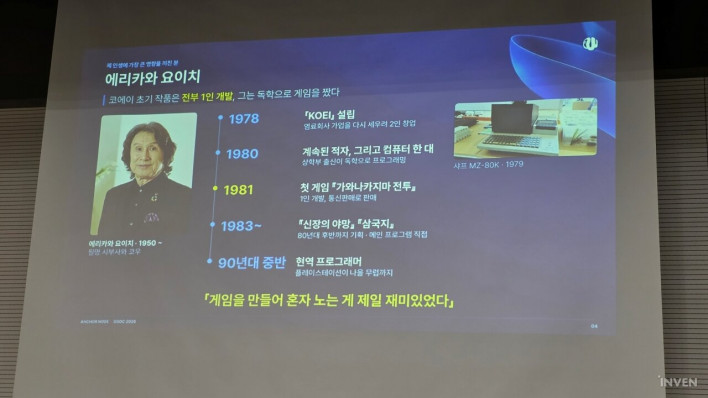
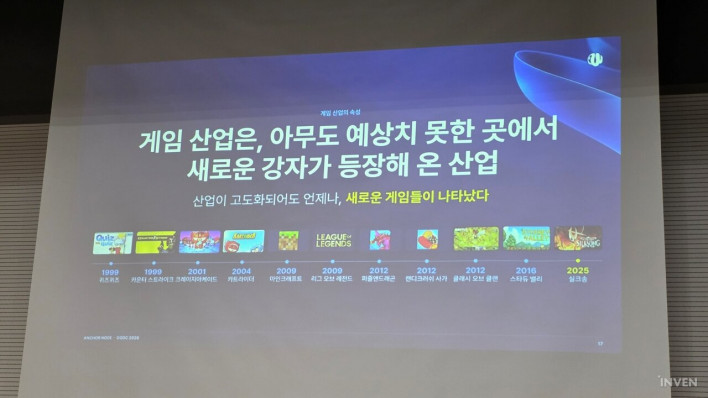
“While it is impossible to compete with Samsung Electronics by making semiconductors or beat Hyundai or Toyota by making cars, gaming has always been an industry where you can start from scratch with your bare hands and build a world-class company.” Won pointed out that unlike manufacturing, where massive capital and infrastructure dictate victory, the gaming industry has consistently seen small groups spark massive innovation from unexpected places.
The first case he cited was Yoichi Erikawa, founder of Koei, well known by his pen name Kou Shibusawa. While struggling in the countryside running a family dye business with just one employee, he taught himself programming on a computer his wife bought him for his birthday and single-handedly developed 'The Battle of Kawanakajima' and 'Nobunaga's Ambition'. As developers gathered around him, Koei churned out successive hits like 'Romance of the Three Kingdoms' and 'Uncharted Waters', eventually building a Tokyo-listed company with 3,000 employees.
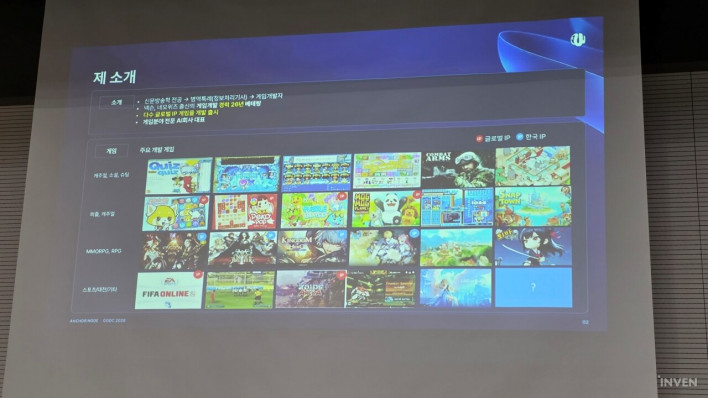
Korea's online gaming history also began with small teams. Nexon's 'QuizQuiz', where Won worked, started with just two people when a programmer doing military alternative service studied server, client, and DB architecture after work and was joined by a designer friend. After creating paper-doll-style avatar dressing mechanics, they added multiple-choice quizzes leveraging the programmer's background as a high school champion on 'Janghak Quiz', resulting in a massive hit. Later, 'Crazy Arcade' was made by 4 people, and 'KartRider' was initially developed by 6 people. These games went on to change the course of Korean gaming history.
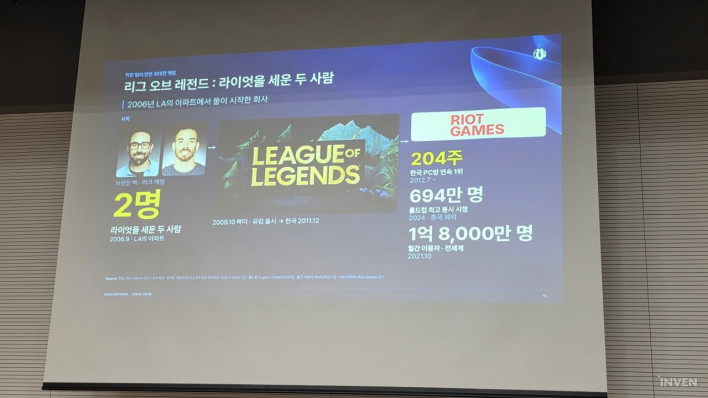
Overseas and recent examples were no different. 'Counter-Strike' and 'League of Legends' started as mod development by two people, while Markus Persson of 'Minecraft' and Eric Barone of 'Stardew Valley' created global blockbusters through solo development. GungHo Online Entertainment's 'Puzzle & Dragons', which began with 4 people creating a $3 smartphone game and at one point surpassed Nintendo's market cap, Supercell's 'Clash of Clans' developed by 5 people, King's 'Candy Crush Saga' which transitioned from Flash to mobile with a 3-person team and surpassed 2 billion downloads, and Team Cherry's 'Hollow Knight: Silksong' built by a 3-person team—all were products of small teams.
Won emphasized that all of these success stories were achieved purely through human effort before the advent of AI. He explained that now, as technical barriers have dropped, the door of opportunity has opened wider than ever for those willing to take the challenge.
From Wire Circuit Boards to Natural Language Prompts A Market That Grew Explosively as Development Barriers Fell
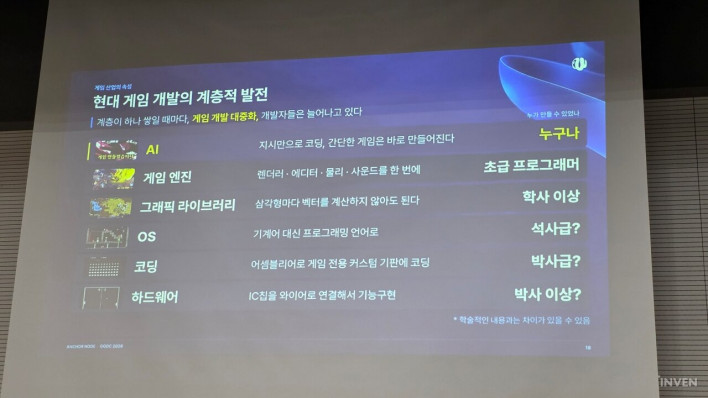
Won defined gaming history as a process of development becoming progressively easier. In the days of 'Pong', the first game built by manually wiring circuit boards in research labs, or 'Space Invaders', which controlled dedicated arcade boards using assembly language, only a handful of Ph.D.-level experts who thoroughly understood logic gates and circuitry could participate in game creation.
Later, operating systems (OS) and programming languages emerged, ushering in the era of DOS games like 'Prince of Persia'. As Microsoft's graphics library DirectX gained traction, PC gaming saw explosive growth with titles like 'StarCraft' and 'Diablo'. Won recalled that when he first joined Nexon, programmers from top universities had to stack five thick books on DirectX on their desks and study them thoroughly just to build a game.
The turning point was the emergence of game engines that handled 3D spatial calculations and lighting. As Unreal Engine and Unity became widespread, an environment was created where anyone could import assets and build games by watching YouTube tutorials. Now in the AI era, development has reached a stage where people with zero coding knowledge can build games using only natural language commands. He pointed out that as development tools became easier to use, more creators and games emerged, expanding the overall industry scale.
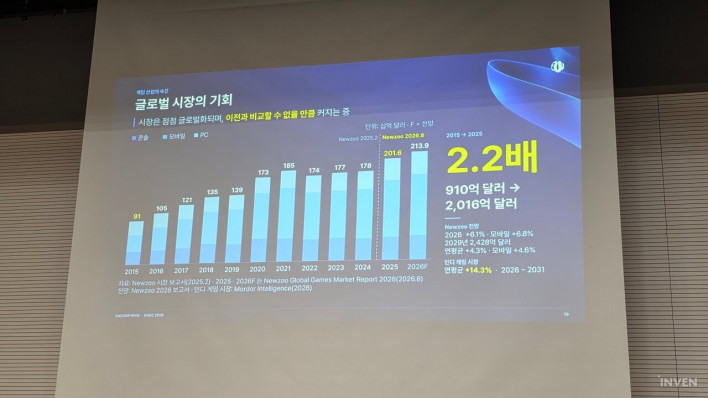
He also urged a shift in perspective regarding the stagnation of the domestic Korean market. He analyzed that the Korean market had been oversaturated relative to its economic fundamentals and is currently normalizing, whereas looking outward reveals that the global market continues to expand due to an influx of populations holding smartphones for the first time in their lives.
According to data he presented, the global games market is valued at around 300 trillion won annually, approaching the size of major industries like healthcare, construction, fashion, food, and automotive while continuing to grow at 6–7% each year. Won emphasized that compared to traditional giant industries whose annual growth hovers around 1–2%, the gaming sector has maintained an unprecedented multi-decade growth trajectory, stressing the need to target expanding emerging markets such as India, South Asia, Brazil, Africa, and Eastern Europe.
From Demand-Side Revolution to Supply-Side Revolution The AI Era's New Conventions Following Free-to-Play and Social Graphs
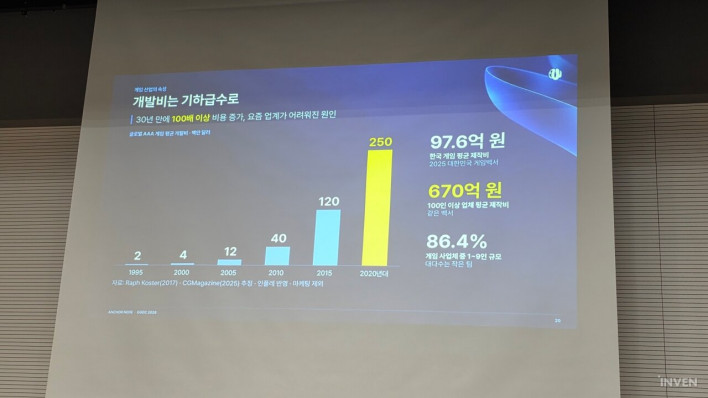
Why, then, are opportunities opening up for small teams once again? Won found the answer in rising development costs and the gaming industry cycle. In the past, when 6 people could make 'KartRider' in 10 months with roughly 50 million won, developers could laugh off a failure and move on to their next attempt. However, with average development costs reaching 10 billion won per title according to KOCCA's White Paper on Korean Games, taking risks on failure has become far harder. When tens of billions of won are at stake, project leaders inevitably rely on proven formulas to avoid failure, stifling creativity.
He compared three major technological shifts he experienced in the industry. The transition from packaged games to online gaming connected worlds previously confined to a single computer to other users, during which the 'QuizQuiz' team discovered a new business model—Free-to-Play (F2P)—by selling avatar items. When they first developed it, people doubted whether users would pay for changing data values rather than physical goods, but that model has now become standard practice. The shift from online to mobile eliminated space-time constraints and integrated smartphone contacts and social graphs into games, allowing 'Anipang' to single-handedly expand Korea's gaming population from 7 million to over 20 million.
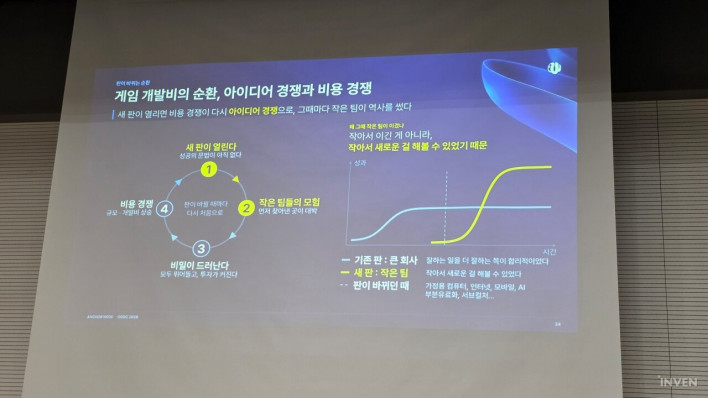
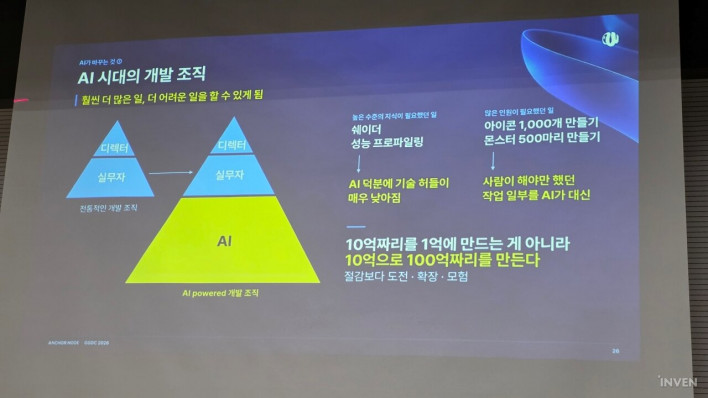
Won defined the first two shifts as "demand-side revolutions" that expanded user connectivity and accessibility, whereas AI is a "supply-side revolution" that enables a team of 10 to handle the workload of 100 people without planners or designers, tackling complex technical tasks like shader programming and performance profiling.
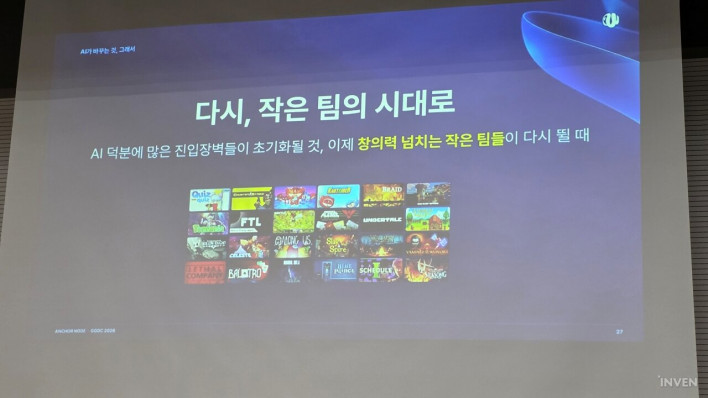
At the beginning of a new technology cycle, because nobody knows what will succeed, mega-capital on the scale of tens of billions of won hesitates to enter. Instead, agile small teams conduct rapid experiments to uncover new metas and design conventions, causing the window of opportunity to blow wide open for a brief period. He explained that unlike the late stage of a cycle, where latecomers compete in capital-driven graphics and sound inflation, the early stage is purely a battle of ideas.
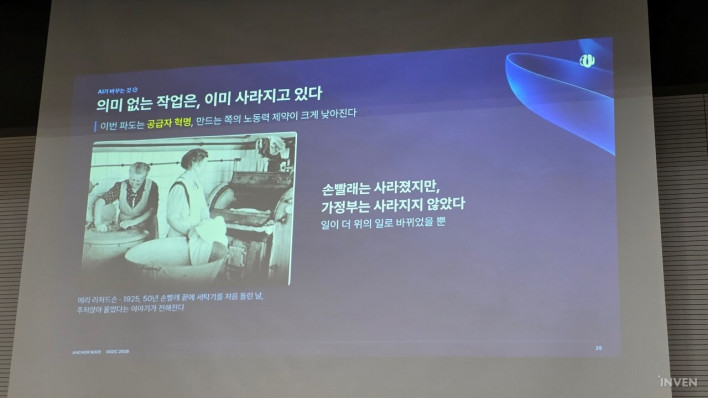
Recalling an anecdote from 1925 when the washing machine first debuted—where a maid who had spent her life hand-washing clothes in cold water collapsed in tears out of frustration—he noted that just as washing machines moved domestic workers to higher-level tasks like ironing or cooking, AI will free developers from tedious, repetitive labor. He reiterated that unlike manufacturing, where producing a sock for 100 won when others spend 500 won means victory, gaming is a realm of relative evaluation chosen by players, meaning AI should be leveraged to craft well-made games rather than merely cut costs.
The Gaming Industry's 'YouTube Moment' Has Arrived Showtime for Korean Developers to Overcome China's Human Wave Tactics
Won, who majored in journalism and mass communication, likened the current gaming industry landscape to the "YouTube moment," where media evolved from a monopoly of three major terrestrial networks through the cable era to an age where anyone can produce and distribute videos. In the early days of YouTube, there were widespread concerns as traditional networks saw their dominant position shaken, but ultimately, enabling anyone to create broadcasts led to an unprecedented explosion in video volume, industry workers, and total market size.
This opportunity is open equally to developers around the world. As the only Korean company to host a standalone booth in the AI Pavilion at Tokyo Game Show (TGS) 2026 this year, Won shared that he personally felt the rapid changes in Japan's indie game ecosystem. Even in Japan, where starting businesses or going independent was traditionally conservative, dedicated indie game halls have emerged over the past two to three years, unleashing titles of diverse styles, while emerging developer hubs like Turkey, Vietnam, and Russia are also advancing rapidly.
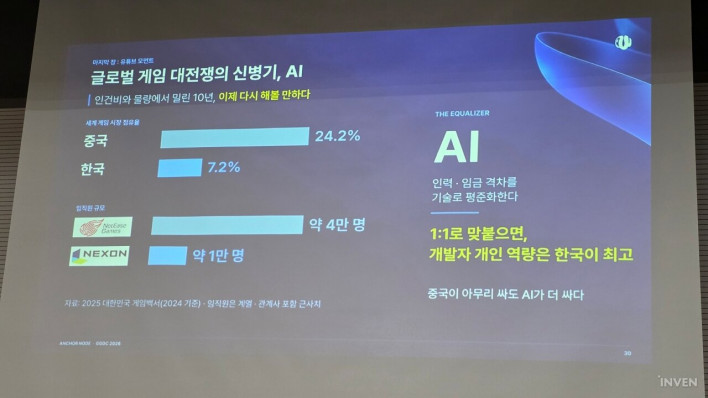
Won expressed regret over how, in his 20s, he worked with pride in Korea being the home of online gaming, only to cede technology and market share to China, while a delayed entrance into smartphones forced developers to pay 30% commission fees and ad costs in ecosystems constructed by Google and Apple. Today, China's scale in both capital and manpower has expanded massively, with its second-largest game company NetEase employing around 40,000 people and single projects routinely deploying 1,000 to 2,000 developers.
However, he emphasized, "No matter how cheap labor in China may be, AI is cheaper," arguing that in a new paradigm where AI erases manpower gaps, Korean developers with strong individual capabilities have a fighting chance once again. Calling the era where diverse titles—previously unbuilt due to financial and technical constraints—pour into the market a "Renaissance" for gaming, he encouraged Korean planners and developers, stating that now is their showtime.
Concluding his keynote, he named the three developers he respects most: Yoichi Erikawa of Koei, Jon Van Caneghem of 'Might and Magic', and Sid Meier of 'Civilization'. Won expressed that his goal is to seize this opportunity, succeed, and personally visit and greet them while they are still with us. He encouraged developers in attendance: "I hope you take on the challenge with the pride that a game you create could become someone's game of a lifetime."
Q&A
Just as YouTube served as the vessel when transitioning from legacy media to new media, existing platforms like Google, Apple, Steam, consoles, and domestic regulatory environments seem limited in housing the wave of AI-based games to come. How do you view new user touchpoints and traffic platforms?
" That is a crucial point. We are accustomed to Google Play and Apple App Store today, but originally, those platforms didn't exist. In the past, if you wanted to play 'KartRider', didn't you search on a portal, visit the official homepage, and download it directly? Companies that built the smartphone ecosystem designed platforms to dominate the market, but that doesn't mean it has to stay that way in the future. Recently, various alternative platforms such as itch.io and ONE Store are loosening restrictions or trying new approaches, so the market itself will grow larger.
An even more important shift is that player game discovery patterns are changing. In the past, people searched for games via search engines or YouTube, but nowadays, they ask AI directly. It has become critical for AI to recommend your game when a user asks, "You know my preferences well, right? What game should I play right now?" As a result, the number of researchers studying 'GEO (Generative Engine Optimization)' tailored to AI recommendation algorithms is growing rapidly.
Recently, when an indie game releases a teaser video or demo with a novel concept and draws high traffic, other developers often immediately clone it and release it first. How should developers respond to this, and what should they prioritize? We'd love to hear your thoughts.
" Cloning and piracy issues have existed since the packaged software era. I once heard directly from a developer that while official sales were 15,000 copies, releasing a patch update resulted in 300,000 downloads. The solution the industry found back then was 'online migration'—moving key data entirely to servers.
The current AI cloning issue is a similar yet newly emerging challenge. Since developers ultimately need to protect their revenue, the industry will find technical and structural solutions, likely evolving toward handling core logic and data on the server side rather than passing everything to the client. However, just as one shouldn't refrain from making sauce for fear of maggots, developers cannot hesitate to develop out of fear of cloning. A game must first gain market attention and blow up before any subsequent problems even arise.
While I agree that AI making game development easier will bring a 'Renaissance,' an explosion in game supply might turn the market into an extremely competitive red ocean. What competitive edge should developers hold in such a situation?
" Twenty years ago in my 20s, a developer who earned 2 billion won and retired seemed to have it all. Then, in the early days of the smartphone market, that threshold rose to 10 billion won, and by the late mobile era, we heard stories of developers making 100 billion won. Now, KRAFTON generates 4 trillion won in annual revenue from a single game, 'PUBG: BATTLEGROUNDS'. As the global market accumulated scale, expected returns from success became incomparably massive, but conversely, the probability of walking through that door has dropped, and the gap has widened further. Whenever I attend events hosted alongside related organizations, I constantly request that these institutions contribute significantly to the ecosystem to help bridge this probability gap.
What I really want to tell developers is that the mobile era convention of quickly cloning someone else's hit game and launching it within a month no longer works. Nowadays, anyone can clone and build something not in a month, but in a single day. Following someone else's success formula is not the way. You must strictly focus on 'your own work.' You don't even need to aim for a mega-hit like everyone else. If you quietly generate revenue in a niche domain you know best and can definitively satisfy, gathering just 10,000 or 100,000 dedicated fans who love your work, the reward is more than enough. As expressed earlier regarding the flood of similar clones, building something entirely original and targeting a clear audience of 100,000 players is, I believe, the right direction for this era.