Date & Time: November 10, 2026 (Tue) 17:00
Attendees: Patrick Söderlund (Chairman), Jung-Hun Lee (CEO), Shiro Uemura (CFO)
Agenda: Nexon Q3 2026 Financial Results, Future Strategy
■ Nexon Q3 2026 Financial Results & Executive Summary
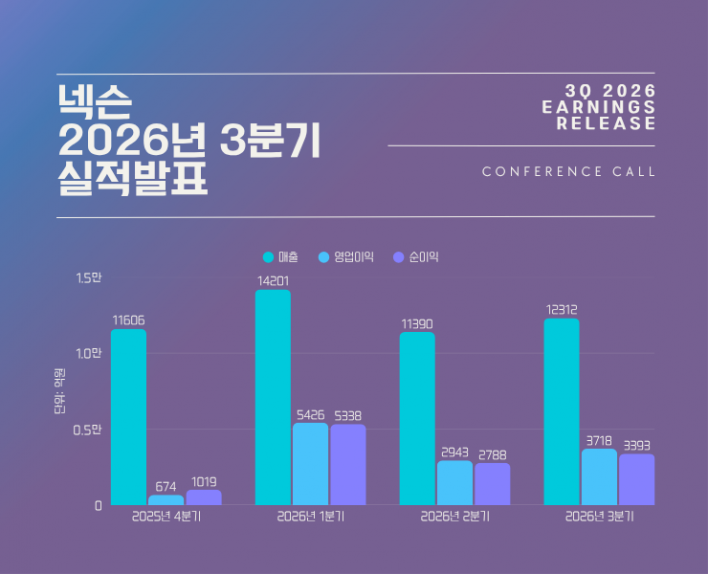
▣ Q3 2026 Earnings Summary (FX Rate: JPY 11.24 per KRW 100)
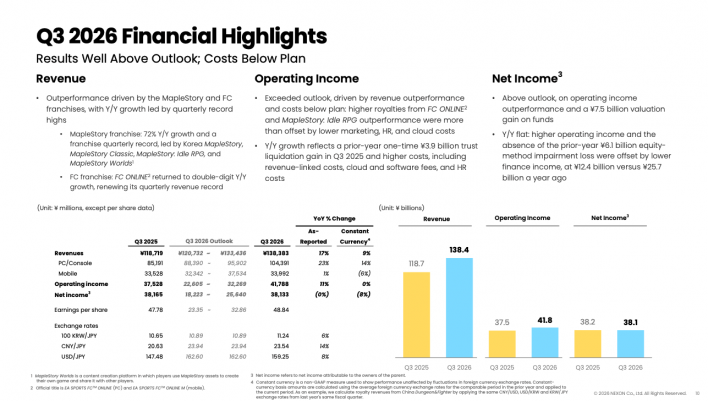
- Q3 2026 revenue of 1.1231 trillion won (+17% YoY, +14% QoQ)
- 'MapleStory' franchise revenue increased by 72% YoY, setting an all-time quarterly record
- Domestic PC 'MapleStory' revenue rose 19%, while PC MapleStory revenue in China grew nearly 4-fold thanks to the success of 'MapleStory Classic' in China
- Continued growth of 'MapleStory Worlds' and revenue contribution from 'MapleStory: Idle RPG'
- 'FC' franchise posted double-digit YoY growth, with 'FC Online' breaking its all-time quarterly revenue record
- Steady earnings contribution from 'ARC Raiders', with global cumulative sales surpassing 17 million copies
- Conversely, 'Dungeon & Fighter' franchise revenue declined 33% YoY, while domestic revenue for 'Mabinogi Mobile' also fell YoY
- Regional revenue increased in Korea (+17%), North America/Europe (+41%), and Other Regions (+77%), while decreasing in China (-7%) and Japan (-13%)
- Q3 2026 operating income of 371.8 billion won (+12% YoY, +34% QoQ)
- Exceeded company guidance due to higher-than-expected revenues from the 'MapleStory' and 'FC' franchises, as well as cost reductions in marketing, labor, and cloud infrastructure
- Royalty costs increased alongside revenue growth in 'FC Online' and 'MapleStory: Idle RPG'
- Payment processing fees and creator fees increased in connection with 'MapleStory: Idle RPG' and 'MapleStory Worlds'
- Marketing expenses rose due to user acquisition campaigns for 'MapleStory: Idle RPG' and promotions for 'ARC Raiders' and 'Mabinogi Mobile'
- Labor costs increased YoY due to one-off stock option adjustments related to a special dividend and headcount growth
- Cloud and software service costs also increased, though actual expenditures came in below original projections
- Q3 2026 net income of 339.3 billion won (flat YoY, +29% QoQ)
- Net income also beat guidance as operating income exceeded outlook and a JPY 7.5 billion gain on fund valuation was recognized
- An impairment loss of JPY 6.1 billion on equity-method investments incurred in Q3 2025 did not recur this year
- However, finance income decreased from JPY 25.7 billion YoY to JPY 12.4 billion, keeping net income at a similar level to the prior-year period
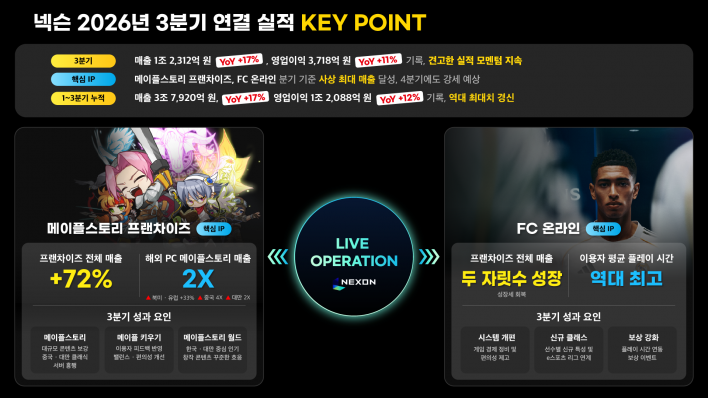
▣ YTD 2026 Cumulative Results (FX Rate: KRW 921.1 per JPY 100, Q1–Q3 average)
- Cumulative revenue: 3.792 trillion won (+17% YoY)
- Cumulative operating income: 1.2088 trillion won (+12% YoY)
- Cumulative net income: 1.1513 trillion won (+54% YoY)
- Set all-time high records for cumulative Q1–Q3 revenue, operating income, and net income
- Growth of the 'MapleStory' franchise and the global success of 'ARC Raiders' contributed to the record cumulative performance
▣ Q4 2026 Financial Outlook (Expected FX Rate: KRW 846.7 per JPY 100)
- Expected revenue: 912.2 billion won to 1.0067 trillion won (-13% to -4% YoY)
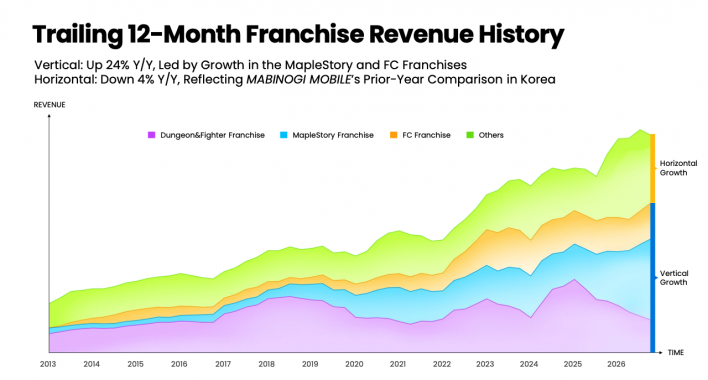
- The 'MapleStory' franchise is projected to grow ~70% YoY, while the 'FC' franchise is expected to sustain double-digit growth
- Reflects declining revenue in the 'Dungeon & Fighter' franchise and high base effect following the launch of 'ARC Raiders' in Q4 2025
- Revenue contributions expected from the Japanese service of 'Mabinogi Mobile' and new titles launching in November
- Expected operating income: 34 billion won to 99.1 billion won
- Labor costs, marketing expenses, and payment processing fees expected to decrease YoY
- Royalty costs expected to expand due to revenue growth from the 'FC' franchise and new publishing titles
- Cloud/software service costs and 'MapleStory Worlds' creator fees expected to increase
- Expected net income: 39.4 billion won to 89.9 billion won
- Expected to decrease YoY due to a high base effect from JPY 16.6 billion in FX and marketable security valuation gains recognized in Q4 2025
▣ Upcoming Title Lineup
- 'Mabinogi Mobile' launched service in Japan last October
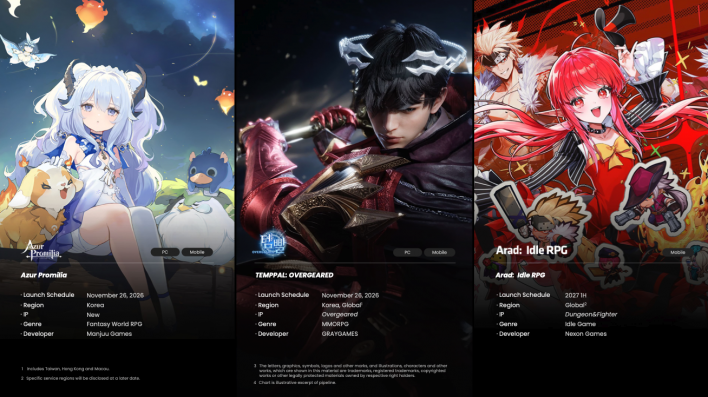
- 'Overgeared' scheduled to release on November 26 in South Korea, Taiwan, Hong Kong, Macao, and other regions
- PC/Mobile MMORPG developed by Gray Games
- 'Azur Promilia' scheduled to release in South Korea on November 26
- PC/Mobile fantasy world RPG developed by Manjuu Games
- 'Dungeon & Fighter: Idle RPG' launch postponed to H1 2027 to polish the game and enhance user experience
- Mobile idle game under development by Nexon Games, representing the first step in expanding the 'Dungeon & Fighter' franchise
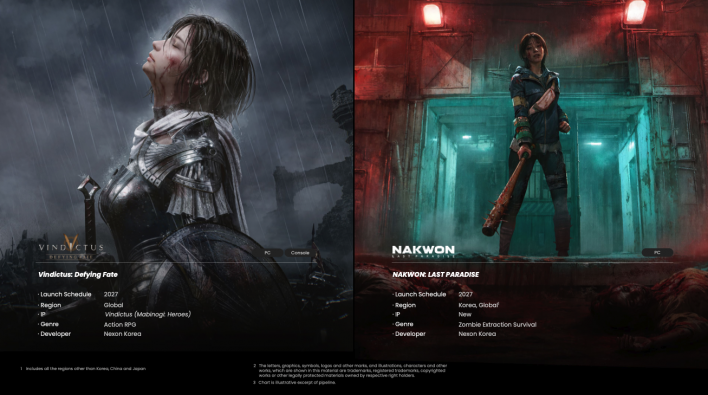
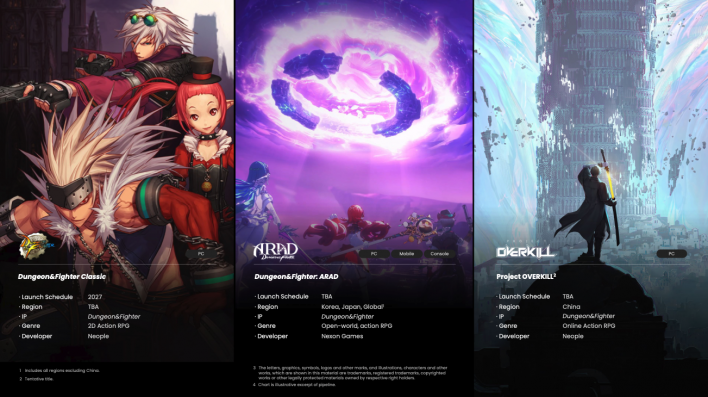
- Plans to release 'Dungeon & Fighter Classic', 'Vindictus: Defying Fate', and 'NAKWON: LAST PARADISE' in 2027
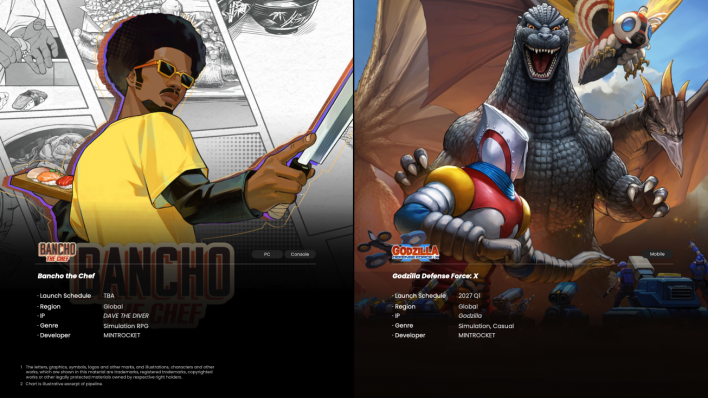
- Mintrocket's 'Godzilla Defense Force X' scheduled for Q1 2027 release
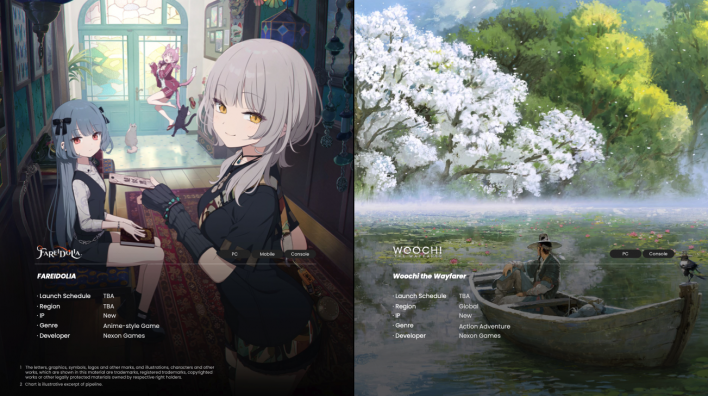
- 'Dungeon & Fighter: Arad', 'Project Overkill', 'Pareidolia', and 'Woochi the Wayfarer' currently in development
- Specific release schedules for these titles will be disclosed at a later date
▣ Development & Cost Efficiency Strategy
- Established performance milestones for new projects and introduced a stage-gate development approval process
- Cancelled 6 existing projects to concentrate development resources on projects with high commercial viability
- Reallocated budget and development staff from cancelled projects to initiatives with higher commercial growth potential
- Maintained overall headcount at a level similar to the prior-year period, managing it below initial projections
- Accelerating the adoption of AI technology while retaining human developers for core creative decision-making
■ Q&A Session
Q. The underperformance of the Dungeon & Fighter franchise is prolonging. We'd like to know if existing users are leaving due to aging game content or if there are other causes. In the past, Nexon successfully staged rebounds whenever earnings declined, but recently recovery seems challenging. What is management's assessment of the current situation and what are your future counter-strategies?
CEO Jung-Hun Lee: Let me first address the Dungeon & Fighter franchise. For PC Dungeon & Fighter, we were aiming for a rebound through large-scale season updates and ongoing live operations, but because the season launched in April failed to resonate well with players, weakness has persisted. Right now, we are pouring all our efforts into the next season update scheduled for early next year.
As for mobile, even though content updates have been rolling out at a much faster pace since transferring a portion of development tasks to Tencent, those efforts have not yet directly translated into financial results.
To address the severity of this recent situation, top executives from both Tencent and Nexon, alongside all key organizations connected to the franchise, convened for an in-depth workshop. During this meeting, we discussed the long-term live service direction for PC and mobile Dungeon & Fighter in China.
The most significant outcome was establishing structural changes and concrete action plans to optimize live operations. Previously, the structure relied heavily on one or two major updates per year, but going forward, we plan to expand overall content output and incrementally increase the volume of content provided to players starting next year.
Additionally, we will improve user community management policies and change how the development team communicates with players. We expect to present the specific details of these changes at the Dungeon & Fighter player event held in China on November 20.
Most importantly, both Nexon and Tencent agree that Dungeon & Fighter is such a differentiated brand in the Chinese market that it is considered a distinct genre of its own. We believe there are currently no competitors in the market that match the action RPG gameplay that Dungeon & Fighter has built. Management from both companies shared the view that over the past several years, numerous competitors attempted to take market share from Dungeon & Fighter without success.
Going forward, we will drive a turnaround for existing PC and mobile live services while simultaneously executing our franchise expansion strategy. We plan to broaden the IP's value through various titles, including Dungeon & Fighter Classic—which aims for a Chinese release next year—and the new title Project Overkill unveiled for the first time during this earnings call.
Q. A large number of new titles are scheduled to launch in 2027. Which title does the company view as having the greatest potential for commercial success? In particular, do you expect the new Dungeon & Fighter titles launching in China to lead an earnings turnaround for the franchise?
CEO Jung-Hun Lee: First, I would like to emphasize that our 2027 new launch lineup is built to be much broader and more diverse than in 2026.
We are preparing titles such as NAKWON: LAST PARADISE, an all-new IP; Vindictus: Defying Fate, which expands the Mabinogi Heroes IP; and Dungeon & Fighter: Idle RPG and Dungeon & Fighter Classic utilizing the Dungeon & Fighter IP.
On top of this, we plan to expand service for MapleStory: Idle RPG into new regions. It will be a year where existing IP expansion and new IP launches occur simultaneously.
We expect this to be a year where these diverse strategies and new titles translate into tangible results. We look forward to introducing these projects in development to players and hope you follow them with great interest.
Q. The MapleStory franchise continues to deliver strong results. Do you expect this growth momentum to carry into 2027? With additional growth expected in Q4 from collaboration content, does the franchise have room to further expand player engagement next year, or do you expect growth to stabilize while contributions from other franchises increase?
CEO Jung-Hun Lee: First, we hope investors take note of the achievements across various MapleStory franchise initiatives in our Q3 results. In particular, MapleStory Classic performed significantly better than internal projections.
To state the conclusion first, we expect the growth momentum seen in H2 this year—centered on MapleStory Classic and MapleStory Worlds—to continue solidly into 2027.
Let me address each business pillar within the franchise. First, for live PC MapleStory, we are preparing plans to consistently deliver high-quality content updates, just as we did this year, to maintain stable user engagement.
MapleStory Classic is also in its early stages, having launched recently in China, Taiwan, and Western markets. Given the positive reception so far, we plan to aggressively expand content supply to sustain initial hit momentum.
MapleStory Worlds is a user-generated content (UGC) platform where players create their own content. The most critical task currently is to solidify its service foundation. We recently hosted a global developer competition and are planning a domestic open beta for MapleStory Worlds 2.0, which will feature webtoon creation capabilities.
Lastly, for MapleStory: Idle RPG, we are managing user retention stably following its domestic launch while preparing to expand service into additional regions.
At this point, we have no new MapleStory titles planned for reveal in 2027. However, as existing franchise initiatives continue to perform well, we expect to sustain solid growth next year comparable to this year's.
Q. We understand Nexon is actively expanding its use of AI. Applying contextual capital accumulated over nearly 30 years to live services and broadening AI across various games is expected to incur costs. On the other hand, it could boost revenue and improve retention. How do you evaluate the cost and revenue impact of AI adoption? Do you expect tangible revenue contributions within 1–2 years, or should we look at a 3–5 year medium-to-long term horizon?
Chairman Patrick Söderlund: As many other companies are likely experiencing similar shifts, it is clear that AI and new tools are bringing substantial efficiency improvements.
When applying AI, Nexon focuses on repetitive tasks within the game development process. Offloading these tasks to AI allows developers to concentrate on more creative work. Furthermore, it enables us to validate bold, new ideas faster and more cost-effectively.
However, the actual end products inside games remain human creations, because the games industry is fundamentally creative at its core.
We are already seeing concrete results in live service titles. For instance, using AI to convert designer-created artwork into pixel art accelerated production speed by more than tenfold. This allows us to produce far more art assets needed for games like MapleStory and Dungeon & Fighter.
We are also leveraging AI for hyper-localization tailored to regional cultures and player characteristics. This enables us to execute localization work several times faster than before while maintaining the required quality for local cultures.
Of course, utilizing and refining AI also incurs costs. Therefore, we approach related investments carefully and incrementally, deciding on larger-scale investments after evaluating results at each stage.
Our goal is not to make games with fewer people using AI. Our goal is to make better games with our current development headcount.
Q. What were the reasons behind Q3 marketing expenses coming in lower than originally planned? We understand marketing and promotion expenses will be expanded in Q4. What criteria will be applied when determining actual spending scale?
CFO Shiro Uemura: Our Q3 marketing budget was planned primarily around new releases. While marketing for existing IP is necessary, we fundamentally allocate a higher proportion to new titles.
When conducting marketing, our goal is to execute in as efficient and effective a manner as possible.
However, in Q3, schedules for some planned marketing activities were pushed back. This was the main reason marketing expenses were lower than originally budgeted.
Consequently, we plan to pursue marketing and promotional activities that were not carried out in Q3 more aggressively in Q4.
Q. Concurrent players for ARC Raiders spiked as returning users surged after the 'Frozen Trail' update, but then declined rapidly again. Looking at the Q4 forecast, it seems you anticipate certain limits in acquiring new users. Going forward, do you plan to focus more on boosting existing user engagement and revenue rather than expanding the player base?
Chairman Patrick Söderlund: Looking at our experience and comprehensive data from competing titles in similar genres and business models, we believe two high-quality, large-scale updates per year is the appropriate cadence to retain core players while driving new sales.
First, we believe the 'Frozen Trail' update has performed well in line with our expectations so far.
Following the update in October, we received strong player feedback, and since then, in-game activity and sales have gradually normalized.
Going forward, we plan to continuously grow our player community through various events and promotions.
As mentioned earlier, we maintain our policy of providing at least two major content updates per year for ARC Raiders, and we will continue executing on that.
Q. To clarify further, to grow revenue for ARC Raiders moving forward, will you focus more on acquiring new paying users or on driving additional monetization from existing players?
Chairman Patrick Söderlund: Because ARC Raiders is a buy-to-play title, all active players currently playing the game are already paying users who purchased it.
Naturally, we plan to pursue both directions. We need to incentivize new users to purchase the game while continually giving existing players compelling reasons to keep playing.
Additionally, we believe it is important to enable existing users to make ongoing purchases of various in-game items. We will pursue acquiring new users, retaining existing players, and encouraging additional in-game purchases in tandem.
Q. MapleStory Classic contributed significantly to this quarter's earnings. Does management view this as a new business pillar capable of generating sustainable revenue beyond 2027, or do you assess it as a temporary nostalgia effect? How do you plan to manage update cadences between live MapleStory and Classic, and how will you address user overlap or cannibalization while growing both services simultaneously?
CEO Jung-Hun Lee: As mentioned earlier, MapleStory Classic received a far stronger reception in Taiwan, China, and Western markets than our original internal expectations and projections.
In particular, performance in Taiwan and China was a major driver behind our strong Q3 results. In those markets, we saw instances where player influx reached up to 9 times that of existing live services. Furthermore, cannibalization between Classic and the existing live service was very minimal.
In Q4, we are fully expanding service across Western markets, where initial local reception has also been positive. We are focusing on enhancing Classic content updates and maintaining player engagement to sustain this initial hit momentum.
Lastly, I want to explain how Nexon views the 'Classic Playbook' company-wide, beyond just MapleStory Classic.
As you know, Nexon possesses numerous PC online games—such as Dungeon & Fighter, MapleStory, and Mabinogi—that have maintained live operations for over 20 years. These games continue to run successful live services today.
From the perspective of a company holding multiple long-standing IPs, we view the Classic Playbook as a highly useful strategy that can be deployed in diverse ways.
Over the past 20-plus years, countless players created accounts and played these titles. Every player treasures a different era and experience in their memory.
Therefore, Nexon does not pursue a one-size-fits-all approach to Classic services across all games. We plan to strategically adapt and leverage the Classic Playbook based on the unique characteristics of each IP and player experience, and we already have relevant blueprints in place.
Q. Please walk us through the Q4 expense structure compared to the previous quarter based on your outlook. While revenue is projected to decrease by approximately JPY 20–30 billion compared to Q3, total expenses combining cost of sales and SG&A appear to increase by about JPY 10.5 billion. What is driving the expense increase despite declining revenue? Is it due to labor or other costs, and could you detail the specific cost drivers?
CFO Shiro Uemura: Quarterly expenses can fluctuate based on revenue scale and mix.
Comparing Q3 to Q4, the single largest driver of increased expenses is marketing. As mentioned earlier, schedules for certain marketing activities originally planned for Q3 were delayed, and the corresponding spend will occur in Q4. This is the primary factor.
Another factor is payment processing (PG) fees. Payment processing fees fluctuate depending on revenue trends of individual titles. In particular, if current revenue momentum for FC Online continues, revenue-linked payment processing fees are expected to increase.
CEO Jung-Hun Lee: I would like to add another perspective here. We hope investors pay special attention to how Nexon's revenue mix itself is evolving.
Legacy Dungeon & Fighter in China carries a highly profitable business structure, but revenue from this business is currently projected to decline YoY.
Conversely, services expected to drive Q4 growth—such as the FC franchise, MapleStory: Idle RPG, and MapleStory Worlds—as well as Q4 upcoming releases like Overgeared, Azur Promilia, and Mabinogi Mobile in Japan, have different cost structures than legacy Dungeon & Fighter in China.
These titles and services incur revenue-linked costs, such as royalties and creator fees, based on top-line scale.
Therefore, rather than looking solely at top-line revenue expansion or contraction, we ask that you also evaluate which titles are generating revenue and how the overall revenue mix is shifting.