While others were busy playing review builds of 'The Legend of Zelda: Ocarina of Time', 'Crimson Desert: Charting the Unknown', and another global blockbuster that shall remain unnamed, I was peeling potatoes.
'Potato Please' is a game about peeling potatoes. You hold a single knife in your hand, a bucket sits at your feet, and a mountain of potatoes lies before your eyes. The player takes on the role of a soldier in a military supply depot run by a totalitarian regime. To meet the quota needed to feed the troops at the front line, you must endlessly repeat the loop of peeling, throwing them into water, and submitting your deliveries. As a reward for deliveries, you can request better tools from the supply bureau, and ultimately introduce machinery to automate the process.
The game was released on Steam by Golden Horn Studios on November 4. The regular price is 11,000 won, and it can be purchased for 9,900 won with a 10% launch discount until November 16. Reaching the first ending takes around 5 hours. It supports Korean subtitles and interface. Although it shows signs of machine translation, it does not hinder your understanding of the game. While it can be played with a keyboard and mouse, the control scheme of rotating and peeling potatoes feels better suited for a controller. As of November 10 on Steam, 88% of 1,768 user reviews are positive, earning it a 'Very Positive' rating.
The game faced plagiarism controversy even prior to its release. Polish indie developer Radosław Klasa revealed a game about hand-peeling potatoes titled '1,000,000 Potatoes' on July 25. When the trailer for 'Potato Please' circulated on September 20, Klasa claimed it was an AI-generated clone that copied his concept. Golden Horn Studios countered the following day, stating they had never seen Klasa's game and that their concept originated independently from a potato meme trending in online communities.
Having played it myself, there was to some extent a cookie-cutter impression. However, it was far from a low-quality game hastily thrown together with AI. There is not yet enough evidence to determine which side's claim is true. Should the allegations prove true, this game will remain an example of how much AI can accelerate the release of commercially viable titles. Ultimately, time and polish will separate the wheat from the chaff.
On the surface, peeling potatoes is all there is. Yet after reaching the ending, what comes to mind first is not the potatoes, but the regime that forced you to peel them. Beyond being a simple labor simulator, it is closer to a black comedy that mocks Soviet-style totalitarianism through a mundane task.
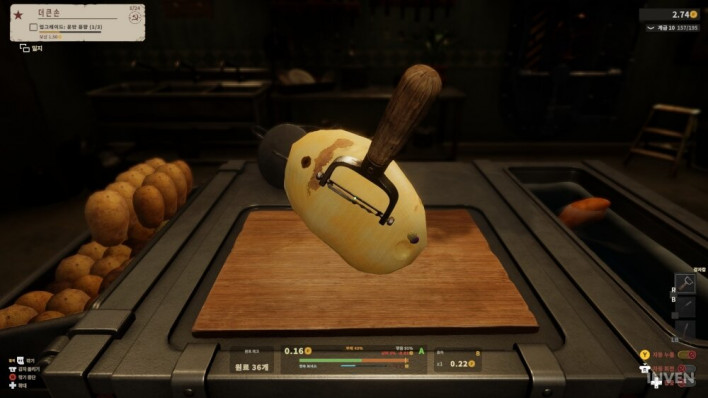
For the first 30 minutes, you hold a potato in one hand, turning it around while bringing the blade against the skin. Each time a thin curl of peel falls off, a small sense of satisfaction builds up. Trimming off bumpy nodules with quick snips and gouging out rotten dark spots with the tip of the knife carries a tactile satisfaction. The physics engine solidly supports this hands-on feedback. I never expected to get this serious in front of a potato skin.
At first, the peeled potatoes looked quite unsightly. But as the number of peeled potatoes grew, I could feel my hands getting used to it. Smoothly peeled yellow potatoes pile straight into the bucket. You feel a sense of accomplishment. Seeing the immediate results is a reward in itself.
However, it is disappointing that the fun of thin peeling stems from tools rather than skill. With the razor blade you start with, no matter how precisely you move, the skin doesn't peel off easily, and occasionally blocky chunks of flesh get sliced off. On the other hand, the Y-shaped peeler acquired during progression strips off thin layers of skin even with clumsy inputs. In short, equipment takes precedence over honed knife skill. Players expecting a tactile mastery curve might feel let down.
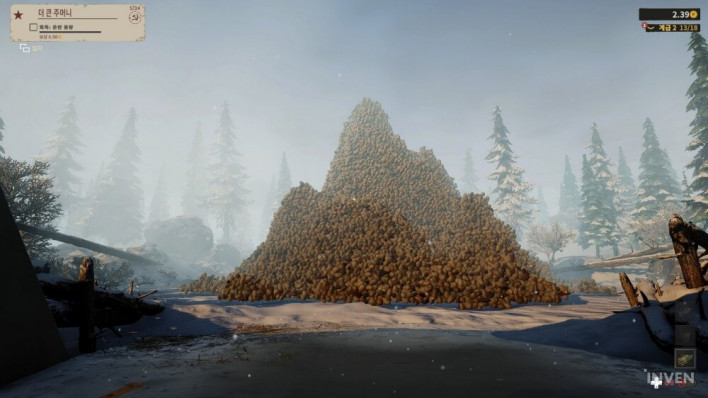
Sacks and handcarts arrive at the workplace where potatoes were once moved from hand to bucket, followed by hand-cranked peelers and eventually automated machinery. The progression curve crawls at the bottom early on, then surges steeply near the end. A workshop spending 5 to 10 seconds per potato suddenly turns into a factory processing dozens per second.
Once automation is complete, you effectively become a 'Potato Commander.' Watching potatoes pour out of the machines, memories of peeling them one by one early on flash like a kaleidoscope. You think to yourself, "So this is what all that hardship was for." But an emptiness sets in as there is no longer any work left for your hands to do. This void feels less like a design flaw and more like an intentional message. The game exposes the remaining void, demonstrating what is left behind after replacing human hands with machines to meet quotas.
If this game had stopped at automating manual labor, it would have remained just an average potato-peeling game. What makes 'Potato Please' meaningful is the human narrative.
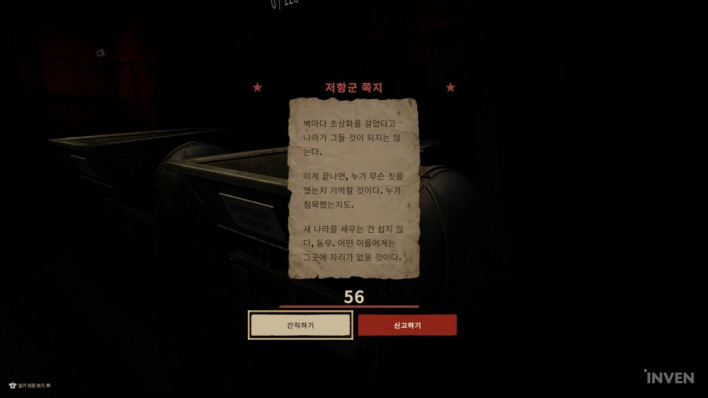
In between peeling potatoes, you exchange letters with your son deployed at the front line, and occasionally discover secret notes hidden inside the potatoes. The letters go beyond trading greetings, demanding moral choices. At times, they plunge the player into dilemmas, leaving them curious about what lies behind the narrative.
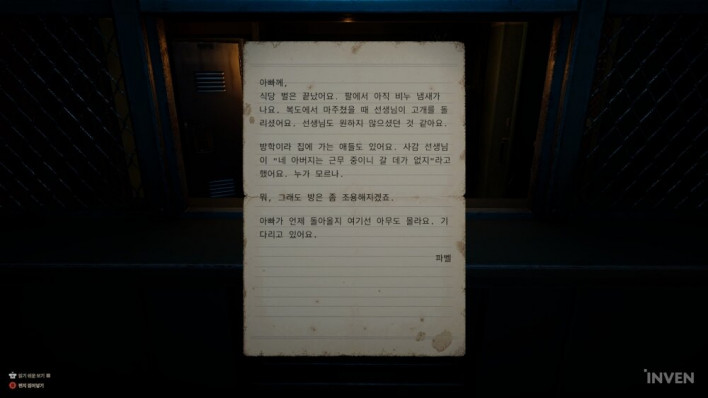
The game's setting is confined to a single management office. It is the human narrative that expands the stage. Just as the film 'The Man from Earth' makes the audience imagine a vastly larger world solely through dialogue in one room, the letters and notes in this game fulfill their role as tools that prompt players to visualize the war and regime outside the factory.
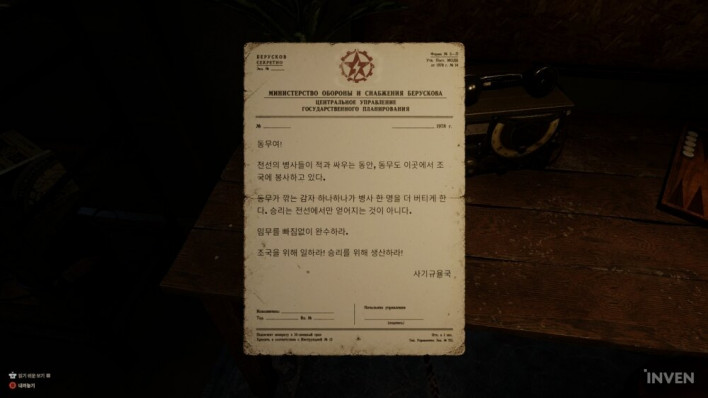
The sense of conforming to the regime is also clear. The Soviet-flavored dystopia is not merely a prop for atmosphere, but a tool for critique. It twists and ridicules the system demanding quotas and loyalty like a black comedy. While it is disappointing that disobedience carries little consequence, it is understandable given the game's scope.
Paradoxically, the coziest moments were when smoking a cigarette. The process of craving a smoke and finding calm in a single puff was surprisingly realistic. The portrayal of looking after a stray dog that visits the depot serves as a reminder of the age-old truth that small acts of kindness eventually return to you. Even so, this game cannot be classified as a cozy healing game. It is closer to a dystopian title that succinctly weaves in auteur vision.
The shortcomings mostly lie in polish. While the tactile sensation of peeling potatoes is captured well, the skin and surface graphics crush into pixelated blocky squares. Even accounting for the limitations of a small indie game, a game centered entirely around potatoes should have polished this aspect further. This stands in contrast to the sound design, which effectively conveys the desolation of a Soviet military unit.
Physics bugs are also frequent. Potato sacks open improperly, spilling potatoes onto the floor, or carts move erratically. It is unclear whether this stems from scale limitations or a lack of polish. Since these bugs are not game-breaking, they feel forgivable considering the roughly 5-hour length and regular price of 11,000 won.
'Potato Please' implements a structure that expands from a single point into a full canvas, using just a single potato. It transforms the mundane task of peeling potatoes into tactile enjoyment, elevates that sensation into the thrill of automation, and ultimately turns it into a mockery of the regime. Players who enjoy watching small growth turn into a massive system will find it worth playing. Spending 5 hours peeling potatoes amid a sea of blockbusters felt surprisingly well spent.
- Tactile physics feedback that even captures gouging out imperfections
- The thrill of progression, from a single knife to a full factory
- A narrative expanded by moral choices
- Peeling satisfaction governed more by tools than skill
- Frequent physics bugs, such as floating potatoes
Reviewed Platform: PC (1.0)