
When discussing a game's popularity, numbers have always served as crucial evidence. In domestic online gaming, PC bang market share was the familiar metric for explaining success, while unit sales served that role for packaged games. Alongside these numbers, which are still used today, Steam's concurrent player count has established its place. When a new game launches, people check its peak CCU, and when player numbers for live-service games rise or fall, they examine the charts. Few data sources reflect player response as rapidly as these continuously updated figures.
Behind this trend lies Steam's expanding scale and influence in the games market. As Inven reported on the 13th, Steam set a new record on the 11th (UTC) with an online concurrent user count of 43,505,724. On that same day, active players in-game reached approximately 14.46 million.
Steam's significance can also be seen in publisher distribution and promotional strategies. Ubisoft announced its return to day-one Steam releases for new titles in 2024, selling 'Assassin's Creed Shadows' on Steam starting on release day last year. According to Valve's 2025 year-end review, developers published 436,592 news posts on Steam, generating 3.13 billion user views. Beyond buying and playing games, the platform has grown into a massive hub for receiving news.
The individual game CCU charts published by such a massive platform serve as convenient clues for gauging success. But if a chart shows 170,000 players, can we take for granted that 170,000 people actually came to play that game?
170,000 Gathered in a Game That Usually Drew Dozens
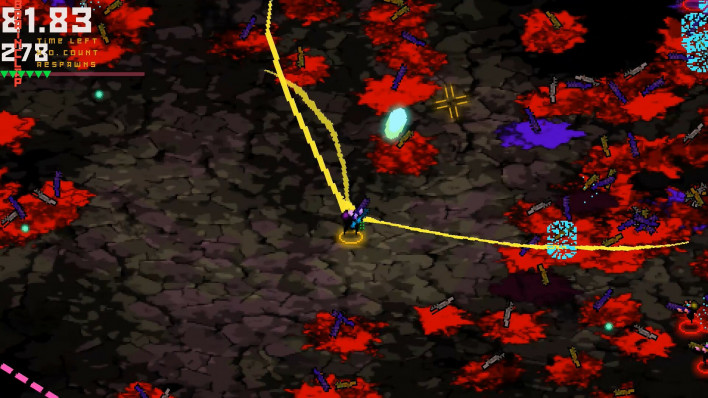
'UBERMOSH:OMEGA' is a single-player top-down shooter released in 2019. According to SteamCharts data, its peak concurrent players reached only 37 in September. However, on the 12th, its peak CCU on SteamDB suddenly spiked to 174,886.
Japanese gaming media outlet AUTOMATON pointed out that the CCU surge coincided with the recent addition of Steam Trading Cards to the game. Highlighting a similar trend in other titles from the same series following the addition of cards, AUTOMATON raised the possibility that automated card-farming bot accounts had flooded in.
Trading Cards drop intermittently as playtime accumulates in supported games, regardless of achievement unlocks. The amount obtainable through play is usually about half of a full set. They can be traded with other users or bought and sold on the Community Market, and completing a set grants badges and profile customization items. Selling cards yields Steam Wallet funds.
Since cards can be sold on the market, an incentive exists to idle games on multiple accounts to farm them. Most of these cards drop simply by accumulating play time. Bot accounts left running in this manner became the primary driver inflating concurrent player counts. The publicly available metrics offer no data to distinguish accounts actually playing the game from those idling merely to collect cards. Consequently, when card farmers mobilize vast numbers of accounts, 'UBERMOSH' suddenly appearing as a top-charting game inevitably looks baffling to observers.
An Issue Valve Knew About: Recurring Surges

Valve explained this problem back in 2017 when altering its system. At the time, some developers were issuing mass game keys to distribute to bot accounts, turning card farming into a profit mechanism. Valve pointed out the risk that bot-generated activity could trick store algorithms into mistaking the title for a game genuinely popular among players.
The solution was changing the system where cards were awarded immediately upon a game's launch. Steam began allowing card drops only after a game built up trust through genuine user purchases and player engagement. Current Steam developer documentation also lists sales and player engagement metrics as criteria for card eligibility, establishing a mechanism to filter out games created solely for card profits.
Yet similar incidents have persisted from then to the present day. In 2018, 'Geneshift' (now 'Skillshot City') saw its CCU surge into the 210,000s during a free giveaway event. In an official announcement, the developer highlighted flaws in Valve's card system, stating that over 200,000 bots were idling the game to collect cards. The developer noted that Reddit promotions did bring in thousands of genuine new players as well. While the campaign succeeded in raising awareness, the figures reflected on the charts were inflated to a far greater scale by card-farming accounts.
An even larger spike occurred in 2021 with 'Capcom Arcade Stadium.' Concurrent players skyrocketed from 18 to over 480,000 in roughly 10 hours. US tech outlet Ars Technica pointed out that trading cards were being awarded to free users as well, identifying card-farming bots as the primary cause.
This July, 'Artifact Classic'—which usually averages between dozens and a few hundred concurrent players—surged to around 10,000 without any noticeable updates or promotional campaigns. Inven reported on suspicions of bot involvement or artificial player inflation at the time. Discrepancies between apparent popularity on CCU charts and actual player engagement continue to surface, even in older games.
Does a Falling CCU Mean a Failed Game?

The opposite scenario unfolds when player counts drop. When Steam CCUs for the global service of 'Lost Ark' plummeted in January 2023, publisher Amazon Games officially explained that it was the direct result of a massive ban wave targeting bot accounts.
Bots in Lost Ark disrupted the in-game economy and user environment as they farmed and sold gold. At the time, operations anticipated that reducing bot numbers would improve market and auction house trading experiences as well as latency in crowded zones. The decline on the charts was a byproduct of purging malicious accounts. Although concurrent player figures for Lost Ark's global service dropped significantly as a result, actual in-game players enjoyed a much smoother experience than before.
Interpreting a CCU decline strictly as player churn and commercial failure leads to misjudging measures meant to create a better playing environment. The reasons behind a drop in numbers are just as important as the reasons behind an increase.
Game structure also impacts CCU metrics. Single-player games completed upon reaching an ending and online games requiring long daily logins can display vastly different chart profiles even with identical player counts. For games with substantial player bases on consoles or other PC launchers, figures outside Steam must also be considered. Ultimately, Steam concurrent player counts cannot serve as an absolute metric.
Beyond Concurrent Players: What Else Should We Look At?
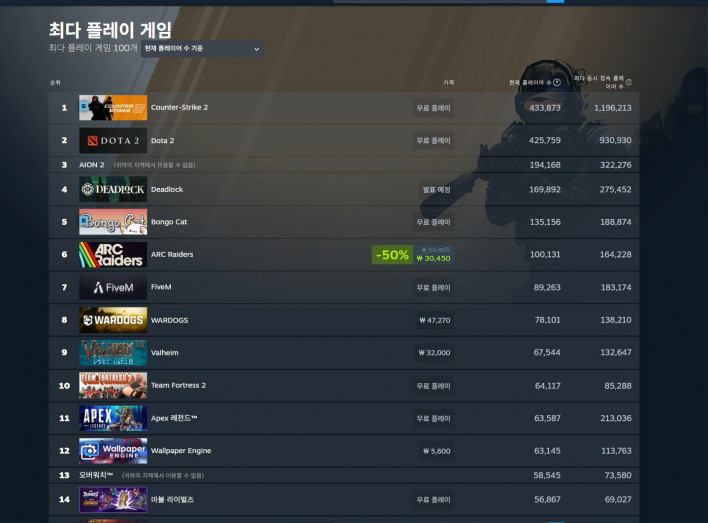
The core issue illustrated by these cases is clear. Fluctuation in automated accounts alone can dramatically swing CCU charts. To interpret those figures as commercial success, corroborating evidence regarding actual purchases and gameplay must accompany them.
First, post-peak concurrency trends warrant close attention: observing whether activity continues days or weeks later, and how many players remain after updates or promotional sales end. While UBERMOSH reached concurrency in the 170,000s on the 12th, SteamCharts recorded figures dropping back down to the thousands the following day. Evaluating a title solely by its peak overlooks this crucial factor of player retention.
To evaluate commercial performance, unit sales and revenue must be checked alongside concurrency. Sales milestones disclosed by developers or Steam's weekly top sellers rankings serve as key evidence. Steam's 'Top Sellers' chart reflects not only base game sales, but also DLC and in-game microtransactions. If revenue gains coincide with player surges, it provides context showing genuine spending demand existed.
The true picture of engagement emerges from reading detailed player experiences across reviews and community forums—examining whether players are sharing strategies for new content, which combat mechanics or systems they find engaging, or what causes them to drop the game. These responses explain why players stick around or leave, while giving readers evaluating a game valuable information to judge if it fits their preferences.
Player trends demonstrate retention, unit sales and revenue demonstrate commercial success, and detailed user reviews reveal why players engage. When diverse data points point in the same direction, the conclusion of commercial success carries weight. While concurrent player counts offer a highly intuitive and accessible metric, relying on player counts alone to judge a game's popularity is unequivocally relying on an incomplete metric.