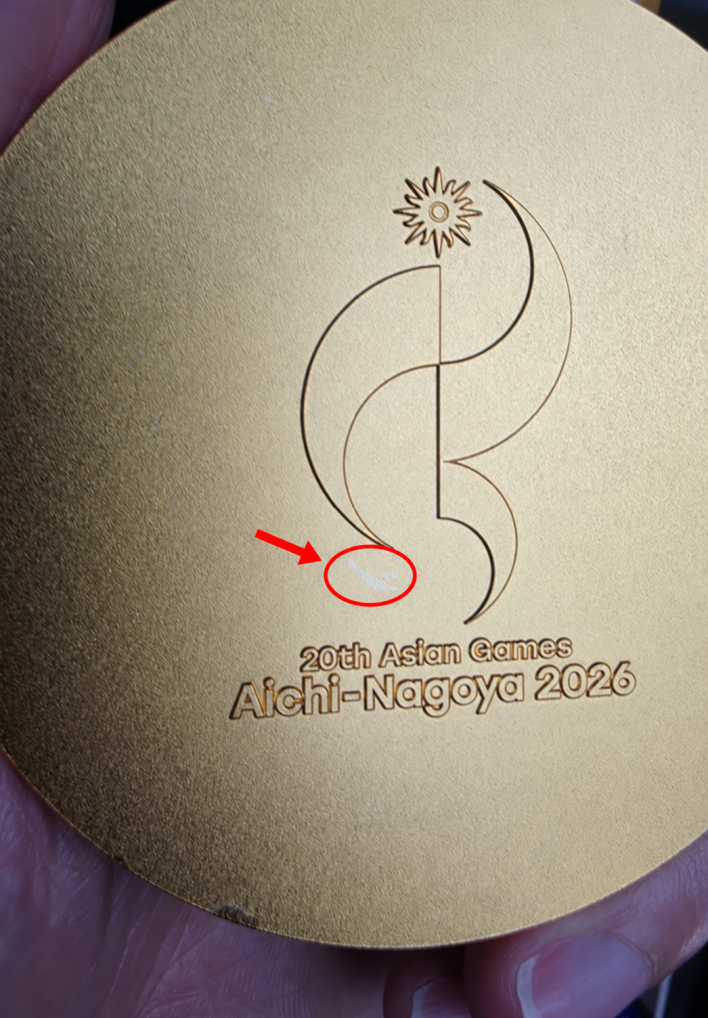
Only one gold medal was reported to have actually been replaced due to a defect at the 2026 Aichi-Nagoya Asian Games. However, it was not the only medal exhibiting unusual marks. An investigation by Inven revealed that white marks suspected to be discoloration or surface damage were also found on the esports gold medals received by the South Korean delegation.
China's Xinhua News Agency reported on September 25 that an esports gold medalist noticed discoloration along the edge of their medal and requested a replacement from the organizing committee. After checking the athlete's departure schedule and accommodations, the organizing committee dispatched staff to the lodging to replace it with a new medal that night. As of September 25, the committee stated this was the only instance of a defect replacement.
Inven subsequently obtained photos of the medal received by a South Korean esports gold medalist. The photos show irregular white marks distinct from the surrounding gold surface, located between the tournament emblem and the English event name.
The player interviewed stated, "The medal we received also had something on the back that looked like peeling white paint." They added that similar marks were present on the medals of all fellow teammates who received gold.
After reporting the issue to the Korea e-Sports Association (KeSPA), the athlete was asked to provide several photos to verify the medal's condition. KeSPA stated, "We have inquired about the replacement procedure with the Asian Games Organizing Committee through the Korean Sport & Olympic Committee (KSOC), and are currently awaiting confirmation."
The problem is that the organizing committee stated that only a single medal had been replaced due to defects as of September 25, leading Japanese sports outlet RONSPO to praise this as proof of the Japan Mint's craftsmanship and medal quality. RONSPO commended the fact that there was only one replacement out of approximately 7,000 medals to be used in the games, as well as the committee's swift response.
However, with Inven's investigation confirming similar marks on South Korean athletes' gold medals, criticisms that praising "only one defective medal" was premature are difficult to avoid. The single case cited by the organizing committee was merely an instance where an athlete raised the issue directly and received a replacement, not the result of a comprehensive inspection of all awarded medals.
The exact cause of the white marks on the South Korean medals has not yet been confirmed. The organizing committee has also not issued an official determination on the defects. However, since additional abnormal marks were discovered on medals that underwent double inspection by both the manufacturer and the organizing committee, there is a need for a comprehensive check on the condition of all awarded medals beyond individual replacements.
Since its opening, the 2026 Aichi-Nagoya Asian Games has sparked multiple controversies over poor operational management regarding meals, accommodations, and athlete transport. With marks similar to the allegedly single defective medal now confirmed on South Korean athletes' gold medals, criticism regarding the overall preparation and management of the Games will be difficult to avoid.