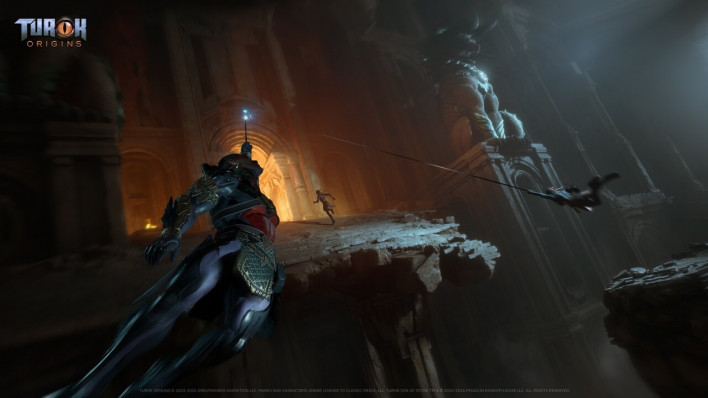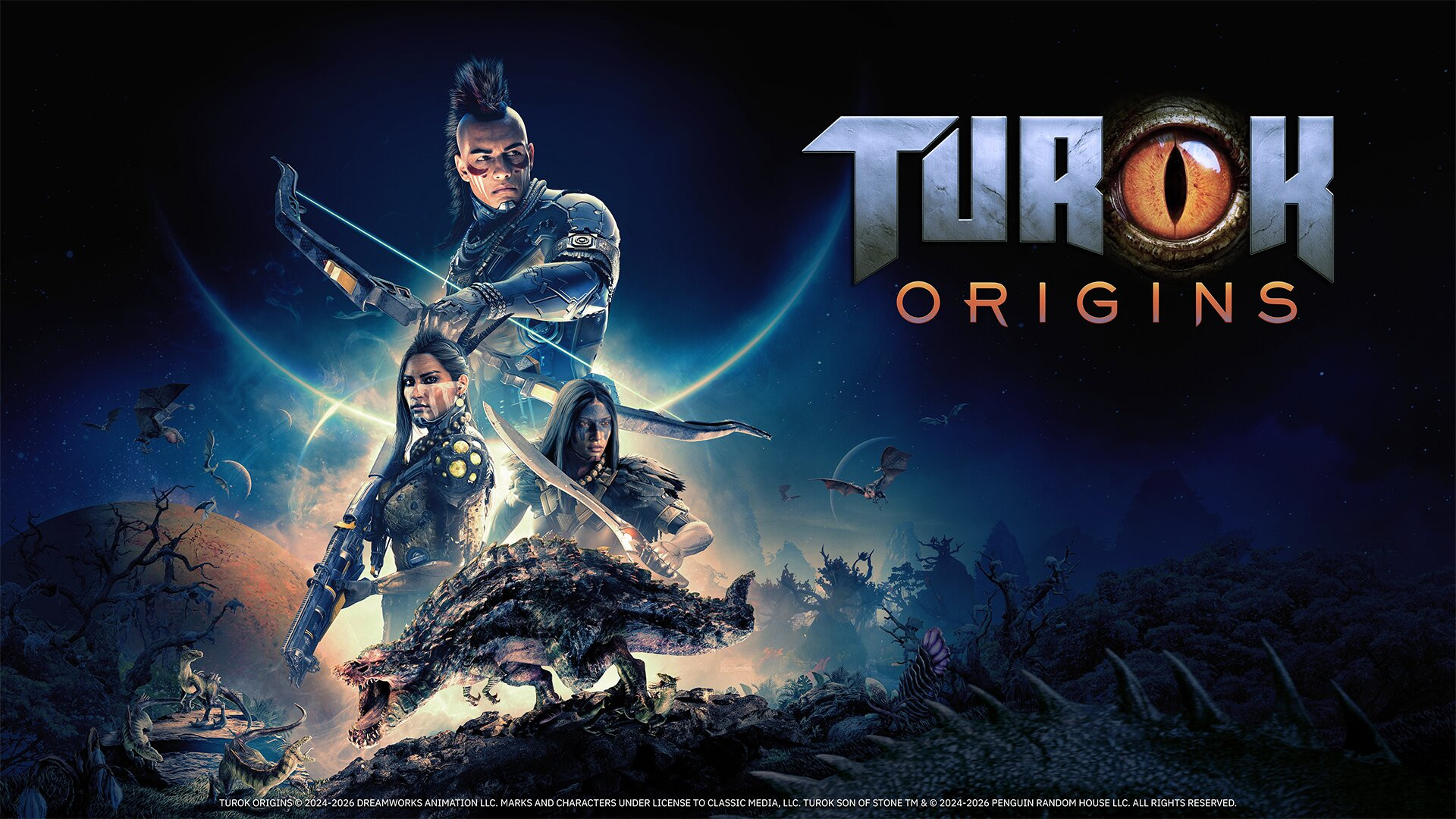
To 1990s FPS fans, 'Turok' is remembered as a unique title that blended dinosaurs, aliens, over-the-top weaponry, and a sci-fi universe. Now, after a long hiatus, the dormant series returns with 'Turok: Origins' at the hands of Saber Interactive.
This game doesn't just revive the 'Turok' of the past with modern graphics. It goes back in time to explore the origin of the name 'Turok' and the past of the Lost Lands, featuring shooting action with seamless switching between first-person and third-person perspectives. While it can be played solo from start to finish, it also supports co-op play for up to three players choosing different classes.
In particular, the development team repeatedly emphasized that 'Turok: Origins' is not a live service game or a looter shooter, but a premium game delivering a complete, campaign-focused experience. On-site at TGS 2026, we met with Saber Interactive Game Director Jesús Iglesias to discuss what was inherited from the classic 'Turok', the reasoning behind supporting both first- and third-person views, the co-op system, and their approach to Native American culture.
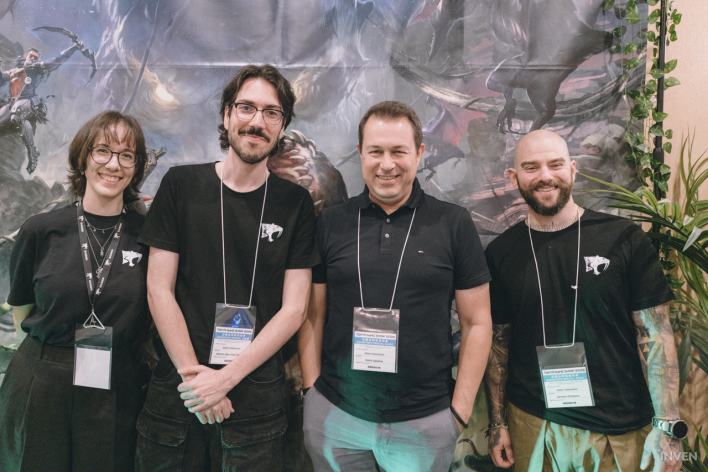
First, please introduce Saber Interactive and the 'Turok: Origins' development team. We're also curious about what motivated you to bring back the 'Turok' IP after all this time.
Jesús = Saber Interactive is a large company with over 3,000 employees, and among them, our Madrid studio is leading the development of 'Turok: Origins'.
Saber has worked on adapting many existing IPs into games. We believe that respecting and handling IP faithfully is our strong suit, and rightsholders trust us for that.
This time, 'Turok' was proposed to us during discussions with Universal Studios. We already had a relationship through other projects, and when we reviewed the 'Turok' IP, we felt it still had tremendous potential. Elements like dinosaurs, aliens, and time-and-space-spanning lore remain exciting even if brought back today.
What elements from the classic 'Turok' series did you feel were absolute must-haves to preserve in this game?
Jesús = The most important elements are Native American culture and dinosaurs. Dinosaurs in particular are the first thing people think of when they hear the name 'Turok', aren't they?
On top of that, we're carrying over over-the-top, powerful weapons, space-and-time-bending settings, the Lost Lands, and many other characteristics fans remember from the original games.
This game features fairly futuristic gear and sci-fi elements. How does it connect with past entries in the series?
Jesús = Actually, futuristic weapons and sci-fi elements aren't new to 'Turok'. Very futuristic weapons have appeared ever since the first game.
What we did this time was go back much further into the past than even the very first game. We wanted to explain how various lore elements from existing titles connect and make the entire universe tie together more naturally.
An important point here is that 'Turok' isn't the name of a specific individual. The protagonist of the first game was Tal'Set, and 'Turok' refers to the warriors who protect the Lost Lands.
In this title, we explore that past and those origins. However, exactly how it connects to past games is a key part of the narrative, so we hope you check that out by playing the game yourself.
When playing hands-on, the structure almost felt like a looter shooter. Could you tell us more about the gameplay loop?
Jesús = It's not a looter shooter. Nor is it a live-service game. 'Turok: Origins' is a premium title. Everything you obtain in the game serves to advance and complete the campaign.
While there are plenty of secret elements and progression systems, it wasn't built to keep players hooked for years. Once you buy the game, you can enjoy the included content and complete the campaign.
How deep are the progression and character development systems?
Jesús = The weapon progression system is quite extensive. Around 250 mods are prepared, and it's not just about changing stats like increasing attack power by 10% or range by 10%. A fully upgraded weapon can function very differently compared to its initial state.
This will be a fun aspect for co-op play as well. Even if you and a friend use the exact same weapon, if you upgrade them in different directions, they can function in completely different ways in practice.
The game features three classes. Could you tell us more about the characteristics of each class?
Jesús = First of all, 'Turok: Origins' was designed from the ground up so it can be played entirely solo.
When playing single-player, you aren't forced to travel with AI bots either. Just like classic 'Turok', a player can pick their preferred class and finish the campaign solo from start to finish. On the flip side, if you play with one or two friends, you can capitalize on the synergies between different classes.
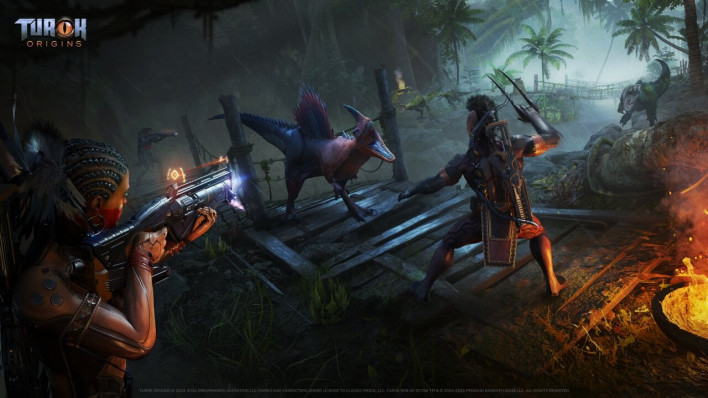
To introduce the classes: one is close to a tank role, another specializes in weaponry, and the third focuses on special abilities that utilize DNA harvested from enemies.
No specific class is mandatory when playing solo, but in co-op, combining different roles allows you to deal with enemies more efficiently.

During the demo, the seamless, anytime switching between first-person and third-person views was impressive. What led to the decision to support both perspectives?
Jesús = We feel this is a unique aspect and a major strength of our game. Rather than making a third-person game first and then simply moving the camera in front of the character to create first-person, we built completely separate development pipelines for first-person and third-person views.
Naturally, the hardest part was ensuring that switching between the two perspectives—crafted through different approaches—felt seamless without altering gameplay balance. As you experienced during the demo, changing perspectives mid-game flows smoothly with almost no sense of disruption.
What was the reasoning behind committing to support both perspectives even if it meant running separate pipelines?
Jesús = Because everyone enjoys shooters differently. Some prefer first-person, while others prefer third-person. We started with the idea: why not let your friend play in third-person while you play in first-person?
We wanted players sharing the same game to play in whichever way they like best. Recent gamer research data also played a big role—around 70% of modern shooter players prefer third-person over first-person play. That's why we wanted to offer players as much choice as possible.
When starting the game, players can choose from various character appearances. Is there any performance difference based on appearance? Also, are there plans to add character customization options?
Jesús = It is purely cosmetic; performance differences are determined during the class selection step after choosing your appearance.
Also, we currently have no plans to add detailed facial or cosmetic character customization features. However, you can unlock various elements as you progress through the game. To emphasize again, this isn't a live-service scheme designed to sell cosmetics separately—it's content unlockable through the base game's progression.

You mentioned that Native American culture plays a very important role in the game. Was there anything specific you paid extra attention to when expressing it?
Jesús = This was something we took extremely seriously.
Elements influenced by Native American culture, such as feathers and face paint, appear in the game, so we hired and worked directly with Native American cultural consultants. We went through a thorough review process for every detail to ensure that representations weren't used incorrectly or offensively.
Because we were dealing with cultural elements, we refrained from making arbitrary assumptions and made sure to consult thoroughly before implementing them into the game.
The suit and abilities used in the game also seem to highlight the connection to Native American culture and nature.
Jesús = That's correct. In Native American culture, spiritual connection with nature is a core element, and there are many myths tied to animals. That's why we used animals like the Raven, Cougar, and Bison to define each class identity.
The suits in the game are also designed around absorbing traits from DNA harvested from nature. You can think of it as extracting the spiritual essence of nature, injecting it into a bio-suit, and using it to generate new abilities.
And this game takes place much earlier in time than previous 'Turok' titles. In this era, that strong bond with nature still exists, but as time passes into the era of the classic games, that connection fades, leaving only traces of the past behind—a detail we built into the narrative.
Even though it's a shooter, melee combat and execution finishers play a significant role. Is there a specific reason you chose this direction?
Jesús = Saber's Madrid studio is traditionally a team that excels at animation. We wanted to leverage that strength in this project as well.
Melee combat isn't usually given much depth in typical shooters. We wanted to strike a different balance between gunplay and melee action. In 'Turok: Origins', melee combat isn't just a side option; it's a key mechanic that you'll need to actively utilize to progress depending on the situation.
First off, executing finishers charges your class ultimate meter. Since each class possesses unique abilities and ultimate attacks, aggressively executing finishers is critical in combat.
We also put considerable effort into technical aspects. Even on sloped terrain, the characters' hands and bodies align precisely, ensuring execution animations play smoothly in any environment. We spent a lot of time getting that right.
Each class has its own unique melee weapon, and different finishers are prepared depending on the creature you fight. In total, players will likely see hundreds of distinct execution animations.
As a dinosaur fan myself, I'm especially curious. How many types of dinosaurs appear in this title?

Jesús = I can't recall the exact number off the top of my head. I think it's around 12 types, but that's not a definitive number. Massive dinosaur bosses will also feature, so please look forward to them.
Also, people often associate 'Turok' as a "dinosaur game," but interestingly, in the earliest titles, there were actually only two or three types of dinosaurs present.
In this entry, far more dinosaur species appear, alongside various alien creatures. Overall, enemy variety is quite extensive.
Currently, Korean language support is not listed on the Steam store page. Are there plans for Korean localization?
Jesús = It is currently under consideration, but nothing has been decided yet.
Personally, I've visited Korea several times and know how big the Korean gaming market is. When I return to Madrid, I'll actively push to advocate for Korean localization support.
What does attending TGS mean for Saber Interactive?
Jesús = Participating in TGS in this format is a first for Saber. While our company is growing as a publisher, we are still exploring opportunities and learning about the Asian market.
In that sense, attending TGS this year is an important first step. In the future, we might even consider running our own booth.
Has your perspective on the Asian market evolved?
Jesús = Traditionally, Saber didn't engage heavily in the Asian market.
However, over the past 5-6 years, as our self-developed and published lineup grew, we realized there is significant interest from players in the Asian market for our games.
TGS is a great venue where industry stakeholders and gamers from Korea, China, and Japan come together to play games and share ideas.
We felt Asian players would thoroughly enjoy 'Turok: Origins', which is why we decided to showcase it in person. This is just the first step, and we expect to see more initiatives like this in the future.
Were there any memorable reactions after demonstrating the game hands-on at TGS?
Jesús = What stuck with me most was seeing almost everyone walk away from their play sessions with smiles on their faces.
We received fantastic feedback, and the depth of the questions was remarkable. We got insightful questions from people genuinely seeking to understand the game, even more so than in some interviews we've had in Europe.
As developers, having those kinds of conversations is immensely encouraging and rewarding.
An exact release date hasn't been announced yet. What are your current plans?
Jesús = We've already shared that it's targeted for release in Spring 2027. We haven't set an exact date yet, but we'll be able to talk about it soon.
When committing to a release window, we have to look at market circumstances. Above all, we want to avoid locking in a date too early only to find we need a few extra weeks of polish later. We intend to give the game the time it needs to achieve the right level of quality.
Finally, do you have any message for existing 'Turok' fans in Korea as well as players experiencing the series for the first time?
Jesús = I wonder how many Turok fans there are in Korea. (Laughs) Honestly, 'Turok: Origins' isn't a game built exclusively for existing fans.
We're building it so new players can thoroughly enjoy it too, and adding a third-person view was a deliberate choice to make it more accessible to shooter players. In particular, we put a lot of focus on aim and shooting responsiveness, ensuring precise, snappy feedback whether you're playing with a mouse or controller. Experienced shooter players will notice that responsiveness immediately when playing.
And as the subtitle 'Origins' suggests, this entry serves as a fantastic starting point for anyone new to the world of 'Turok'. Existing fans can also recommend this game to friends unfamiliar with 'Turok' and jump into co-op together.
The first Turok video game debuted in the 1990s, and the comic book series goes back even further. 'Turok' has a much richer, more unique lore than people realize. We hope new players discover just how exciting this universe is through this game.