On the 18th, Riot Games held the Korean launch showcase for 'Riftbound,' its physical trading card game (TCG), at GGX in Dongdaemun, Seoul. Marking the official release of 'Origins,' the first set in Korean, Riot introduced the game's key features, introductory products, local play environments, and competitive programs.
Attending the event as speakers were Chengran Chai, Executive Producer for Riftbound at Riot Games; Rachel Unruh, Director of Global Publishing for Riftbound; and Lee Ji-soo, Head of Publishing Strategy & Operations at Riot Games Korea. Shin Byung-yun, APAC OP Lead at Riot Games, also joined the subsequent media Q&A session.
'Riftbound' is a physical card game for 2 to 4 players set in the 'League of Legends' universe. Players build decks by combining champions and cards, battling to control battlefields and reach the winning score first. Strategic decision-making—predicting opponent moves to position units and playing cards at opportune moments—is key.
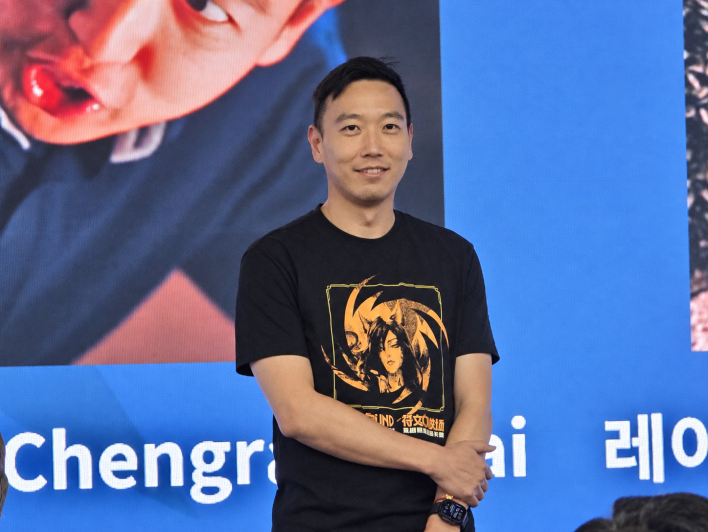
Executive Producer Chai introduced 'Riftbound' as an independent card game featuring its own distinct strategies and rules. While embedding the unique personalities of familiar champions into card and deck playstyles, he emphasized the in-person social experience of reading an opponent's choices at the same table and discussing tactics after the game.
A new Overnumber card, 'Ahri, Nine-Tailed Fox,' was also introduced to commemorate the Korean launch. Featuring artwork that pays homage to Hanbok Ahri, the card has a chance to drop from Korean 'Origins' booster packs alongside the existing Ahri Overnumber card. Executive Producer Chengran Chai explained that Ahri—whose lore originates from the Korean nine-tailed fox legend and whose name was chosen through a vote by Korean players—is a champion with a special connection to Korean fans.
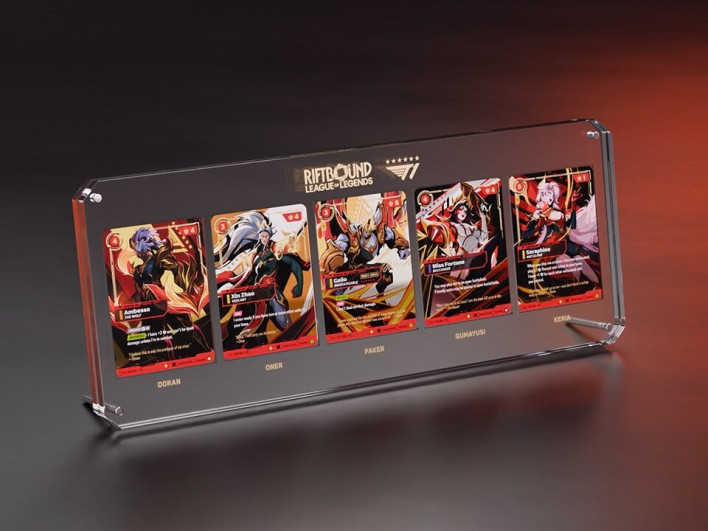
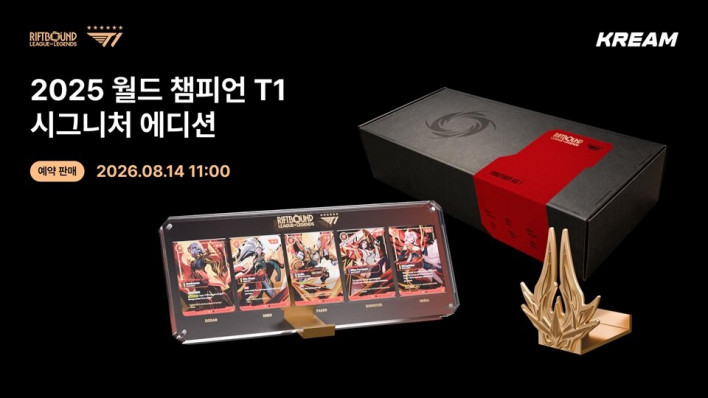
To showcase the connection with Korean esports fans, the 'Riftbound x 2025 World Champions T1 Signature Edition' was presented. Following this limited-edition collection celebrating T1's victory and three consecutive World Championship titles, Riot revealed that it also designed a T1 Player Bundle so more fans could collect and use the cards in actual decks.
Publishing Lead Unruh explained the product lineup tailored to different entry points for players. The 'Origins' Champion Decks feature three pre-constructed decks built around Jinx, Lee Sin, and Viktor, allowing players to start right away without having to collect cards and build decks from scratch. 'Proving Grounds' includes four introductory decks for Annie, Garen, Master Yi, and Lux, designed for learning and enjoying the game with friends.
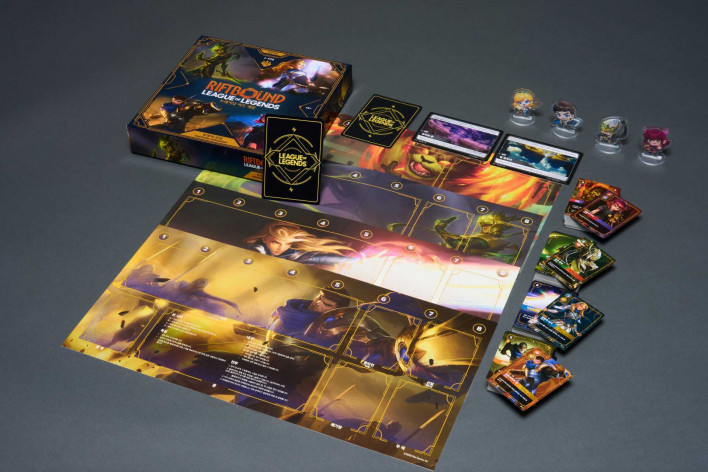
For players looking to collect cards or expand their decks, booster packs are available in two options: 5-card and 14-card packs. At the popup events celebrating the Korean launch, players can purchase products like Champion Decks, 'Proving Grounds,' and booster packs, as well as learn how to play the game.
Head of Department Lee Ji-soo outlined the direction for the local rollout: expanding player-centric offline experiences, building a structured competitive ecosystem, and providing customized content for Korean players. Riot plans to partner with specialized TCG stores to support spaces where people can learn and play the game, as well as hold regular hands-on events for beginners.
The play environment will also expand into spaces familiar to Korean gamers, such as PC bangs. A dedicated area for enjoying 'Riftbound' in person has been established at GGX, and Riot aims to increase opportunities for gamers to experience physical card games by partnering with key PC bang hubs.
The competitive program is planned to establish a pathway starting from small in-store tournaments and progressing to higher-tier competitions and global stages. During the Q&A, Riot explained that for the Korea Major, it is considering accepting general participants in addition to store qualifier winners, with a lottery system under consideration for general registration.
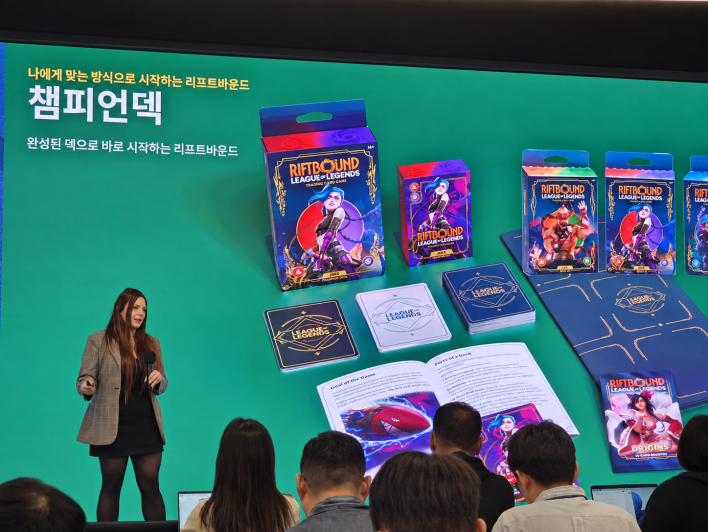
Following the presentation, the Q&A session addressed topics such as how the game differs from 'Legends of Runeterra,' the reasons for choosing a physical TCG, and the release schedule for upcoming sets. The developers emphasized the strategy of physically moving cards across the table, the psychological warfare of reading opponent reactions, and the joy of collecting and face-to-face social interaction. They stated that the goal for future sets is to align release schedules so Korean players can experience them at the same time as other regions.
The launch popup events run from the 18th to the 23rd at GGX, and from the 18th to the 30th at Dopamine Station on the 3rd floor of Living Park in IPARK Mall Yongsan. Both venues offer opportunities to purchase products and learn how to play, with rewards such as promo cards available depending on participation requirements. The showcase also included a hands-on play session for attending journalists following the presentation and Q&A.