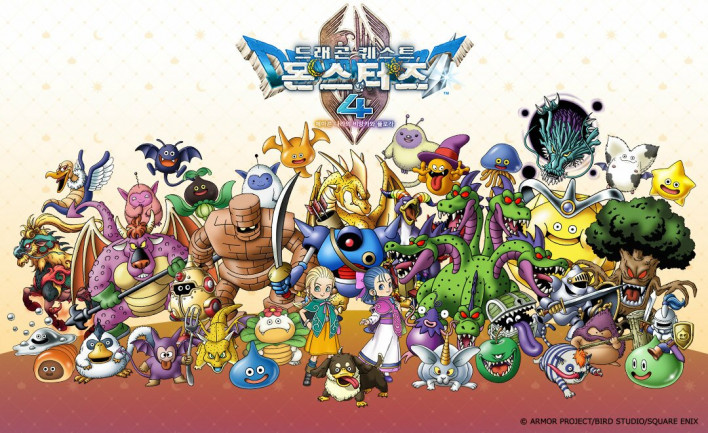
Popularity for the Dragon Quest Monsters series isn't what it used to be. It wasn't always like this. The ambitious first and second entries made a huge splash back in the day, praised for being quality monster-collecting spin-offs of Dragon Quest. However, that popularity was short-lived.
Although the first two games were remade several times, it took a whopping 22 years before news of a numbered sequel arrived with the release of 'Dragon Quest Monsters 3' on December 1, 2023. Given the long wait, fans were ecstatic for the third entry. However, when 'Dragon Quest Monsters 3' finally launched, it proved disappointing in many ways. The biggest problem was the visuals. While the gameplay itself was considered reasonably solid, the subpar graphics undermined its strengths.
With the survival of the franchise hanging in the balance once again, 'Dragon Quest Monsters 4' (hereafter 'DQM4') has made its entrance. It goes without saying how the fandom reacted.
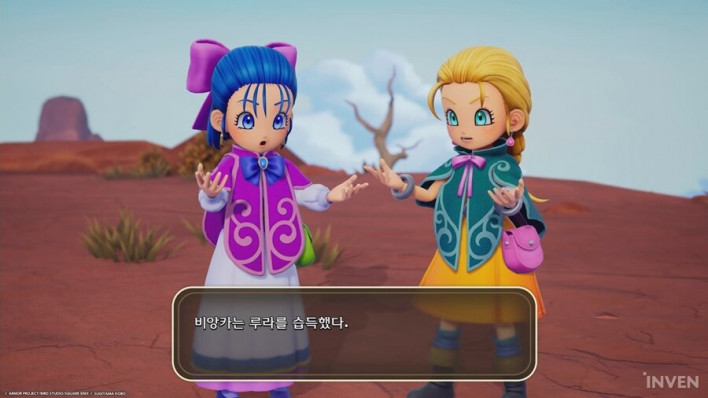
Fortunately, 'DQM4' leaves a fairly good first impression. While it might not stand alongside the most cutting-edge modern titles, it features noticeably improved visuals, stars the Heavenly Brides from the main series' fifth entry as protagonists, and introduces unique mechanics like spherical fields—offering plenty of intriguing elements.
So how does the most important part—the gameplay—hold up? We checked it out firsthand at Square Enix's Pre-TGS event held for Asian media over two days, from August 31 to September 1.
First Off, the Visuals Are Adorable
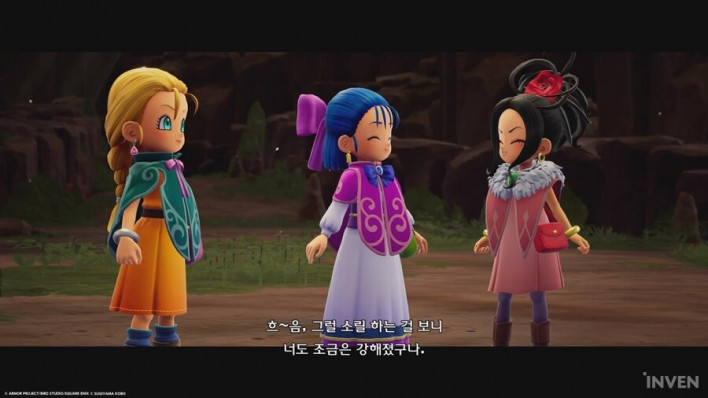
Before diving deep into the game, let's start with the visuals that dictate the first impression. Many gamers interested in 'DQM4' likely kept a close eye on graphics. Considering how disappointing the third entry's visuals were compared to contemporary games at the time, this aspect is a must-address point for the new title.
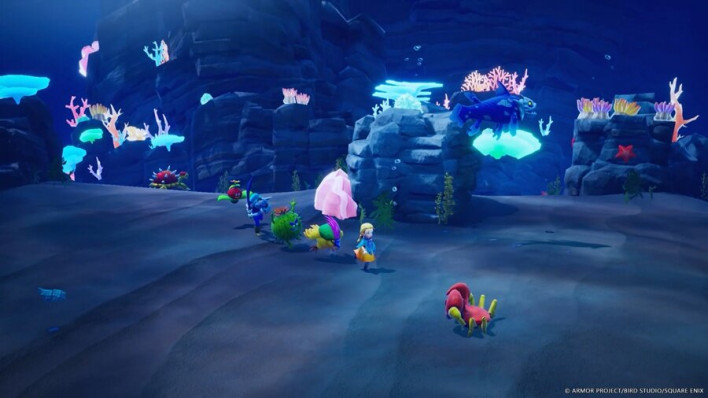
In that sense, as seen in the previously released trailers, 'DQM4' boasts impressive visuals in many respects. They can best be described as adorable. Without betraying the signature art style of the original 'Dragon Quest' series, the game effectively captures its own rounded, squishy charm.
Of course, that doesn't mean it relies solely on rounded visuals tailored for kids. For monsters blocking Bianca and Flora's path—especially Netherworld Commander Gurgoma, who appears to be their leader—the character proportions are set to a 7-to-8-head height ratio to create contrast. This visually establishes him as a formidable foe. While maintaining the overall visual tone, the game differentiates design based on character personalities and roles.
A Dash of Novelty (Fields) Atop Familiarity (Combat/Training)
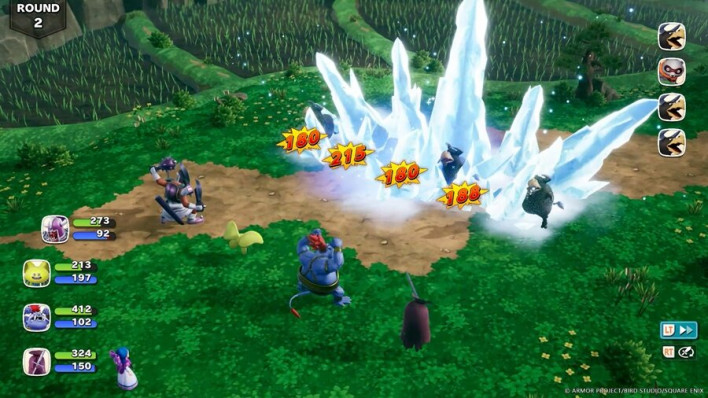
The game's combat and monster training systems do not differ much from the previous installment. In fact, they are practically identical. Just like in the previous title, you can travel with up to four monsters at a time. However, this only applies to small monsters (S). Large monsters (L) naturally occupy two slots, so depending on your party composition, you can bring three monsters, or only two if you build a party consisting entirely of large monsters.
There are pros and cons to this. Large monsters generally have higher stat caps, making them stronger than small ones. In other words, you can strategically decide whether to run an elite few powerful monsters at the cost of total action count, or field multiple small monsters to gain an advantage in action frequency.
Combat also remains largely unchanged, save for minor tweaks to visual effects and camera angles. Targeting enemy weaknesses deals massive damage, and as an enemy's HP drops, the success rate for Scout Attacks to capture them increases. Anyone who played the previous game—or anyone with a basic understanding of monster-collecting RPGs—can adapt quickly without needing much explanation.
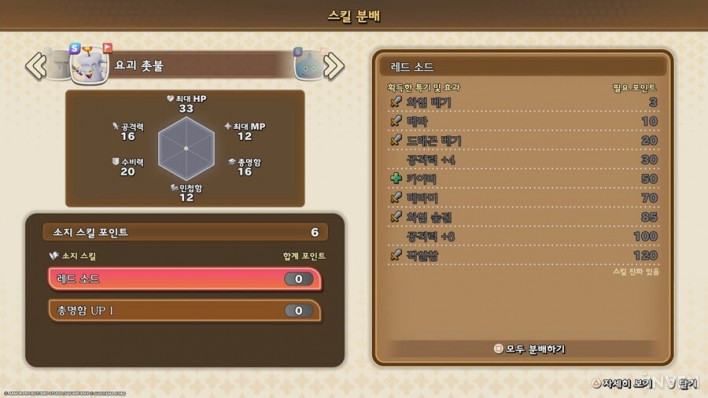
Growth progression follows the same pattern. Depending on where you invest Skill Points, you decide whether to unlock active skills or secure passive skills that boost stat caps like maximum HP and MP. Unlocking skills isn't a simple matter of dumping single points into them. Certain skills require 3 or even 10 points to unlock, giving players the freedom to decide whether to spread points evenly or specialize in a single area.
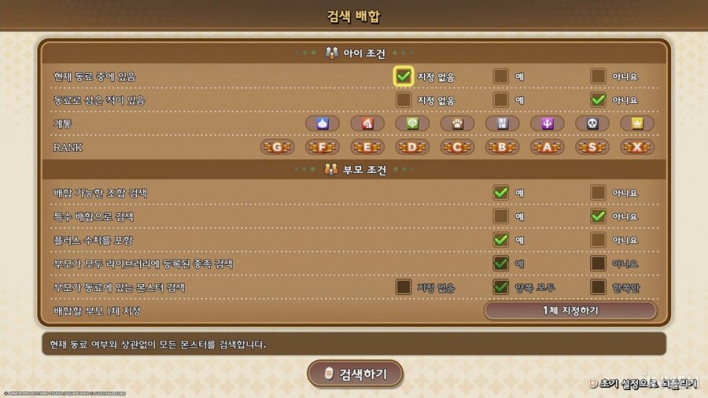
The Synthesis system, the core of the DQM series, has been improved for better clarity. Instead of merely checking what monster results from synthesizing Monster A and Monster B, players can now see at a glance which monsters are required to create a specific Monster C. Considering there are over 500 monsters in the game, this is a significant quality-of-life upgrade. With options to apply various search filters as well, it marks a major step forward in user convenience.
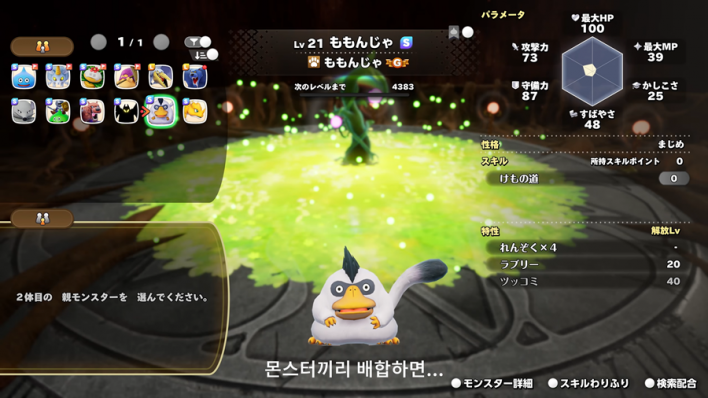
There are two main things to keep in mind during Synthesis. The first is the sparkle mark. A sparkle mark indicates that the resulting monster will be of a higher rank than its parents (the synthesis candidates) or belong to an unexpected family. Therefore, it is essential to actively check for sparkle marks when synthesizing.
The second is skill inheritance. During Synthesis, up to three skills from the parents can be passed down. However, they aren't inherited completely as-is. Only half of the Skill Points in the selected skills are carried over, and you also regain half the points from unselected skills. As mentioned earlier, skills are divided into active and passive types, requiring careful consideration. A misstep could yield a peculiar monster with high stats and plenty of passive skills, but very few usable active abilities.

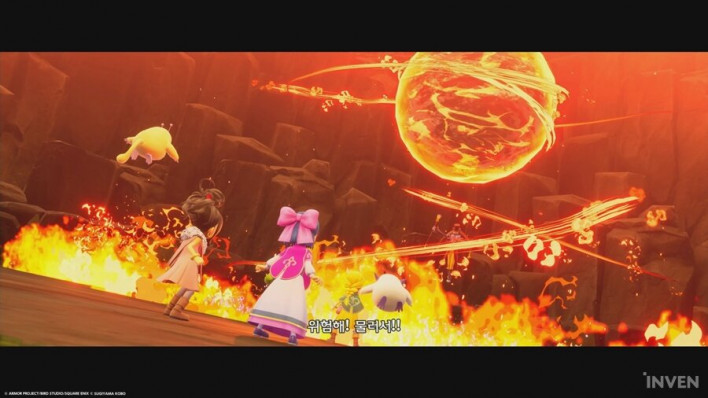
While 'DQM4' largely retains the prior game's systems while adding subtle quality-of-life polish, it is not without distinct features. The most eye-catching change is the terrain layout: spherical fields. Whereas previous entries and most RPGs feature expansive, flat environments, 'DQM4' introduces spherical terrain to shake up how players explore.
The biggest shift caused by spherical fields is that you cannot see the entire surrounding area at a single glance. While this might be seen as a minor drawback regarding convenience, it proves to be quite an intriguing change for the game's atmosphere. Not seeing everything at once means not knowing what lies just ahead. Asking yourself questions like "What's over there out of sight?" or "How do I get to that spot?" captures the true joy of exploration during navigation.
There are downsides, of course. Personally, I rarely feel motion sickness even in fast-paced action games with characters flipping mid-air, yet I felt a slight dizziness while playing 'DQM4'. Fortunately, the game offers various anti-motion-sickness options in the settings. Since it provides a fresh experience alongside countermeasures to address potential discomfort, it doesn't seem like a major cause for concern.
The Lack of Major Overhauls Is Its Greatest Strength
Playing 'DQM4' firsthand gave me plenty to think about. The core takeaway is that the core system hasn't changed dramatically from its predecessor. While that can often be a double-edged sword, in 'DQM4' it comes across as a strength. Because these mechanics have been well established under the 'DQM' umbrella, forcing drastic changes could have easily backfired.
What fans eagerly anticipating 'DQM4' want isn't a radically reinvented game, but rather one that carries forward the sensibilities of the established series. In that sense, deciding against sweeping overhauls feels like a welcome choice.
That is not to say nothing has changed. 'DQM4' clearly shows effort in addressing the visual shortcomings that drew heavy criticism in the previous entry. Coupled with spherical fields, it's evident the developers pondered how to deliver a distinct sense of exploration compared to past titles.
It is still too early to tell whether 'DQM4' will outperform its predecessor. But one thing seems certain: for longtime fans of the DQM series, it offers an experience that should prove thoroughly satisfying.