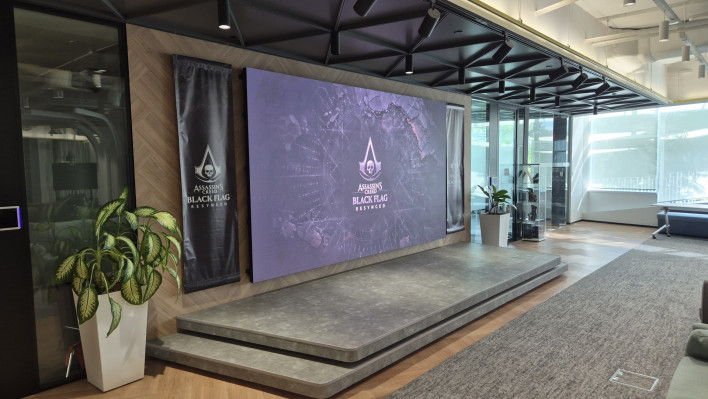
In May 2026, an event was held at Ubisoft Singapore Studio to introduce, demonstrate, and interview 'Assassin's Creed Black Flag Resync'. Held about two months before the launch, this event was attended by media and creators from Korea and Japan, as well as key developers from the Singapore studio. And at this event, we were able to speak with Technical Director Jussi Markkanen. Director Jussi Markkanen is a veteran developer who served as the Lead Gameplay Programmer for 'Assassin's Creed Origins' after joining Ubisoft in 2012, and in this interview, he answered questions regarding the technical aspects of 'Assassin's Creed Black Flag Rethink'. Ubisoft Technical Director Jussi Markkanen ©INVEN The original 'Black Flag' was famous for its innovative structure that allowed players to freely move between land and sea, but at the same time, there were also technical issues such as the 'ghost ship bug'. Were there similar technical challenges in this remake as well? The original game seamlessly connected land and sea gameplay, and in this ‘Resynced’ version, we have expanded this a step further. The biggest difference is that loading screens between land and sea have now completely disappeared. Therefore, ship anchoring physics processing and the stability of the docking system have become extremely important. In the past, there was time to internally realign or modify data between loading screens, but in this game, the entire open world is always operating simultaneously. That is why we put a lot of effort into ship position processing and docking system stabilization. Since it has been completely rebuilt based on the latest Anvil Engine, it seems there were various technical changes beyond just graphics, such as NPC density and world streaming. What were some of the representative changes? While the graphical improvements are undoubtedly the most noticeable change, there have actually been many other improvements as well. From a player's perspective, the most easily felt aspect is the loading speed. It responds so quickly that almost every action is performed instantly from the start of the game. Additionally, thanks to the latest engine, the UI, HUD, and accessibility options can be customized much more freely. Detailed options, such as color adjustments and subtitle settings, have also become much more diverse than before. "In this game, are waves and storms designed to affect the actual gameplay feel?" While ‘Resynced’ features significantly improved visual quality, there are concerns regarding PC system requirements and console performance due to the game’s nature of exploring a vast ocean. What are the target specifications and supported technologies currently? “We are currently putting a tremendous amount of effort into optimization. Our goal is to ensure stable operation from minimum specifications to high-end environments. For minimum specifications, we are aiming for 30 FPS on a GTX 1660. The mid-range specifications have also been set to be slightly lower than those of ‘Assassin’s Creed Shadows.’ This is because we did not simply lower the graphics quality, but rather proceeded with more aggressive optimization.” It also supports the latest upscaling technologies such as DLSS, FSR, and XeSS. Optimization was carried out very aggressively. ©INVEN It seems it was not easy to significantly improve graphic quality with the latest technology while maintaining the unique Caribbean atmosphere and colors that fans of the original remember. What internal standards did you establish and how did you approach this? “We considered that aspect extremely important internally. This is because we had to maintain the atmosphere of the blue sea and white sandy beaches that everyone remembers. Since this work was produced based on ray tracing and physically based rendering, the lighting structure itself changed completely. For example, we utilized systems such as those for rendering sediment underwater to finely adjust how light reacts to the water. We repeated the process of matching the colors and atmosphere extensively by comparing the original and the new footage side by side. I believe one of the most difficult parts of producing a remake is creating a balance where it makes a clear visual advancement without deviating too much from the original. If you have any memorable anecdotes related to this, please share them.” I remember working on the intro sequence, Cape Bonavista. Although the time of day and the environment itself were correct, the lighting and shadow atmosphere continued to feel awkward. Upon analyzing the cause, I found that in a physically based lighting system, the actual world location itself was important, and the direction of the sun was subtly off due to the difference in location values compared to the original. Ultimately, only after realigning the location to the original standards did the overall atmosphere finally come to life naturally. In the era of modern hardware, maintaining a stable frame rate has become just as important as graphic quality. What was the most重点 optimized area in this project? “The biggest goal was to achieve a stable 60 FPS on the latest consoles. Since console hardware is fixed, all optimizations had to be done within performance limits. In particular, open-world games place a heavy burden on both the CPU and GPU, so detailed optimization was required for both. It was a considerably difficult task, but ultimately, we were able to achieve the desired level of smooth 60 FPS experience. However, due to hardware limitations, the Xbox Series S only supports 30 FPS mode. Please introduce any technical moments or scenes from the development team's perspective that you felt were absolutely impossible to achieve in 2013. The first thing that comes to mind is the fully dynamic destruction system. We can now destroy boxes and environmental objects in complete real-time. During development, while testing a new rope dart system, we once pulled an enemy toward a pile of boxes. The boxes shattered as if they were exploding, and fragments flew in all directions. At that moment, everyone said, "This is a scene that would have been absolutely impossible in 2013." The latest rendering technologies are also very impressive. How have these technologies evolved? The Anvil Engine continues to evolve with a dedicated engine team. The engine team strives to maintain industry-leading technology by consistently studying global technology conferences and the latest case studies. For example, the micropolygon technology used in this project can be seen as a concept similar to Unreal Engine's Nanite. Internally, we implemented this directly using the Anvil method. This technological advancement is not the result of a single project, but rather the outcome of collaboration between the engine team and various projects, including ‘Shadows’. The mention of support for mobile devices was also impressive. What approach did you take to support such a wide range of specifications? The key is scalability. The Anvil Engine features a system called the ‘Platform Manager,’ which allows hundreds of graphics and engine settings to be adjusted individually for each platform. Thanks to this, it can support everything from low-spec portable devices to high-end PC environments. Of course, this requires a significant amount of work and expertise. This is because one must accurately understand which settings to adjust and to what extent to maintain both performance and visual quality simultaneously. However, I believe the Anvil engine is currently one of the best in the industry in terms of scalability.

Sort by:
Comments :0