On January 26, 2026, the Framework Act on the Development of Artificial Intelligence and Establishment of Trust (hereafter, the AI Framework Act) took effect. Because the law simultaneously pursues both the promotion of the AI industry and the securing of safety, it is expected to bring concrete, direct changes across the games sector—where AI adoption is among the most active of any industry.
“If It Was Made With Generative AI, Even NPC Dialogue Must Be Marked ‘AI’”
The single biggest change game companies now face is Article 36, the “duty to label generative AI” provision. This clause stipulates that when text, images, video, audio, and other content is produced using AI, it must be clearly labeled so that users can readily identify it.
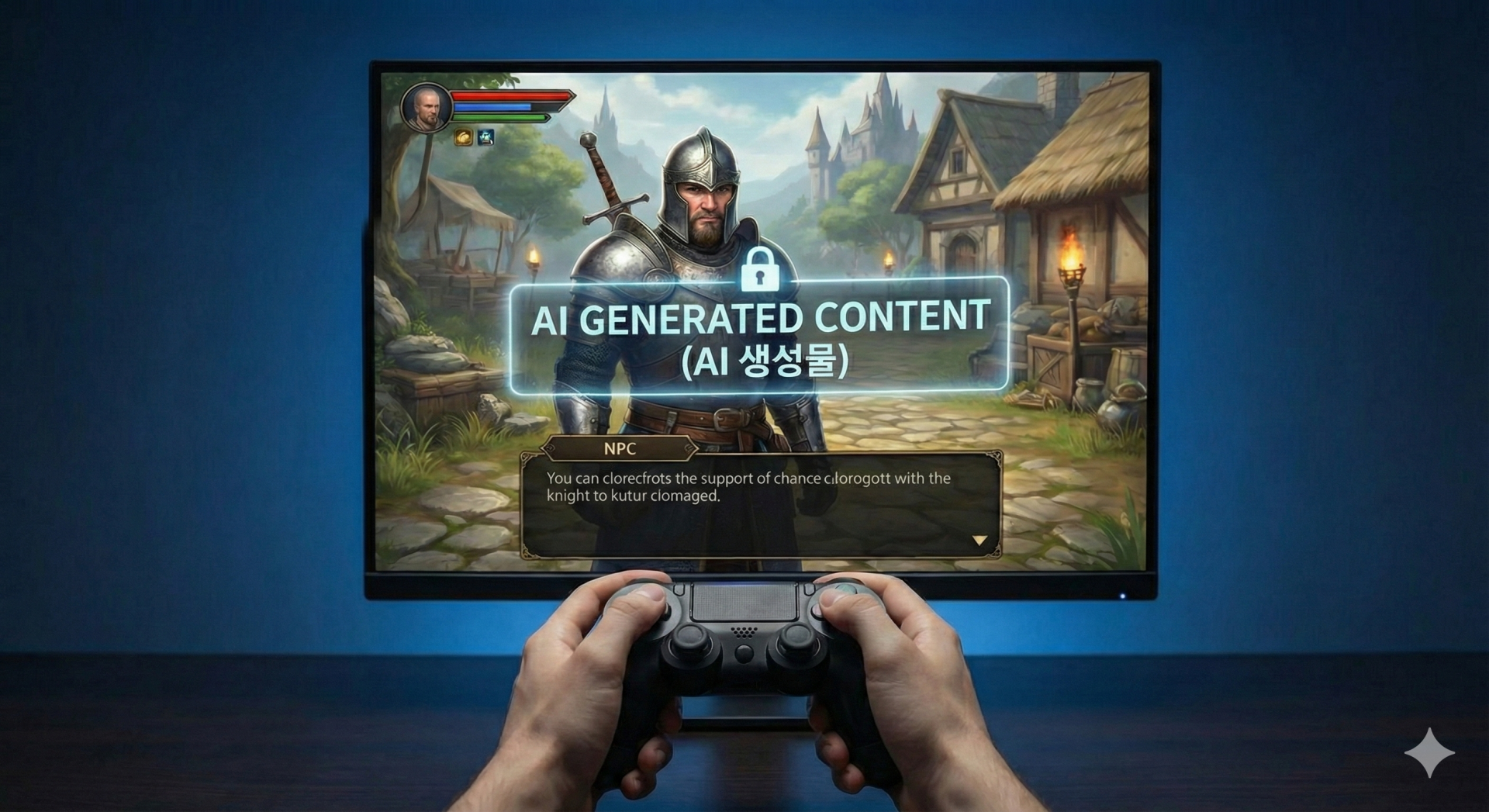
In game development, there is a strong likelihood that AI will be used to generate NPC dialogue in real time, or to create character illustrations and background music. With the law now in force, whenever AI-generated content appears inside a game, developers will be required to include a watermark or other notice indicating that it is an “AI-generated” work.
This measure is intended to protect users’ right to know and to prevent misuse such as deepfakes. For game companies, however, it raises a different concern: how to avoid undermining immersion. If a warning message stating that content was made with generative AI pops up on a dialogue screen with an NPC inside a fantasy setting, there is a real possibility it could break the player’s immersion.
Global Platforms Aren’t Exempt—Even a Local Representative Must Be Appointed
This law applies not only to Korean game companies, but also to overseas businesses. Article 4 (Application to Acts Conducted Abroad) makes clear that even conduct occurring outside the Republic of Korea may still fall under the Act if it affects the Korean market or Korean users.
In addition, Article 39 requires certain overseas operators above a specified size to designate a domestic representative in Korea. As a result, global platforms such as Steam and Epic Games, as well as foreign game companies, will need to maintain a local representative in Korea and comply with Korean requirements—such as the duty to label generative-AI content—on the same basis in order to continue providing services in Korea. This also enables authorities to pursue legal accountability via the domestic representative in cases of violations.
Securing Development Autonomy Through “Permit First, Regulate After”
The Act is not purely restrictive. Article 6 codifies a “permit first, regulate after” principle, stating that unless another law provides special restrictions, anyone may research, develop, and release AI technologies without limitation.
Until now, there have been aspects of the ecosystem—such as the Game Rating and Administration Committee (GRAC) ratings classification process—where a lack of clear criteria for AI-applied games led developers to take a more conservative approach. With this legal foundation now in place, experimental AI adoption is expected to accelerate within the institutional framework—such as systems that learn a user’s play style to automatically adjust difficulty, or that generate virtually infinite maps in real time.
Smaller Studios: “Worried About Compliance Costs”—Government: “We’ll Support On-the-Ground Adoption”
That said, small and mid-sized game companies and startups with limited capital and staffing are concerned about the costs of regulatory compliance. If advanced AI technology is classified as “high-risk AI” (Article 2, Article 33), companies may be required to implement a range of trustworthiness measures and fulfill reporting obligations.
In response, the government’s stated stance is that, early on, enforcement will focus more on guidance than punishment, encouraging the system to settle into real-world practice. The Ministry of Science and ICT (MSIT) has previously stated that it “will spare no effort in providing consulting and support so that companies can properly comply with unfamiliar regulations.”
With the AI Framework Act now in effect, the games industry finds itself carrying both the opportunity for a technological leap forward and the responsibility to meet heightened social expectations. How well the detailed guidelines to be announced going forward reflect the unique characteristics of games will likely determine whether the system succeeds.
This article was translated from the original that appeared on INVEN.


Sort by:
Comments :0