Krafton is stepping into the two-player co-op market. Showcased at Gamescom 2026, 'Age Twisters' targets the space opened up by 'It Takes Two' and 'Split Fiction,' while shifting the competitive focus from difficulty to the texture of failure.
'Age Twisters' is a two-player co-op narrative adventure developed by Barcelona, Spain-based Piccolo Studio. Players become a grandfather and granddaughter traveling through near-future Barcelona in search of the missing mother. Their only clue is the 'Age Twister'—a bracelet that allows them to transform in real time through childhood, adolescence, adulthood, and old age.
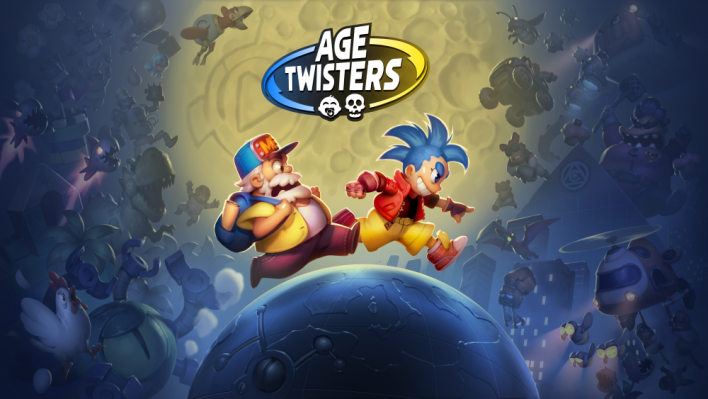
In childhood, players use fast movement speed and position swapping; in adolescence, rhythm-based abilities that slow down enemies; in adulthood, fist attacks for combat and destroying obstacles; and in old age, magnetic abilities to manipulate metal objects.
New mechanics appear in every chapter, such as growing palm trees in a jungle, speeding through a desert while outsmarting villains, sneaking into an enemy hideout via dance battles, teleporting alongside chickens in a factory, and riding an animatronic Tyrannosaurus. The game is scheduled to launch in 2027 on PC (Steam, Epic Games Store), PS5, Xbox Series X|S, and Nintendo Switch 2.
Co-op with reduced frustration
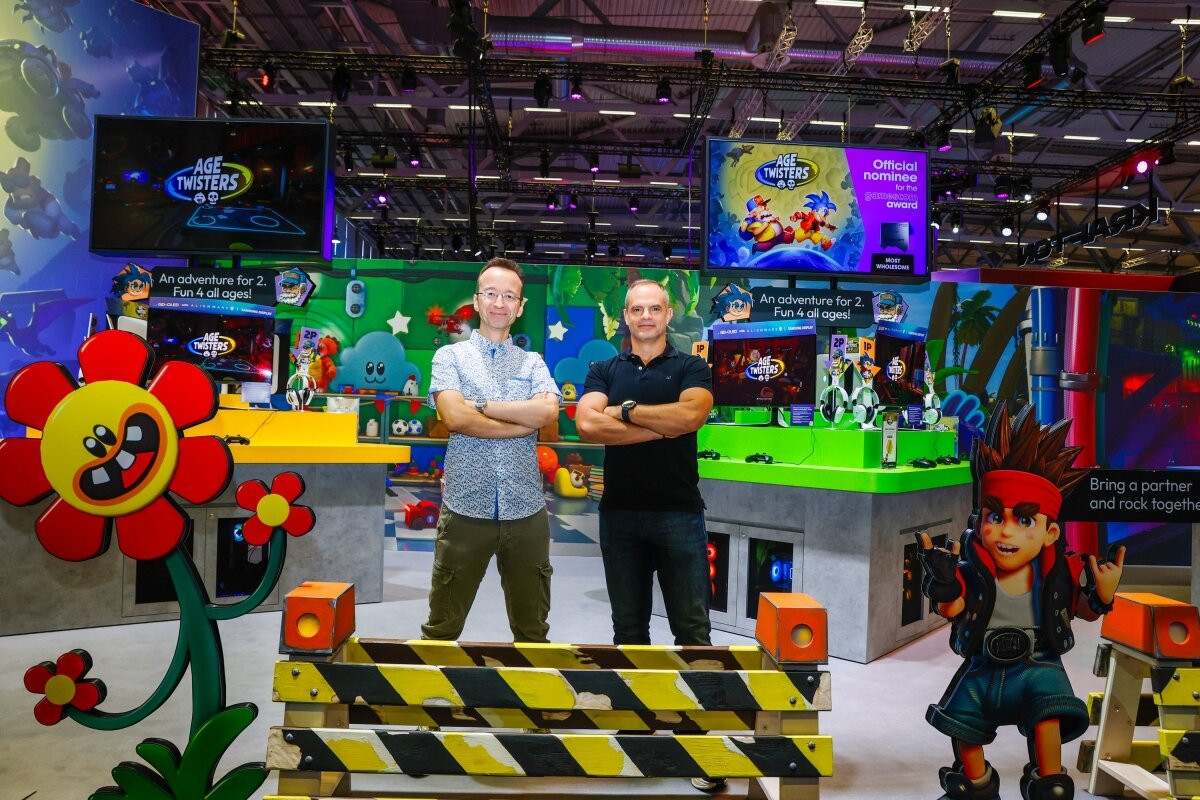
The impression from playing the demo at Gamescom was "casual." Two-player gaming inevitably tends to cause frustration between partners. 'Age Twisters' tones down the intensity of that frustration. What stood out was that it did not simply lower the difficulty, but reduced frustration through sensible design. It is structured well for parents and children, or couples with a large gap in gaming skill, to enjoy together.
This was an intentional design choice. In a joint interview following the demo, Jordi Ministral welcomed the boom in co-op games itself. As fans themselves, they are glad to see co-op gaming enter a golden era and want to add value to this market. He said, "In our game, fun comes above everything else. Failure should be fun, not frustrating."
The design criterion he emphasized was "memorable moments." Ministral explained that he views the game not as a set of challenges, but as an emotionally resonance-filled experience: "You don't remember how many attempts it took to defeat a monster. What stays with you are the moments spent together, the strategies built together, and the conversations shared." He added, "Accessibility is different from being easy. There must be a sense of accomplishing something together, but that doesn't mean it has to be hard. Simply moving something without breaking it is already an achievement." In short, players should not be forced to fight against controls or incomprehensible puzzles.
He also shared the challenges of creating their first co-op title. Alexis Corominas noted that choosing an isometric camera instead of split-screen completely reshaped the entire design. "We didn't want players to stray too far from each other. We wanted an experience where you are always together and your partner is always visible on screen," he said. "So we had to adapt the entire design so that everything takes place in 'room' units."
Ministral cited the moment team members began treating the game as play rather than work as the most memorable milestone in development. "When everything clicked together for the first time—when it worked not just mechanically, but emotionally," he recalled, "the team started playing the game not because it was work, but because they wanted to. Even if it was just for five minutes, that was the most magical moment." He also added the practical challenge that, as their first co-op title, every test required two people.
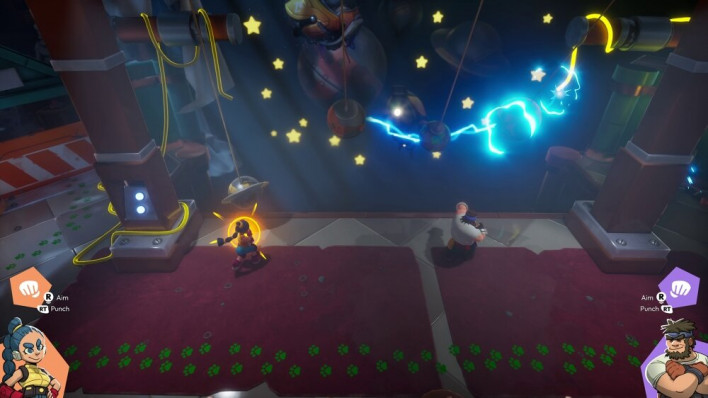
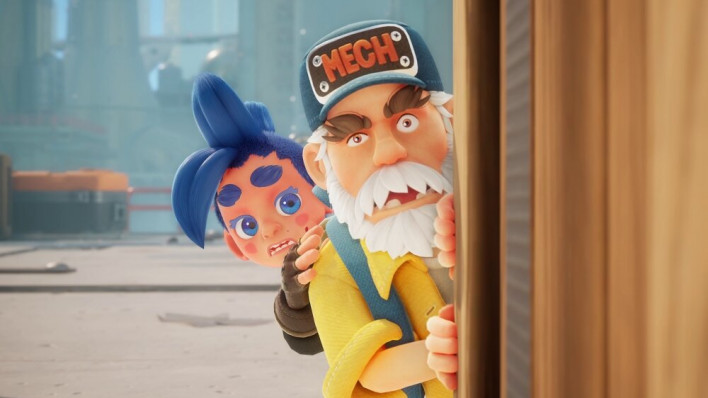
His explanation regarding the pairing of the protagonists was specific. Ministral stated it was because they are family. With family, a relationship already exists, and because everyone has a relationship with a grandfather or a child, there are many inherent emotions already present without needing explanation. He felt that if they were friends or had a different relationship, it would require explanation and the emotional bond would be weaker.
The generational gap was also a deliberate choice. He explained, "The grandfather and granddaughter are at opposite ends of life. The granddaughter thinks of herself as an adult but still has much to learn, while the grandfather's life may not have turned out as expected and he no longer remembers what it was like to be young. This allows the two to embark on journeys in opposite directions at the same time."
This ties together both the theme of age and the theme of relationships. As for the story, Corominas stated only that it is "a grand story full of mystery" and that players must play to the end to see the conclusion.
The death animations follow the same principle. Corominas explained that since everything in the game is about age, he wanted to handle death animations in the same way, targeting a broad audience so that even children could play. He wanted to avoid traditional depictions of death involving corpses and violence.
Enemies turn into babies when shot, while players turn into babies or skeletons. Functionally, players enter an incapacitated state and must be revived by their partner, but the visual presentation is much softer. Corominas added, "When you turn into a baby, you cry and call for help, and when you become a skeleton, you bounce around."
They also did not prevent players from hindering or killing their partners during gameplay. When asked why sabotage was allowed in a game themed around intergenerational harmony, Corominas answered, "That's also part of the fun. Some players find great joy in pranking their partner, while others respect their partner deeply and learn how not to hinder each other."
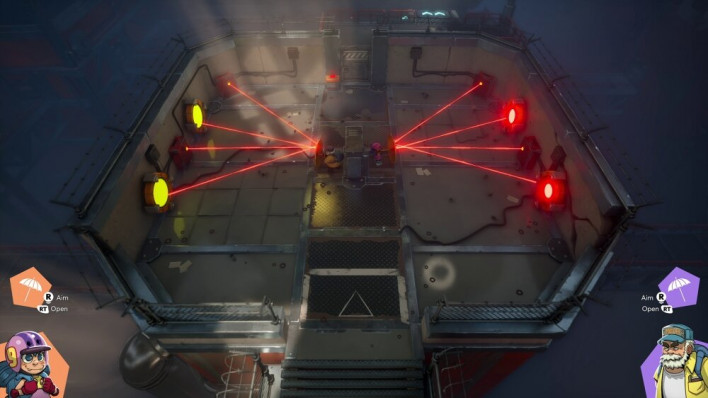
Physical differences between age groups were reflected even in details that do not significantly impact gameplay. The older the character, the slower they get up when knocked down. Corominas noted, "If you're a child, you can't jump higher, and if you're an elderly person, you're slower. That's what it means to handle nuanced details with age," adding that he even saw players who constantly shifted into babies because they wanted to move fast. Ministral summarized, "The point is to let players feel every age and experience what each age is like."
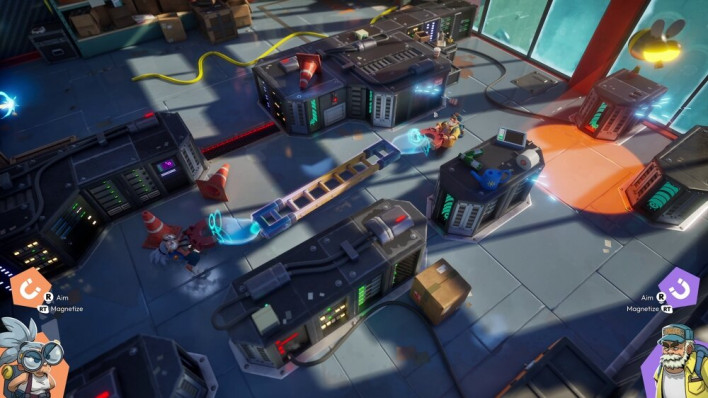
The reason behind giving old age magnetic abilities stems from this context as well. In response to feedback that older people and magnets do not intuitively connect—unlike a child's toys or an adolescent's musical instruments—Ministral answered, "When you're young, your body is your main asset, so you try to run or solve things physically. As you grow older, wisdom and experience become your primary assets."
He explained, "If you look at soccer, older players don't run as much; instead, they think a lot. They manage the entire game. The reason they don't run is because they are wise. When an elderly person wants to move something, they create something to move it for them." Corominas added that while old age is neither strong nor fast, it is wise and capable of utilizing the environment, making magnetism a great way to let players feel useful while manipulating objects.
The developers repeatedly emphasized that the playable demo at the event was only half of the tutorial and that only two of the four abilities were revealed. Corominas said, "We have about 50 more things to show you later, utilizing age in a wide variety of ways, and those are very unique," adding that players will eventually be able to combine abilities as well.
Playtime is expected to vary greatly depending on playstyle. Ministral stated, "Even watching people play in our office, playtime varies surprisingly widely. It's not a matter of skill, but player type," noting that while some stop everywhere to see and hear everything, others ignore the environment and speed through like a speedrun. Corominas added his personal preference: "I personally like playing as the grandfather."
Minigames were not set aside as separate content. Corominas explained that this is because a narrative of discovery is important: "Everything is inside the story. There are minigames, but they are fully integrated into the story and what you do." The purpose of the coin chests found by many during the demo has not yet been revealed. However, he added that some chests are placed behind specific, difficult, or fun puzzles, functioning as standalone games in their own right.
Accessibility is a work in progress. Corominas explained that the game supports keyboard and mouse, and that difficulty does not scale up as the game progresses. Players continue aiming, shooting, throwing, and moving, with only the situations and obstacles changing around them. He said, "The goal is for a 10-year-old child and a 50-year-old adult to play together, and it shouldn't be too difficult for them," adding that while there is naturally an entry barrier if someone has never played games before, he expects the audience to be very broad.
At its core, the game incorporates twin-stick shooter characteristics, requiring the basic skill of doing different actions simultaneously with left and right hands. He explained, "What we can do is ensure that this doesn't feel punishing in itself. You might have noticed that in almost every situation you played, there was no time pressure. The puzzles themselves don't push you." He added that assist features such as snap and auto-targeting are also in development.
Both local and online co-op are supported. Only one player needs to buy the game, while the other can play for free using the Friend's Pass.
Regarding the setting, Ministral said that while it is a future Barcelona, what matters is the spirit of the city. As an ancient city that went through various invasions starting from the Roman Empire, its history is built in layers; if you look closely at the demo environment, you will see shiny iron and glass alongside old walls made of brick and stone. "Barcelona is having a block of iron and glass next to a thousand-year-old cathedral," he said. "Just as the old and the new coexist within a family, the same is true in its architecture."
The early version featured a more realistic Barcelona. Ministral revealed that they removed explicit Barcelona elements and left only the concept, saying, "It was too overt. While dealing with age, we didn't want to shove things in players' faces." Corominas added that players do not need to recognize landmarks like tourists in the game, noting that since players also visit a toy factory and a chicken factory, it is not purely a story about the city itself.
Piccolo Studio is a studio acclaimed for its emotional storytelling, art direction, and creative mechanics through 'Arise: A Simple Story' (2019) and 'After Us' (2023). 'Age Twisters' is their first two-player co-op title and a co-op adventure released by Krafton in collaboration with a European studio.
'Age Twisters' delightfully crafts casual two-player gameplay. Whether the age-shifting pillar runs effectively through the entire game remains to be seen in the remaining half of the tutorial and subsequent chapters, but it shows great promise as an entry point for co-op games and a prime example for parents and children to play together.

Sort by:
Comments :0