
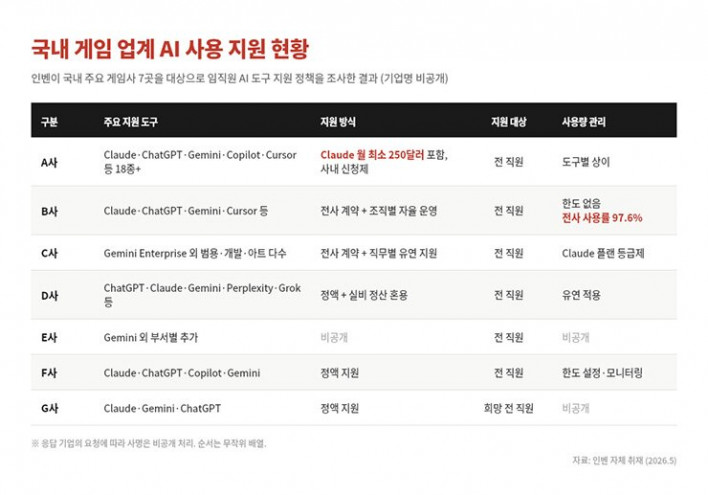
Major domestic game companies are expanding access to AI tools to all employees, regardless of their job function. This is according to an INVEN investigation into the AI support policies of seven major Korean game companies. Per the request of some participating companies, their names have been withheld.
| 📒 | - Seven Domestic Game Companies Provide AI Tools to All Staff - Claude, ChatGPT, and Gemini Are Common Tools Provided - Costs Mostly Undisclosed, Management Methods Vary |
The scope of support was broad from the start. Six out of the seven companies provide AI tools to all members, regardless of whether they work in development, business, or management, while the remaining company stated it provides them to all employees who request them. Given that game development—from coding and art production to planning—has a high potential for AI utilization, the practice of rolling these tools out company-wide rather than limiting them to specific departments has become standard.
The suite of supported tools was largely consistent across companies. Claude, ChatGPT, and Gemini have become the standard tools supported by all responding firms. Beyond these, specialized tools are added based on job function: coding-specific tools like GitHub Copilot and Cursor are provided for developers, while image generation tools like Midjourney are available for art teams. One game company reported that, by incorporating these role-specific tools, it now manages a catalog of over 18 AI services available through an internal request system.
Unlike the similarity in tool selection, cost policies varied by company. Most declined to disclose the support amount per person, stating that it is "managed according to internal operating policies." Only one of the seven companies disclosed a figure, stating that it provides Claude at a level of at least $250 (approx. ₩375k) per person per month. Usage management methods also differed. One company manages usage at the enterprise level rather than setting individual limits, with its company-wide AI utilization rate reaching 97.6%. Conversely, another company differentiates support by assigning different plan Grades based on job function, providing higher-tier plans to development teams with heavy coding workloads and basic plans to management teams.
The trend of expanding support is expected to continue in the future.
Most companies responded that they would "actively provide support if it helps with work efficiency," while only one company emphasized efficiency, stating, "Rather than increasing the number of tools, we will focus on selecting the necessary ones and refining our operational system." However, as most of the responding companies did not disclose their total costs, the actual AI expenditure borne by domestic game companies could not be verified.
An official from a game company currently using AI said, "It is true that the introduction of AI tools has accelerated tasks like research and simple repetitive work. However, it is essential for practitioners to verify and refine the results produced by AI rather than using them as-is. Currently, we are in a stage where all employees are gradually expanding the scope of their usage and adapting to AI as a supplementary tool to enhance work efficiency."
Meanwhile, some companies were cautious about responding to the survey, conscious of the negative public perception surrounding the adoption of AI in the gaming industry.


Sort by:
Comments :0